When It Comes to Killing Protesters, Trump Sounds Like Iran
From Minneapolis to Mashhad, similar rhetoric justifying lethal government violence.

DONALD TRUMP HAS A PUBLIC RELATIONS PROBLEM: The agents he unleashed to round up illegal immigrants have been attacking and killing American citizens. The backlash is so bad that Trump had to sideline Greg Bovino, the Border Patrol’s former “commander-at-large.” Kristi Noem, the secretary of homeland security, might be next.
Clearly, the administration needs new faces to defend its thuggery. Perhaps it should consider the rich talent pool available in a country with a like-minded government: Iran.
This month, as Trump’s goons have been beating and shooting Americans, Iran’s regime has been busy crushing its own mass protests. Initial estimates put the death toll in the thousands. The carnage far exceeds what’s happening in the United States, but the lies and excuses from Iran’s leaders are uncomfortably close to the propaganda we’re getting at home about the crackdown in our country.
With that in mind, here are a few Iranian officials who might be good fits for the Trump administration.
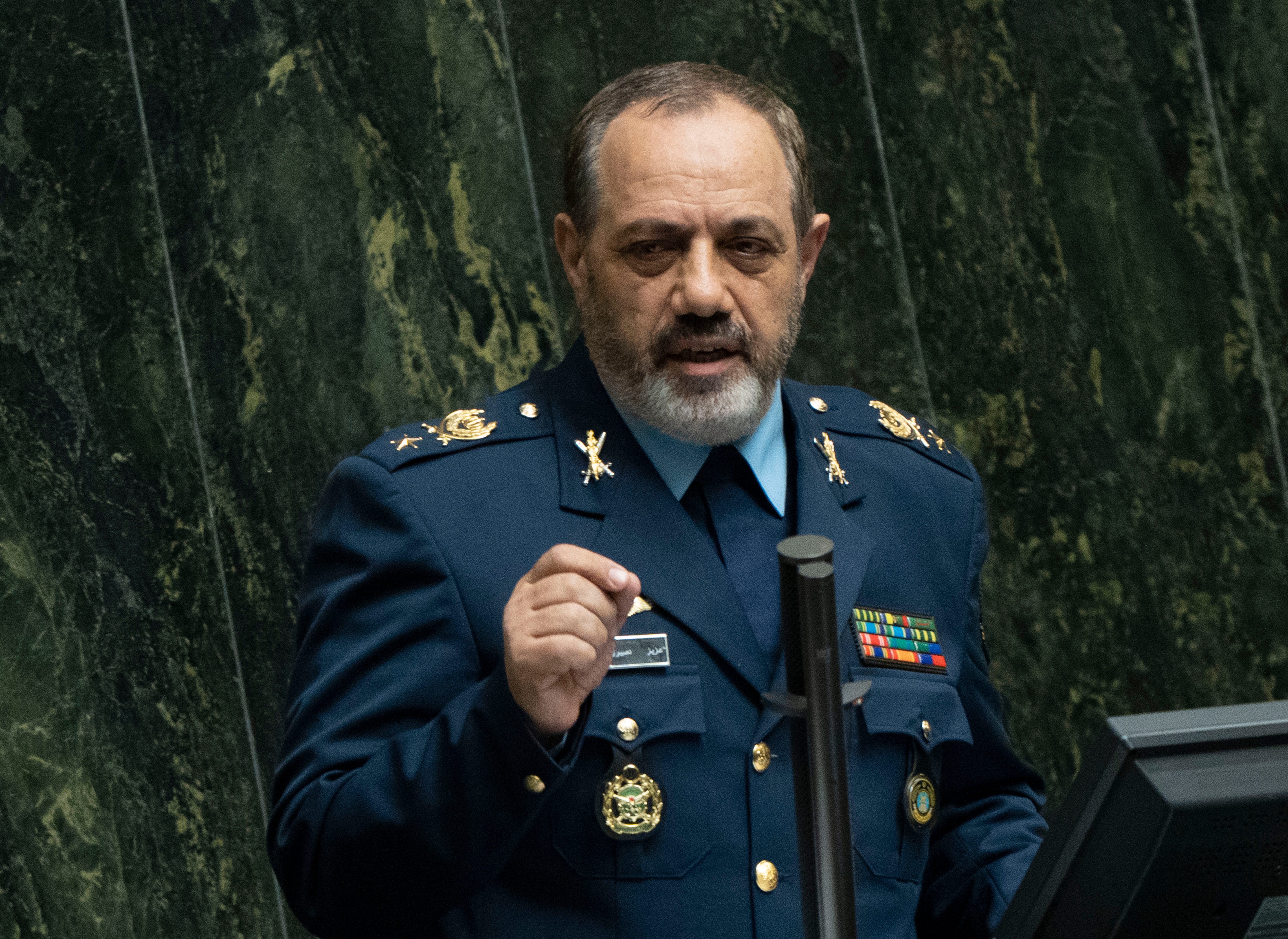
Aziz Nasirzadeh, defense minister.
On January 15, a few days after the peak of the uprising in Iran, Nasirzadeh called the Iranian protesters “savage armed terrorists.” He was lying—with few exceptions, they were neither armed nor terrorists—but his message echoed the Trump administration’s lies about Alex Pretti and Renee Good, the two protesters killed by federal agents in Minneapolis.
Pretti, who was shot to death on Saturday, had a gun tucked away at his waist. He was licensed to carry it, but he never drew it. Instead, the agents pushed him down, grabbed his gun, and took it away before shooting him. Noem accused Pretti of “brandishing” the gun. Bovino said Pretti’s behavior indicated that he had shown up to “massacre law enforcement.” Both were lies.
Good, who was shot to death while trying to drive away after blocking a street, had no gun. So Noem claimed she had “weaponized” her car. Noem said that as agents “were attempting to push out their vehicle” from snow, Good “attempted to run them over and ram them with her vehicle.” By definition, according to Noem, that made Good a terrorist: “When there is something that is weaponized to use against the public and law enforcement, that is an act of domestic terrorism.”
Noem’s story was bunk. But her distortions of what had happened, combined with her redefinition of “terrorism” to include almost any confrontation with law enforcement, would make her an ideal spokeswoman for the Tehran regime. Or, if the mullahs wouldn’t accept a woman in that role, perhaps they’d consider Stephen Miller, Trump’s deputy chief of staff, who dismissed Pretti’s execution by tweeting, “A domestic terrorist tried to assassinate federal law enforcement.”
Mohammad Movahedi, prosecutor general.
In his condemnations of the Iranian protesters, Movahedi has invoked one of Trump’s favorite words. “We must be grateful, as always, to the people who extinguished this sedition,” Movahedi said last week.
You might remember that term from Trump’s recent threats against members of Congress who advised American troops not to follow illegal orders. “THE TRAITORS THAT TOLD THE MILITARY TO DISOBEY MY ORDERS SHOULD BE IN JAIL RIGHT NOW,” Trump wrote on Truth Social in late November. “IT WAS SEDITION AT THE HIGHEST LEVEL, AND SEDITION IS A MAJOR CRIME. THERE CAN BE NO OTHER INTERPRETATION OF WHAT THEY SAID!”
In December, Trump extended his threats to the media:
I actually believe it’s seditious, perhaps even treasonous, for The New York Times, and others, to consistently do FAKE reports in order to libel and demean “THE PRESIDENT OF THE UNITED STATES.” They are true Enemies of the People, and we should do something about it.
For good measure, Trump decreed that the lawmakers’ warning about illegal orders was “SEDITIOUS BEHAVIOR, punishable by DEATH!” That’s a message worthy of the ayatollah.
Abbas Araghchi, foreign minister.
Araghchi is Iran’s chief propagandist to the wider world. Last week, in a Wall Street Journal op-ed, he praised Iranian security forces for gunning down the regime’s opponents. “Thanks to the intervention of our brave security personnel,” he wrote, “terrorist cells have been hunted down and eliminated.”
That might sound harsh, but it’s not much different from what Bovino said on CNN about his agents’ execution of Pretti: “The fact that they’re highly trained prevented any specific shootings of law enforcement. So, good job for our law enforcement in taking him down before he was able to do that.”
Araghchi also accused the international media of inciting violence in Iran by publishing phony reports about the regime’s atrocities. “Media narratives have actively distorted reality and helped create an atmosphere that risks unleashing violence,” he wrote.
That sounds a lot like JD Vance’s lecture to the White House press corps a day after Good was killed. “There’s an entire network—and frankly, some of the media are participating in it—that is trying to incite violence against our law enforcement officers,” Vance fumed. He berated the reporters: “How have you let yourself become agents of propaganda, of a radical fringe that’s making it harder for us to enforce our laws?”
Gholamhossein Darzi, deputy ambassador to the United Nations.
In a speech to the U.N. Security Council on January 15, Darzi said the Iranian protesters (he called them “violent separatist groups”) had “deliberately targeted civilians and law enforcement officers.” Other diplomats stared in dismay at Darzi’s harangue. But a week later, American officials told similar lies about Pretti, claiming that he had “assaulted federal officers” (Bovino), “attacked those officers” (Noem), and “tried to murder federal agents” (Miller).
Darzi also alleged that media reports about Iran’s “senseless killing of protesters” were “fabricated narratives.” That, too, sounded a lot like Vance. “You people in the media . . . have been lying about this attack,” Vance complained, falsely, in his diatribe to the press corps about Good. “She was trying to ram this guy with her car,” and “he defended himself.”
Masoud Pezeshkian, president.
Pezeshkian’s office has released a series of press statements calling the Iranian protesters “trained rioters” and “organized terrorist groups.” That’s not much different from Miller’s description of ICE protesters (“organized violent leftists”) or Trump’s refrain that the protesters are “professional insurrectionists.” Trump routinely insists that the protesters are carefully prepped outsiders. They’re “not people that are, like, living in Minnesota,” he scoffed last week. “These are professional paid people.”
Gholamhossein Mohseni-Ejei, chief of the judiciary.
On January 19, Mohseni-Ejei demanded swift prosecution not only of the protesters (he called them “rioters and terrorists”), but also of shadowy conspirators he accused of giving them “financial support.”
Trump’s officials also like to throw around the R word. Bovino accused Pretti of bringing “a loaded weapon to a riot, and Noem likewise called it “a violent riot,” though videos showed it was no such thing. And numerous officials, including Miller and Attorney General Pam Bondi, have vowed to crack down on sinister donors they blame for the protest movement
“We are doing so much to try to find the financing networks and the domestic terrorism networks that legitimate this violence, that funded this violence,” Vance told reporters on January 8, just after Good’s death. Three days later, Trump excused Good’s shooting by calling her “highly disrespectful of law enforcement,” and he said the government would “find out who’s paying for” the protests.
Mohammad Baqer Qalibaf, speaker of the parliament.
Qalibaf has extolled Iran’s ruthless security forces—especially the Islamic Revolutionary Guard Corps and its volunteer wing, the Basiji—for crushing the uprising. “We must kiss the hands of every IRGC member, Basiji, and police officer who stood firm,” he gushed in a speech to the IRGC on Saturday.
That’s pretty gross. But the Trump administration has also been grotesque in its defense of federal agents who kill people. In his lecture to the press, Vance asserted, falsely, that the ICE agent who pumped three bullets into Good—two of them through her side window—had “absolute immunity.” And when CNN’s Dana Bash referred to Pretti as “the victim” of the attack that killed him, Bovino said she had it backward. “The victims are the Border Patrol agents,” he told her. “The suspect put himself in that situation.”
Ahmadreza Radan, chief of police.
Radan says Iran’s police exercised “maximum restraint” during the protests and risked harm to themselves rather than use lethal force. That’s preposterous—as is Bovino’s similar account of what his agents did to Pretti. They used “de-escalation techniques,” including “pepper spray, which is another de-escalation technique,” Bovino told Bash. “Officers always try to use the minimum amount of force necessary.”
When Bash noted that videos of the scene showed “law enforcement was assaulting” Pretti, Bovino rejected that possibility. “Law enforcement doesn’t assault anyone,” he insisted.
In Iran, Radan declared that the carnage supposedly inflicted by his officers was fake. “We arrested individuals who were trained to stage scenes,” he announced. “They were instructed to pretend they had been wounded by police to manipulate public perception.”
It’s hard to imagine an American official brushing aside visible facts with such bizarre conspiracy theories—unless you count Trump’s dismissal of ICE demonstrators as “actors” engaged in “fake protests” (or his allegation that Rep. Ilhan Omar, against whom he has fomented hatred for years, staged Tuesday’s attack on her at a town hall meeting).
WITH SUCH HEARTY AGREEMENT on matters of civil disobedience, crowd control, and lethal force, it’s a shame that leaders in Washington and Tehran don’t get along. Instead, the Iranians are accusing us of hypocrisy. In his speech at the U.N., Darzi suggested that the Security Council should examine “the killing of [the] innocent lady in Minnesota” and the “nationwide crackdown” in the United States.
That’s unfair. Border Patrol and ICE haven’t killed anywhere near the number of people who died in Iran. But if Trump needs a few new apologists for executing people in the street, he knows where to look.
Will - Hello from Occupied MN. NO ONE does better side by side breakdowns than you. I always appreciate the comparisons. If this regime had it their way, women would be covered in head to toe in trad wife gear, aka, the S Baptist Burqa. Keep up the good work illuminating, educating and fighting for our democracy.
I would say it's weird that Trump apologists don't fault him for sounding (and acting) much like the people they have easily identified as evil - but they've now spent a decade insisting that whatever might be bad when other people do it is never wrong when Trump does it, so by now I would find it weirder if the Trump apologists started saying "Oh, that's bad."