Push Back Against Trump’s Press Abuse
It’s long past time for the Fourth Estate to challenge the president’s unhinged hostility and unbridled misogyny.

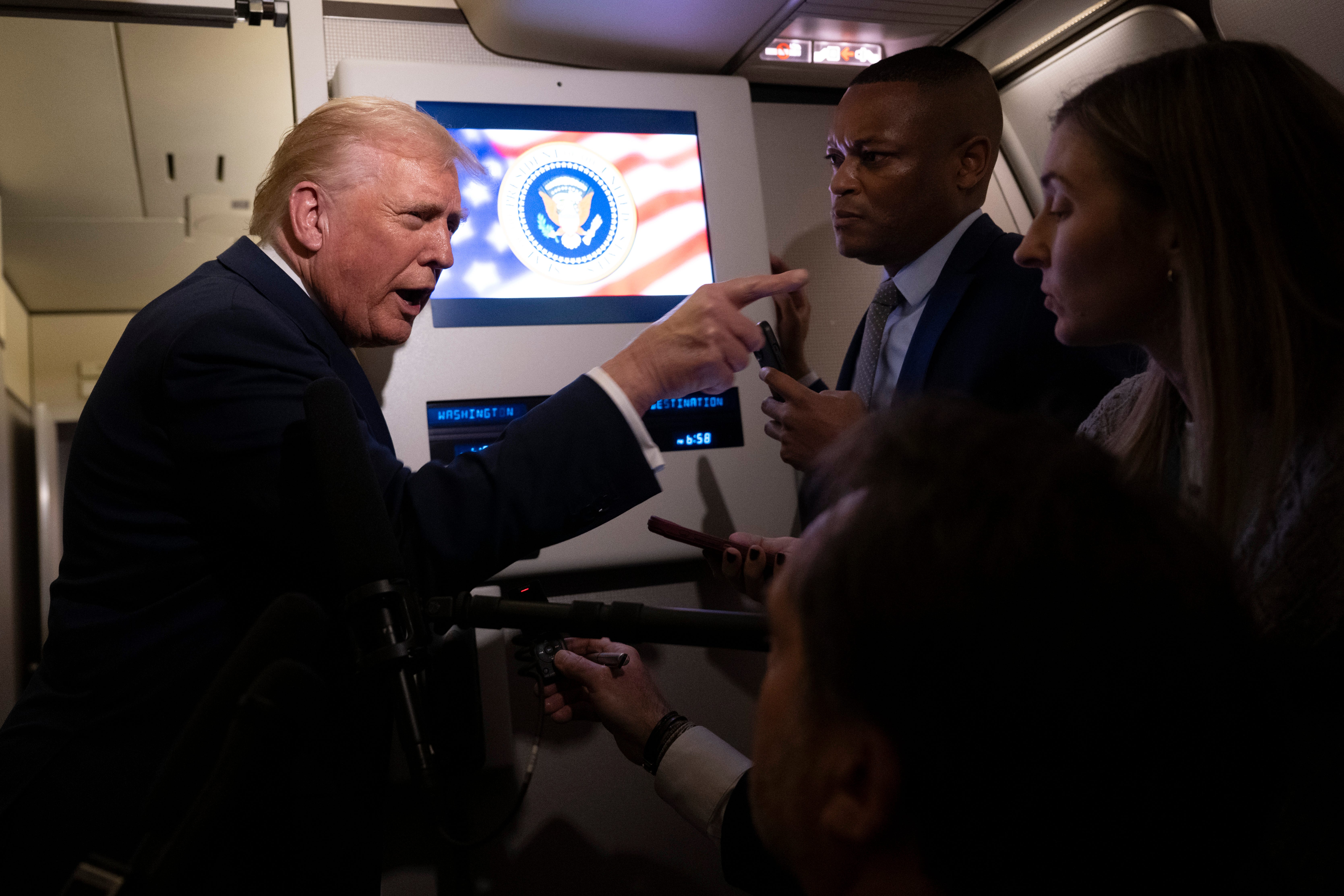
THE OTHER DAY ON AIR FORCE ONE, Catherine Lucey of Bloomberg News tried to ask Trump why he did not release the so-called Epstein files on his own authority, which he can do. “If there is nothing incriminating in the files . . . ” she began, before being cut off by Trump, who pointed at her and demanded, “Quiet. Quiet, piggy.”
A few days later, on November 18, the president upbraided Mary Bruce of ABC News for having the temerity to ask Saudi Crown Prince Mohammed bin Salman, at a White House event, about his involvement in the murder and dismemberment of Washington Post columnist Jamal Khashoggi. (A U.S. intelligence report concluded that bin Salman ordered this killing; the prince has denied involvement.) Trump accused Bruce of having set out to “embarrass our guest,” shrugging off this gruesome crime by saying “a lot of people didn’t like” Khashoggi, adding, “things happen.” He said Bruce had asked “a horrible, insubordinate, and just a terrible question.”
When Bruce then asked another totally valid question of Trump, related to his old pal Epstein, the president unloaded: “You’re a terrible person and a terrible reporter.” He suggested that his Federal Communications Commission chairman look into revoking ABC’s broadcast license.
It’s hard to decide which is more disturbing—that the president of the United States thinks that being disliked is a mitigating factor in the murder of a journalist; or that he considers reporters who ask questions he doesn’t like to be “insubordinate.” At any rate, Trump’s verbal belligerence toward these and other reporters constitutes abuse, even if it falls short of what might be legally actionable. A reporter who spoke this way to a public official would soon be a former reporter. A husband who spoke this way to his wife would be giving her grounds for divorce. But Trump just does it and gets away with it.
Maybe it’s time for that to end.
TRUMP’S ENMITY TOWARD THE FOURTH ESTATE knows no bounds. He calls the press “the enemy of the people,” “fake news,” and “dangerous and sick.” He’s filed baseless defamation suits against media outlets, slashed funds for public broadcasting, endangered reporters at events by singling them out for derision, and barred Associated Press reporters from White House events over the news service’s refusal to accept his nonexistent authority to change the name of the Gulf of Mexico. He’s even pettily sought the firing of late-night comics who make fun of him, with his most recent target being Seth Meyers, who he claims “is suffering from an incurable case of Trump Derangement Syndrome (TDS)”—the made-up malady ascribed to those sick souls who for some strange reason don’t like Trump.
Trump bashes and the members of the media reel. They accept his abuse stoically, believing it is part of the job to remain professional even though the president cannot. Consider the tepid response by Bloomberg News to the president calling its reporter “piggy.” “Our White House journalists perform a vital public service, asking questions without fear or favor,” said a Bloomberg spokesperson. “We remain focused on reporting issues of public interest fairly and accurately.”
Here, in contrast, is what CNN’s Jake Tapper posted on X: “Disgusting and completely unacceptable.” Former Fox News anchor Gretchen Carlson, in her own X post, chose the words “disgusting and degrading.” April Ryan, a longtime White House correspondent who was referred to as “Miss Piggy” by a Trump administration official in 2018, was asked by the Guardian about Trump’s use of this term. Her response: “The president of the United States is supposed to be the moral leader, the leader of the country, and he’s acting like some thug on the street.”
And here’s what Elisa Lees Muñoz, executive director of the International Women’s Media Foundation, told the Guardian: “While name-calling may seem harmless, coming from the head of our government, it often sets in motion a torrent of abuse towards the journalist, which not only impacts her ability to work, but also sends a chilling message to other women journalists who are confronting him with hard-hitting questions.”
When the Guardian inquired about Trump’s comment, a White House official claimed Lucey had “behaved in an inappropriate and unprofessional way towards her colleagues on the plane.” When asked what Lucey had done that was inappropriate, the White House had no response.
End of story? No. It should not be. Why not raise a fuss over Team Trump’s inability to come up with a valid explanation for his disgusting behavior? Why not make this a question the president himself is forced to address? Why shouldn’t he be asked, “Can you explain why you referred to a female reporter as ‘Piggy,’ Mr. President?” and “Why is it that you think a reporter who asks questions you don’t like is ‘insubordinate,’ Mr. President?”
In fact, Democrats in Congress should consider introducing (admittedly doomed) resolutions censuring the president for the disgraceful ways in which he treats reporters, women in particular. And while reporters are never allowed to lose their cool, there may be situations where they can respectfully challenge the president’s right to treat them so contemptuously. Even an occasional “I do not deserve to be talked to like that” would be nice. “She does not deserve to be talked to like that”—even better.
MY MENTOR ERWIN KNOLL, the late great editor of The Progressive, once told me that “the only way for a journalist to look at a politician is down.” That may be taking things a bit far, but let’s not ever forget that people in the press own the moral high ground over Trump. By a lot.
The truth is that, in my four decades as a reporter and editor, I have worked with many hundreds of journalists but never knew a single one who didn’t have more integrity, and a deeper commitment to fairness and accuracy, than Donald Trump. Journalism is an honorable and ethical profession, as opposed to, say, what Trump does day-to-day. Why not back up this distinction with a little swagger?
Hip hip hooray for the dozens of media organizations, from the New York Times to the Associated Press to Fox News and NewsMax, who refused to sign agreements with the Pentagon not to publish (or even ask about!) information whose release is not approved, even though it meant they would be exiled from the building.
That’s the kind of thing that needs to happen more often.
Sadly, though, it’s easier to find examples of media organizations capitulating to Trump than standing up to him.
Last December, ABC News agreed to shell out $16 million and issue an apology over news anchor George Stephanopoulos’s slight and malice-free misstatement of a civil court’s finding that Trump sexually abused writer E. Jean Carroll. In July, Paramount, the owner of CBS, parted with $16 million over what Trump falsely alleged was deceptive editing of its 60 Minutes interview with former Vice President Kamala Harris. The show’s executive producer, Bill Owens, resigned as a result; correspondent Norah O’Donnell, during introductory remarks before her recent interview with Trump, took pains to point out that “the settlement did not include an apology or admission of wrongdoing.”
Mused attorney Marc Elias in an opinion column, “To say that the media [are] bending a knee, falsely assumes there are still hardened bones and a joint in place in their operations. Their mission now is to report the news fearfully and to seek Trump’s favor.” Chided the good-government group Common Cause, “Americans deserve a press that tells the truth, not one that caves to political pressure. It’s time to remind media companies of their duty: to inform the public, not to protect their profits.”
Good luck with that. In the meantime, it may fall to reporters more so than their employers to stand up for themselves and their profession. A little backtalk now and then could make a huge difference.
Earlier this year, the Wisconsin Freedom of Information Council, an open government advocacy group for which I have served as president for more than two decades, took to task the liberal mayor of Madison, Satya Rhodes-Conway, for her mean-spirited and opportunistic attacks on the press following a deadly school shooting last December. The mayor accused the media of lacking “human decency” and suggested they were trying to “feed off” the pain of the victims’ families, a claim for which she offered no evidence. The comment drew national attention and scores of mostly supportive comments flowed into Rhodes-Conway’s in-box. Wrote one: “I just wanted to let you know that I appreciate you putting them in their place!!”
In our annual awards ceremony, we gave the mayor negative recognition—an award for being “No Friend of Openness.” I told the audience that the journalists who have to cover such stories hurt as much as anyone. I noted the judging panel’s overwhelming support for giving Rhodes-Conway the rebuke she deserved, and offered this explanation: “The press is tired of getting kicked around. We’re tired of being used by politicians seeking to score cheap political points. Tired of being called the enemy of the people, or derided for an alleged lack of fairness or accuracy, often by those who have absolutely no regard for either.”
Going forward, I said, “I for one am never going to let someone put the press down for no good reason without pushing back. I am not going to let other journalists be disparaged because it’s fashionable to do so. . . . We are professionals who deserve to be treated with respect. And it’s time that we started insisting on it.”
So let’s take this as an individual challenge: Have you defended a journalist today (possibly yourself included)? If not, there’s still time and good reason.
 | A guest post by
|