Putin Always Breaks His Word. Why Would This Time Be Different?
A peace agreement with Putin is a contradiction in terms.

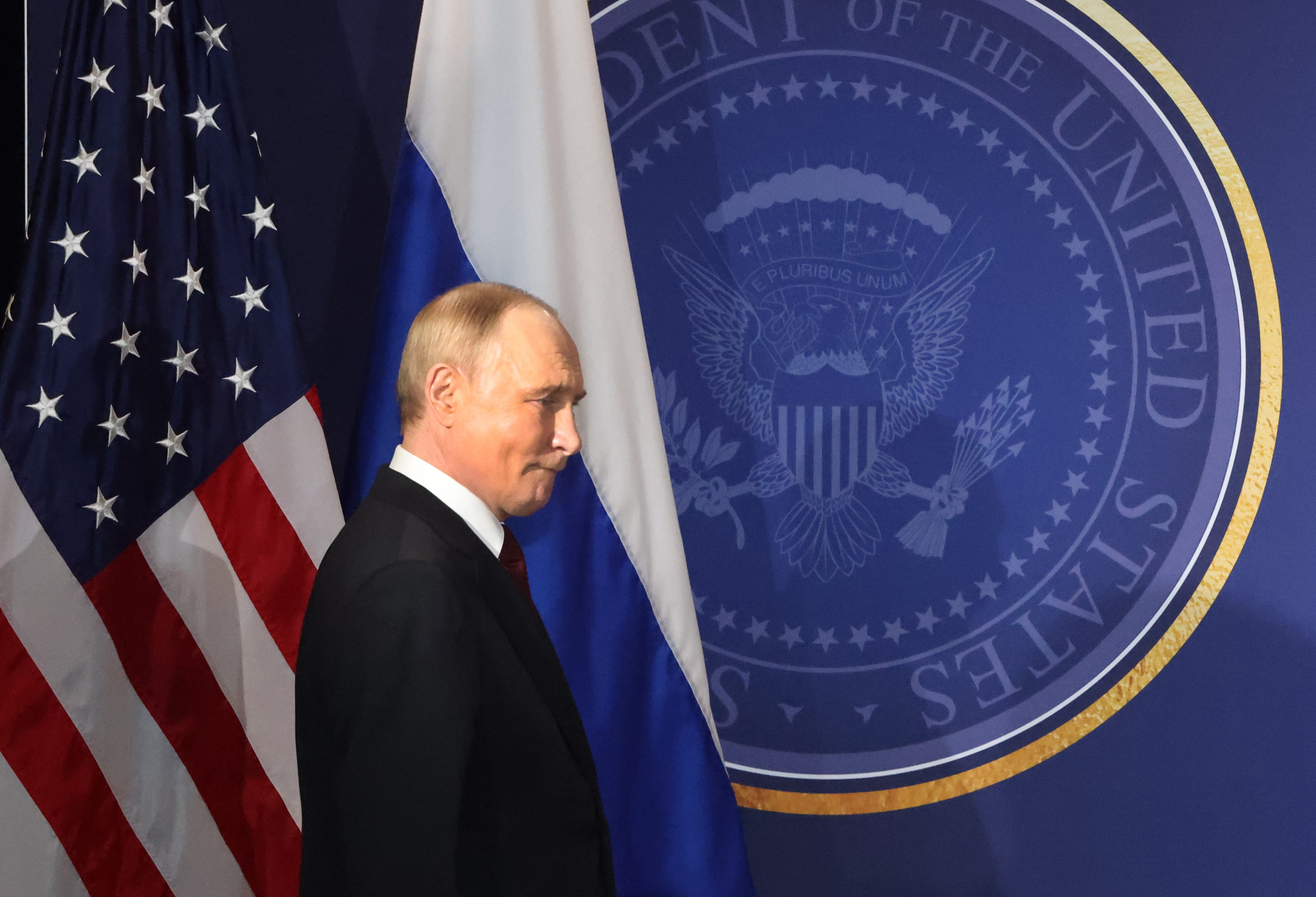
THANKS TO PRESIDENT TRUMP’S ALASKA SUMMIT with Vladimir Putin and the subsequent Washington meetings with Volodymyr Zelensky and a host of European leaders, there’s a lot of talk going around about a “peace deal” between Russia and Ukraine—even though the prospects of the two sides agreeing to anything are no different now from a month ago. The largest obstacle to peace remains the president of the Russian Federation.
There’s always someone in Washington or Brussels who believes Putin might hold to a deal; that if he receives the right offer or “off ramp” or the right concessions, or if he hears the right words, he might be accommodated and agree to a responsible peace.
This is a dangerous illusion.
Putin has shown the world again and again that his word is worthless. He breaks treaties, violates borders, murders opponents, and weaponizes everything from cyberspace to natural gas. To trust him in any negotiation is to play poker with a man who cheats even when he’s winning.
To those who have dealt with him, his government, or even his lower-ranking military commanders, this is obvious. When I was in command of U.S. Army Europe, I dealt with his generals and many of his civilian officials. They would regularly agree to something—even small things that didn’t seem to me worth dickering about—until they said no and attempted to change the deal, usually during execution. It was as if their only goal was to make our lives more complicated and difficult.
Those officials had that in common with their colleagues throughout the Russian government. I received daily intelligence summaries detailing the breadth of Russian malign activity across the continent. Those reports catalogued a staggering range of hostile, covert acts designed to disrupt, damage, and at times destroy those who opposed Putin. Some, but not all, of what was in those reports has since emerged in the news. But even the open-source records—the things the entire world sees and knows—should be enough to remove any doubt today about Putin’s nefarious and malign activities. That some people still find ways to excuse them is beyond comprehension.
I first noticed Putin’s turn against the United States and our allies in 2006, not long before he announced his open hostility. Reviewing the list of provocations, acts of aggression, international crimes, lies, deceits, and abuses Putin has committed since then is staggering. In the intelligence community, these are known as “trends”—and they are rarely this clear.
In 2006, in London, Alexander Litvinenko, a defector from the FSB, was poisoned with the radioactive isotope polonium-210 in a hotel bar. A British inquiry concluded that Putin “probably” approved the murder. It was more than an assassination—it was a radioactive calling card.
After the government of Estonia chose to relocate a Soviet war memorial in 2007, the country was paralyzed by weeks of increasingly damaging cyberattacks, all traced back to Russia. First, government ministries were frozen, then banks, followed by media outlets, and then infrastructure—even traffic lights went dark. The actions were traced to Moscow, and the story indicated Russia had discovered the effectiveness of a new weapon: digital siege warfare. This was less than eight years after the Russian government, in which Putin was then prime minister, reaffirmed the sovereignty and independence of its neighbors in the Charter for European Security.
The following year, I was in northern Iraq leading a division in combat operations, with an attached Georgian battalion under my command. One day, I received a call to get the Georgian soldiers on a plane back to Tbilisi as soon as possible. Russian tanks were pouring into the northern Georgian province of South Ossetia, and another province, Abkhazia, was also under attack. Nearly two decades later, Russian troops remain in possession of a fifth of Georgian territory—one of the “frozen conflicts” in Europe. Russian malign influence controls the rest of Georgia through the influence of the oligarch Bidzina Ivanishvili and his authoritarian Georgian Dream party. Georgia, like Estonia, is one of the countries whose independence and inviolability Russia had promised to respect.
The next five and a half years were relatively uneventful, not because Putin had been satiated by biting off little bits of Georgia, but because he was retooling and modernizing his military for much more ambitious efforts.
In 2014, Russia’s “little green men” seized Crimea. A sham referendum, overwhelmingly condemned by the United Nations, amputated the peninsula from Ukraine and grafted it onto Russia. Similar Russian-backed “civilian” forces started a revolt in the Donbas, followed soon by Russian special forces and then regular troops. In the early days of that takeover, a Buk missile shot down the civilian airliner MH17, killing 298 civilians. Moscow lied, obfuscated, and denied, but evidence eventually showed Russians forces to have committed the crime. Again, this was in direct violation of Putin’s promises: The Russian-Ukrainian Friendship Treaty had come into effect and was renewed under Putin’s presidency.
In the summer of 2014, Putin’s government agreed to the Minsk I agreement—a ceasefire that they used just to amass more forces and renew the attack in violation of the agreement. He later blamed Ukraine for the collapse of the agreement and declared that the peace deal “no longer existed.”
Also in 2014, Russian agents blew up ammunition depots in Vrbetice, Czech Republic, killing two people. Only years after the fact, in 2021, did Czech authorities complete an investigation that revealed deadly Russian sabotage on NATO soil.
In 2015, as Syrian dictator Bashar al-Assad was on the brink of being deposed four years into Syria’s civil war, Putin ordered his military to intervene to save him. The campaign featured what have since become hallmarks of Russian military operations: deliberate targeting of hospitals, indiscriminate bombing of civilians, and dissimulation about who the enemy really was, as the Russian government claimed to be fighting ISIS but spent much more time fighting non-Islamist and moderate opposition groups or massacring civilians.
More cyberattacks followed in 2015 and 2016, as Russian hackers shut down Ukraine’s power grid. This was the first time in history a cyberattack caused a national blackout. Also in 2015, Russian hackers attacked the German Bundestag. In the United States, GRU officers stole Democratic emails and spread disinformation across social media. Twelve of them were indicted in U.S. courts. Putin shrugged.
In Montenegro, Russian operatives plotted a coup to derail the NATO accession process in 2016. The following year, Russian hackers unleashed “NotPetya”—malware disguised as ransomware—that spiraled into the most destructive cyberattack ever, crippling global firms and causing billions in damage.
In another chemical attack in 2018, this time in Salisbury in the United Kingdom, two GRU officers deployed Novichok, a military nerve agent, in an attempt to kill Sergei Skripal, another Russian defector. He and his daughter barely survived; a local British woman died. The operatives posed as tourists but reporting later revealed they were decorated Russian intelligence officers. Russia is a signatory of the Chemical Weapons Convention, yet it used a chemical weapon on foreign soil.
Russia’s SVR intelligence agency hacked SolarWinds software updates in 2020, compromising U.S. government agencies and corporations in a massive espionage operation. The scale of this operation was staggering, and it showed Moscow would treat the global digital supply chain as fair game.
No Russian transgression was as large, as destructive, or as obvious in its violations of Russia’s international legal commitments as the full-scale invasion of Ukraine. Cities like Mariupol were obliterated, Bucha became a byword for atrocity, and millions of Ukrainians were driven from their homes. The Kremlin’s mass deportations were so brazen and illegal that the International Criminal Court issued an arrest warrant for Putin himself for the unlawful transfer of Ukrainian children.
Even as Russian missiles fell on civilians in Ukraine, Moscow meddled elsewhere. Romania annulled its presidential election due to Russian interference. Russian influence in Georgia has effectively suspended democracy in that country.
And over the years we also have seen what has happened inside Russia. Journalists like Anna Politkovskaya and opposition leaders like Boris Nemtsov have been gunned down. Alexei Navalny was poisoned, jailed, and ultimately killed in a Siberian penal colony. Others—regional governors, oligarchs, critics—have fallen from balconies, “slipped” from windows, or died suddenly of “heart attacks” after crossing the regime. These deaths follow a grim pattern. When truth threatens Putin’s system, truth-tellers die.
THESE EXAMPLES ARE NOT from ancient history. They are part of a continuous pattern stretching from radioactive tea in London to the trenches of Bakhmut. The tactics change—cyber one day, assassination the next—but the strategy does not. Putin wants to destroy NATO and humiliate and weaken the United States. Intimidation, violence, disinformation, and contempt for law are constants of Putin’s rule.
Which is why the notion that Putin can be trusted in any peace deal is a fantasy. President Zelensky knows it, and it was obvious that all the European leaders who came to Washington this week to support him know it as well. They’ve seen it. Every truce with Putin is temporary. Every handshake comes with fingers crossed behind the back. Every concession is pocketed and used to prepare the next aggression.
Putin has changed his methods, but he has never changed his nature, and he never will. The sooner the free world accepts that fact, the better chance we have of defending ourselves, and contributing to the defense of our partner Ukraine.
One would think that a man who once owned a casino would know not to allow a known cheater into the house.
 | A guest post by
|