Putin’s Pathetic Parade
A spectacle of fear and loathing in Moscow.

THERE WAS A SOVIET JOKE back in the 1970s in which a tank driver on a military base gets a very tempting offer from a black-market dealer to sell his tank, but hesitates because the May 9 Victory Day parade is coming up. The dealer suggests that he could make a cardboard tank and walk along with the parade making vroom vroom noises. The tank driver agrees. Then, arriving for the big event, he sees that the parade grounds are full of nothing but cardboard tanks with drivers doing their own vroom vroom—while pilots walk along carrying cardboard planes and making airplane noises.
I was reminded of that joke the other day when, amid news stories of Victory Day parades in Russia dropping the customary displays of heavy weaponry, videos emerged of kindergartners in various Russian cities marching with cardboard and plastic tanks, fighter planes, and artillery. That was just one of many moments of cringe from a day marked by what many Ukrainian, and Russian expatriate opposition, media called a “parade of shame,” a “pathetic spectacle,” or “nightmare on Red Square.”
The prelude to the parade was bad enough. Vladimir Putin, obviously spooked by the prospect of Ukrainian drones raining on his parade, had to ask Donald Trump to negotiate a Victory Day ceasefire. Volodymyr Zelensky, who wasn’t a famous comedian for nothing, responded with a brilliant move: an executive order officially permitting the May 9 parade to be held “in the city of Moscow (Russian Federation),” for “humanitarian purposes outlined during negotiations with the American side.” For next-level trolling, Zelensky added the precise coordinates of the spot exempted from Ukrainian strikes. (Yuri Velikiy, one of Ukraine’s best heirs to Zelensky’s comedy mantle, promptly posted a clip in which Putin, nervously conferring with Belarus’s Alexander Lukashenko while viewing the parade, waits for Zelensky’s permission to go to the bathroom.)
Russian war-hawk bloggers met Zelensky’s masterful stunt with a chorus of fury in which rage at the Ukrainian president—some suggested that his insulting order was reason enough for a strike on Kyiv—coexisted with thinly veiled contempt for Putin himself. Many did not mince words, saying that Zelensky had rubbed Putin’s face in it or reduced Putin to a terpila, a slang word for a perpetual victim patiently enduring abuse and humiliation.
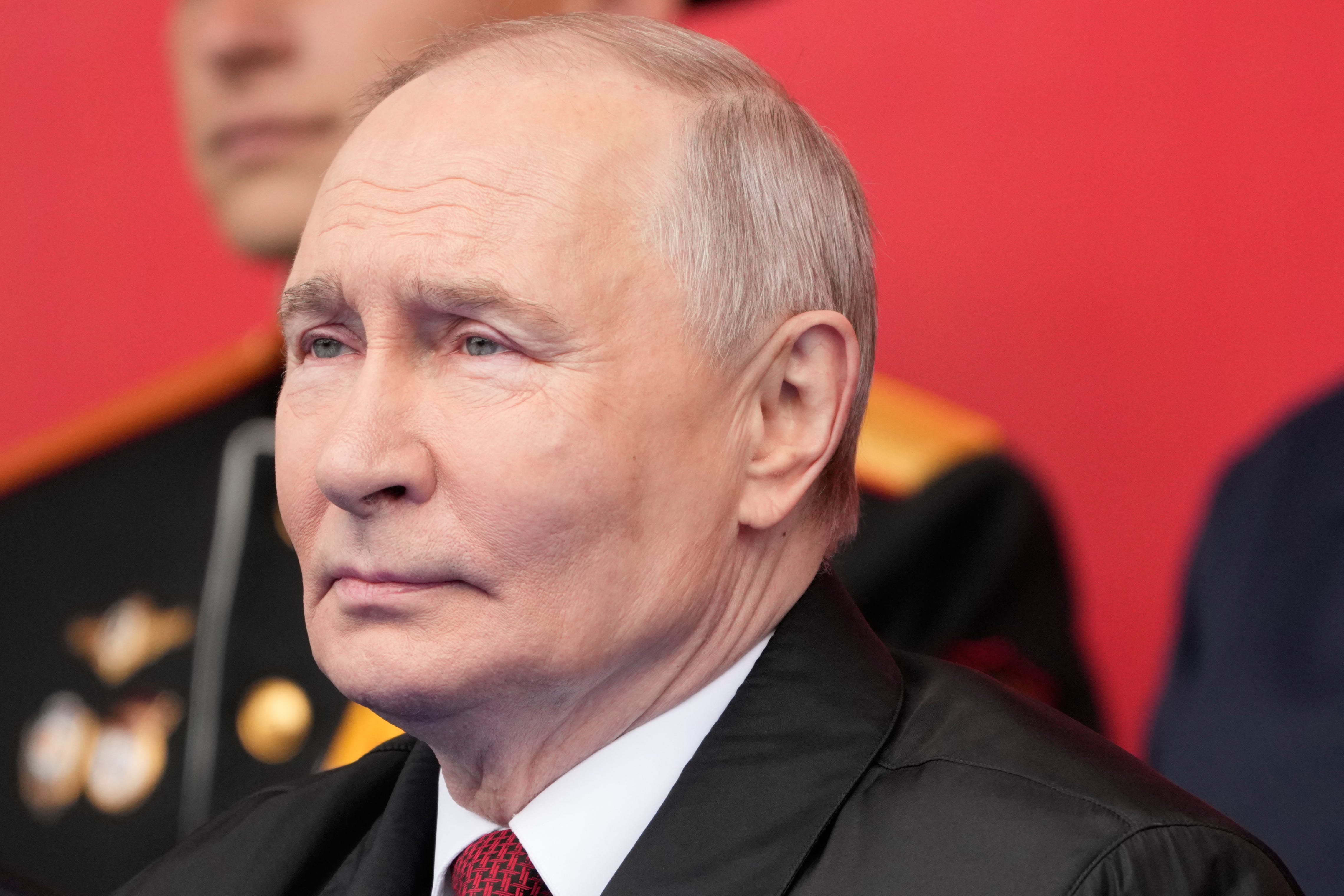
After this fiasco, the parade itself was described as “muted” and “subdued”; armored vehicles and intercontinental ballistic missiles were displayed only on video. The event was less than an hour long, with Putin, surrounded by visible security and wearing a bulky black coat that may have had a bulletproof vest underneath, briskly ushered in and out. His speech struck a defiant note—he declared that Russian soldiers in Ukraine “face an aggressive force that is armed and supported by the entire bloc of NATO” but are fighting on nonetheless, and that “victory has always been and will be ours”—but the Kremlin strongman looked tired and weak, more cranky grandpa than fearsome leader.
Putin’s post-parade remarks to journalists, in which he said, “I think the conflict in Ukraine is coming to an end,” have been interpreted by some as a signal that he may be finally trying to back out of the war. Maybe. But his reaction to Zelensky’s proposal for a meeting was belligerent. “Whoever wants to meet, let him come [to me],” he said, with only an afterthought about a possible meeting in a third country, and his mention of the need for peace “for a long historical perspective” suggests that he could always back out if a proposed peace agreement doesn’t resolve the supposed historical injustices that he has always claimed are the war’s root causes. Indeed, on the same day, he seemed to back out of a prisoner swap that his own senior aide, Sergei Ushakov, had previously confirmed as part of the ceasefire agreement.
Can Putin, the man who built up and weaponized the Victory Day cult as the sacred foundation of his rule, afford to end a war without a victory? In an interview before the parade, exiled Russian political scientist Ekaterina Shulman noted that Putin has become, in a sense, a victim of that very cult. With Russia unable to eke out a new victory in Ukraine or even protect its own annual celebration without help from the U.S. president, May 9 has turned, says Shulman, “from an asset to a liability.”
There is no better illustration of this fact than Victory Day 2026, which not only became a display of Putin’s weakenss but also underscored his, and Russia’s, international isolation. Just five foreign leaders, including Lukashenko, were present. Venezuela’s Nicolás Maduro was, ahem, unavoidably detained. Armenian Prime Minister Nikol Pashinyan, a onetime parade regular and formally still an ally in the post-Soviet Collective Security Treaty Organization, snubbed Putin’s parade days after hosting EU leaders at the European Political Community Summit in Yerevan—and shaking hands with Zelensky. Slovakia’s Prime Minister Robert Fico, Putin’s remaining half-friendly face in the EU after Viktor Orbán’s electoral defeat, flew in and laid flowers at the Tomb of the Unknown Soldier outside the Kremlin but stayed away from Red Square. There was, however, a contingent of North Korean soldiers on hand—hailed by the announcer, in Soviet-style bombastic tones, for their heroic contribution to “freeing the Kursk province from neo-Nazi invaders.”
Could it get more cringe than that? In Russia, certainly: News footage from the Siberian city of Chita showed a column of widows and mothers of fallen soldiers marching in a military-style stiff step, wearing their husbands’ and sons’ military jackets over Handmaid’s Tale–style identical blue dresses with black shoes.
And then there was the shocking viral clip from the “Immortal Regiment” march—a tribute to the war dead that has become a popular companion event to the victory parade—in the city of Kemerovo. A local TV reporter approached a woman carrying a placard with a black-and-white image of a World War II veteran and also holding a clearly recent photo of a young man; the photo, the woman explained, was of her son, missing in action in the “special military operation.” The journalist reacted with a cheery, “So this is a double holiday for you! Congratulations!”
The reporter later apologized. But her real offense, perhaps, was saying the quiet part out loud: The Putin regime has Russia in the grip of a death cult.
And yet occasionally, May 9 also offered glimpses of a different Russia—the one Putin has spent years trying to destroy. In St. Petersburg, the police arrested (but soon released, apparently without charges) 85-year-old Lyudmila Vasilieva, a survivor of the grueling German siege of Leningrad in 1941–44, for holding a solitary antiwar protest. Her sign said, “Don’t use the people’s victory to cover up your crimes.”