As Putin Threatens Europe, Failure of Trump Peace Plan Laid Bare
Peace games from the Russian dictator, who can’t win but can’t afford to stop fighting.

DESPITE REVELATIONS that Donald Trump’s special envoy Steve Witkoff has been acting as more of a Russia lobbyist than a negotiator, Witkoff still jetted to Moscow on Monday, along with Trump’s son-in-law Jared Kushner, to talk to Vladimir Putin about ending the war in Ukraine—and discuss a peace plan whose first prototype Witkoff apparently cribbed from his Russian pals. After the five-hour huddle, Putin foreign policy aide Yuri Ushakov, one of the Kremlin officials involved in the leaked phone calls that exposed Witkoff’s behind-the-scenes bumbling, dropped all the usual clichés about a “constructive” and “substantive” meeting. Putin, meanwhile, showed up after a three-hour delay—and right on the heel of swaggering comments about his readiness for war with Europe: “If Europe suddenly wants to start a war with us and starts it,” he said, “then it would end so swiftly for Europe that Russia would have no one left to negotiate with.”
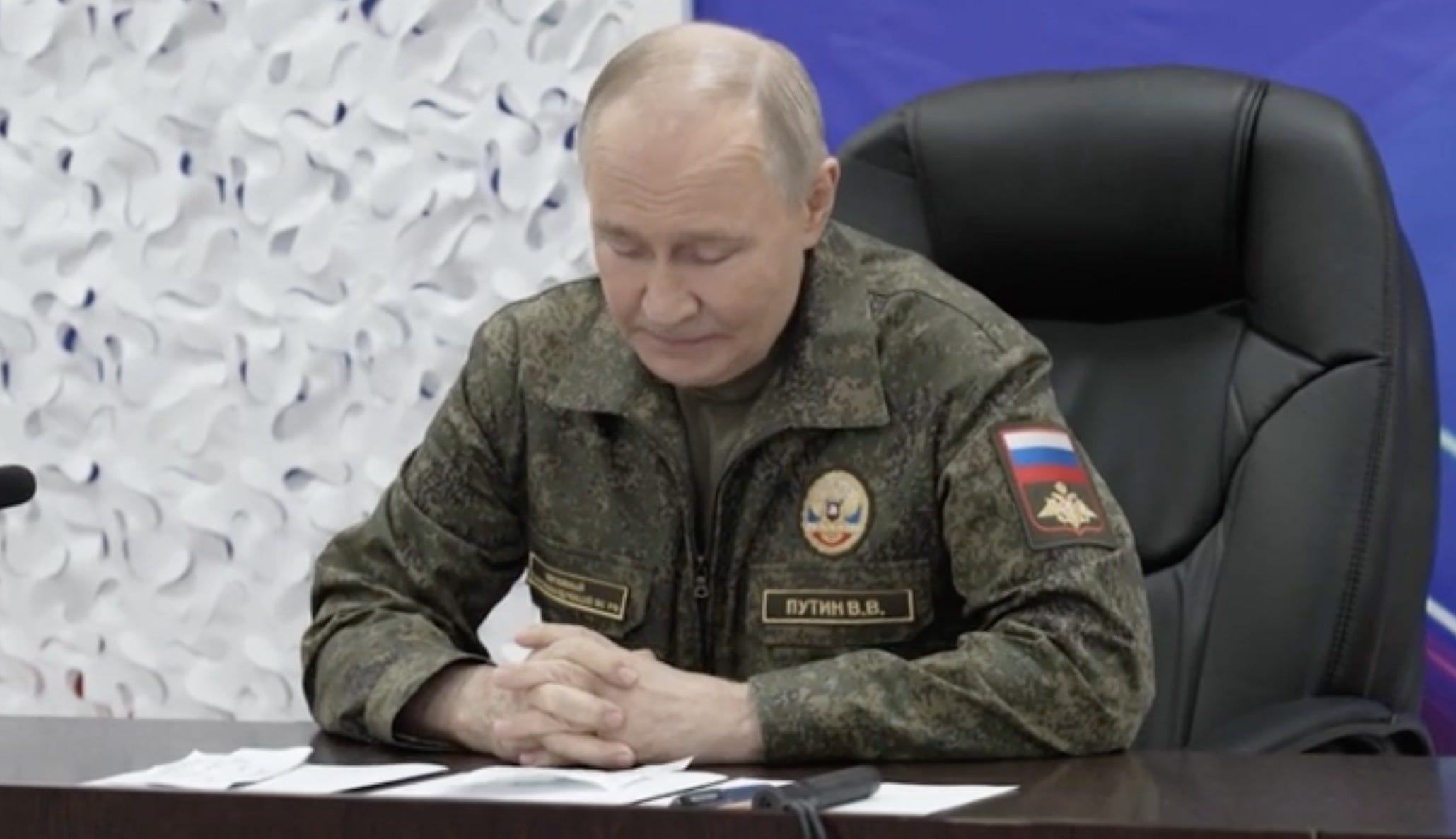
A couple of days earlier, Putin had made his latest appearance cosplaying in camo as generalissimo at an unidentified “command post” and receiving the latest report claiming (yet again) a Russian victory in the nearly sixteen-month-long fight for Pokrovsk.
This certainly doesn’t look like peace is in the air.
Putin’s belligerent remarks about Europe also set the stage for blaming the likely failure of the peace talks on subversive meddling by the Europeans—presumably because of too many Kremlin-unfriendly alterations to the original 28-point peace plan fed to Witkoff by Putin envoy Kirill Dmitriev. But it’s important to remember that even that plan—which handed Russia some major wins, notably the entirety of the Donetsk and Luhansk provinces, including territories currently held by Ukraine—probably would not have been accepted by Russia, at least not unless its more Ukraine-friendly provisions had effectively neutralized. Above all, that proposed plan laid out a “security guarantee” that would treat a future attack on Ukraine as an attack on the “transatlantic community,” similar to NATO’s Article 5. Russia’s war-hawk bloggers, at least, found the peace plan utterly infuriating—among other things, because it would have let Ukraine keep an army of 650,000 and would have approved what amounted to reparations for Ukraine from Russia’s frozen assets in Europe (although in the form of a reconstruction effort from which the United States would have skimmed off half the profits).
It is also worth noting that just as the 28-point plan was picked up by the press last month, Putin was telling Russian troops at yet another command post that “we have our own tasks and goals,” and that foremost among these was “the unconditional achievement of the aims of the special military operation.” The Witkoff/Dmitriev proposal would have fallen far short of these aims, since its cap on the size of the Ukrainian military falls far short of “demilitarization” (Ukraine would still have a much larger military than it did before the Russian invasion) or “denazification,” which, in translation from Putinese, means the de facto abolition of Ukrainian sovereignty and the replacement of its government by a Kremlin puppet regime.
Since then, Putin has repeatedly made it clear that he has no intention of signing a peace agreement on any terms. Just last week, for instance, he opined that it would be “senseless” to sign any agreement with the current Ukrainian leadership because it lacks legitimacy due to Volodymyr Zelensky staying in office after his presidential term expired last May. (In reality, the extension of Zelensky’s term was mandated by the Ukrainian constitution’s ban on wartime elections—and that’s aside from the darkly comical chutzpah of such a claim from Putin, who repeatedly tinkered with Russia’s constitution to stay in power.) Putin claims that an agreement with the “illegitimate” Zelensky would not be internationally recognized as legally binding. Since Ukraine isn’t going to do insta-elections just to satisfy the Russian dictator’s supposed legal scruples, one might ask why the peace talks are even being held—other than to put on a show for Trump.
THAT PUTIN DOESN’T WANT the war to end seems to be the general consensus except in Putin-friendly circles. And not just because he believes that he’s slowly winning on the ground and that Ukrainians are so exhausted by the war that Kyiv will soon be forced to surrender, but also because the war has become a tiger he’s holding by the tail. Ending it would mean bringing home some 700,000 men who have almost literally been to hell and back, are trained in the use of weapons, and in many cases had a history of criminality and violence even before they went to the frontlines. Many of these men have been underpaid and mistreated—and have watched their fellow soldiers die. If Putin ends the war without a result he can sell as a victory to the Russian public, this may not particularly bother most Russians (most of whom, polls show, want the war to end now)—but it will almost certainly exacerbate bitterness among its returning veterans. It will also antagonize Russian society’s war-hawk segment, which is far more politically active than the war-weary but apathetic majority.
Add to this the fact that Russian society now runs like a war machine—economically and politically. The war and its fallout, including the sanctions, are imposing heavy economic costs on Russia—but, paradoxically, the war industry is also just about the only thing fueling the economy right now, and returning it to a civilian footing will create a host of short-term problems. Meanwhile, most of Russia has adjusted to levels of censorship, repression, and enforced pseudopatriotic zeal that would have been unthinkable even in 2021. The end of the war—and hopes for improved relations with the West—would very likely create expectations and pressures for a thaw, which is the last thing Putin wants.
Thus, the most likely explanation of Russia’s peace games is that Putin is simply playing for time. Meanwhile, Witkoff and Kushner want business deals, Trump is happy to lend his name to anything called a peace plan, and Zelensky and his team have to play along because they still have to stay on Trump’s good side. It’s a “peace process” that brings to mind the old Soviet joke about the Soviet Union’s alleged dedication to preventing war: “There will be such a struggle for peace that no stone will be left standing.” The joke acquires a grim reality when one looks at the remnants of Ukrainian cities “liberated” by Russia.
And so, regardless of how many gourmet meals or exotic meat pies Witkoff enjoys in Moscow, the war is virtually certain to continue into 2026. And if the last two weeks have demonstrated anything, it’s that any peace discussions in which Trump and Putin are major players are going to be a travesty and a distraction.
Still shocked how no one in the MSM has any insights like this. Just daily "updates" that provide no real information. It's shameful how they're not questioning Kushner's involvement and Rubio's exclusion from these "negotiations".
Kudos to Cathy Young!
This is the finest summation of what is happening with the "peace talks" that I've read.
Perhaps your next article could dive more into the Trump/Witkoff/Kushner corruption aspect of it.