Putin and Trump, Still Colluding
Every time the president’s apologists swear he’s not conniving with the Russian dictator, he does it again.

ON JULY 23, THE WHITE HOUSE held a briefing to rebut the notion that Donald Trump had colluded with Vladimir Putin in the 2016 election. Tulsi Gabbard, the director of national intelligence, accused previous U.S. officials of inventing “a contrived false narrative that Putin developed a ‘clear preference’ for Trump.” Karoline Leavitt, Trump’s press secretary, accused the former officials of “concocting this narrative that the president colluded with the Russians, that the president’s son was holding secret meetings with the Russians. All of these lies that were never true.”
Hogwash. There’s plenty of evidence that Putin had a preference for Trump and acted on it, along with the other central claims of the “Russiagate” scandal. To begin with, there’s the infamous email chain in which an intermediary offered Donald Trump Jr.—these are direct quotes—“official documents and information that would incriminate Hillary” as “part of Russia and its government’s support for Mr. Trump.” Don Jr. wrote back, “if it’s what you say I love it,” and he met with Russians to hear the offer on June 9, 2016. The meeting failed to produce the promised dirt. A year later, President Trump conspired to cover up the offer.
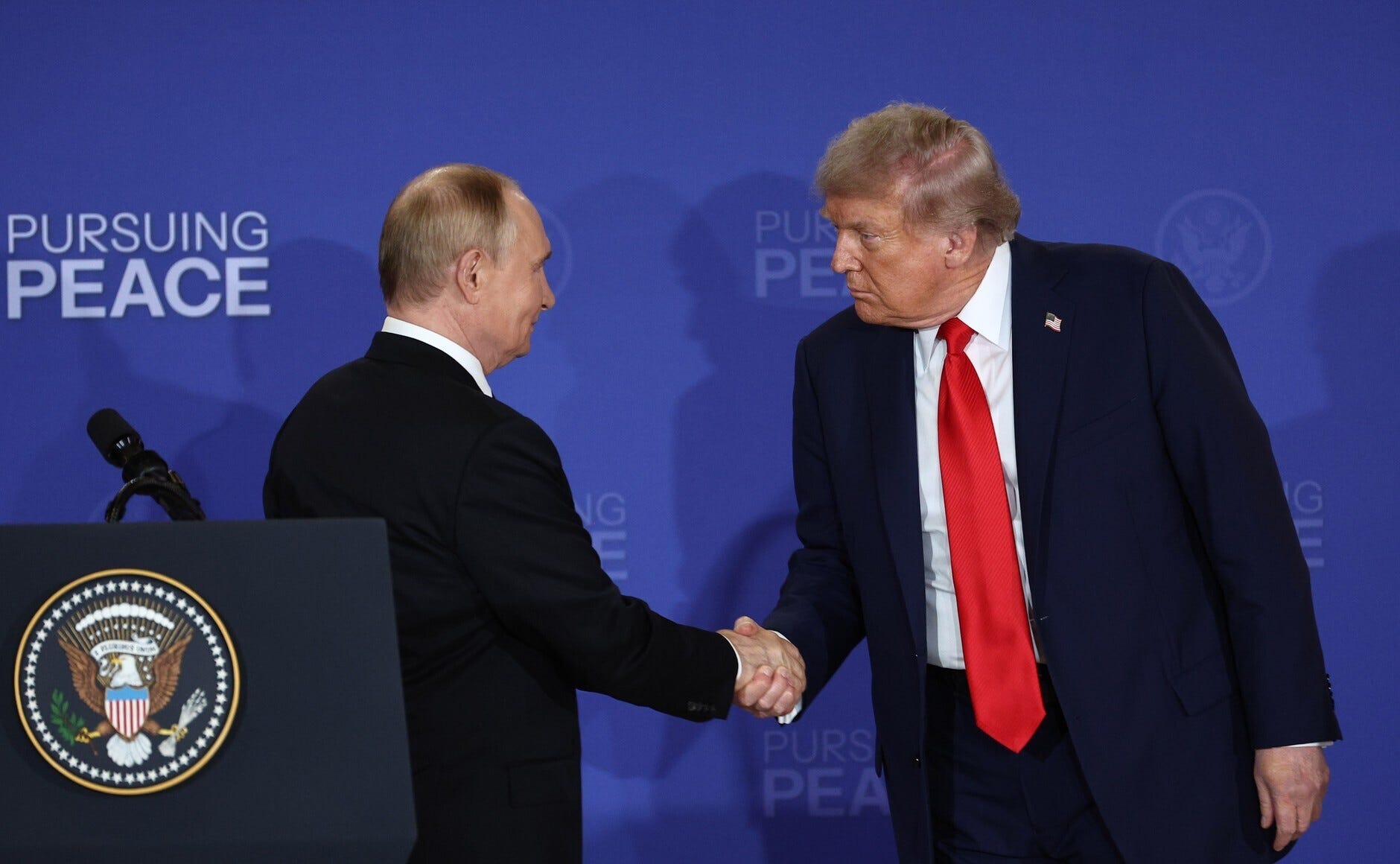
The intrigue didn’t end there. In 2018, after meeting with Putin in Finland, Trump dismissed the well-documented U.S. intelligence finding that Russia had interfered in the 2016 election. The idea that all these claims were bogus became an article of faith among Trump supporters. And in the days since his latest meeting with Putin, this time in Alaska on August 15, Trump has again been spewing Russian propaganda, including against the United States.
The collusion was real. And it never stopped.
TRUMP’S PROTESTATIONS ABOUT RUSSIA have always been self-discrediting. He persistently maintains that (1) allegations of his bromance with Putin are a hoax and (2) the hoax is interfering with their bromance. On August 15, as he flew to Alaska for their latest summit, Trump told Bret Baier that “very, very bad Americans” had tried to disrupt his relationship with the Russian dictator:
We have tremendous potential to have a great relationship, a great business relationship. But we couldn’t do it because of the crooked, demented people that created the phony “Russia, Russia, Russia.” And I told him, I said, “You know, Vladimir, there’s no way we’re going to make a deal. You know that.” He said, “Well, I think it’s going to be tough.” I said, “No, not tough. It’s impossible. Because I have wise guys that created a phony deal.”
It’s conceivable that Trump made up this conversation, as he has made up many others. But either way, it’s striking that he brags about badmouthing Americans in private conversations with Putin. It tells you where his allegiance lies.
In Alaska, Trump’s staff had military personnel literally roll out a red carpet for Putin. The two men met for nearly three hours. Afterward, in an interview with Sean Hannity, Trump repeatedly described the meeting as “very warm.” Four days later on Fox & Friends, Trump effused about their chemistry: “You saw that when he got off his plane, I got off my plane. There’s a warmth there.”
Putin came into the meeting with four main goals: to excuse Russia’s ongoing attacks against Ukraine; to blame the war on Ukraine and the United States; to lift the threat of sanctions if Russia didn’t agree to a ceasefire; and to get American assent to Russia’s conditions for ending the war. Trump has delivered on all four objectives.
On the flight to Alaska, a reporter told Trump: “Russia continued its violence into Ukraine last night, launching even more drones.” It looked like brazen disregard for Trump’s peace initiative, but he shrugged it off. “I think they’re trying to negotiate,” he ventured.
In their meeting, Putin didn’t agree to a ceasefire, but Trump made excuses again. “I’d like them to stop,” he said of the warring parties, but “strategically, that could be a disadvantage.”
On Tuesday, eleven days after the summit, Trump held a three-hour cabinet meeting. A reporter asked him about the “severe consequences” he had threatened to impose if Putin didn’t agree to a ceasefire at the summit. Trump responded by shifting blame to Ukrainian President Volodymyr Zelensky. “Zelensky’s not exactly innocent either,” he scoffed.
Trump also embraced Putin’s conditions for ending the war. “President Zelenskyy of Ukraine can end the war with Russia almost immediately, if he wants to,” Trump wrote on Truth Social on August 17, two days after the summit. “No getting back Obama given Crimea,” he stipulated, “and NO GOING INTO NATO BY UKRAINE.”
Two days later, on Fox & Friends, Trump said Russia’s demands should be honored not just because they were backed by force, but because they were justified. “Russia said [of NATO], ‘We don’t want ’em on our border.’ And they were right,” he argued. “If you were Russia, who would want to have your enemy, your opponent, sitting on your line? You don’t do that.”
Rather than hold Russia accountable for rebuffing the ceasefire, Trump suggested that Ukraine would be at fault if it failed to accept Putin’s terms for peace. He told Hannity that Putin was “pretty close” to a deal but that Zelensky might “say no because Biden handed out money [military aid] like it was candy.”
IN THE ALASKA MEETING, Putin peddled his twisted story that Ukraine and NATO, not Russia, were responsible for starting the war. And Trump bought it. On Fox & Friends, Trump rebuked Ukraine: “You don’t take on a nation that’s ten times your size.” At Tuesday’s cabinet meeting, he repeated the false insinuation: “You don’t go into a war that’s fifteen times your size.”
Trump is particularly interested in faulting previous American presidents, since he sees them, not Putin, as his true enemies. On Fox & Friends, he claimed that Crimea, which Putin seized in a 2014 invasion, was actually “given” to Russia in a “real estate deal.” “Obama gave it away,” said Trump. “He gave it away.” In fact, Trump praised Putin for taking the territory: “Putin, in all fairness to him, he made a good deal. He got it from Obama.”
As to Russia’s 2022 invasion, Trump said the real culprit was Joe Biden. And who did Trump cite as his star witness to make that case? Putin.
In his interview with Hannity, Trump noted with delight that Putin had implicitly attributed the war to Biden. “I was very happy to hear him [Putin] say if I was president, that war would have never happened,” said Trump. Later, he repeated that Putin’s statement had made him “so happy.” At the cabinet meeting, Trump added that if it hadn’t been for the president who was “in here before,” the war “would have never started. And Putin said that himself. President Putin said that himself.”
Trump also touted Putin as his chief endorser on domestic policy. “Vladimir said just a little while ago, he said, ‘I’ve never seen anybody do so much so fast,’” Trump told Hannity. “He said, ‘Your country is, like, hot as a pistol.’ And a year ago, he thought it was dead.” At the cabinet meeting, Trump said Putin had also vouched for Trump’s management of COVID. “Everybody, including Putin, said that Operation Warp Speed, ‘What you did with that, nobody can believe it.’”
But Trump’s most remarkable invocation of Putin was on the subject of elections. He told Hannity:
Vladimir Putin said something, one of the most interesting things. He said, “Your election was rigged because you have mail-in voting. . . . It’s impossible to have mail-in voting and have honest elections.” And he said that to me. It was very interesting, because we talked about 2020. He said, “You won that election by so much.” . . . He said, “And you lost it because of mail-in voting. It was a rigged election.” . . . Vladimir Putin, smart guy, said you can’t have an honest election with mail-in voting.
That’s how Trump thinks about Putin and the United States. He sees Putin—who notoriously rigs his own elections in Russia—as an ally in discrediting American elections, except when Trump wins.
The irony is that Gabbard, in her attempt to exonerate Trump, tried to separate him from Russia’s ongoing campaign to discredit America. At her July 23 briefing, she argued, “Putin’s principal interests relating to the 2016 election were to undermine faith in the U.S. democratic process, not show any preference [for] a certain candidate.”
But in his comments to Hannity, Trump demolished that distinction. He made it clear that he and Putin have talked together—and, by spreading Putin’s rigged-election propaganda on Fox News, are working together—to undermine faith in the U.S. democratic process.
That’s why it’s so hard to sell the lie that Trump doesn’t collude with Putin. He just goes out and does it again.