‘Ravelstein’ Revisited
Saul Bellow’s last novel is brilliant, funny, and unsettling. It also leaves an uncomfortable question hanging: What exactly did all that shamelessness buy us?

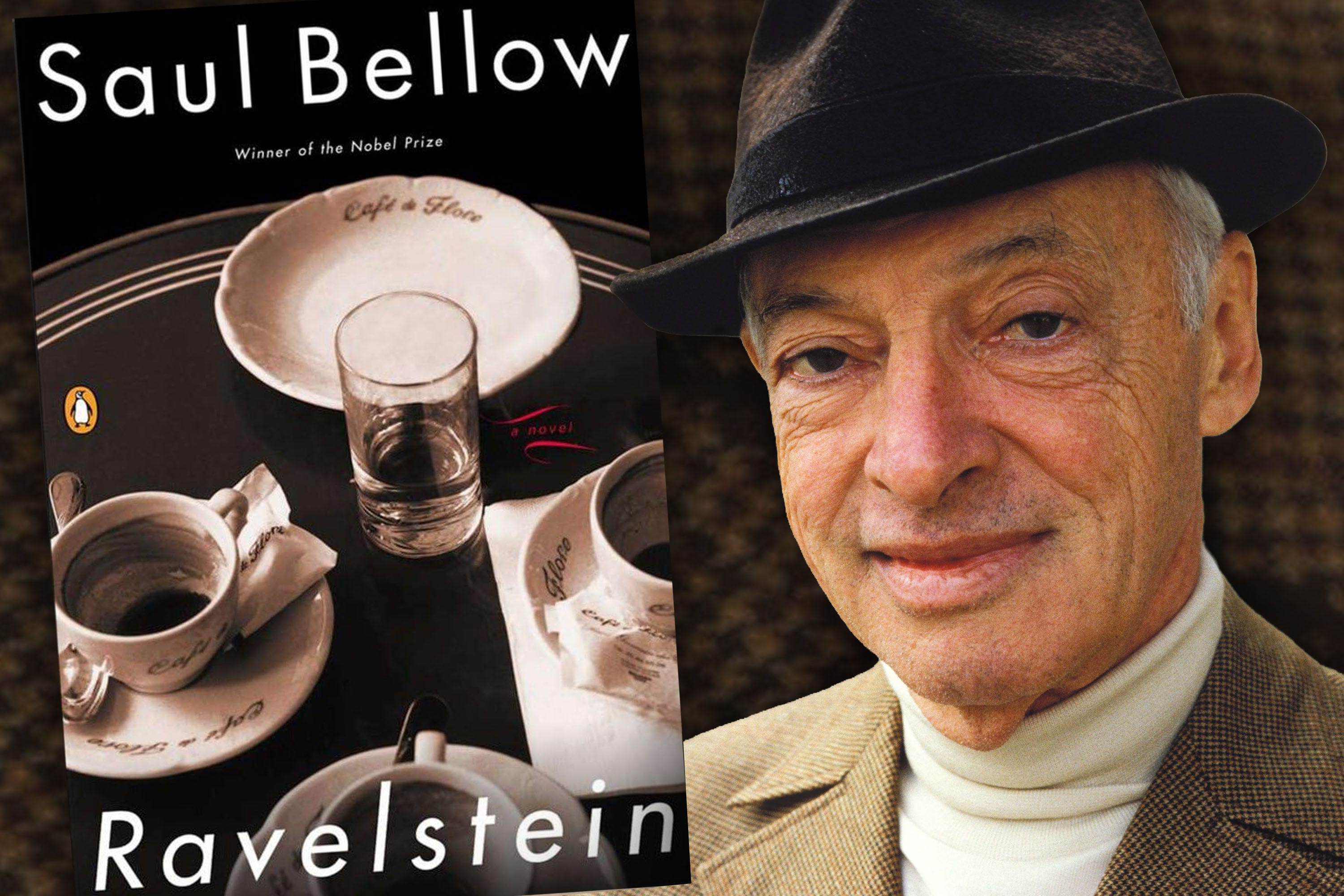
WHEN SAUL BELLOW’S RAVELSTEIN came out in 2000, some took it personally. The character Abe Ravelstein, a gay man who dies of complications from AIDS, was a thinly disguised Allan Bloom, Bellow’s friend, a professor of political philosophy and the author of the 1987 bestseller The Closing of the American Mind. In the runup to publication, Bellow told an interviewer that he wanted to “get [Bloom] down on paper.” Thus, Bellow non-fictionalized his fictionalized outing of Bloom.
In a panel discussion about Ravelstein a month after its release, Bloom’s friend (and my father-in-law), Werner Dannhauser called Bellow’s interview “deplorable” and “cheap.” Bellow, on his deathbed five years later, reportedly asked, “Was I a man or was I a jerk?” In 2000, others were asking the same question.
A quarter century later, we can take this final novel of a fine novelist less personally. Indeed, Dannhauser didn’t take it altogether personally either. He called his remarks a commentary on Aphorism 161 of Friedrich Nietzsche’s Beyond Good and Evil: “The poets are shameless toward their experiences. They exploit them.” Dannhauser didn’t know whether an artistic payoff justifies a betrayal. But he affirmed that betrayal can artistically pay.
EARLY IN THE NOVEL, Ravelstein, a political philosopher and professor made rich by a bestselling book on the soul-sickness of modern democracy, sits in a penthouse suite, wearing a kimono “fit for a shogun.” Chick, Ravelstein’s friend and Ravelstein’s narrator, observes that the kimono is “more than half open,” revealing Ravelstein’s “long, not shapely” legs and his underpants, which “were not securely pulled up.” To peek under Bloom’s kimono is shameless. What is the payoff?
That is both a question about Ravelstein and a question that Ravelstein explores without ever settling. Chick says repeatedly that his friend asked, even “ordered,” him, to write a “Life of Ravelstein.” In reflecting on models for that “Life,” Chick turns to Thomas Macaulay’s 1856 essay on Boswell’s Life of Johnson. He doesn’t mention that Macaulay called Boswell “one of the smallest men that ever lived” or that, according to Macaulay, Boswell cheerfully shared details about his life “the publication of which would have made another man hang himself,” or that Boswell’s shamelessness extended to others. Boswell showed “little discretion in cases In which the feelings or the honor of others might be concerned.” “No man,” says Macaulay, “ever published such stories respecting persons whom he professed to love.”
Chick has “never been cured” of his weakness for Macaulay or for Boswell’s Johnson. That Johnson was a “poor convulsive” man, “touching every lamppost on the street and eating spoiled meat and rancid puddings.” Before he mentions those lampposts, Macaulay claims that Boswell’s shamelessness enabled him to surpass, in memoir writing, otherwise superior talents, including Johnson. As for Johnson, the “best proof” of his greatness is that “his character, instead of being degraded, has, on the whole, been decidedly raised by a work in which all his vices and weaknesses are exposed.” Perhaps that is why Ravelstein demanded to be shown, as Chick says, “without softeners or sweeteners.” The payoff of shamelessness, for a truth-seeking soul, is that it exposes the truth. The shameless memoirist honors his subject’s greatness by putting it to this test.
Shamelessness is also, for Chick, part of friendship. There was nothing “too shameful to be said” between him and Ravelstein. That is partly because a person “should be able to hear, and to bear, the worst that could be said of him.” But it is also liberating. In Ravelstein’s presence, Chick can confess “corrupt shameful secrets,” the covering up of which drains his strength. Ravelstein, Chick thinks, offered the memoir and the injunction to “be as hard on me as you like” as a last, freeing, gift. “You aren’t the darling doll you seem to be,” and “by describing me maybe you’ll emancipate yourself.” The exposure of Ravelstein could serve to expose Chick himself, in a manner that benefits Chick. And if shamelessness was at the core of Ravelstein and Chick’s friendship, perhaps a shameless tribute is the most fitting tribute to Ravelstein.
Chick, although his very name suggests naïveté, really is no darling doll. Reflecting on what he takes to be his own, genuine, innocence, Chick complains about a “humongous divorce settlement” forced on him by “a woman who had more than once declared that she was an innocent.” That must be Chick’s ex-wife, Vela, who, though insignificant in Ravelstein’s life, has an outsized significance in the “Life of Ravelstein.” Ravelstein notices before Chick does that Vela is a self-centered phony who unmans Chick and “refuses to be pleased” by him. Chick’s account of Ravelstein, he says, necessarily has “the slant given by” his “temperament and emotions.” This temperament and those emotions make a major accomplishment of Ravelstein’s minor deed of despising Chick’s ex-wife, which affords Chick the opportunity to stab at her reputation with his poisonous pen. Chick is not, like Macaulay’s Boswell, “one of the smallest men who ever lived.” But he isn’t a big man either.
In coupling his injunction to “be hard on me” with the charge that Chick is “no darling doll,” Ravelstein invites Chick to ask after his own motives. Ravelstein, though Chick’s junior by a “good many years,” “saw himself as [Chick’s] teacher.” Will being hard on Ravelstein offer Chick the satisfaction of taking him down a peg? Chick doesn’t ask, which suggests that he is either unwilling or unable to investigate fully the worst that can be said of him.
Support our coverage of books and arts by becoming a Bulwark+ member.
CHICK SAYS THAT THERE WERE no secrets between him and Ravelstein. But he also holds back from Ravelstein the most important thing about himself, his “private metaphysics.” A person, Chick believes, cannot be “known thoroughly” unless he can disclose that metaphysics to another. He never disclosed his to Ravelstein because he “didn’t feel like” having his ideas “anticipated or dismissed.” Since those ideas are fanciful, it is no wonder that he is reluctant to subject them to scrutiny. He believes that a human being waits “for millennia,” in “primal oblivion” to see the world, that “the world’s first gift was the gift of itself,” and that therefore it is a privilege and a duty to grasp the “mystery of reality,” to “hear, feel, and touch” the “mysterious phenomena.” He believes that adults, “too familiar with the data of experience,” find this more difficult to achieve than children, who can be stood still by experiences adults barely notice.
Since Chick describes Ravelstein’s opinion of this metaphysics—that it should be outgrown in favor of more rational principles and public concerns—Chick must have explained himself. But not as he would have liked to explain himself. “Only a small number of special souls,” says Chick, “have ever found a way to receive such revelations.” Ravelstein is not among them. That may be because Ravelstein tends toward dismissive judgement. Chick, contrasting himself with Ravelstein, claims that he takes “all sorts of ambiguities into account” and avoids “hard-edged judgments.” Ravelstein, who has “mapped out the world and made it coherent,” is severe in comparison. But it is also because Chick resists being taught. Even if Ravelstein is right that Chick’s private metaphysics is self-indulgent, preferring minute, private observation to public responsibility, Chick has “no intention of removing, by critical surgery, the metaphysical lens I was born with.”
His private metaphysics is not the only thing Chick holds back from Ravelstein. When he decides to marry Rosamund, a graduate student who has studied with Ravelstein, he doesn’t confide in his friend, who doesn’t learn that Rosamund and Chick are an item until the relationship is a year old. Chick admits that Ravelstein “might know more about me than I myself knew, but I was not about to . . . rely on him to run my life for me.” But Chick has a reason, apart from a prickliness about his autonomy, for reserve. “I had never told him,” Chick says of Ravelstein, “that I had fallen in love with Rosamund because he would have laughed, and told me I was being an idiot.”
Chick says that he is not altogether unteachable—indeed, he credits Ravelstein “with forcing you to reopen what was closed,” though he offers no example of such a reopening in his case. Nonetheless, the sole illusion Chick directly attributes to the otherwise clear-headed Ravelstein is the illusion that Chick is “capable of accepting correction.” Yet Chick pays no price for this incapacity.
Instead, Chick surpasses Ravelstein in Ravelstein’s own wheelhouse. For Ravelstein teaches, above all, about eros, our longing for completeness, the pursuit of which, though typically futile, ennobles human beings. Modern people are, for the most part, “dominated by fears of violent death,” Ravelstein claims, but “spirited men and women,” even in modern democracies otherwise inhospitable to greatness, are “devoted to the pursuit of love.” Yet Ravelstein himself doesn’t do what he teaches. “There is no intimacy” between Ravelstein and his long-term male companion, Nikki—“more father and son,” Ravelstein says. Though he spends his declining days with Nikki, students, and friends, Ravelstein is also horny—“I’ve never gotten so hot”—and speaks to Chick, first, of masturbation and later of young men he sees behind Nikki’s back. “I feel hot,” he says, and what am I supposed to do with it?
Chick could have presented Ravelstein as channeling his erotic energy into philosophy or as finding friendship superior to love. Instead his Ravelstein is an erotic failure, practicing at the end of his life the “reckless sex habits” through which he was—Chick invokes Biblical language—“doomed to die.” In contrast, Chick is a smashing erotic success, having made his way from Vela, a prodigy of womanly wickedness, to Rosamund, a miraculously good woman, as we’ll see.
CHICK SUBJECTS RAVELSTEIN to the final indignity of an intellectually incoherent death. Ravelstein is, according to Chick, an intrepid atheist, who thinks that “no philosopher can believe in God.” That observation comes out when the two friends are discussing the afterlife, which Ravelstein rejects but which Chick, who has a “persistent hunch” that the dead “are not gone for good,” accepts. Chick also says that Ravelstein prefers Athens, pagan or atheistic Greek philosophy, to Jerusalem, the Bible, which he respects. Chick, on the other hand, is the “child of a traditional European Jewish family” who has not shaken off his upbringing.
Yet, at the end of his life, Ravelstein is “full of Scripture” and rarely mentions his Greeks. He turns to a kind of Jewishness, one which entails reflecting on the viciousness of the Holocaust and telling Chick to take Rosamund to synagogue on Rosh Hashanah and Yom Kippur. Moreover, Chick concludes that Ravelstein, despite his professions to the contrary, “did not accept the grave to be the end.” “Nobody can and nobody does accept this,” Chick says. Had Ravelstein not told him, “you look as if you might by and by be joining me”? Chick’s “Life of Ravelstein,” in which Chick gets the girl and wins the argument, is a victory lap, but not for Ravelstein.
But that’s not fair. After Chick shares his evidence that Ravelstein believed in an afterlife, Rosamund demurs: “You can’t build too much on remarks like that.” This is not the only instance, including the reference to Macaulay with which I began, of Chick unintentionally suggesting that his picture of Ravelstein might be distorted. In this case, Chick may be blinded by his hopes. In other cases, Chick may miss important things because, as both Ravelstein and Rosamund tell him, he lets superficial “observations crowd out the main point.” That explains his failure to take seriously an acquaintance’s fascist past. He is too pleasantly engrossed in the man’s tics. Ravelstein pushes him to face the facts, that he is being used for social cover by a man with a record of Nazi sympathizing and Jew hating. If Ravelstein is too quick to judge at times, he complements Chick, who evades the responsibility of judging.
I DON’T THINK THAT CHICK’S EXPOSURE, sometimes intentional, sometimes unintentional, of his own defects justify his shameless exposure of a friend. To be sure, Ravelstein and Chick both merit praise from Bellow’s perspective. Bellow, throughout his career, took a special interest in ineffectual intellectuals, most notably Moses Herzog in Bellow’s novel Herzog, whose book-learning and talent for observation does little to make him wise. Herzog is, however, raised above his fellow moderns, who are less foolish than he is in some ways, by his high ambition, rare in a world ruled by economics, natural science, and the quest for the comforts those pursuits provide. Herzog wants to “live out marvelous qualities vaguely comprehended.” That desire, pursued even to the brink of madness, matters more than the failure of Herzog to gain more than the mystical conclusion that “only the incomprehensible gives any light.”
Chick and Ravelstein, who attempt but fail to understand a world Chick deems “mysterious,” are honorable in the same way Herzog is, a way that is compatible with great foolishness. Perhaps Ravelstein, who understood the quest for human completeness to be nearly always futile, wouldn’t mind being understood as a noble failure. But I doubt that even Chick’s Ravelstein would consider the abandonment of his lifelong convictions and preferences in the face of death to be the kind of failure that is noble.
He might also be severe about how Chick escapes his individual failure—through the miracle of Rosamund, the angel to Vela’s demon. Chick, who does indeed nearly die in the course of Ravelstein, has reason to sing Rosamund’s praises. She saves him. But his praise strains credulity. Rosamund has an improbable combination of good qualities. Chick is observant. Ravelstein is clear-minded. But Rosamund “was unlike most other observant persons in that she also thought clearly.” There is nothing Chick “could say to this woman that she would not understand.”
Spurred by her love for Chick, she extends this superpower even to medical matters. As Chick lays near death in the hospital, Rosamund not only refuses to leave his bedside but also masters his condition and treatment: “There was no subject raised which she didn’t immediately understand.” To help Chick, Rosamund walks miles to the pharmacy. She moves heavy furniture. Yet she is deferential. She doesn’t feel shut out when Chick is reading. She isn’t irritated by his lectures. She listens to his complaints “without irritability.” We are told four times that she is pretty. But she is not, like Vela, threateningly sexy.
In case we are in danger of missing Rosamund’s superiority, Chick spells it out, in a line cloying enough to induce diabetes. “Rosamund had studied love . . . with Ravelstein,” he says, “but she knew far more about it than either her teacher or her husband.”
Coming near the end of the novel and the end of Bellow’s career as a novelist, this cheaply sentimental line suggests that poetry and philosophy alike pale in comparison to the love of a good woman who happens to be pretty. If that’s the payoff of zooming in on a friend’s ill-fitting drawers, it’s not worth it. We can only hope that Bellow, the author of Ravelstein, is making fun of Chick, the author of a “Life of Ravelstein,” and that Chick’s uxorious utterings don’t speak for him. But if Rosamund isn’t the payoff of betrayal in Ravelstein, it’s hard to say what is.
 | A guest post by
|
I read Ravelstein years ago. Bellow's plot lines tend to be quite thin; so, I found his books to be a slow read. Still, the character development, his masterful use of the English language, and his commentary and reflections on modern life and times makes reading him very worthwhile