Remembering Spc. Sarah Beckstrom and Honoring Her Service
A soldier lost in Washington, and what her death means for those who served beside her.

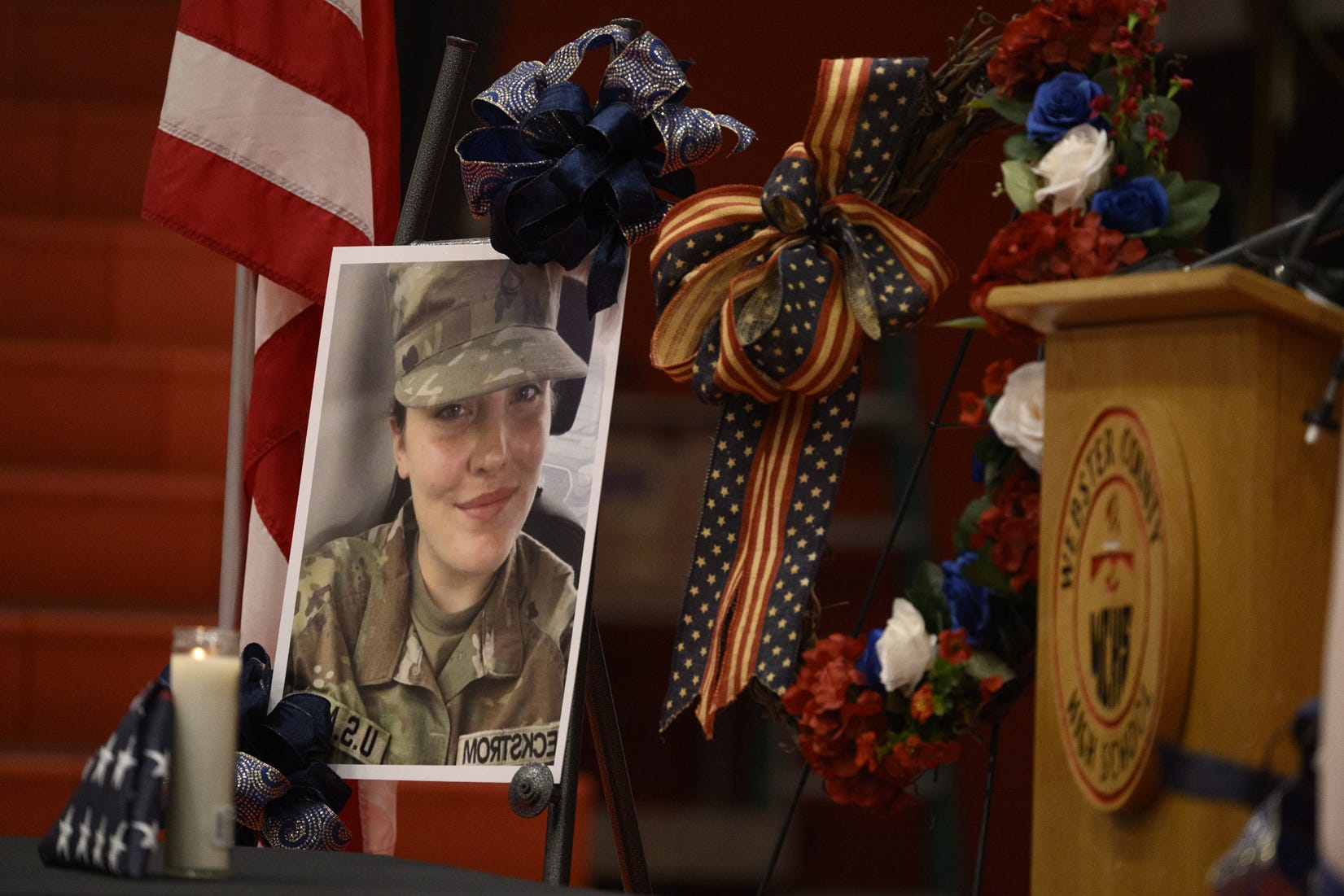
SPECIALIST SARAH BECKSTROM was 20 years old—a young woman from West Virginia who joined the National Guard at 18 and reportedly became the kind of soldier every leader hopes to find in their formation. Her family and teammates state she was diligent and disciplined, likely grounded in the lessons of her small-town upbringing, and seemingly rising through the junior ranks of the Guard. I would suspect she was preparing for a promotion board to sergeant while also doing what so many young soldiers do whenever they find themselves in new environments: exploring the nation’s capital during rare off-hours, taking in the history she had sworn to defend.
Nothing in her mission suggested she would die on a street corner while performing what commanders often call a “presence patrol.” These patrols—designed to deter local crime by providing a visible military presence to supplement police actions—were never intended to resemble combat. They are routine, steadying missions, carried out in a city where monuments shine and tourists jog with earbuds in place. Yet it was during one of those seemingly benign duties, on the day before Thanksgiving, that Spc. Beckstrom and another soldier were attacked by a gun-wielding assailant. Both soldiers were likely caught completely off-guard. Both Army National Guard Specialist Beckstrom and her teammate, Air National Guard Staff Sergeant Andrew Wolfe were grievously wounded. She died the next day. He remains hospitalized in critical condition.
For most Americans, this tragedy will be a headline that soon fades. But for those in her unit, it will divide their service, and likely their lives, into “before” and “after.” Soldiers know that feeling. I certainly do.
During the surge in Iraq in 2007–08, while commanding Task Force Iron in northern Iraq, we experienced too many days like this—days when the world tilted without warning. One was the day Captain “Rowdy” Inman of the 3rd Armored Cavalry Regiment was murdered. The shooter was an Iraqi insurgent who had infiltrated the local security forces as a jundi, a trainee soldier. Cpt. Inman had been overseeing rifle marksmanship for these new Iraqi recruits on a training range near Mosul when the gunman turned his weapon on him. It was a despicable act of betrayal committed in a place meant for mentorship, growth, and building partnership between two nations.
While I will forget some of the details of that tragic day, what I will always remember is what happened after the incident. Senior Iraqi officers—the generals, colonels, and captains who commanded their formations and had been fighting alongside us to build a more stable and secure Iraq—expressed their condolences to their American partners. They apologized, deeply and sincerely, for the actions of the killer. They were ashamed that one wearing their uniform had taken the life of an American officer, a man working to help train their army. Their grief was genuine. Their anger at the betrayal was palpable. Their overwhelming presence at the unit’s memorial service in a small unit chapel on our base in Iraq did not lessen the pain, but it mattered; it showed that even in the fog of war, moral lines still existed.
The second memory, one I also still carry, was a “blue-on-blue” incident in which a U.S. soldier was unintentionally killed by a fellow American during an intense firefight. We did not know the truth until there were suspicions of the location of the soldier compared to the rest of his unit, and investigators examined the angles, distances, and ballistics and determined that the fatal round came from a rifle of a junior officer. I will not name the soldiers involved; their families have carried enough burden. But after I returned home, I met with and spoke to the father of the young man who died. That father’s grief remained raw and unyielding, and beneath it lived something harder—an insistence that the lieutenant who fired the fatal round should be court-martialed. The father believed that justice demanded punishment. What he could not fully grasp—and what I struggled to explain—was that in the chaos of combat, in the split-second decisions made under fire, tragedy can erupt without malice or negligence. The son he loved had died in the kind of moment soldiers dread but come to understand, and the young man who fired the shot has lived with that weight every day since. It was a wound that cut two families, not one.
THOSE EXPERIENCES came rushing back when I learned one specific detail of Spc. Beckstrom’s final duty. She reportedly volunteered to take the patrol on the day before Thanksgiving so another soldier could spend time with family. That kind of gesture is instantly recognizable to anyone who has led troops. It is not dramatic, and it is not performed for praise. It is the quiet generosity that lives at the heart of military service: a willingness to take the hard shift so someone else can catch a break. Soldiers admire those who do this instinctively. Leaders treasure them.
There is a consequence to that we must consider. The soldier she relieved—the one who should have been on that patrol—is already carrying a heavy burden that will follow him or her for years: the haunting thought that It should have been me. Survivor’s guilt is not logical, but it is universal. It is one of the most enduring emotions soldiers feel after a loss like this, even when the circumstances were beyond anyone’s control.
The rest of the unit will now move through the familiar, wrenching sequence of emotional shock: anger at the attacker; confusion about the mission; grief over the loss of a teammate; guilt from those leaders who believe they could have done something differently to prevent this; and the shattering of innocence for young soldiers who until now believed danger existed only in far-off combat zones, not on the streets of D.C.
These soldiers will also feel something else: solidarity. Shortly after Spc. Beckstrom died, soldiers reportedly formed an honor guard as the ambulance carried her from the hospital. I can see those images clearly, too: soldiers standing at attention, emotions welling, silent rows of those wearing the uniform forming a corridor of grief and respect, saluting as she passed. I saw that scene too many times in Iraq during the dignified transfers of our fallen. No matter how many times anyone stands beside a helicopter or an aircraft that carries the fallen soldier home, the ritual never dulls. It always breaks something open inside.
There will be at least two memorial services. One was held on Saturday in Webster Springs, West Virginia, where the community that shaped Spc. Beckstrom—the family and friends who loved her, the high school classmates who knew her before she put on the uniform, and even the governor, her National Guard commander-in-chief—attended. They all gathered to grieve, but also to celebrate her selfless service.
The second will likely be in Washington, D.C. Soldiers will gather in rows. Her commanders and sergeants will speak about who she was as a soldier and as a person. Her friends will share stories that reveal her humor, her character, her promise. A chaplain will offer words of comfort—old words, familiar words, words that have carried soldiers through loss for generations. There may be a helmet, boots, rifle, and dog tags arranged at the front of the room. The final roll call from her first sergeant will likely echo in the room, with her name repeated three times, the silence growing heavier after each unanswered call. Then a rifle salute and finally taps. Afterward, soldiers will linger, comforting each other, before picking up their gear and going back with heavy hearts to patrol the streets where she served.
Though never stated through all this, there is the hardest contemplated truth of all. Every soldier who raises a right hand and takes the oath will remember, at some level, that they offer their life in service to the Constitution. Those who go to combat know that danger intimately. But soldiers serving in Washington on presence patrols do not wake each morning expecting that their service might demand the ultimate price. Spc. Beckstrom’s death forces them—and us—to confront a truth the public rarely sees: that military service, whether in Baghdad or on a quiet street in the District of Columbia, is never without risk, and that the character of soldiers like Spc. Beckstrom is measured not only in combat, but in the quiet, selfless choices made every single day.
THE NATION LOST A SOLDIER the day we gave thanks for our blessings. And her family lost a daughter. And her unit lost a teammate and a friend. And one young soldier, who Sarah was standing in for that day, will carry a burden that love and leadership will have to help lift over time.
But we owe Specialist Beckstrom more than sorrow. We owe her remembrance—clear-eyed, grateful, and honest. At a very young age, she chose to serve others before she served herself. She then willingly took an additional duty so someone else could enjoy a few more hours away. And she upheld the oath she took as an 18-year-old from West Virginia until the very last moment of her life.
In a year filled with division, cynicism, and reckless rhetoric, her story reminds us that quiet virtue still exists—that in the ranks of the citizen-soldiers whom civilian leaders ask to walk our streets and guard our institutions, there are young Americans who embody the best of us. Specialist Sarah Beckstrom was one of them. Her death won’t be forgotten. Her example will not be lost.