

RFK Jr.’s Lifelong Lapse of Judgment
A new book shines light, if any were needed, on the man’s manifest unfitness.

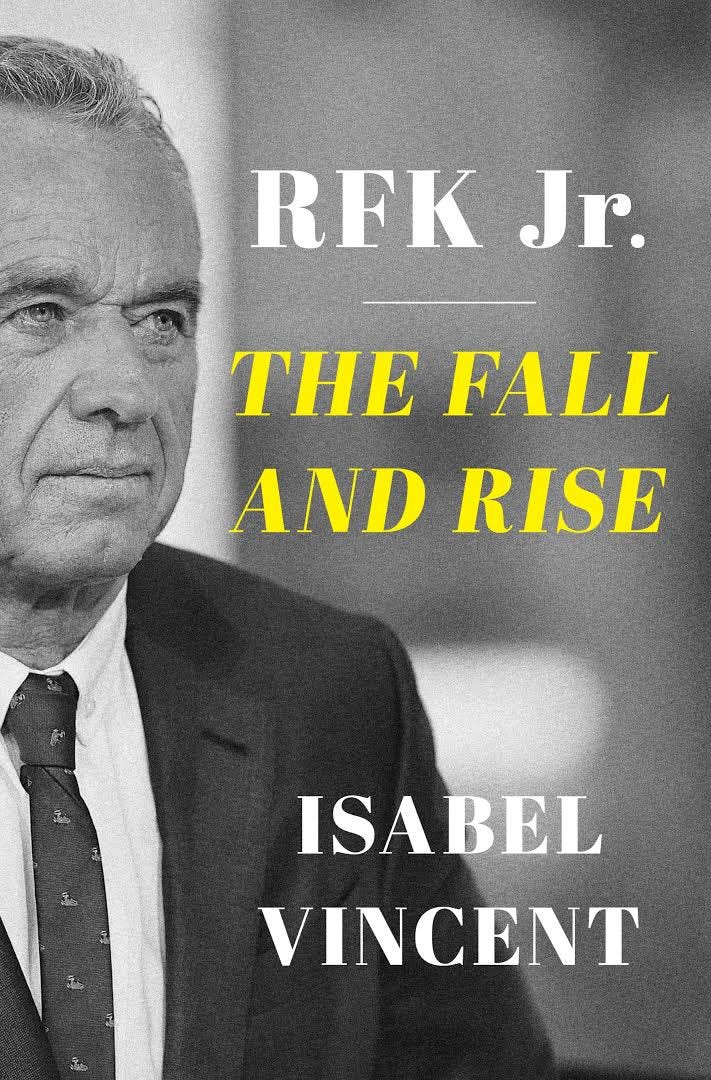
RFK Jr.
The Fall and Rise
by Isabel Vincent
William Morrow, 304 pp, $30
SOME YEARS BACK, WHILE TRAVELING with his family, Robert F. Kennedy Jr. came across a dead whale that had washed up on Squaw Island in Hyannis Port, Massachusetts. He used a chainsaw to cut off its head, which he then strapped to the family minivan, family inside, for a five-hour ride. “Every time we accelerated on the highway, whale juice would pour into the windows of the car, and it was the rankest thing on the planet,” his daughter, Kathleen “Kick” Kennedy, recalled in a 2012 interview. “We all had plastic bags over our heads with mouth holes cut out, and people on the highway were giving us the finger, but that was just normal day-to-day stuff for us.”
This bit of Kennedy family lore is not among the stories told in RFK Jr.: The Fall and Rise, Isabel Vincent’s new book about the tortured scion who now serves as President Donald Trump’s secretary of health and human services. It does mention his attraction to roadkill, memorably illustrated by the episode involving the dead baby bear he scooped up in his van in 2014 and deposited in Central Park. But somehow, the whale tale did not make the cut, so to speak.
No matter. Vincent, an investigative reporter for the New York Post, seems to have gotten to nearly all the rest, from Kennedy’s boyhood pranks of spiking family members’ drinks with laxatives to his bizarre but not entirely implausible claim to have a dead worm in his brain. And that, let’s face it, is why people will want to read this book—to gain insights into Kennedy’s poor judgment and raging sense of entitlement as he fulfills Trump’s mandate to “go wild on health,” “on the food,” and “on the medicines.”
RFK Jr. is serviceable if not always enlightening; some nuts, it turns out, are truly hard to crack. There are fresh interviews with named and unnamed sources, but the most important contribution that Vincent brings to the table is Kennedy’s personal diaries from 1999, 2000, and 2001, which she obtained in 2013 from “a trusted source who knew the Kennedy family well.” At the time, Vincent had been reporting on the May 2012 suicide of Kennedy’s second wife, Mary Richardson Kennedy, during the couple’s nasty divorce. Mary hanged herself in the couple’s barn, where she was found by Kennedy and one of Mary’s friends. Mary’s family blamed Kennedy for her death. (“You have killed my sister,” Nan Richardson charged.) Several days after Mary’s family buried her at a cemetery in Centerville, Massachusetts, Kennedy had her dug up and moved to a Kennedy family plot in the same cemetery, leaving Mary’s family enraged.
Kennedy’s diary entries are a testament to, as Vincent puts it, “a lifetime spent grappling with the weight of his family’s legacy and his quest to carve out a distinct identity as an environmental crusader, public health critic, and political maverick.” He did so, it seems, by being unfailingly weird, relentlessly self-centered, and determinedly dishonest.
“After daddy died I struggled to be a grown-up,” confided Kennedy, who was fourteen when his famous father, Robert F. Kennedy, was assassinated, in one journal entry: “I felt he was watching me from heaven. Every time I was afflicted with sexual thoughts, I felt a failure. I began to lie—to make up a character who was the hero and leader I wished I was.”
It’s an act of make-believe that seemingly continues to this day.
KENNEDY GREW UP IN MCLEAN, VIRGINIA on the family’s estate, Hickory Hill, which “doubled as an extension of the White House.” As he once wrote in a memoir, it felt as though “history was happening all around us”: Important government decisions were made “by men in swimming trunks on the pool-house patio.” His father spent almost two weeks straight at the White House in October 1962 tending to the Cuban Missile Crisis, with his family fully aware that if things went badly they could be “vaporized,” as Kennedy put it.
When Kennedy was 11, he became fascinated with falconry. He trained with a local falconer and eventually acquired a hawk of his own. He named her Morgan, after King Arthur’s half-sister. He also had a pet sea lion, named Sandy, who was fed a diet of fresh mackerel, which she devoured except for the eyes, leaving them “scattered like marbles across the pool, patio, and lawn.” The animal was a gift from Jimmy Skakel, one of Kennedy’s mother’s older brothers. A sea lion.
And when Kennedy traveled to Africa in 1964 with his uncle, Peace Corps director Sargent Shriver, and others, he returned with a sixteen-pound leopard tortoise that went through customs undetected in a diplomatic pouch. The tortoise lived at the family’s Hickory Hill residence in McLean for the next two decades.
Kennedy’s use of illegal drugs got him booted from two of three prep boarding schools he attended during his high school years. His mother, Ethel, ordered him more than once to leave the house. As a student at Harvard, he sold cocaine out of his dorm room. And when Lem Billings, a family friend who had been tight with John F. Kennedy, came into his life to serve as a “surrogate father,” Bobby Jr. responded by introducing him to heroin; Billings was apparently still an addict when he died of a heart attack in 1981 at age 65. Meanwhile, the writer David Horowitz blamed Kennedy for his younger brother David Kennedy’s drug addiction: “Bobby held him down when David was thirteen and shot him with heroin.” David Kennedy died of an overdose in 1984, at age 28.
Kennedy purportedly attained sobriety after he was arrested for heroin possession in 1983, when he was 29 (although Vincent suggests he has continued to dabble in psychedelics). And for a while he seemed to find his footing as an environmental lawyer, gaining lucrative settlements, raking in huge speaking fees, and hobnobbing with celebs, including his eventual third wife, the actress Cheryl Hines. But even here, Vincent notes, Kennedy managed to behave badly, by “greatly exaggerat[ing] his role” in brokering environmental agreements.
Kennedy, in his diaries, tracked and scored his infidelities. In 2001, he recorded trysts with thirty-seven women, including sixteen he gave a “10” score, his code for intercourse. When Kennedy was married to Mary, he disparaged her repeatedly and cheated on her constantly. But now that Mary is gone, one of Vincent’s sources told her, Kennedy “spends a lot of time in private conversations comparing Hines unfavorably to Mary.”
In her preface, Vincent remarks that other Kennedy family members “were no saints.” John F. and Bobby Sr. “took the country and the world to the brink of nuclear conflagration” in the Cuban Missile Crisis. They wiretapped Martin Luther King’s phone and motel rooms “hoping to discredit him by exposing his various romantic trysts.” Ted Kennedy “left a young woman to drown at Chappaquiddick in 1969.” And all three brothers followed their father Joe Kennedy’s lead in their prolific philandering.
But the portrait of RFK Jr. that emerges from her account is of a man uniquely bereft of redeeming qualities. Wherever he happens to be, he is out of place. Whatever he does is not enough. His lusts are omnipresent and insatiable. As he writes in a diary entry: “No matter how much I have, I want more!” The word “more,” Vincent points out, is “thickly underlined.”
KENNEDY EVENTUALLY GOT SQUEEZED OUT of his role as an environmental lawyer and pulled into what Vincent calls “an all-encompassing obsession to challenge common vaccines and the entire medical establishment.” For eight years, beginning in 2015, Kennedy served as the chairman and chief legal counsel for the anti-vaxxer group Children’s Health Defense, spreading lies and misinformation.
In December 2017, Kennedy met in prison with his father’s convicted assassin, Sirhan Sirhan, and thereafter proclaimed his innocence and campaigned for his release. At a parole hearing in 2021, he called Sirhan, then 77, “a gentle, humble, kind-hearted, frail and harmless old man.” Kennedy’s mother, Ethel, had a different take: “He should not have the opportunity to terrorize again.” Sirhan remains in prison.
In October 2023, when Kennedy switched from running for president as a Democrat to running as an independent, several of his siblings issued a statement saying “We denounce his candidacy and believe it to be perilous for our country.” Similar alarms were sounded when Kennedy dropped out of the race and threw his support behind Trump, in exchange for which he was awarded the job of his dreams, heading HHS.
In this role, Kennedy, now 72, is doing serious and likely long-term damage to the nation’s health, as the measles’ comeback tour attests. He has fired tens of thousands of employees across his department’s agencies, including the National Institutes of Health, the Food and Drug Administration, and the Centers for Disease Control and Prevention. He has slashed spending on research, including $500 million in contracts for the development of future mRNA vaccines such as those that helped the world emerge from the COVID-19 pandemic. And he summarily “retired” all seventeen members of a key vaccine advisory board, something he explicitly promised Senator Bill Cassidy, Republican of Louisiana and a physician, that he would not do.
But there are clear signs that Kennedy’s “power is waning,” as a headline in the Week expressed. His NIH director, Jay Bhattacharya, has publicly pushed back against his vaccine skepticism, calling it “absolutely vital” that “every kid” in the county gets vaccinated against the measles. In response to a lawsuit brought by the American Academy of Pediatrics and other groups, a federal judge just overturned Kennedy’s appointment of anti-vaxxers to the vaccine oversight board, at least temporarily blocking their changes to the nation’s childhood vaccine schedule. And polls are showing disfavor with Kennedy’s performance, even among Republicans, who can put up with almost anything. Trump, reportedly, has told Kennedy to stop talking about vaccines.
In response to these indicators of his growing unpopularity, Kennedy has just launched a podcast, cleverly titled “The Secretary Kennedy Podcast.” Its goal, he says, is to usher in “a new era of radical transparency in government” and expose “the forces that obstruct the paths to public health.” It’s emblematic of his judgment that Kennedy thinks the thing that might save him is greater public exposure to his world of nutty ideas.
More likely his fortunes will continue to fall, and the negative consequences of replacing science and medicine with quackery and fraud will become even more apparent. It may well be that future editions of Vincent’s useful book will bear the subtitle, “The Fall and Rise and Fall Again.”
 | A guest post by
|