

Ro Khanna Tosses the First Grenade Into the 2028 Democratic Primary
The California congressman calls Dem hopefuls’ Laken Riley vote “disqualifying.”

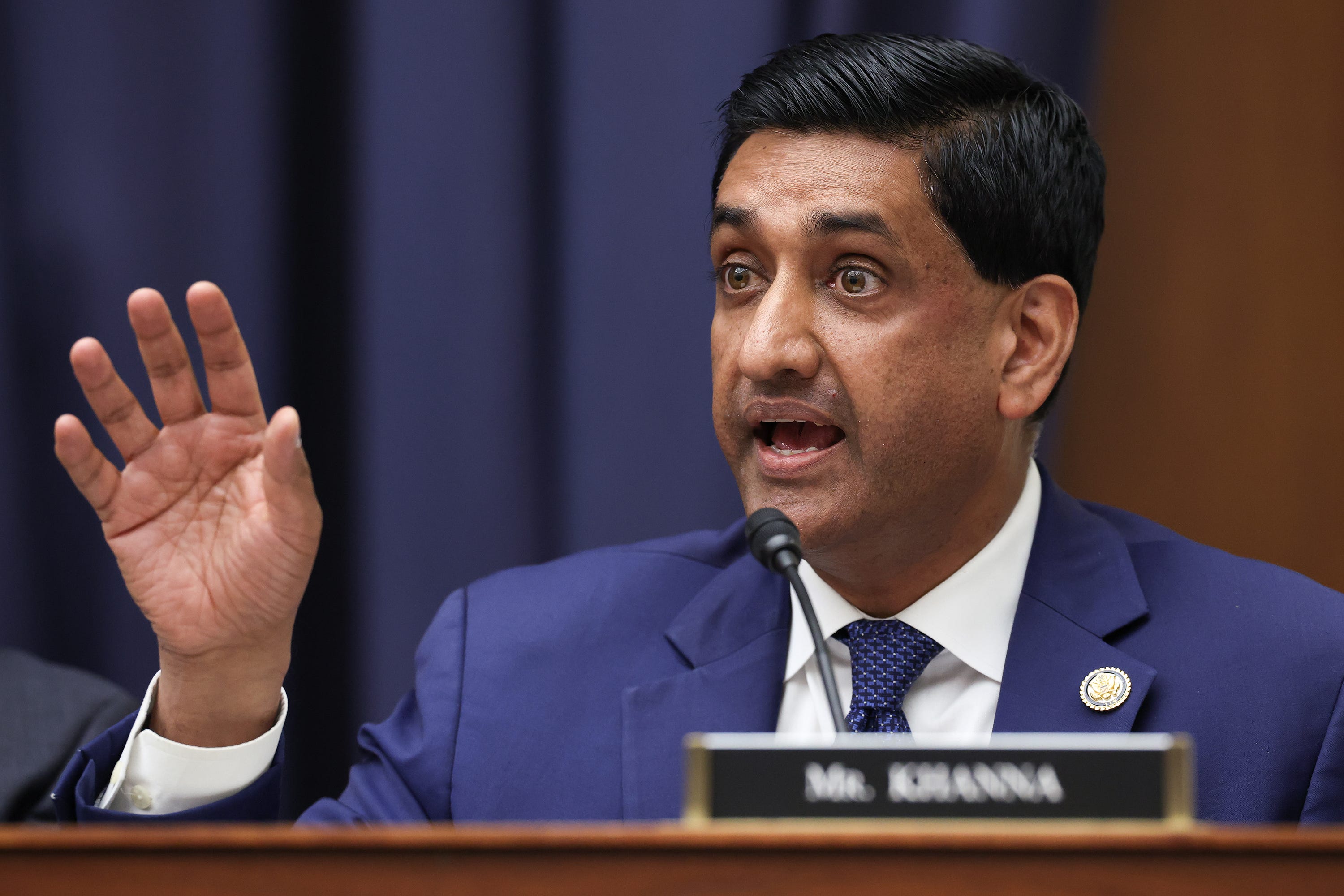
THE DIVIDING LINES in the 2028 Democratic presidential primary are coming into focus. And they’re running right through the issue of immigration.
Ro Khanna, the ubiquitous California congressman with one eye ever on the White House, put his fellow Democrats on blast this week, saying anyone who supported the Laken Riley Act—one of the first major laws passed during the second Trump administration—should be disqualified from becoming the party’s next standard-bearer.
“Nine swing-state Democrats gave permission for mass deportation,” Khanna told me. “No one who voted for the Laken Riley Act should have any role in the future leadership of the Democratic party in this country. . . . It’s disqualifying, just like the Iraq War vote.”
His remarks offer an early preview of the fraught and complex immigration debates yet to come among Democrats who aspire to the presidency. While the party is fairly united in opposition to Trump’s use of ICE and his pursuit of mass deportations, there remain sharp disagreements over how much they should lean into aggressive interior enforcement policies and tough talk on border security. The Laken Riley Act, in particular, has potential to become a major point of friction.
The bill, which was signed into law in January 2025, grants law enforcement a wide berth to detain immigrants arrested for low-level crimes like shoplifting, whether or not they are ultimately convicted of the offense. When it was considered by lawmakers, Democrats were still reeling from the 2024 elections, during which the party had been tagged as insufficiently responsive to voters’ worries about illegal immigration. Twelve Democratic senators voted for it. Nine are from swing states: Sens. John Fetterman, Ruben Gallego, Mark Kelly, Catherine Cortez Masto, Jacky Rosen, Jon Ossoff, Raphael Warnock, Gary Peters, and Elissa Slotkin.
Of those, Gallego, Kelly, Ossoff, and Warnock are often discussed as—or are seemingly positioning themselves to be—potential candidates for president in 2028. Khanna, who is heading to South Carolina (a critical early primary state) this weekend, criticized those senators for “political opportunism” in voting for the bill.
“If you didn’t have the guts to stand up to Donald Trump then, why will you have guts as leader of this party?” he said.
Khanna, whose mix of progressive views and technocratic capitalism idiosyncratically bridge the left and centrist wings of his party, and who vaulted to national attention over the last year because of his work exposing the Epstein documents, made these comments during a wide-ranging interview on immigration. The topic is already testing the party in subtle and not-so-subtle ways. As I’ve written before, simply saying “Trump is bad” and “mass deportation is terrible” can only take Democrats so far. Voters disgusted with Trump still need to be persuaded by Democrats that they will not just do a better job on immigration, but bring forward a strategy that includes everything from revamping our asylum system to modernizing our borders to, yes, establishing pathways to legalization and citizenship.
The officials who are going to have the most influence in filling in those blanks are the ones most likely to run for president. And Khanna himself has made no secret of his interest in that office. The congressman has said he believes he has the right economic vision for the country. In our interview, he cast Trump as a vestige of the past, someone whose ideas about how to build wealth are locked in a 1980s frame (including the focus on acquiring land). Khanna argued that what the country really needed was someone who knows how to position the economy for the twenty-first century. And as a congressman representing Silicon Valley, he might just fit the bill.
“I want the economic future in my district for every American,” he told me. “That success—I get it, as the son of immigrants. We have that roadmap, and I want the Democratic party to be that party, and I have a clear sense of where I want to lead.”
Khanna said immigration reform and economic growth go hand-in-hand, noting that immigrants helped found a significant proportion—he puts the figure at 40 percent—of venture capital–backed tech companies that went public, including Yahoo, Intel, eBay, and Google. Khanna, to be clear, has not announced a candidacy for the White House. But apparently envisioning what he would do as president, he told me he would prioritize legalization for immigrants who have weathered a brutal assault from the Trump administration. He even offered that he would do so during the first six months of his hypothetical administration.
“You have to have a real path to legalization and citizenship,” Khanna said, “but we won’t stand for another Democratic president promising the moon and not getting legalization done.” He argued the first thing immigrants are interested in securing is not the right to vote, but the ability to live and work here without fear of getting dragged out of their car by masked police and thrown in detention.
“In the first six months, we would get the immigrant community out of the shadows,” Khanna said.
While some Democrats have recoiled at the immigration rhetoric the party adopted during the Joe Biden era, Khanna seemed comfortable embracing some of it. He called to “abolish ICE—first of all—tear it down,” saying the agency had vastly outgrown the purpose of its post-9/11 creation, which was meant to coordinate immigration issues with national intelligence around terrorism threats. Instead, Khanna called for the dynamic that existed under the previous Immigration and Naturalization Service (INS), where it served as the lead enforcement agency, operating under the Department of Justice, as it had for six decades before its abolition.
I asked Khanna if he believed Trump has done anything right on immigration. He said the president was right to say we need a secure border. But he didn’t frame it as a matter of national security so much as economic exploitation. Without border protections, Khanna said, big corporations are able to exploit undocumented immigrants for lower wages, which in turn undermines unionization efforts.
Some of the country’s biggest corporations have roots in Khanna’s district. I asked him if he had any exhortations to offer tech leaders like Mark Zuckerberg, who quickly abandoned their past pro-immigrant positions once Trump returned to power, or others like Peter Thiel, whose company Palantir helped build tools to make immigration enforcement easier and more precise.
“Have some courage,” Khanna said. It was a statement directed at several CEOs he knows, like Google’s Sundar Pichai and Microsoft’s Satya Nadella, who themselves had to navigate the immigration system before their stratospheric success. “You had no trouble telling Biden what he was doing wrong, but you’re seated with Trump and can’t say ‘Hey, Mr. President I was on an H-1B visa.’ Tim Cook is giving [Trump] gifts but has no guts to say [that he doesn’t] agree on his assault on immigrants in the country, which has quietly impacted [his] company. None of you were quiet with Biden on crypto and regulations, but [you] have sat, muted, with a total lack of courage with Donald Trump.”
Palantir and the True Cost of Mass Deportation
Standing in front of a lectern that said “ICE KILLS, PALANTIR PROFITS” at a press event in February, Khanna became the first Bay Area Democrat to agree to return contributions from the Thiel-founded company. He also pledged that he would accept no future contributions from its employees, either. Palantir secured a $30 million ICE contract to build an “Immigration Lifecycle Operating System,” or “ImmigrationOS,” to enable the agency to track self-deportations almost as they happen. The company also enjoys a $1 billion purchasing agreement to provide future services with the Department of Homeland Security.
But Khanna’s not entirely clean here, either. He filed a stock transaction disclosure in January that showed his wife bought up to $125,000 in Palantir stock last year. According to NOTUS, her transactions include a $50,000 stock purchase on April 22, days after the news broke about ICE’s contract with Palantir for “ImmigrationOS.”
Khanna told me his wife has a trust that his in-laws set up prior to marriage that he has no say over. “Neither of us trade, .001% of it has some transactions with Palantir. It’s like looking at a mutual fund and picking one stock, but I have zero say in it.”
Khanna wasn’t combative when I pressed him on the stock transactions, but he did slow down the interview to more clearly explain his position. He then requested that it be properly explained to readers, cognizant that the situation could be used to come up with “attack lines,” as he said. The moment opened a small window into the other ways immigration policy—and how the Trump administration has conducted it—will shape Democratic politics in the years ahead.
The more immediate matter, though, is the mass deportation machine that keeps humming along, even as Republicans, wary of its unpopularity, insist it no longer exists.
It’s still visible in the actions of the White House, as when earlier this month Trump issued an executive order leaning on banks to look into the immigration status of customers, or as Markwayne Mullin, the newly minted DHS chief, floats the idea of canceling international flights into sanctuary cities. And it’s evident in local communities, too, as in the case of Wendy Hernandez Reyes—an Alabama woman who was deported from Louisiana, where she was detained, to Honduras without her toddler, who was then killed by a violent uncle. ICE actually blamed her for her tiny child’s murder.
Khanna recently spoke up at a hearing about the Reyes case. And he mentioned it to me, as well, arguing that Trump’s cruel mass deportation policies undermined a central American project, Frederick Douglass’s Reconstruction-era vision of a “composite nation” built on absolute equality.
“It undermines the principle of America as an immigrant nation, as a nation where anyone can come from any background, education level, and help contribute to our culture, help build a life for themselves,” Khanna said. “People are being deported without any respect for their dignity, for their rights, deported even though they’re paying taxes, and are peaceful neighbors.”
Not to defend voting for the Laken Riley Act, but Khanna's "if you did this, you're out" position is why it is so hard to be a moderate in this country. There's always some vote, some statement, some relationship, some horse-trading that bothers the extremists seeking to depower anyone they believe is not at their purity of virtue. "If you did this, you're out" is a terrible way - in general* - to run a political party.
Ed Koch used to say, "If you agree with me on nine out of twelve things, vote for me. If you agree with me on twelve out of twelve things, get your head examined." However, the purity extremists take the opposite position - "if I agree with you on eleven out of twelve things, but not twelve out of twelve, I won't vote for you."
*Murder, rape, domestic violence, fraud, major crime, child abuse, and similar things are definite exclusions.
Interesting article, thank you. I don't think he's wrong about the Laken Riley Act votes. I do wonder if dems have learned how to talk about such issues. I have my doubts.