Robert Duvall, R.I.P.
From ‘True Grit’ to ‘The Godfather’ to ‘Apocalypse Now,’ a mainstay of American cinema.

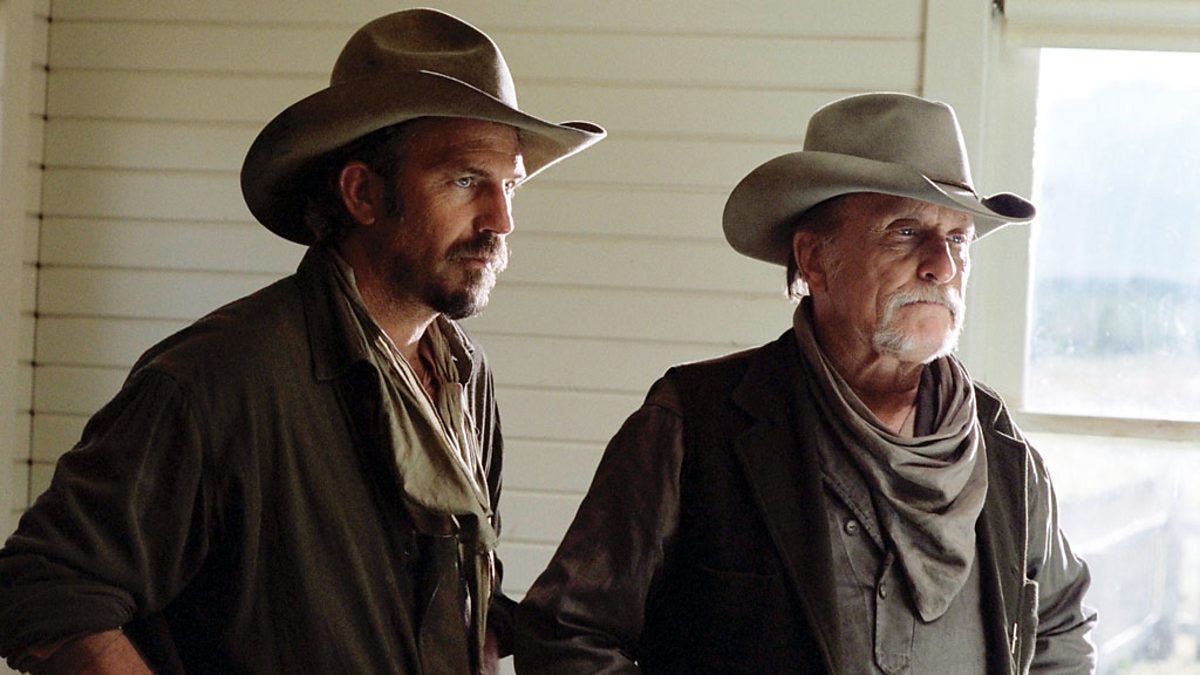
I WASN’T EXPECTING A TON when I wandered into the last showing of Open Range in that Charlottesville movie theater toward the end of October. I was a college kid, dabbling in indie and foreign stuff. A western? Starring Kevin Costner and Robert Duvall? I mean . . . I guess. Maybe it’ll be worth checking out.
It was, of course, worth checking out; Open Range is one of the last great studio westerns, a genre that’s been dying since before Clint Eastwood’s requiem for the form, Unforgiven. Wonderful shootouts in Open Range, particularly with a thunderous theatrical sound system; the gunplay is encompassing. Costner is perfect as the taciturn gunman turned town protector, a man set on vengeance.
But it is Duvall who really makes the whole thing feel lived in, real. He brings both the wisdom and the randiness of old age, alternating between dishing out life lessons to the burgeoning cheat Button1 (“A man’s trust is a valuable thing, Button. You don’t want to lose it for a handful of cards.”) and shaking his hips in imitation of a man out on the town and looking for some action.
His weathered face was perfect for the western and had been for some years, all the way back to 1969’s True Grit as the vicious Ned Pepper and then twenty years later as the chatty Gus McCrae in Lonesome Dove.
It’s impossible to single out a lone defining performance by Duvall, who died Monday at 95 in his Middleburg, Virginia, home.2 He was in so many of the greatest films of all time that one loses track trying to count them. Where do you start? With To Kill a Mockingbird, I suppose, though his turn as Boo Radley doesn’t really give you a sense of what was to come. He’s one of those actors who had to age ever so slightly, who had to grow into that weathered face and earn that wry smile that suggested so much hidden knowledge.
That smile serves him well in the first two Godfather films, as consigliere to Don Corleone. The first time you see the movie you don’t know what it means when he grins at the mogul’s seamless transition of ethnic slurs, from guinea goombah to his “kraut-mick friend,” but you know it can’t be good. Duvall was lucky enough to have fallen in with that whole crew a decade into his career—Coppola, Lucas, and the other filmmakers who would change the world as we know it—so you have to mention The Conversation and THX 1138 and, of course, Apocalypse Now. Has there ever been a more quotable character with less screen time than Lt. Col. Kilgore? “I love the smell of napalm in the morning”; “Charlie don’t surf”; “Bomb them into the Stone Age, son.” He’s in the movie for maybe ten minutes and they’re all unforgettable, which is probably why he got his second Best Supporting Actor nomination for the role.3
And then there’s Network, a movie I spent a lot of time with last year in the midst of all the drama surrounding CBS News and governmental pressures exerted on the broadcast networks and film studios alike. Duvall’s Frank Hackett is a vision of the future, the amoral corporate hatchet man whose only worry is getting the spreadsheet numbers up a few percentage points to make the shareholders happy at the annual meeting. If that means degrading the news division, fine. If it means killing the news division’s lead anchor, well, who is to say what’s right and wrong in this crazy world of ours? Of all the actors in that film—and there are a number of all-time greats, including Faye Dunaway and William Holden—I’ve always felt as though Duvall adapted best to the overlapping, rhythmic dialogue deployed by screenwriter Paddy Chayefsky in this film.
It was always just really reassuring to see Duvall show up in something; I’ve maintained a soft spot for the 2000 remake of Gone in 60 Seconds in large part because of a single scene where Delroy Lindo and Duvall go back and forth about the power of a good muscle car. Just two actors in a movie that most recognize as not particularly good doing the work and doing it at a high, entertaining level. I’ve long admired actors who settle into a sort of super-cameo mode, and while that’s not quite where Duvall wound up, he was always wonderful in short bursts in films like Thank You For Smoking or Widows or The Road.
Robert Duvall has been a part of the American cinematic landscape—an imposing mesa, cragged and hard to look away from—since before I was born and starred in more great movies than any one man has a right to. May he rest in peace.
Diego Luna, of Andor fame, in an early role. That this film is not readily available on Blu-ray or 4K in the United States is a crying shame, and one our good friends at Disney should remedy posthaste.
Not too far from that Charlottesville theater, matter of fact. Duvall settled into the Virginia countryside and spent a decent amount of his time making sure that, for instance, Walmart couldn’t set up shop in the middle of a historic battlefield. He was a small-c conservative in all the best senses of the word.
He would be nominated seven times over the years, winning once in 1984 for Tender Mercies.
I was raised on and have always loved westerns. Lonesome Dove may be my faborite novel of all time but I only read it after I'd seen the miniseries and been completely captivated by Duvall's Gus McCrae, whose chemistry with Tommy Lee Jones was off the charts. Time for a rewatch.
A moving tribute to a great actor - many thanks.