So You Lied About Your Relationship With a Sex Trafficker. Now What?
Howard Lutnick searches for a way out of his Epstein pickle.

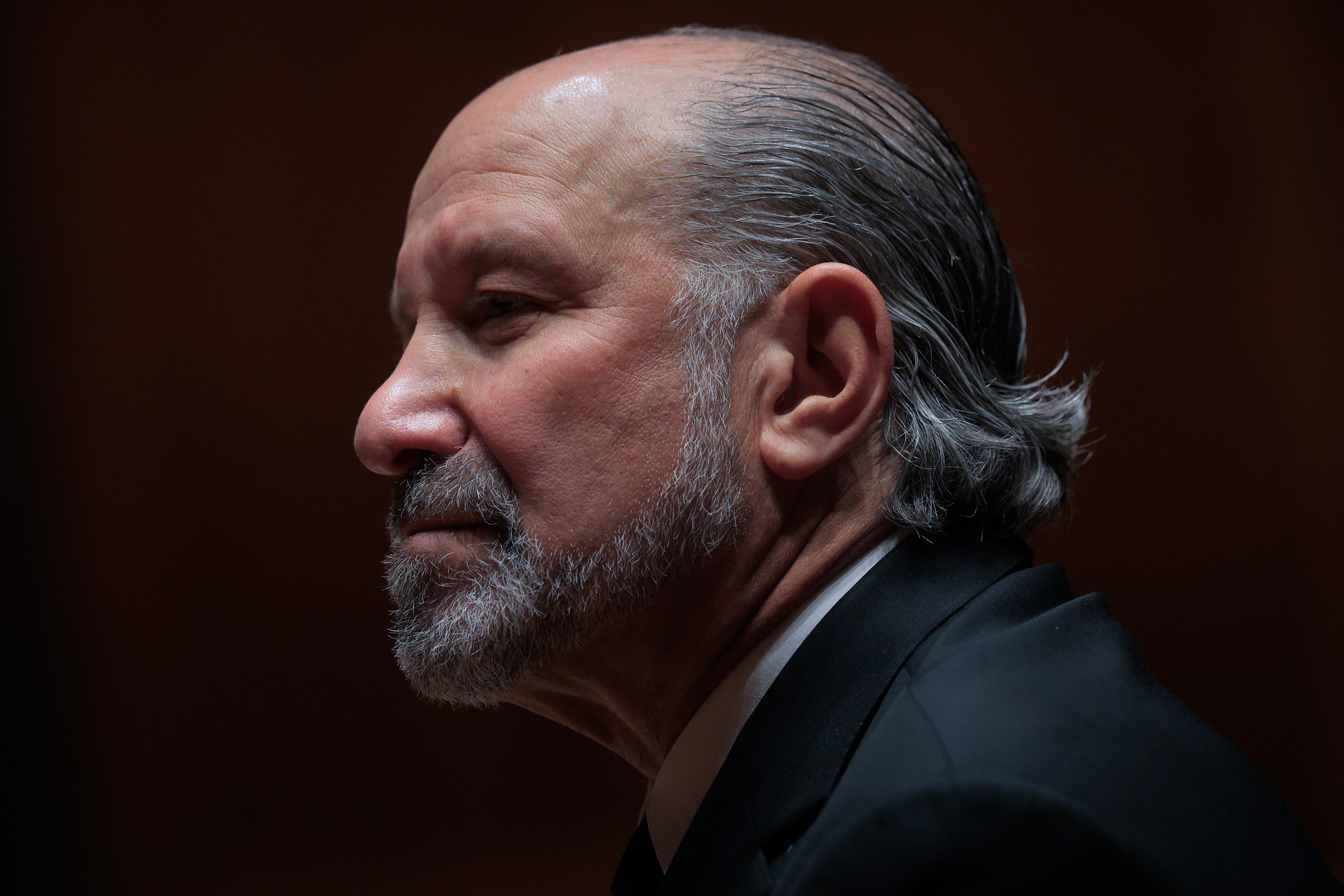
Howard hunt
Commerce Secretary Howard Lutnick clearly wasn’t forthright about the extent of his relationship with the late Jeffrey Epstein, the child sex trafficker.
In a New York Post podcast interview in October, Lutnick claimed he visited Epstein’s home in New York City only once, prior to the latter’s 2008 conviction for soliciting a prostitute and soliciting a minor. Lutnick said that he was so put off by “that disgusting person” that he had no contact with him after that. “That’s my story,” Lutnick added, “a one-and-absolutely-done.”
That was a lie.
According to documents included in the Justice Department’s latest legally mandated release of Epstein files, the largest batch to date, Lutnick regularly communicated with “that disgusting person” for years after Epstein’s 2008 conviction. He went into business with him. He even visited Epstein’s notorious island where many crimes allegedly took place.
Even the culture-warring Republican commentator Erick Erickson, who is cynical about whether anyone in politics or media has an authentic desire for justice when it comes to Epstein’s crimes, wrote that Lutnick “clearly lied about his relationship with Epstein, which turned out to be much deeper and lasted much longer than Lutnick said.”
The Commerce Department and the Trump White House both spent yesterday defending Lutnick by casting blame on the media instead of explaining the secretary’s dishonest statements to the New York Post. But on Tuesday, Lutnick was left to defend himself when he appeared on Capitol Hill for a hearing on funding for broadband. He took the moment to downplay his relationship with Epstein, saying:
Probably the total—and you’ve seen all of these documents, of these millions and millions of documents—there may be ten emails connecting me with [Epstein], probably about ten emails connecting me with him over a fourteen-year period. I did not have any relationship with him. I barely had anything to do with that person, OK?
Lutnick also admitted to visiting Epstein’s island for lunch while on a boat trip with his family. He said he did not interact on the island with Epstein’s longtime collaborator, the convicted sex trafficker Ghislaine Maxwell.
Prior to the hearing, there were already bipartisan calls for Lutnick to step down over his Epstein lies. Rep. Thomas Massie (R-Ky.) told CNN in an interview that Lutnick has “a lot to answer for, but really, he should make life easier on the president, frankly, and just resign.”
“Lutnick’s lies about his business dealings with a convicted child sex offender . . . raise serious concerns about his judgement and ethics,” Sen. Adam Schiff (D-Calif.) said in a statement. “Lutnick has no business being our Commerce Secretary, and he should resign immediately.”
In a different country, this might be enough to move the needle. Government officials overseas have already stepped down over Epstein revelations.
But in the second Trump administration, one doesn’t succumb to scandal, one endures it. Lutnick gave no indication on Tuesday that he was thinking of leaving his post. And Republicans in Congress beyond Massie didn’t seem particularly inclined to demand he do so.
Sen. Bernie Moreno (R-Ohio), a member of the Commerce Committee that oversaw Lutnick’s confirmation, told me he didn’t know much about the secretary’s longstanding relationship with Epstein. But what he did know is that the Obama administration deserves blame for failing to go after Epstein in the late 2000s and early 2010s.
“I mean, obviously you got to separate between people that are just mentioned, meaning that they were copied on an email or an email sent that had nothing to do with that, versus the people who actively participated in the grotesque behavior. I mean, those are two different categories, right?” Moreno said. “But ultimately, this is really old stuff that I wish that Obama and his Justice Department had really gone after.”
Leaving aside the fact that Epstein’s plea deal came together during the George W. Bush administration under future Trump 1.0 cabinet member Alex Acosta, I noted to Moreno that some of Lutnick’s correspondence with Epstein happened as recently as 2018. Obama had been out of the White House for some time by then, and Trump was in the Oval.
“Right, well, again, if Biden and Obama’s Justice Department had really gone after him in a substantial way, you know, President Trump didn’t take office until ’18,” Moreno said, wrongly (it was 2017). “So it’s a shame because a lot of this stuff gets lost with time, right? Because now time goes by, you can’t interview people, etcetera.”
“But I would be careful saying somebody’s mentioned because they were copied on an email or ‘Hey, are you going to a party?’ that has nothing to do with anything other than a White House event or ‘I saw you at this breakfast’ and that has nothing to do with the terrible behavior,” Moreno added.
Asked if Lutnick’s later correspondence with Epstein at least demonstrated a lack of character judgment, Moreno’s loquaciousness started to ebb. He averred that he had “not followed [it] that closely.”
As of now, it remains unlikely that the new revelations of the true extent of Lutnick’s relationship with Epstein will prompt the GOP-run House Oversight Committee to rope him into their Epstein investigation. They are actively pursuing testimony from a wide range of Epstein associates, including former President Bill Clinton. Rep. Ayanna Pressley (D-Mass.) told me on Monday that Democrats on Oversight will be strategizing about next steps. But they won’t be the ones making decisions about whether to subpoena Lutnick. That call will come from Big Jim.
“We’ve got a lot of very important people we’re trying to bring in to answer questions,” Rep. James Comer (R-Ky.), the chairman of the Oversight Committee, told reporters Monday. “We don’t want to do anything to jeopardize the five that we have on the books. So we’ll see what happens here and we’ll move forward.”
Icelandic influence
As President Trump, during his speech at Davos last month, discussed his wish for the United States to take over Greenland—by military means, if necessary—he repeatedly seemed to swap the name of the country with that of Iceland, its smaller neighbor to the south. In light of the potentially alarming implications of the flub, the government of Iceland did what any reasonable governing entity would do: It turned to K Street.
In a filing initiated February 1 but dated a few days later, Iceland’s ambassador to the United States, Svanhildur Hólm Valsdóttir, contracted Brownstein Hyatt Farber Schreck, a major K Street law firm and lobby shop, to “provide strategic advice on navigating engagements with the United States government.”
The mundane language on the Icelandic government’s Foreign Agents Registration Act filing should not be misconstrued as a sign that they are hiring the firm to provide run-of-the-mill service. In FARA and lobbying disclosures, the stated purpose of the contract is often much more serious than it appears on paper. (For instance, “DOJ related issues” can often mean something closer to “seeking a presidential pardon.”)
Under the contract, Iceland’s government is paying Brownstein et al. $25,000 per month for at least the next six months.
The timing of the deal is the biggest tell, however. Not only did it come just a week after Trump’s repeated apparent substitution of Iceland for Greenland in his belligerent Davos speech, but earlier in January, Trump’s nominee to serve as ambassador to Iceland, Billy Long, joked to his former House colleagues that the country would become America’s 52nd state with himself installed as its governor.
Long later apologized, and his nomination remains in limbo.
“There was nothing serious about that, I was with some people, who I hadn’t met for three years, and they were kidding about Jeff Landry being governor of Greenland and they started joking about me and if anyone took offense to it, then I apologize,” he said.
But the scary—even if unserious—behavior was clearly enough to leave a bad taste in the mouths of Iceland’s political leaders. The Trump administration’s obsession with the Arctic has Europe in a panic, and seeking expert counsel in Washington is usually the first step in navigating (or avoiding) a crisis such as a hostile takeover by a foreign power.
Whoops
The New York Times editorial board rarely admits when they’ve gotten something wrong. But the paper’s readers were treated to the once-in-a-blue-moon occurrence on Monday when the board shared some very stark realizations they had come to about the failures of widespread marijuana legalization.
According to the Times editorial:
This editorial board has long supported marijuana legalization. In 2014, we published a six-part series that compared the federal marijuana ban to alcohol prohibition and argued for repeal. Much of what we wrote then holds up — but not all of it does.
At the time, supporters of legalization predicted that it would bring few downsides. In our editorials, we described marijuana addiction and dependence as “relatively minor problems.” Many advocates went further and claimed that marijuana was a harmless drug that might even bring net health benefits. They also said that legalization might not lead to greater use.
It is now clear that many of these predictions were wrong. Legalization has led to much more use. Surveys suggest that about 18 million people in the United States have used marijuana almost daily (or about five times a week) in recent years. That was up from around six million in 2012 and less than one million in 1992. More Americans now use marijuana daily than alcohol.
This wider use has caused a rise in addiction and other problems. Each year, nearly 2.8 million people in the United States suffer from cannabinoid hyperemesis syndrome, which causes severe vomiting and stomach pain. More people have also ended up in hospitals with marijuana-linked paranoia and chronic psychotic disorders. Bystanders have also been hurt, including by people driving under the influence of pot.
The Times stops short of endorsing a return to the national prohibition the United States had for decades. But the board does argue that many serious reforms are needed to prevent or mitigate the problems that have quickly emerged as a result of unfettered access.
While reporting on Capitol Hill, I’ve noticed how many elected officials now embrace recreational marijuana policies, in no small part because of the increased business interests that sprang up in response to legalization. But it’s clearly causing a lot more problems than its original advocates envisioned.
Read the whole editorial, and let me know how you feel in the comments.
'Rep. Thomas Massie (R-Ky.) told CNN in an interview that Lutnick has “a lot to answer for, but really, he should make life easier on the president, frankly, and just resign.”' Gaaaaaaaaaaaaaahhhhhhhh! What is it about these Repubs that their logic is so screwy? This should have been "WE should make life easier on EVERYONE and frankly, IMPEACH AND REMOVE the President who had just as much to do with Epstein as any other major government figure."
The GOP sure is chill about their boys having close friendships with convicted pedophiles. Almost seems a little....weird.