Special Delivery: Ukraine Blows Up ‘Russia’s Amazon’
With its drone attacks on the e-commerce giant Wildberries, Ukraine hopes to ship the reality of war right to Russians’ doorsteps.

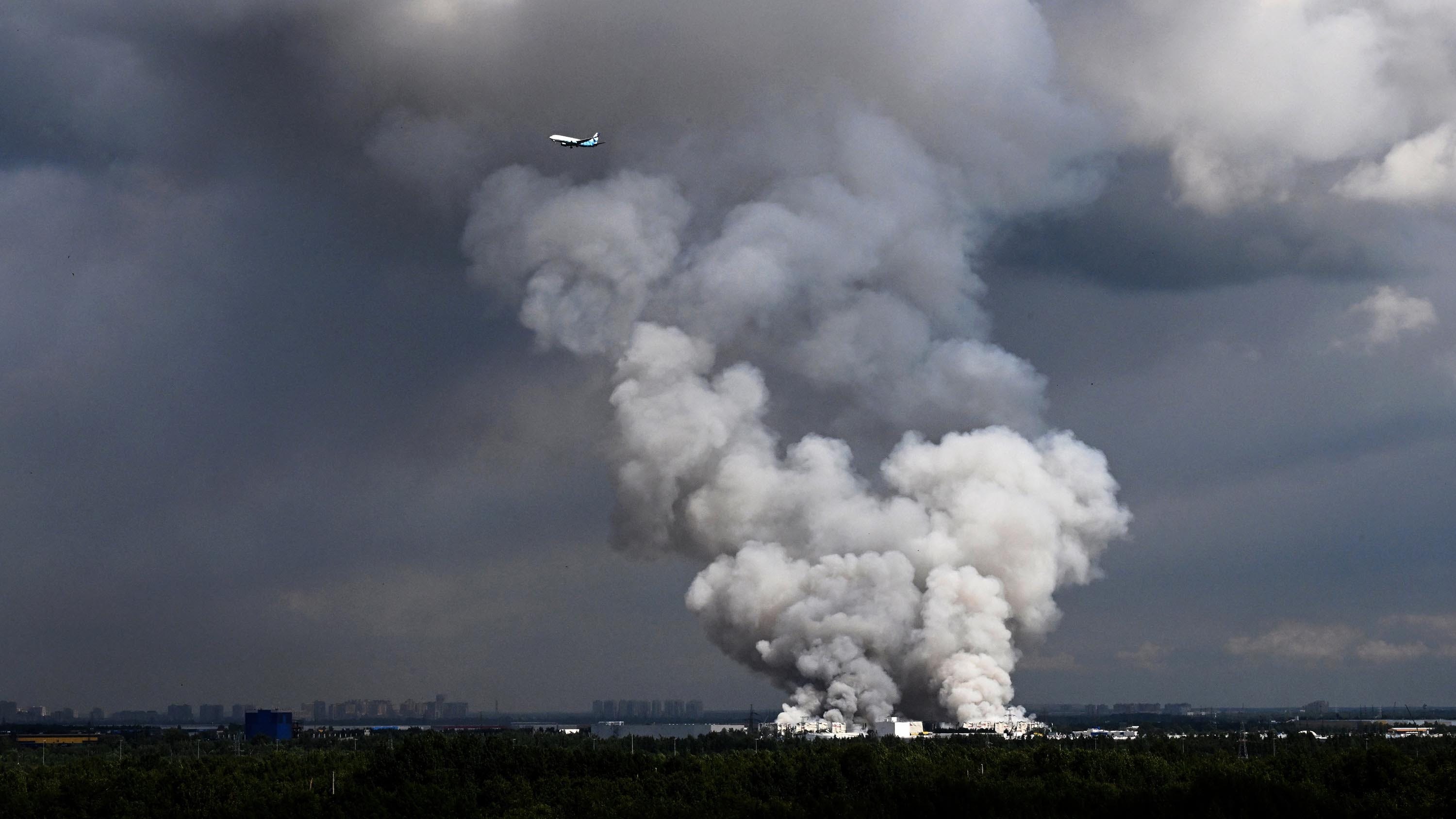
“EVERYONE JUMPED OUT OF BED in the middle of the night, no one could understand what was happening,” said an elderly woman in a short video clip that went viral in Russia over the last few days. She was talking about a nighttime Ukrainian drone strike on the outskirts of Elektrostal, an industrial city some 36 miles east of Moscow. “Scary isn’t the word,” said the woman. “People thought it was war.”
Did they, now? More than four years into Russia’s war against Ukraine, it’s hard to think of a more tragicomic symbol of the clueless Russian remaining clueless.
The war of aggression came home to Russia itself long ago, with Ukrainian drone and long-range missile strikes deep inside Russian territory—primarily targeting oil refineries and munitions factories and depots—escalating since at least late 2023. Since the start of this summer, Russians have been seeing and feeling the effect of those raids at the gas pump: long lines, closed gas stations, rationing. But the strike that so shook up the woman in the clip from Elektrostal was on a new Ukrainian target of choice: a warehouse belonging to Russia’s biggest online retailer, Wildberries, often nicknamed “Russia’s Amazon.” At least nine Wildberries warehouses—including a major hub in St. Petersburg—have been hit since July 18, with most of them either destroyed or severely damaged.
In a country where online shopping accounts for about a fifth of all retail sales and Wildberries handles about half of all e-commerce orders, that’s hitting where it hurts. Some online commenters have joked that instead of his alleged goals of the “demilitarization” and “de-Nazification” of Ukraine, Vladimir Putin is getting the “de-wildberrization” of Russia.
Kyiv has described the Wildberries strikes as retaliation against continuing Russian attacks on Ukraine’s civilian infrastructure and also cited the firm’s role as a seller of military and dual-use goods: military helmets (described as combat-tested), bulletproof vests, radios, first-aid kits, and fiber-optic cable for drones. The Wildberries website has now apparently disabled searches for “SVO”—the Russian acronym for “special military operation”—and “everything for SVO.” But related keywords seem to still work: My own search for “SVO accessories” on Sunday returned over 100,000 items, including “tactical backpacks,” helmets, and military patches.1 (The text on one patch uses a pun on the dual meaning of mir as “peace” and “the world” for a global domination joke: “We want mir—preferably all of it.”) Russia has especially little cause for complaint, considering that it has repeatedly bombed sorting facilities and vehicles belonging to the Ukrainian private postal operator Nova Poshta, supposedly because of its use for delivery of dual-use goods.
Opinions differ on whether the military justification holds water under the Geneva Conventions. (It should also be noted that at least nine Russian warehouse workers have been killed in the strikes and dozens have been injured—though, unlike Russia, Ukraine has tried to minimize civilian casualties by striking only at night when there is likely to be minimal staff presence at the facilities.) Be that as it may, there is widespread agreement that the primary purpose of the Ukrainian strikes is not to incinerate some vests, helmets, backpacks, and patches with bad puns. As expatriate Russian commentator Dmitry Bykov put it, “It’s a very legitimate way to shatter not even the Russian economy so much as the Russian consensus that everything is normal.”
WILDBERRIES SELLERS, AT LEAST, are certainly getting an unpleasant taste of the new normal—as evinced by video clips compiled by the exiled dissident network TV-RAIN. “I’m raising two children on my own,” sobs one woman. “I’ve fucking lost everything.” Others point out that you can’t do business when your inventory could be seconds away from burning to a crisp: “Yesterday you were leading a normal life, now you’re a bum.”
The sellers’ dismay has been exacerbated by the fact that on July 7—eleven days before the first warehouse strike—Wildberries had announced a policy change (or “clarification”): From that point forward, “attacks by military hardware and aircraft (including UAVs), weapons of destruction, munitions or their components” will be treated as force majeure and not subject to mandatory compensation. On July 12, another big Russian online retailer, Ozon, sent out a similar notice. Naturally, conspiracy theories have quickly taken off. Could someone at Wildberries have been tipped off about the upcoming strikes by a contact in the Ukrainian military? It’s not inconceivable, given how many personal and family ties still exist between the two countries. But it’s equally possible that the owners simply saw which way the wind was blowing, or which way the drones were flying.
Public outrage, and perhaps fear of government action, did force Wildberries management to announce that the sellers will be compensated—but so far, details remain murky. Several sellers who appear in the TV-RAIN reel complain about pitifully inadequate compensation, such as a 3,000-ruble payout for 800,000 rubles’ worth of destroyed merchandise.
Will Ukraine’s “war is hell” message reach the average middle-class Russians, until recently largely shielded from this war’s effects? Maybe. So far, says TV-RAIN host and analyst Anna Mongait, none of the video reactions from distraught sellers mention the war. There’s no surge of hatred against Ukraine—but no tangible anger at the Kremlin, either. (One young woman in the TV-RAIN compilation cited above does plaintively ask, “Why can’t we all simply live in peace?”) Mongait believes it may not be cluelessness so much as fear: “People have grown used to the fact that any talk of the war is punished.” But she also thinks this may change: “There’s a sense that people are getting so sick of all this, they’re on the brink of speaking the forbidden words” (for instance, ‘stop this war’).
One person who has come very close to that third rail is fitness and beauty influencer Victoria Bonya, a former Russian reality-TV star who now lives in Monaco but still has a large following in her native country. As I reported in late April, Bonya caused a stir earlier this year with a viral video criticizing Putin for being out of touch with the country’s problems. While the video didn’t mention the war and ultimately blamed feckless or mendacious advisers for Putin’s indifference (the old ‘good tsar, bad boyars’ trope), it was enough to elicit a massive response and infuriate Kremlin propagandists. Now, the blazing Wildberries warehouses have apparently induced Bonya to break her silence again. In a new video, she asks:
When have we gotten so out of control and so divided from each other that we are engaging in self-destruction? Please answer this question for me. Does anyone know? We’re leaving our children a legacy more shameful than any generation has ever left.
When indeed? Numerous commenters have volunteered snide answers to Bonya’s question. True, much of the video dealt with environmental catastrophe, and Bonya stressed that she didn’t want to blame anyone. But the former reality star also offered a remarkable explanation for this sorry state of affairs: “One small dick—one small peepee is having a measuring contest with another small peepee while destroying everything in its path.” A “both-sides” analysis, to be sure, but let’s face it: In 2026, suggesting to Russian audiences that Putin is sacrificing the country to the inadequacies of his manhood is pretty radical.
It’s hard to say what further fallout the Wildberries attacks may have. Russian economist and dissident politician Vladimir Milov points out that Wildberries has made itself an easy target by investing in mega-warehouses and touting its partnership with Russia’s second-largest, primarily state-owned bank: A collapse of Wildberries, Milov says, could lead to a banking crisis. Milov estimates that damage to the company already amounts to 500 billion rubles, or about $6 billion—and the strikes will undoubtedly continue.
Whether more disaffected Russians will finally be pushed to name the war as the cause of the destruction remains to be seen. But TV-RAIN’s Mongait, at least, sees evidence that “things are starting to boil.” The Wildberries strikes certainly promise a long, hot rest of the summer for Russia—and more pressure on Putin to accept a peace deal in the fall.
It should be noted that I conducted my test searches of the Wildberries storefront from the United States, but the company might give different results for searches originating from different locales.
Cathy, I love your reporting and try to read everything you post. Could you show up on one of the Bulwark podcasts? Maybe Shield of the Republic? I would love to hear you discuss this war for an hour with a couple of other well informed interlocutors. Or maybe one of Tim Miller’s podcasts when he gets back from vacation. Tim is the best when it comes to Ukraine and Russia, other than the old guys.