

Putin’s Propagandists Scramble to Respond to Celeb Critic
‘The common people are afraid of you’—and they’re angry, too.

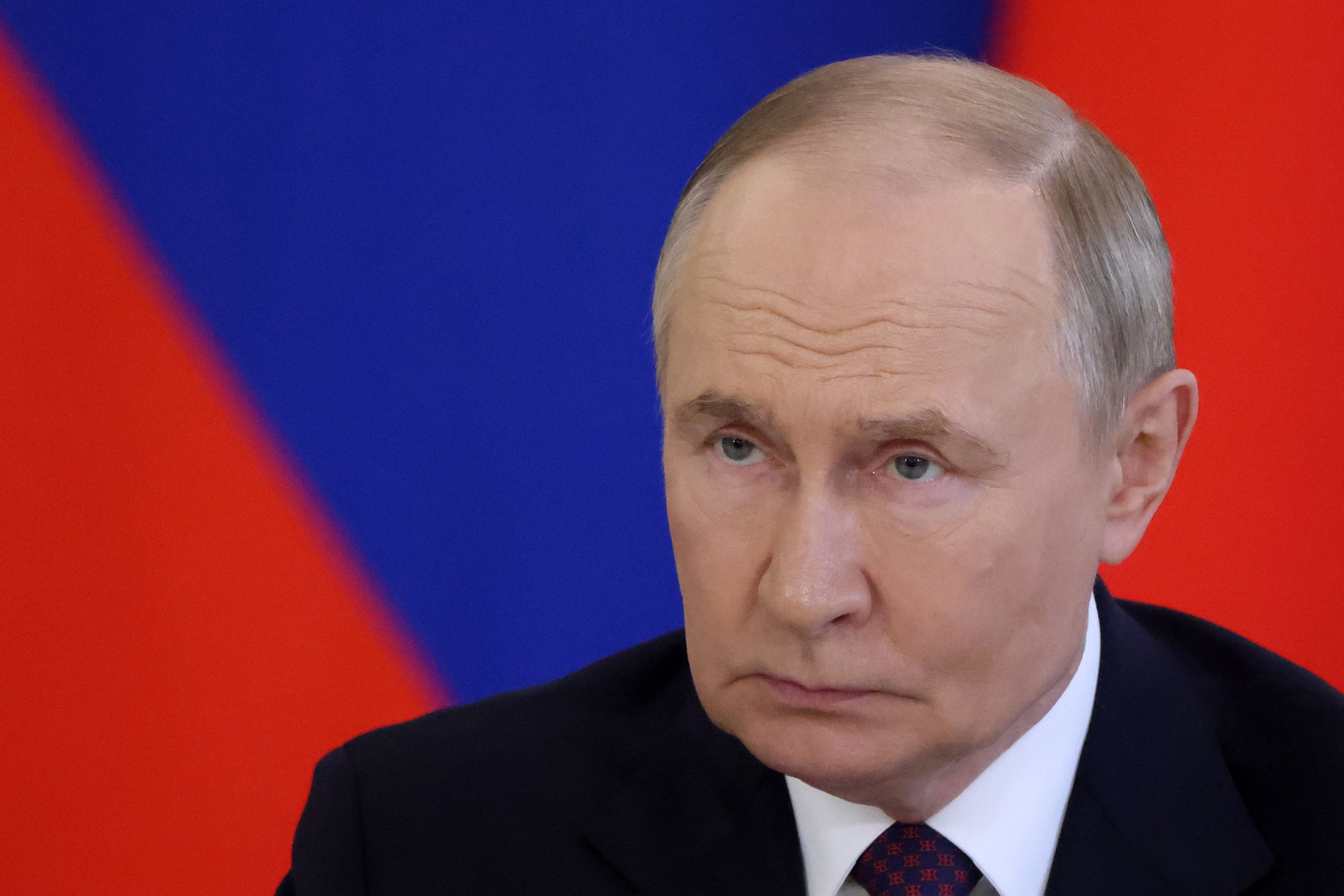
HIS APPROVAL RATINGS ARE SAGGING. His foreign war is floundering while economic woes multiply at home. His erstwhile loyal supporters are rebelling, and there are elections coming up. Donald Trump? Yes, but his role model in the Kremlin is having the same problems.
Not exactly the same, of course. Vladimir Putin’s war in Ukraine is now in its fifth year, and the Russian economy has been previously saved from collapse by being retooled as a war machine. Putin’s recent drop in approval ratings has left the share of Russians who say they trust him at 72 percent, which Trump could only dream about; but that’s still down nearly 7 points from two months ago, and in official surveys by the government’s own polling agency. Of course, as expatriate political analyst Abbas Galyamov points out, under a borderline totalitarian regime such questions primarily measure “the level of fear.” Notably, when approval is measured in a way that doesn’t force respondents to state directly that they don’t trust Putin—by asking Russians which politicians they trust—Putin gets the nod from only 29 percent, and that figure is down from 35 percent at the end of last year.
Another big difference between Trump and Putin, obviously, is that the elections to the state Duma coming up in September are very unlikely to pose a threat to Putin: Over his twenty-six years in power as president and prime minister, the Russian political system has perfected the art of both rigging the vote and keeping undesirables off the ballot in the first place to such a point that only a genuine tsunami of popular anger might be able to break through.
Yet alarm bells are going off. At a recent televised meeting of high-level officials, a petulant Putin demanded to know “why the trajectory of macroeconomic indicators is currently below expectations.” Despite still being fueled by military spending, Russia’s GDP grew just 1 percent in 2025—and shrank by nearly 2 percent in January and February of this year. The budget deficit is growing, and oil revenues are falling despite the spike in oil prices caused by the war in Iran—thanks mainly to Ukraine’s remarkable success in taking out, or at least temporarily disabling, Russia’s oil depots and oil-processing facilities. Those strikes are also adding to the general sense of instability: Even the official Russian media have been reporting on the massive fires following two waves of drone strikes at the southern Russian port city of Tuapse, not only a major transport hub but a popular seaside spot. A viral video shows a tearful Russian woman lamenting that she just wanted to live by the sea with her child, but “now the sea is all fucked up” by oil spills and “those drones are flying around and smashing the fuck out of everything.”
Meanwhile, the Russian state continues its war on the internet—a big deal in a country where the digitization of life, especially since the COVID-19 pandemic, was until recently an area of surprisingly rapid progress. With more and more websites blocked and more and more apps disabled, the Roskomnadzor, Russia’s fearsome “Federal Service for Supervision of Communications, Information Technology, and Mass Media,” is halfheartedly trying to fight the use of VPNs, virtual private networks that allow people to bypass the blocks. Russian VPN users are no longer able to access government websites that provide essential services; some major Russian banks and online shopping companies are blocking them as well. It’s more of a hassle than an insurmountable obstacle, since it means simply that people have to turn the VPN on and off; but regular small hassles can add up to a lot of irritation, in this case unmistakably directed at the government.
IN THE MIDST OF THIS SIMMERING TURMOIL, an unexpected would-be voice of the people has emerged: Victoria Bonya, а 46-year-old fitness and beauty blogger and former Russian TV personality who now lives in Monaco. I wrote last month about Bonya’s Instagram video clip denouncing the slaughter of supposedly infected cows in Siberia (and also taking a swipe at the internet shutdowns). Recently, she has upped the ante with an Instagram video billed as “an appeal to Vladimir Vladimirovich Putin from all Russians who care.” It opened with a remarkable statement:
Vladimir Vladimirovich, people are afraid of you. The common people are afraid of you. Bloggers and artists are afraid of you. Governors are afraid of you. But you are the president of our country. It seems to me that we should not be afraid. . . . I think there is a great, thick wall between you and the people.
Bonya then took it upon herself to report to Putin about several problems on which she believed he was not being adequately informed: recent floods in Dagestan, oil spills in the southern Anapa Bay (this one apparently unrelated to Ukrainian drones), the cow slaughter in Siberia, and the internet blockings. To some extent, this is a standard “good tsar, bad boyars” line, but with a key twist: The boyars aren’t keeping the tsar in the dark because they’re bad but because they’re scared to tell him the truth. So maybe the tsar isn’t so good after all.
Of course, it’s still a hilariously absurd assessment of the actual situation in Russia. There is, of course, no mention of the war in Ukraine. And it’s hard not to crack up when Bonya breathlessly declares, “One gets the feeling that we don’t live in a free country anymore, but in some sort of banned country.” Um, yes, where have you been? It’s like the people just now discovering in 2026 that Trump is an egotistical narcissist with no moral center.
But guess what: Whatever one thinks of her intellect or integrity, Bonya has an impact. Her celebrity goes back to a year-long stint on Russia’s biggest reality show, House 2, in 2006–07. She still has some 13 million Instagram followers—some presumably expatriates, but most of them living in Russia and cheerfully defying the Instagram ban. Indeed, her appeal to Putin had 30 million views in one week. (Putin’s annual news conference at the end of last year was viewed live by 6.7 million; obviously, it’s not an apples-to-apples comparison since at least some people presumably watched Putin recorded, but even so, the numbers put Bonya’s reach in some perspective.)
Some dissident Russian commentators have speculated that Bonya’s mutiny-lite was staged by the regime—perhaps as a distraction from the bad news on the war and the economy, perhaps as a prelude to liberalization-lite. But some of Bonya’s statements smacked of heresies far too dangerous to be planted: for instance, that if the government continues ignoring ordinary people’s problems, “they will eventually stop being scared—they’re being pressed like a spring, but one day this spring may shoot out.”
What’s more, the propaganda machine’s response to the video suggests something of a scramble to address an unexpected challenge. Kremlin bots and various loyalist media quickly went on the attack, accusing Bonya of pro-Ukraine sympathies and dubious morals. Kremlin spokesman Dmitry Peskov made a cautious and vaguely conciliatory comment, saying that the video had been seen and that “a great deal of work [was] being done” on the issues raised in it. And chief propaganda jock Vladimir Solovyov unleashed a torrent of invective, denouncing Bonya as a “used-up skank” spewing garbage from her “filthy mouth” at the instigation of some nefarious forces.
More dramatics ensued. Bonya—who has lived in Monaco since 2011 but still has properties in Russia and can thus fear retaliation from the government—seemed to turn down the heat in a second video that tearfully thanked Peskov for his attention to her appeal and asked foreign and opposition media like the BBC and TV-RAIN to “leave her out of it”: “I’m not with you, I’m with the people and within the people,” she declared. (An easy target for gibes when you’re “with the people” from your luxury home in Monaco.) Her next video took on Solovyov and other pro-Kremlin men who had attacked her in misogynistic language—including Duma member Vitaly Milonov, who remarked that he had thought she was “some escort girl working in Dubai.” Not only did Bonya threaten to sue Solovyov and his fellow sexists for defaming women, she also posted an AI video of herself as Spider-Woman pummeling the offenders, with an invitation to other women to join her in a community of “warriors of light.”
The result, so far, has been a torrent of online indignation at Solovyov, who has backed off enough to suggest that he never meant to attribute any ill intent to Bonya—only to say that she was being used. Russian émigré journalist Tatiana Felgengauer suggests that this spat reveals the artificial nature of the controversy: public attention is now being diverted away from the Kremlin’s political and economic problem toward Solovyov’s sexist vulgarities and from the war in Ukraine toward gender wars within Russian culture. Yet Felgengauer also thinks that, whatever the purpose of Bonya’s declarations, the popular response—expressed, among other things, in the comments on her videos—shows a burgeoning discontent among the Russian public which feels that its concerns are being ignored.
Maybe Bonya’s display of defiance is merely a marketing ploy (she has her own line of cosmetics). Or maybe it’s a political ploy to channel that discontent into safe outlets—or even to undermine hardline propagandists like Solovyov and pave the way for a new perestroika. (Yes, that’s a theory too, articulated by podcaster and former TV-RAIN host Vyacheslav Shiryaev.) But, interestingly, it was none other but Solovyov who put his finger on the quiet radicalism of Bonya’s first video: the statement that the country is afraid of Putin, to the point of being terrorized into silence. Solovyov thinks—or, at least, says—that this is an enemy “narrative.” In fact, it’s a powerful truth—and one that positions Putin as a tyrant, not a strong leader. Coupled with an exhortation not to be afraid, it’s downright revolutionary. For that matter, even Bonya’s rebuke to the misogynist rhetoric emanating from some of her detractors can be seen as a larger challenge to the Putin regime’s aggressive macho ethos.
Will there be a Bonya revolution? No. But the Bonya rebellion, such as it is, could be a sign of shifting winds in Russia.
Your updates on Russia are invaluable. I learn so much from them. Thanks for all the time put into it
Fascinating. I hardly know what to think in the end, but on top of the good news from Hungary last week, it does feel like the winds are shifting.