The Smugness of Anti-Empathy Politics
Gad Saad spells out his ‘own the libs, scorn the weak’ ethos.

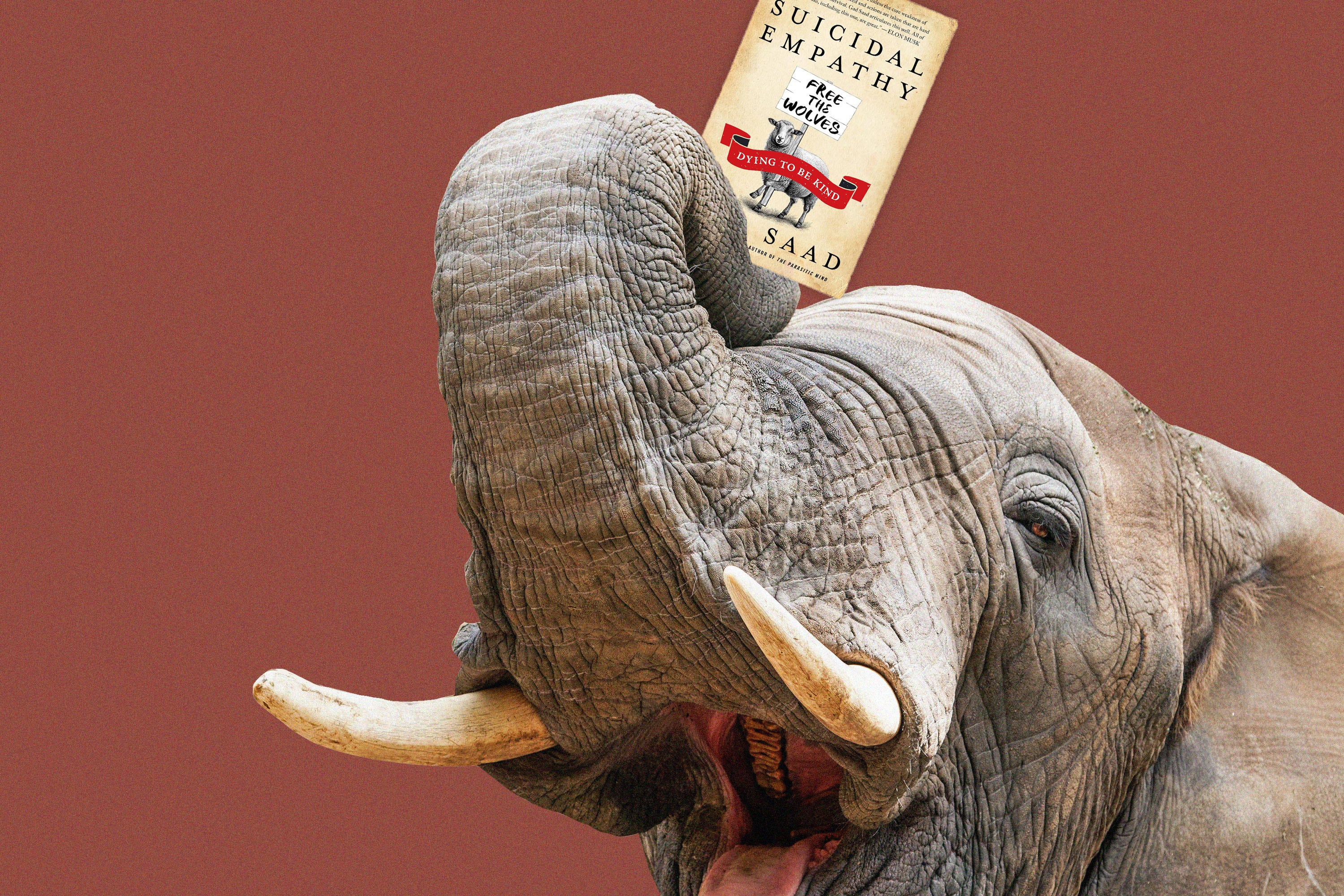
Suicidal Empathy
Dying to Be Kind
by Gad Saad
Broadside, 238 pp., $32.99 (hardcover)
“SUICIDAL EMPATHY,” THAT BUGABOO OF THE RIGHT, is back in the news. Gad Saad, the Canadian “heterodox” pop psychologist who coined the concept and gave it to folks like Elon Musk, is hawking a new book titled Suicidal Empathy: Dying to Be Kind. Meanwhile, a tragic incident in New York is being held up as emblematic of this hidden menace. After an elderly retired teacher was shoved down a flight of stairs on the subway—allegedly by a just-released psychiatric ward patient—and died from the fall, a 23-year-old woman told the New York Post that the same man had assaulted her and a friend in a scary subway incident in April. The perpetrator had been arrested at the time, but the woman had decided not to cooperate with the prosecution—because, as she told the Post, she didn’t want to “put another black man in jail.” Gad Saad couldn’t have asked for better promotions.
But not everyone—even among the affirmatively non-woke set—is buying what he’s selling. Quillette ran a scathing review by conservative British writer Ben Sixsmith titled “Playing Gad,” critiquing it as simplistic and intellectually self-absorbed. The reviewer in another “heterodox” outlet, Unherd, panned the book for dressing up a catchy concept in a lot of incoherent and “vibes-based” arguments, political vitriol, and lame humor.
The thing is, Saad’s concept—empathy is a good and necessary trait, but can be bad and self-damaging when taken too far—is one few people would dispute. Obvious examples include being trapped in an abusive relationship or a toxic friendship because you’re afraid to hurt the other person by ending it, a concern exploitative people can easily manipulate. On a larger scale, it is self-evidently true that empathy alone is usually not a reliable guide to policy or collective action: refusing, on compassionate grounds, to forcibly hospitalize people experiencing certain acute mental health crises can result in grave harm not only to other people but to the patients themselves.
Indeed, other people have critiqued the overreliance on empathy—at least in the literal “I feel your pain” sense which distinguishes empathy from the related concepts of sympathy and compassion, even if many people use the words interchangeably. Yale psychology professor Paul Bloom wrote a generally well-received book titled Against Empathy in 2016, proposing “Rational Compassion” instead. Bloom argued, among other things, that the emotional component of empathy leads us to focus too much on highly visible cases of suffering (a little child who falls down a well becomes more important than a lot of little children whose lives are quietly wrecked by poverty). Ironically—given that Saad spends a lot of time excoriating liberals for being too afraid to seem racist—Bloom also argued that empathy-based morality can easily become de facto racist and tribalist, since we tend to empathize more with people like ourselves: hence the disproportionate media focus on young white women who go missing.
For Saad, though, “suicidal empathy” is strictly a culture-war concept. In his framework, the term refers to ostensibly compassionate political views he considers misguided: support for migrants and refugees, Muslim immigrants in particular; excessive concern with the rights and well-being of criminals and/or homeless people; high taxes to pay for social programs; defense of transgender identities; an #IBelieveHer stance toward women who accuse men of sexual misconduct. (Unless, of course, the alleged perps are migrants or Muslims or both, in which case insufficient support for the victims is a sign of suicidal empathy for those groups.)
This isn’t to say that Saad is always wrong. Progressive policies on crime, homelessness, immigration, etc. sometimes really are flawed in ways that can be described as arising from misplaced empathy. But much of the time, Saad can’t help taking his argument to the other extreme: If progressives can downplay Islamist radicalism, he treats the Taliban as representative of Islam and asserts that Muslim public prayers in Western countries are “a signal of dominance.” When residents of a small Italian town insist that they have no problem with Muslim refugees despite one refugee man’s arrest for the rape of an underage girl, Saad can only throw up his hands at what he sees as liberal brain rot; he’s unwilling or unable to concede that the townsfolk might not wish to judge the whole group by the one case.
What’s more, Saad’s insistence on squeezing every real or perceived problem into the procrustean bed of excessive empathy results in some extremely shoddy analysis. At one point, for instance, he suggests that negative reactions to research on supposed innate racial differences in intelligence, or on links between race and criminality, are based on “the empathetic argument” that such research “will cause harm to ‘marginalized’ communities.” But surely, given historical experience over the past two centuries, wanting to be nice is not the only reason people (not just on the left) tend to be extremely wary of researchers whose primary focus is scientific evidence for some groups’ racial superiority over others.
Even more bizarrely, Saad also treats efforts to combat disinformation on the internet as a manifestation of empathy gone bad: Apparently, it’s all about trying to police mean words or to keep mean people like Donald Trump from taking power. Take, for instance, the banning of Trump’s Twitter account at the tail end of his presidency:
The argument was that while freedom of speech is a great idea, it did not apply to Trump, as he was an existential threat to civilization, democracy, and our way of life, albeit the official position of Twitter was that he was banned “due to the risk of further incitement of violence.”
What any of this has to do with empathy, suicidal or otherwise, is unclear. But a bigger problem is that someone unfamiliar with the events that preceded Trump’s Twitter ban on January 8, 2021 would have no idea why Twitter management was concerned about “further incitement of violence,” or why a lot of people saw him as an existential threat to democracy. If leftists were hand-wringing about a left-wing agitator getting booted from a social media platform while making no mention of that agitator’s incitement of a mob attack in which 140 cops were injured, I bet Saad would be pointing to that as an example of “suicidal empathy.”
If you’re starting to suspect that much of Suicidal Empathy boils down to a catalogue of familiar right-wing grievances, you’re not wrong. Hunter Biden’s laptop makes an appearance, and there’s even a reference to the euthanizing of an animal-rescue squirrel and raccoon on suspicion of rabies in New York state, an incident that briefly became a cause célèbre on the right a few days before the 2024 election—apparently a result of overempathetic environmentalism. Or something.
Add to this Saad’s constant grandstanding (he drops endless references to his earlier books, articles, speeches, and podcast appearances, sometimes self-quoting at length), his love for his idiomatic coinages (such as “Civilizational Seppuku”) and his evident belief that he is a very funny man (as when he pens a snarky riff on replacing the term “rapist” with “undocumented lovemaker,” spoofing progressive efforts to avoid hurtful language, or cringeworthily refers to the concept of white privilege as “Dermatological Original Sin”). Worse yet, Saad has a tendency to turn his snark on people who end up dead as a result of what he considers misguided empathy—such as a woman who sheltered a homeless man in her apartment and was murdered by him after she asked him to move out. You can practically see the author smirking as he comments:
This was apparently not the first time that the victim had offered refuge to the homeless in her apartment. The victim’s moral virtue is eternally intact, as her life was terminated by an unhoused man of color. She is dead but at least she is not an elitist racist.
This repulsive passage, which attributes white-liberal “virtue signaling” to a murdered woman Saad knows absolutely nothing about, highlights a notable fact: For all his supposed devotion to Western civilization, Saad seems completely unaware that this civilization has a millennia-old tradition of treating charity—even charity at personal risk—as one of the highest virtues. I was reminded of the famous episode in Victor Hugo’s Les Misérables in which the recently released convict Jean Valjean is sheltered for the night by a kindly bishop and repays him by sneaking off with the silverware. Instead of learning his Saadean lesson about suicidal empathy, the bishop chooses to take another chance on his ungrateful houseguest when Valjean gets caught, telling the police that the silver was a gift and even throwing in two candlesticks. I don’t know if Saad considers Hugo a proto-wokester, but I imagine that if asked to consult on the manuscript, he would have suggested a revision in which Valjean returns to beat the good bishop to death with one of those candlesticks and the rest of the novel is about Inspector Javert’s heroic efforts to catch the unrepentant felon.
You can see why even some people who think, as does the Unherd reviewer, that Saad’s premises are largely sensible also think that this slim volume is a terrible contribution to the public discourse.
BUT ARE SAAD’S PREMISES sensible after all? Again, he makes some valid points, none of them particularly original; the problem is trying to pull them all into the suicidal-empathy grab-bag. For that matter, that young woman in New York who supposedly helped let a subway pusher loose because of her reluctance to help jail a black man may not be such a poster child for Saad’s theory. A look at her New York Post interview shows that she expressed gratitude and respect for the cops who quickly arrested the man during her run-in with him. Yes, she did say, “Maybe a part of me was just like, I don’t want to put another black man in jail, but, you know, at some point, if you are a criminal, you’re a criminal, and he was a scary guy.” But that sounds more like an ex-post-facto attempt to explain her decision not to cooperate with prosecutors (likely due at least in part to the hassle of being a witness in a criminal trial) than a conscious political motive.
The soft-on-criminals progressives Saad talks about obviously exist (as Saad himself notes, the hit TV show Cheers was already making fun of the idea that a violent assailant is just crying out for help forty years ago). But weaponized empathy is not a phenomenon limited to the left: witness the right’s appeal for sympathy for the “martyrs” of January 6th. Likewise, diatribes about compassion for the “wrong” targets are not an exclusively right-wing phenomenon: In the past decade, feminist philosopher Kate Manne coined the term “himpathy” to refer to supposed excessive sympathy for men accused of abusing women, and “white tears” became a popular phrase to mock complaints about unfair accusations of racism. For the record, I thought such rhetoric was bad because it could easily function as a permission structure for cruelty. But the same is abundantly true of Saad’s weaponization of anti-empathy.
Suicidal Empathy arrives at a cultural moment when a political movement backed by the president of the United States wears cruelty as a badge of honor. Not only right-wing activists but Trump administration officials make a point of mocking the suffering of migrants detained for deportation. Increasingly overt racism is being mainstreamed in large swaths of the right. In this climate, even critiques of genuinely toxic forms of empathy need to be mindful of the risk of throwing out the baby with the bathwater. Otherwise, in place of suicidal empathy, we are likely to end up with toxic Saadism.
Sorry if I don't quite understand the concept, but isn't "suicidal empathy" something that has been widely admired, not condemned, as far back as human history can be traced? What else besides "suicidal empathy" could be credited for the parent who willingly gives up his life for his child, or the passerby who rescues a drowning stranger at the cost of his own life, or the hero who risks his own life by running into a burning building to bring out trapped strangers? Or even, to stretch the case a little, to the soldier who throws himself on a grenade to save the lives of his buddies? "Suicidal empathy" seems to be just the latest, nastiest neo-Randian label for selfless heroism. Is it really likely that the young lady in New York thought "I have more empathy for the person who attacked me than for those he might harm in the future"? Perhaps, in the twisted minds of Saad or Musk, but to me and most clear-thinking people, no such thought would have passed through her mind. That's not how real people think. I would prefer to think that her motivation was simple altruism mixed with some notion of justice. And in a much less tragic form, that altruism explains the life of Martin Luther King, Jr., Mother Teresa, Nelson Mandela, and thousands of lesser known heroes. Saad and Musk are idiots.
I wonder what he makes of Jesus, who let himself be crucified in order to absolve us of our sins. You dont get any more suicidal empathic than that.