

Technology and Its Terrors
‘Exit 8’ and ‘Undertone’ reviewed.

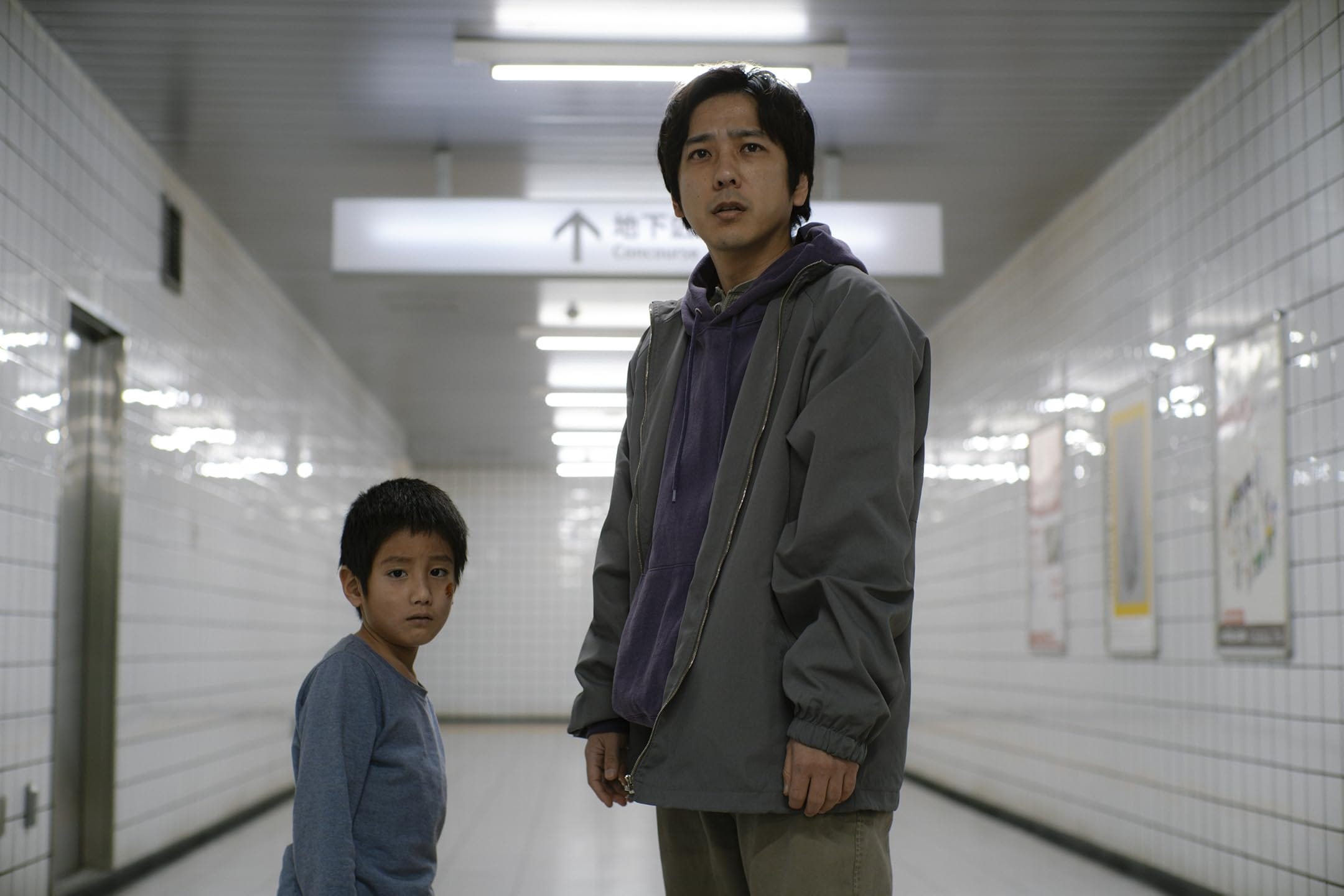
SORRY, MARIO: Exit 8 is the best adaptation of a video game playing in theaters now.
And that’s because Exit 8 leans into the gameplay of its source material, The Exit 8, an indie game released in 2023 that is often described as a “walking simulator.” The player, stuck in a Japanese subway station hallway, is forced to walk forward until they encounter an “anomaly”—that is, something that looks different from the patterned hallway they’ve seen before—and then turn around. Every time they catch an anomaly, the exit counter increases by one; If they miss the anomaly, the counter resets to 0. Get to the titular exit 8 and you go free.
In the film, we begin on the “Lost Man” (Kazunari Ninomiya), who is taking a train to his dead-end temp job. After sitting by while a man berates a woman with a crying infant on her lap, he gets a call: His girlfriend is at the doctor, she’s pregnant, and she doesn’t know what to do. Importantly, we see all of this from the first-person POV, mimicking the view a person in a walking simulator might have. Thankfully, this is only temporary—extended first-person sequences in a film like this are recipes for motion sickness—but it sets the mood and pays just enough homage to its source material for us to know it is taking seriously what it’s riffing on.
The Lost Man is soon disoriented in the bowels of a subway stop, only realizing something has gone wrong when he passes the same posters, the same lockers, the same unseeing commuter walking toward him a handful of times in a row. No matter how far he goes, he’s stuck in a loop. Then he stops and reads a sign, learning the rules: Walk until you see an “anomaly”; keep going if you don’t see one; turn back if you do; and leave at exit 8. The anomalies come in a variety of forms, from alterations of posters to unexpected phone calls, but part of the game is figuring out the rules of the game.
Is the Walking Man (Yamato Kochi) another lost person or part of the game? Is the Boy (Naru Asanuma) who tags along with the Lost Man an anomaly or not? What happens when a tsunami hits a simulated labyrinth?
Some audiences will find Exit 8 grating, and I get it: It is repetitive by design, and if your brain hasn’t been trained by video game logic to pick up on tiny details or engage in foolishly intricate puzzle-solving to, say, extricate a medallion from a locker (I’m looking at you, Resident Evil), you’ll likely find the entire exercise pointless.
However. I couldn’t help but find Exit 8 charming at times and, eventually, quite moving. It is, ultimately, a film about a man trapped in a doom loop of his own making and trying to break out of it, a mode of living that corresponds well to the fears that so many in the younger generation struggle with. How can I get married; I don’t have a good job. How can I have kids; I’m just a temporary worker. Where will we live; we don’t have a proper home. I can’t move forward until everything is perfect; nothing is ever perfect, I can’t move forward.
The function and the form of the story are thus in almost perfect sync; director Genki Kawamura (who co-wrote the film with Kentaro Hirase) has managed to simulate the gameplay in a way that furthers the film’s plotting and expands its symbolism into something universal, maybe even profound. The more I think about it, the more I can’t help but admire it as an adaptation of an evolving medium’s storytelling capabilities to tell an ageless story (a boy’s journey into manhood) in a new way.
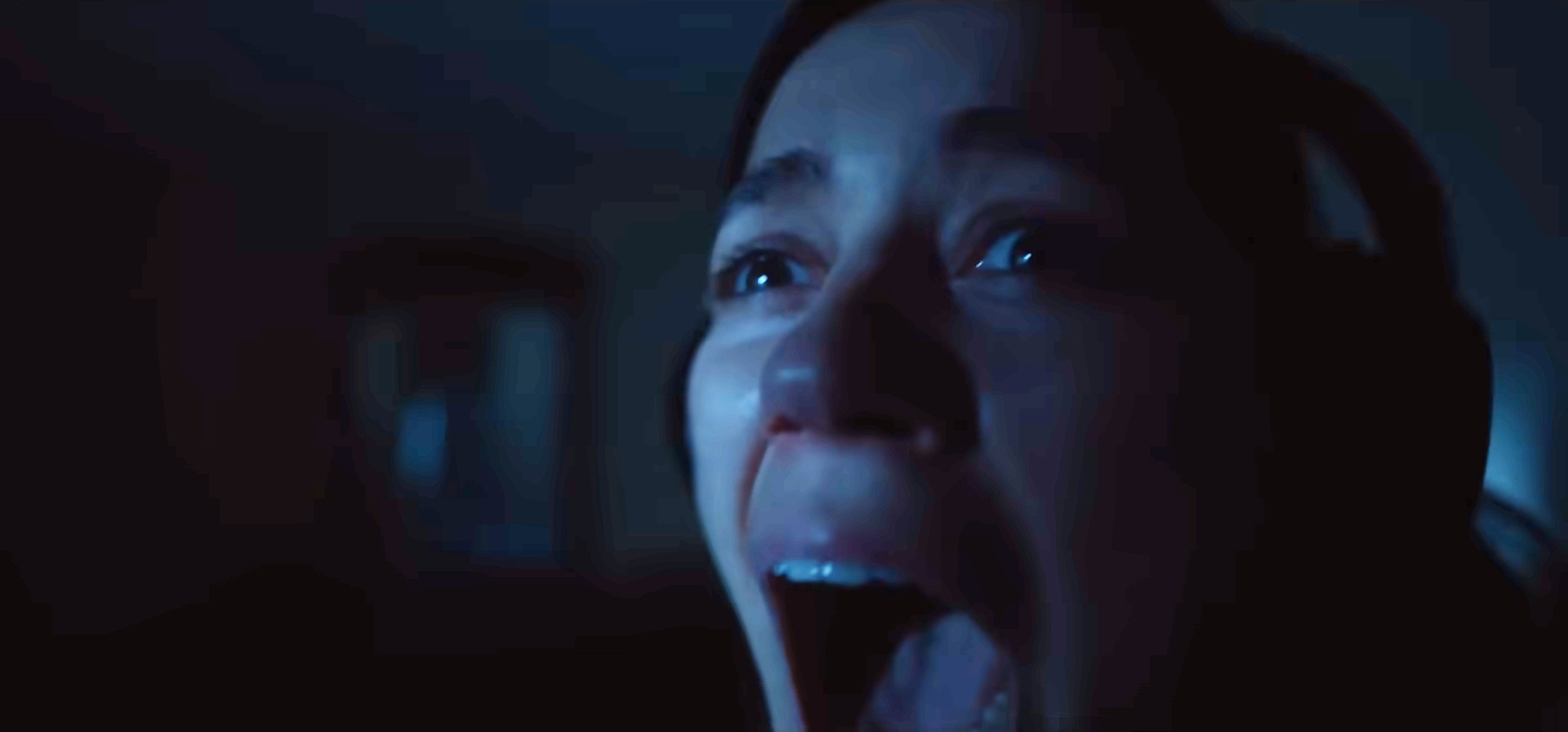
UNDERTONE, MEANWHILE, IS A FILM THAT tinkers with a new mode of storytelling (in this case, podcasting) but doesn’t seem comfortable committing to that mode’s limitations and strengths as a means of telling the film’s story.
The setup and the set are both pretty simple. Evy (Nina Kiri) is living at home with her dying mother, Mama (Michèle Duquet); the whole film takes place inside this house. Evy has a boyfriend, whom we never see but whose presence is felt when we discover that she is pregnant. More importantly, she has a podcast called “The Undertone,” which she hosts with Justin (Adam DiMarco), who lives in London, necessitating that they tape at three in the morning. The subject of this podcast is terrifying ghost stories, which Justin lays out with breathless glee; Evy is the rationalist of this pair, the Scully to Justin’s Mulder.
Now, I have some nitpicks about this whole setup. One of them is that it is simply foolish to tape your ghost story podcast at the literal witching hour with your dying mother upstairs and your back to the entirety of the dark, empty, old house. I don’t care how much of a Scully you are; we’d all go a little Mulder in that situation. Another is that the actual schedule of taping is, frankly, bizarre; they tape a few minutes several times over the course of a week, stitching it all together to have an episode every Friday.
The final nit I’ll pick is that the podcast itself is just . . . kind of terrible? Here’s the précis of the episode we watch them tape: Justin tells Evy that he got a random email with some random audio files—which he hasn’t listened to—and he’s going to play them for her and get her response to them in real time. While they’re listening to ten random clips recorded by a mysterious couple, they’re googling bits and pieces of random information about children’s nursery rhymes and the such and silently reacting to what they read.
I’ve done my fair share of podcasts and while I’m no Tim Miller, I can assure you: This podcast would suck ass.
Set aside my quibbles: The biggest problem with Undertone is that it is, frequently, kind of boring. There are long stretches where nothing of import and nothing terrifying happens. But there are moments when it is tremendously effective—jarringly creepy and genuinely frightening—and those moments all revolve around Evy’s (ridiculous) podcast. I feel there is a lesson to be learned here.
The effectiveness is achieved by leaning into the advances and the limitations of the technology available to podcasters. The way the sound design mimics what it’s like to wear noise-canceling headphones, for instance, is striking: There’s something intensely eerie about being in a big, old, empty house while wearing cans that cut you off from the noise around you. It’s an unnatural short-circuiting of the systems we’ve evolved to protect ourselves, a lowering of our defenses in a situation where they should be up. (Or, at least, we know they should be up since we’re watching a horror movie.) We’re on edge because she’s on edge, and she’s on edge because once she starts listening to the audio files, things start getting weird.
It helps that a podcaster’s life is a series of natural jump scares: the way sound editing twists language into unholy pretzels via looping and quick repetition; the way your iPhone’s unnaturally cheerful ring breaks into the terrifying chant that repetition has created. (This Undertone gets very right.) A more successful version of this film might have taken place over the course of a single night, with all of Evy’s issues resolved (or not) as she listened to the scary story Justin is telling her in one go. Pulling us away from the podcast setup is simply a mistake; writer-director Ian Tuason should have kept us cocooned from the world as much as possible, kept us guessing which noises were within the tapes and which were coming from the house.
He should’ve leaned into the inherent weirdness of this new storytelling medium, in other words. Instead, we’re treated to a ghost story that’s a bit more generic and thus less interesting. It’s a pity, because the 20 percent or so of Undertone that works really works. There’s just . . . everything else.
"Exit 8" is on my to see list now. I haven't played the game, but the concept is right up my alley. Puzzles within games are always some of my favorite parts of gaming. I like to tell myself that the puzzles are exercising my neurons to offset the damage done to them by the actual gameplay, so it's all good. Hah! I think I will pass on "Undertone" since I would rather not spend money to watch people make a shitty podcast but with jump scares.
Saw Exit 8 based on your review and the starred review in the New York Times. Given the horror movie tropes in the preview, I probably would’ve avoided it otherwise. Glad I saw it. Thanks for recommending it.