Ted Turner, 1938–2026
A man who changed the world.

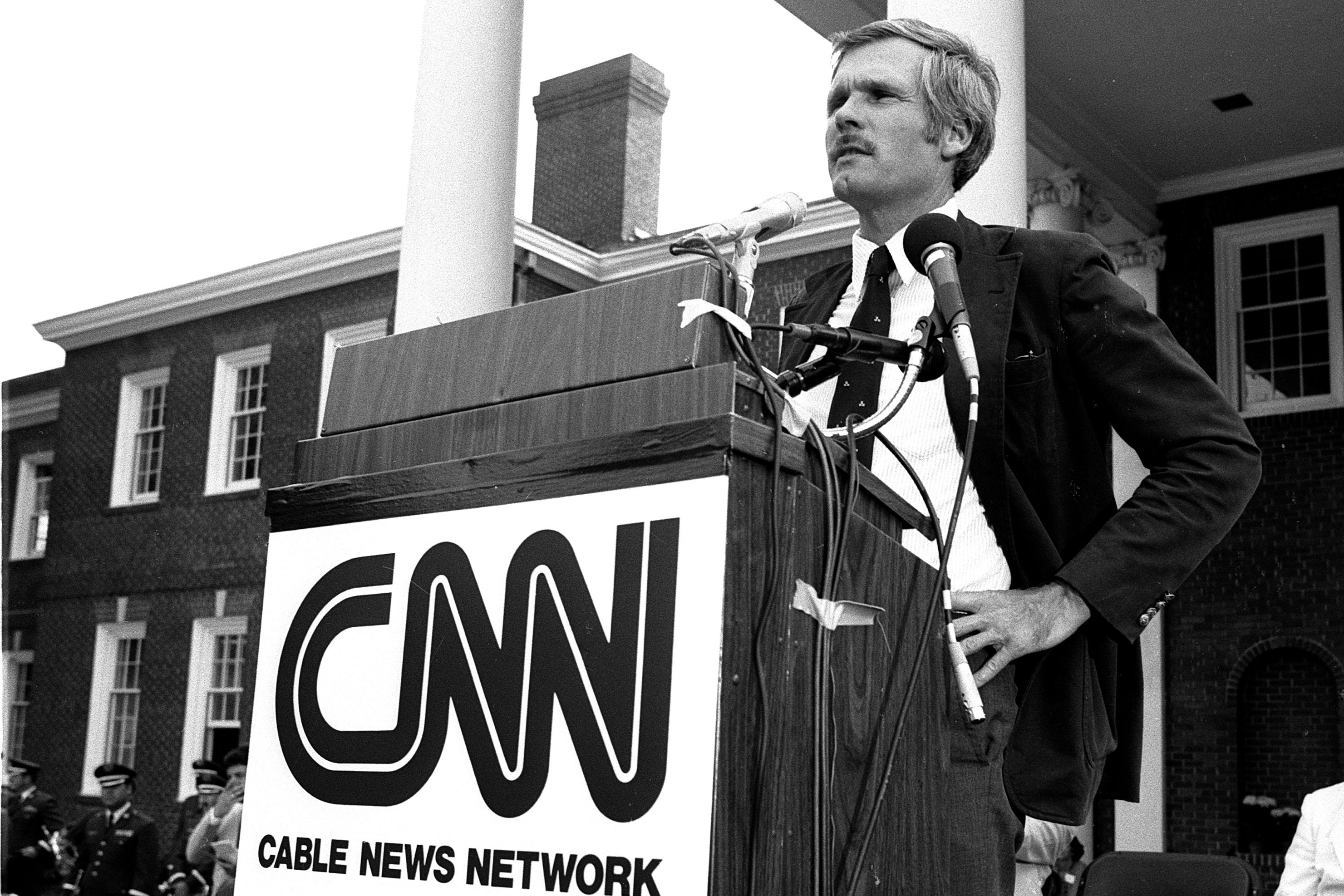
GREAT MAN THEORY IS OUT OF VOGUE these days, but there are few individuals one can credibly say changed the world—or, at least, how we saw the world—more than Ted Turner, who died today at the age of 87. The media magnate ushered in the 24-hour news cycle, championed both film desecration and preservation, and maybe helped sow the field we’re all reaping from.
The one thing Turner understood, and helped create, before most was the ability to turn media properties into nationwide phenomena via the burgeoning technology of satellite and then cable television. He parlayed a handful of radio stations into a bottom-feeding UHF channel, then rebranded it the Turner Broadcasting System and beamed it into space, then into everyone’s homes. (Or, at least, everyone with a dish and a cable sub.) TBS out of Atlanta joined WGN out of Chicago as weird little windows into America for folks around the country, a fact that helped turn the Turner-owned Atlanta Braves into a national sports brand just a tier below the Yankees and the Cowboys, particularly in the American South where baseball franchises were few and far between.
But TBS was relatively small potatoes—an overpowered UHF channel trafficking mostly in reruns and sports—compared to Turner’s next big idea: CNN, the Cable News Network. Founded in 1980, it was the first 24-hour news network. But news alone would not fill all those hours; this is TV, after all, and television viewers demand programming. So there were shows like Lou Dobbs’s Moneyline and Evans and Novak, a show built around the longtime writing duo of Robert Novak and Rowland Evans who brought a sort of Siskel-and-Ebert charm to the day’s events. And then a few years later, Crossfire, which (alongside The McLaughlin Group) did much to introduce the shouting-head format to the body politic. Larry King Live debuted in the middle of the decade and helped bring newsmakers to the masses via the call-in format.
It’s amusing to scan the highlights of early CNN coverage, see how the weird mix of spectacle (kids falling down wells) and tragedy (the Challenger explosion) feels resonant years later. (Baby Jessica and Balloon Boy remain watchwords after all this time.)1 But I’ll just leap to the moment when it felt like everything changed, at least for my then-8-year-old eyes: the first Gulf War, Operation Desert Storm. Equipped with night-vision-enhanced cameras and broadcasting from inside the country, CNN brought a grounds-eye view of war into viewers’ homes, yet managed to show how warmaking had a new distance. This was not like the filmed footage of CBS reporters walking around with American soldiers torching villages in Vietnam or seeing wounded servicemen being choppered out; the first war in Iraq felt more like watching a movie or playing a video game. That distance probably helped Americans regain comfort in military action.
The success of CNN would spawn imitators, notably MSNBC and Fox News, and we can have longer debates another time about the world that cable news ushered in. All I’ll say is that my election night viewing has, for years, been CNN’s.
TED TURNER WAS ALSO A MOVIE MOGUL, of sorts, though his legacy here is decidedly mixed, particularly among fans of older films.
No mention of Ted Turner is complete without highlighting the barbarism of his colorization efforts, a well-intentioned defacing of classics to make them more palatable to moderns who cannot envision spending two hours with a black-and-white entertainment.
For the low-low price of $80 in 1989 dollars, you could buy a colorized copy of Casablanca on VHS, which Turner had acquired the rights to when he purchased MGM’s library to stock his cable networks with nigh on endless programming.2 Seeing these colorized monstrosities demonstrates the lunacy of this effort, but let’s set that aside. Instead consider the reasoning for the high price point given to the Los Angeles Times in 1989, and I think you’ll get a telling glimpse into Turner’s particular brand of mad genius:
That $79.95 price is a mystery. Usually such a high price is reserved for new movies sold to retailers as rentals. But old movies are usually introduced in the $20 to $30 range—a price appealing to collectors.
The high pricing decision, said Steve Chamberlain, vice president of Turner Home Entertainment, was made by Turner himself.
The reason? “He doesn’t have to give any,” Chamberlain said. “He’s the boss.”
The colorization fad passed relatively quickly and Casablanca is enjoyed by new generations in beautiful black and white on sparkling 4K discs the world over. Turner Classic Movies, however, remains a going concern (at least until the dust from the Paramount-Warner Bros. deal settles), and it is a godsend for movie lovers of all ages around the country. In a world of duplication, there is simply nothing else like it: a curated, commercial-free cable network that is committed to showing older films, uncut and uncensored, to audiences that otherwise might never experience them.
Eventually Turner would sell his cable networks, his smaller film studios like New Line and Castle Rock, and that vaunted library to Time-Warner for more than $7 billion in stock. It was a deal that both created the largest media company ever and has reverberated for decades, as other entities absorbed, and then discarded, it. The latest iteration of this absorption/rejection continues today in the form of last year’s Paramount-Skydance merger.
OVER THE YEARS, Turner would donate no small portion of his billions to various causes. He was a committed environmentalist, and channeled some of that energy into the green agitprop cartoon Captain Planet. (I watched every episode! By our powers combined, etc.) And yet, I cannot help but think his biggest impact on the social world was almost accidental. I certainly cannot imagine he intended it.
Turner, you see, owned World Championship Wrestling, a southern wrestling circuit that for most of its existence played distant second fiddle to what was then named the World Wrestling Federation. In the mid-1990s, Turner gave WCW and its creative head Eric Bischoff the funds needed to compete with the WWF. He poached talent, including the legendary Hulk Hogan, and kicked off what is, to this day, the greatest wrestling storyline of all time, the so-called invasion of WCW by previous WWF stars that created the New World Order. And audiences ate it up. They loved seeing their heroes turn “heel.” They cheered as the good guys took it on the chin. The WCW, in its own way, presaged the entire antihero movement that would come to prestige cable a few years later.
The response to this by Vince McMahon was to amp the coarsening of the culture up a thousandfold. The so-called “Attitude Era” that McMahon ushered in was profane and vulgar, featuring beer-swilling goons and strippers disguised as “managers.” And audiences ate that up even more. Ratings soared. Wrestling was, arguably, as big as it had ever been in history. Never underestimate the lowest common denominator. Eventually, Turner sold the WCW to McMahon for a few million bucks in 2001 and washed his hands of it.
Maybe none of this really matters. But the current occupant of the White House is a creature of the WWF/WWE. His hotels hosted early WrestleManias. He brawled outside the ring. He was a regular guest, particularly during the Attitude Era that saw reality and fiction intermingle almost seamlessly. The keynote speaker on the last night of his most recent convention was none other than Hollywood Hulk Hogan. Trump himself sat down for an interview in the Oval Office for Netflix’s new four-part documentary on Hogan.
I’m not saying that Ted Turner created Donald Trump. But he certainly helped create the media-saturated world in which a gauche antihero with professional wrestling aesthetics like Donald Trump could soak up billions in free airtime during a presidential run. R.I.P.
And speaking of weird, if you haven’t read about and seen the one-minute video Turner ordered CNN prepare to air in case the world ended, treat yourself.
Technically, he purchased the whole of MGM-UA, but offloaded the active studio a few months later while retaining rights to the pre-1986 library, which included classics like Gone with the Wind and The Wizard of Oz.
He was also one of the first to buy up large Montana ranches and with Jane Fonda, his wife of the time, turned it into something of a private wilderness area. It was not well received by his neighbors, but definitely presaged what was to come for Montana privately held lands.
TCM is the sanity island that I go to when overwhelmed by the horrors of the daily news cycle. The technical artistry behind classic films is amazing even when the storytelling can be a bit heavy handed on the good vs evil dynamic. Thank Dog the colorization of classic B&W movies never caught on.