

The Anti-Prestige Prestige Show: Why ‘The Pitt’ Is the Cure for What Ails TV
Good art, healthy business.

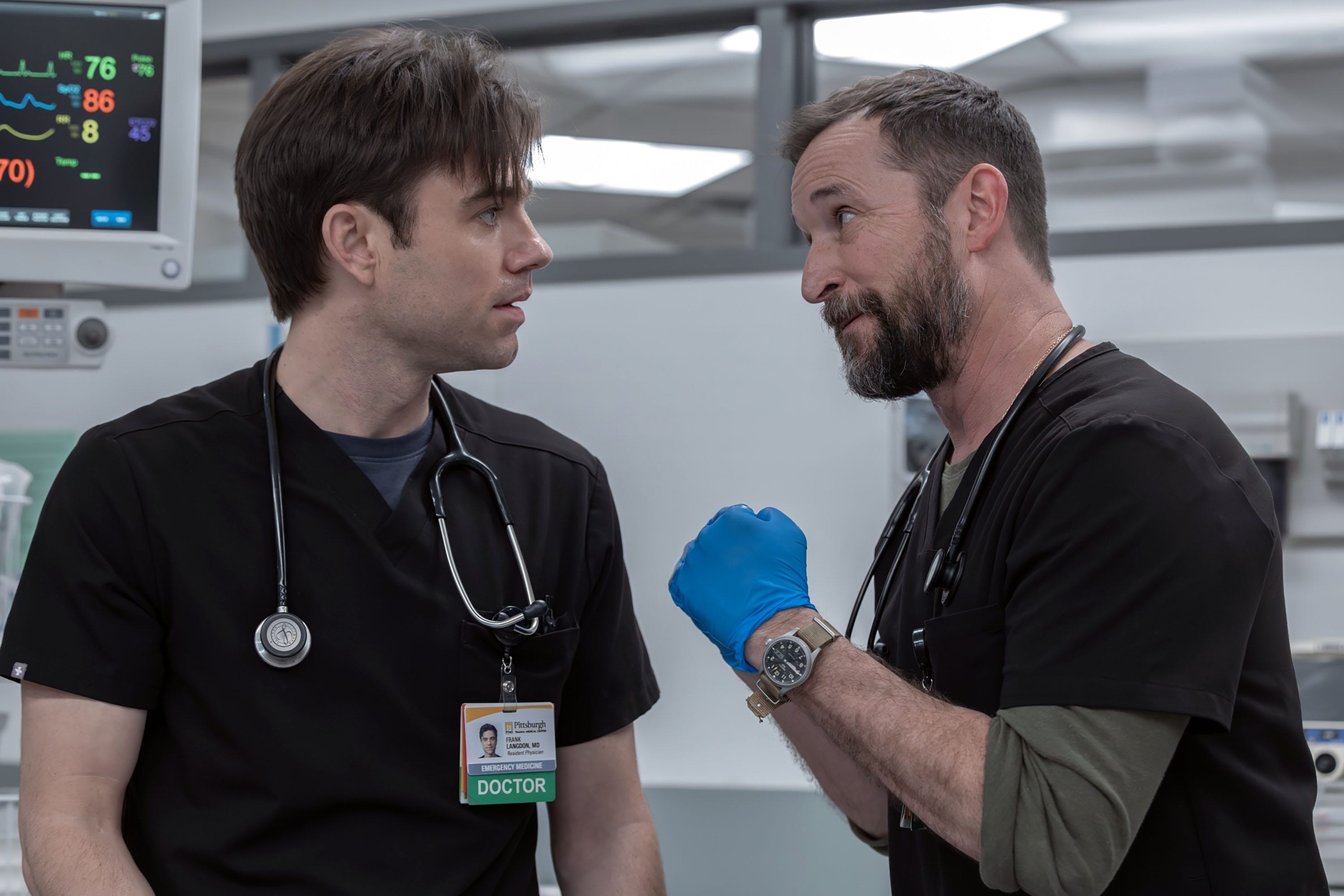
THE PITT, WHICH JUST FINISHED its second season, is extraordinary television thanks in part to its ordinariness. Without flash, it updates the tried-and-true elements of the Golden Age of ’90s television procedurals with a patina of pay cable prestige. On top of all this, the success and savvy of The Pitt might singlehandedly save Hollywood’s moribund television industry.
Created by former ER producer R. Scott Gemmill (joined by other ER veterans, Noah Wyle and John Wells, as executive producers), each episode of its fifteen-episode season covers one hour of a fifteen-hour shift at “the Pitt,” an overcrowded, understaffed, and underfunded emergency room in blue-collar Pittsburgh, Pennsylvania. Powered by the aforementioned trio’s impressive creative history, The Pitt seems like a throwback to a simpler, more streamlined (but not streaming) TV era.
But its simplicity is deceptive. What The Pitt’s creators, actors, and crew pull off is in fact revolutionary and maybe even miraculous: they are proving that good, solid professionalism and integrity not only can survive but can thrive in the age of streaming. That, in fact, audiences crave authenticity, intelligence, thoughtfulness, and proficiency, especially when in real life we seem to be besieged by amateurs, hacks, and con artists. Wyle, in his recent GQ interview with Frazier Tharpe, suggested as much about The Pitt’s appeal: “This is essentially ‘competence porn.’ You’re watching really smart, dedicated people do what they know how to do at a level that you don’t how to do it, and you’re so fucking glad that they’re there doing it.”
The onscreen competence is driven by offscreen preparation and excellence as well.
The actors participated in a two-week medical boot camp taught by actual doctors, where they learned CPR, how to perform tracheotomies, and how to intubate patients, along with many other medical skills. Every drawer and cabinet on set is filled with real-life instruments or supplies hospital staff might need. The series shoots in the round, with the hospital bay being the focal point and the examination and operating room as offshoots radiating outward. Rather than static shots, cinematographer Johanna Coelho uses a handheld camera so she can be fluid and nimble. Her camera moves where the action takes it as the doctors deal with a never-ending stream of patients in desperate need of medical attention. The lighting equipment is ambient overhead hospital lights, whose harshness emphasizes the exhaustion and pallor of doctors and patients alike and allows everything to be shot “for coverage” (that is, without a special setup for each and every shot, a necessity that would dramatically slow the pace of filming).
There is minimal hair and makeup, and although the main actors are attractive, The Pitt—unlike Grey’s Anatomy or ER before it—is the antithesis of glamor. At the end of their fifteen-hour shift, these actors look wrung out. And mercifully, unlike The West Wing (for which John Wells was the showrunner), there is no swelling theme music nudging and manipulating the audience’s feelings. The characters are rarely seen outside the hospital, so the timestamp at the beginning of the episode is how the audience knows what time of day or night it is. When the doctors’ personal lives intrude it really does feel like an intrusion: an unwanted phone call or a relative interrupting the flow of the shift. All these meticulously chosen design and story elements give The Pitt an objective and realistic documentary feel.
As an actor myself, I can’t help but admire the way they make the show. There is only one set—a soundstage on the Warner Bros. lot in Burbank, California—save the few outdoor scenes shot over three days outside a real Pittsburgh hospital. Except for Wyle, who stars and produces (and who also writes and directs some episodes), the actors’ salaries are capped at $50,000 an episode (tier 2 actors make $35,000 per episode). Filming is kept to a very humane ten hours per day, which also ensures shooting doesn’t go into costly overtime. The show is filmed in continuity from beginning to end, like it’s a piece of theater rather than a TV show. The name of the game is speed and efficiency (hence the aforementioned lighting). And because of smart fiscal decisions, The Pitt’s creators are able to make each episode for $4 to $5 million, a bargain by modern TV standards.1 As a result, the producers can make fifteen episodes per season while other streaming shows with more bloated budgets can only afford to make seven or eight. It may sound like a no-brainer, but the more episodes a show makes, the more crew members and actors drawing a salary there are. And in Hollywood, a town rocked by AI disruption and larger tax incentives for filming in other states and overseas, this level of employment is a godsend.
The Pitt’s cast is a true ensemble: few faces are recognizable outside of Wyle’s, which lends a sort of easy verisimilitude to the proceedings. Everyone is believable, and everyone has their moment to shine. There are plentiful parts for actors, whether it’s a main character, a regular or a day-player. (And honestly: It’s refreshing to see new faces instead of Nicole Kidman’s, who is seemingly in everything.) I’ve heard several of The Pitt’s newly-minted stars speak with immense gratitude for the show. Patrick Ball, who plays Dr. Frank Langdon, spoke about how he never thought he’d pay off his $80,000 drama school debt, which he was able to do after three months of working on The Pitt. As a struggling actor myself, watching relative unknowns have the opportunity to knock one out of the park and make a good living gives me hope. Oh, dangerous hope.
The show is a genuine lifeline for a beleaguered, burned-out (literally and figuratively) city. Wyle even testified last month at a hearing in Burbank with Sen. Adam Schiff to grow the tax incentives in California. He argued that The Pitt’s successes, both financially (it created 600 jobs and added $125 million to the state economy) and in terms of awards (multiple Emmy wins, including Best Drama), are The Pitt’s “proof of concept” that could save Hollywood from becoming a ghost town. Not only is Noah Wyle playing a hero on our screens, he might very well become the real-life hero show business needs behind the scenes as well: The Burbank backlot hasn’t been this busy in years.
(And if they ever need a featured day player with a history of work on medical shows on short notice, just let me know: I live less than five minutes from Warner Bros.)
For comparison, by its final season, The Sopranos—another hit show for HBO back when it didn’t have the “Max” tacked on—cost $7 million per episode, and those were 2007 prices. The average Game of Thrones episode costs more than most midsize indie films.
 | A guest post by
|