
1. Michigan
The Associated Press this morning called the Michigan Senate Democratic primary: Abdul El-Sayed won a much closer than expected victory over Haley Stevens.
Let’s get under the hood on the numbers to understand if Democrats are taking a big risk on the youngblood.
Start with this: El-Sayed should beat Mike Rogers, the former longtime congressman who is the Republican nominee, because Michigan is a fairly Democratic state.
The current governor of Michigan is a Democrat and Democrats have held the governorship for 16 of the last 24 years.1
Since 1979, Democrats have held both of Michigan’s Senate seats for the entire period, with the exception of a single Senate term when Spencer Abraham was elected in the 1994 Republican wave.
That’s an incredible run.
Here are the ten Senate elections since Abraham broke the streak:
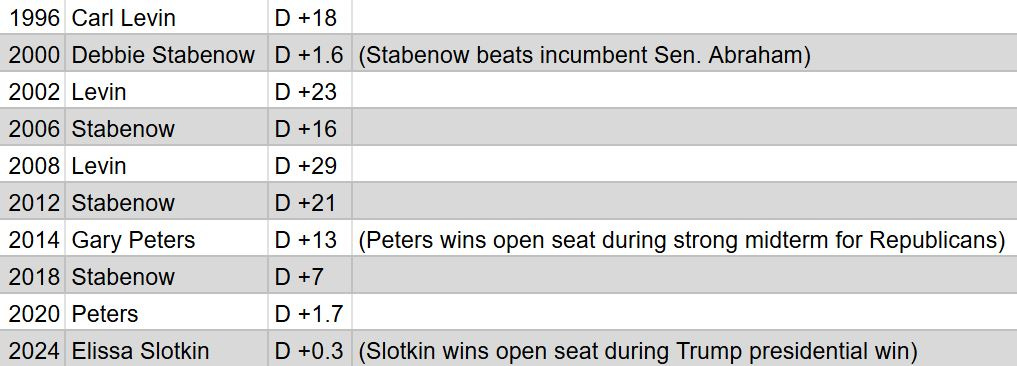
You can see a clear pattern of Republicans gaining ground since 2014—but Democrats have still performed well. They’ve won open seats; they’ve won in midterm elections when Republicans are surging nationally. They’ve won in presidential years when Republicans captured the White House.
They’ve even won an open seat while Trump was carrying the state at the presidential level.
What this tells us is that Michigan is a Democratic state. With an open seat, in a good environment for Democrats, without Trump at the top of the ticket, any replacement-level D should win this Senate seat.2
Probably by > 1.5 percent.
Translation: El-Sayed would have to be worse than a generic Democrat—by at least 1.5 points—in order to lose.
Is he?
2. Results
Start with El-Sayed’s positives.
He’s an excellent speaker and a real political talent.
He ran an insurgent campaign, going from near the rear of the pack to the front.
He beat the entire state Democratic establishment that came out to oppose him.
He was outspent by close to 11 to 1.
That’s a lot of positives. And here’s another one: El-Sayed turned out a lot of voters.
The last time Michigan Democrats had a semi-competitive primary was in 2024. Elissa Slotkin romped with 76 percent of 934,000 votes.
More than 1.5 million people voted in yesterday’s primary. In a primary race in a state where the total number of eligible voters—of both parties—is around 8 million, that’s a lot of excitement; a lot of energy. You have to give El-Sayed credit for a lot of it.
And yet . . .
El-Sayed dramatically underperformed his polls. The last batch of polls had El-Sayed ahead by +13 on average. His worst poll in the final days had him at +8.
As of this writing, he’s ahead by just about 1 percent.
Not the end of the world, maybe. But concerning.
Also concerning is the voting pattern. This race had become a referendum on El-Sayed. He was the main character. He was so far ahead and had so much energy behind his campaign that the question for Democrats wasn’t so much Stevens vs. El-Sayed, but, “Are you sure you want to roll with this guy?”
When Slotkin beat Mike Rogers in 2024, she won by a total of 19,000 votes out of 5.6 million votes cast.
How did she do it? She rolled up huge margins in Wayne, Washtenaw, and Ingham Counties where she won with Saddam numbers. She dominated 8 of the 11 most populous counties.

But she also hung on in the rural counties. Slotkin only dropped below 30 percent in a handful of rural outposts. The difference between hitting 30 percent, or falling to 20 percent, in a county with 5,000 voters isn’t much—500 votes.
But again: She won by 19,000 votes, total. And there are a lot of those small, rural counties.
So the blueprint for a Democrat winning Michigan is:
Absolutely crush with the black vote in Wayne, Oakland, and other dense urban counties, but also . . .
Find every vote you can in the small, rural counties. Lose by 30 points, not 40 points.
El-Sayed only did half of that.
Look at that list up top 👆. El-Sayed lost Wayne and Oakland by >6 points. This tells us that he wasn’t able to excite the African-American voters who are the foundation of the party in Michigan. (Our Jonathan Cohn had his eye on this possibility, and wrote about it last week.)
Now maybe El-Sayed turns out those voters in November. But remember: He doesn’t just need huge turnout in those counties—he needs to absolutely crush the margins.
I am slightly concerned with El-Sayed’s numbers in Macomb, too. Macomb is an affluent white Detroit suburb where Mike Rogers did very well in 2024. El-Sayed lost Macomb by 7 points. He’s going to need to get a bunch of votes out of there and probably can’t afford to lose Macomb by >10 points.
On the rural counties, it’s a mixed bag for El-Sayed.

He did well in places like Iron and Marquette Counties while Stevens won most of the rural counties. But El-Sayed stayed competitive. He didn’t dip below the 30 percent mark anywhere. This suggests to me that rural Democrats are not totally opposed to him. They’ll listen to his pitch and if he connects, then maybe he can get the numbers he needs from the hinterlands.
The final concern for El-Sayed is that Mike Rogers has done this before.
Democrats are dismissive of Rogers as a carpetbagging empty suit. Fair enough. But Rogers ran statewide two years ago and earned a lot of votes. He’s been tested in a high-profile, big-time campaign. There won’t be any bombshells blowing him up. Two years ago he got 48.3 percent of the vote against a quality Democrat. The guy has already convinced 2.7 million Michiganders to pull the lever for him once.
How much is that worth? We have a comp.
In 2018, Republican John James ran for Debbie Stabenow’s Senate seat. He got 45.76 percent of the vote—good enough for 1.9 million votes.
Encouraged by this showing, James ran it back in 2020 for the other Michigan Senate seat. He ticked up to 48.22 percent and 2.6 million votes.
This isn’t straight apples-to-apples. But it’s close. It’s hard to picture Rogers doing much worse in 2026 than he did in 2024. Without Trump at the top of the ticket, he could lose some altitude. But he probably has a hard floor of 47 percent.
Do you like deep-dive analysis that has a point of view but doesn’t pander to your preferences? That’s what we do here, every day. Come ride with us:
Bottom line: We have a bunch of conflicting signals here.
This should be a winnable seat for Democrats in a very good environment.
El-Sayed has real strengths as a candidate.
But he also has work to do, especially with African-American voters.
Mike Rogers may not be the tomato-can people expect.
And the race might turn out to be a close-run thing, determined by less than 50,000 votes.
All in all, I like his chances; but it isn’t a gimme.
Last thing: Another hidden advantage for El-Sayed is that Francesca Hong is going to act as a human shield for his campaign. Every time the media has a “Look at the radical DSA” story, it’ll focus on Hong and El-Sayed will seem mainstream by comparison.
Don’t sleep on this dynamic.
3. Drones
The era of drone warfare is already posing risks to civilian aviation. Yikes.
This past May, a twin-engine Beechcraft King Air medevac plane took off from Roswell, New Mexico, and headed west to the town of Ruidoso to pick up a patient. It shouldn’t have been a challenging flight for the two pilots and two nurses aboard. The temperature was 69 degrees; the sky was clear. The 60-mile journey normally takes a half hour, at most.
But once airborne, the plane ran into trouble. At the White Sands Missile Range that night, US military personnel were conducting a GPS jamming exercise that left the King Air pilots—and anyone else within hundreds of miles—unable to use modern navigation systems. Forced to revert to older technology, ones that they rarely if ever use, the medevac pilots got disoriented and crashed into the side of a mountain. There were no survivors.
The accident marked the first time that GPS jamming had contributed to the crash of a civilian plane in the United States. But it was just one of a string of recent disruptions across the world. The skies are more contested than ever, whether it’s civilian drones wandering out of the approved zone or US agencies getting their signals crossed, as happened earlier this year when New Mexico and Texas scared the public by temporarily closing their airspace. (It turned out that US Customs and Border Patrol were using anti-drone lasers in that area.) The GPS jamming exercise that led to this latest crash is not a singular event. In the past year, the US military appeared to have sent out notices for at least 10 such exercises. “As drone warfare and electronic warfare expand, airlines are increasingly encountering navigation disruptions hundreds of miles beyond the actual conflict zone,” says Eliran Almog, CEO of the cybersecurity firm Cyviation.
I’m extrapolating out to the end of Gretchen Whitmer’s term in 2027.
This may sound cruel, but Stevens strikes me as the living embodiment of a replacement-level Democrat.
I’m going to openly say what we only ever gesture at; I’m always made deeply uncomfortable by the subtext of these conversations; same with Mamdani.
There is a large portion of the American population that does not want to treat Muslims as full citizens of the American country with the same rights and the same responsibilities as anyone else in the country. And whenever we talk about “is $Muslim a good politician?” - well, we need to talk about that, obviously, the stakes are too high to not do that - but I always feel like we concede a bit too much ground by refusing to attack the premise that Mamdani and El-Sayed have as much right to participate in society as anyone else.
This is important enough to me that I always feel… uncomfortable. These are important questions. But it’s important that we maintain the answer to the question that these articles only ever gesture at - “is it acceptable for a politician to be a Muslim?” with “screw you, of course it is.”
JVL, I really appreciate your perspective on Michigan. I understand why so many of us are anxious. El-Sayed is an unconventional candidate who won a close primary, and there are legitimate questions about whether some Michigan voters will respond to his outsider status. Those concerns are real. At the same time, I keep coming back to the thought that what Democrats have been doing for the last several election cycles hasn't consistently produced the results we want. If we're serious about building a durable majority, perhaps we need to be willing to take some calculated risks instead of defaulting to the traditional "safe" or "moderate"playbook. That doesn't mean there aren't risks here. There clearly are. But every new political direction begins as an experiment. If the party is going to adapt to where the electorate may be heading rather than where it has been, this may be one of those moments. Like you, I'm choosing cautious optimism and hoping El-Sayed can put together the coalition needed to defeat Mike Rogers.