The CIA Director Didn’t Read His Own Report
If he had, he would have known that it said basically the opposite of what he says it did.


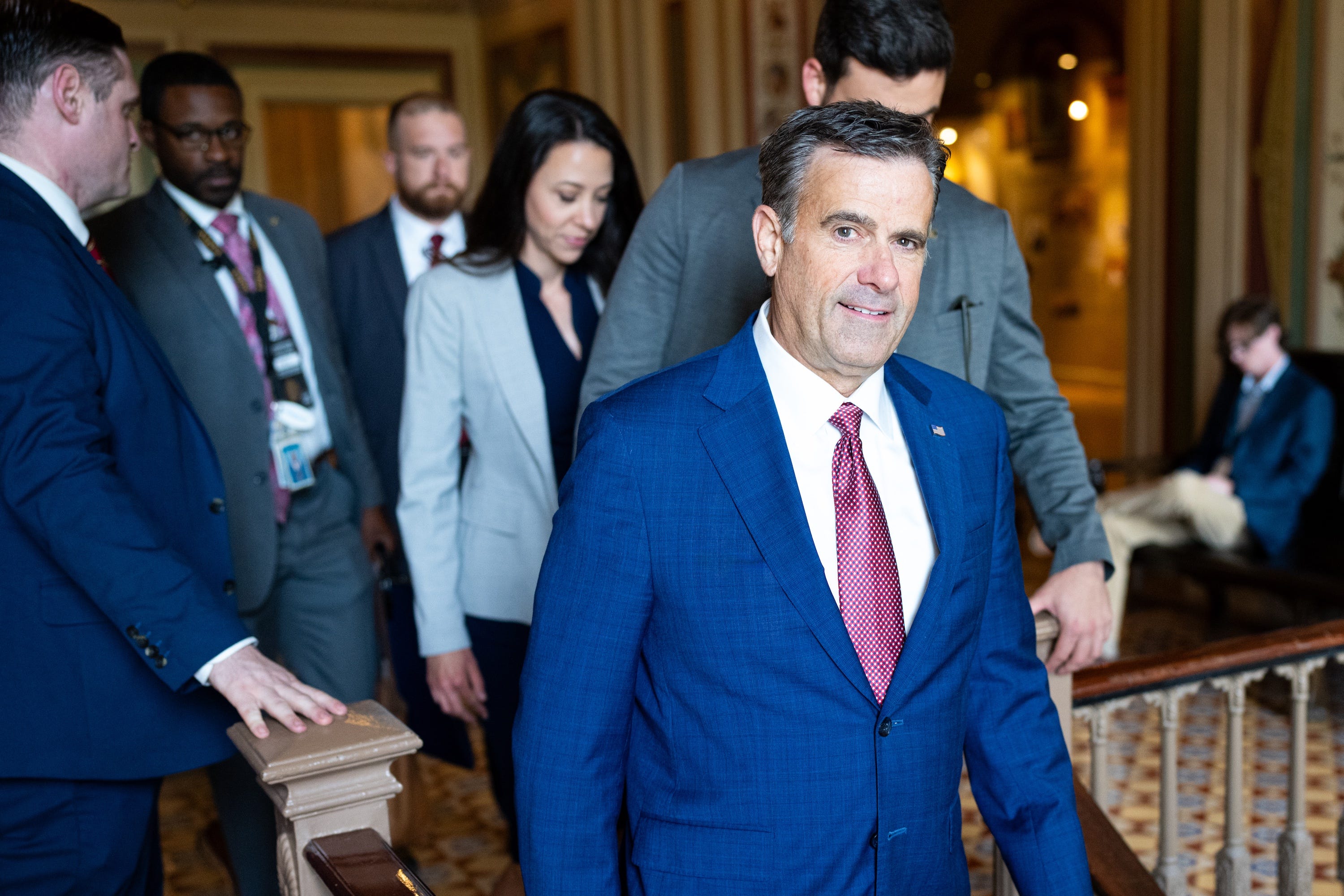
THE FBI HAS LAUNCHED A CRIMINAL INVESTIGATION into James Comey and John Brennan, respectively directors of the FBI and CIA, for an alleged criminality involved in the investigation of the 2016 Trump campaign’s links with the Russian government. Setting the predicate for the investigation, last week, CIA Director John Ratcliffe declassified and released an internal CIA “lessons learned” review of the classified 2016 Intelligence Community assessment (ICA) on Russian interference in the presidential election. While the original 2016 report concluded that Russia interfered in the election to harm Hillary Clinton and help Donald Trump, it did not speculate on whether the efforts actually influenced the election’s outcome.
The newly declassified review is essentially an inside-baseball document intended for a small circle of intelligence analysts—in other words, it’s rather dry. Nevertheless, much like Bill Barr’s misleading framing of the 2019 Mueller Report, Ratcliffe appears eager to impress his boss in the White House by spinning the review as a bold exposé of an alleged deep-state conspiracy.
The CIA director is not a member of the president’s cabinet, and should remain publicly nonpartisan in order to represent the agency and its analysis, which may contradict the wishes of one party or another. Ratcliffe has taken a different tack, touting an explicitly partisan narrative on a media tour through Fox News, social media, and various right-wing outlets. For instance, the New York Post, to which Ratcliffe gave an exclusive interview about the review, declared, “Bombshell Report: Obama’s Trump-Russia collusion report was corrupt from start.” Ratcliffe told them: “This was Obama, Comey, Clapper, and Brennan deciding, ‘We’re going to screw Trump.’”
This behavior is hardly new for Ratcliffe. During his eight-month tenure as director of national intelligence during President Trump’s first term, Ratcliffe became known for partisan posturing and cherry-picking intelligence to help the Trump campaign. He clearly expects that the people he needs to impress will not be able to adequately decipher the recent report, because it says pretty much the opposite of what he is alleging publicly.
IN RATCLIFFE’S TELLING, THE REVIEW uncovers the corrupt manipulation of intelligence by Obama-era intelligence leaders, who supposedly spread a lie that Putin’s Kremlin interfered in the 2016 election in coordination with the Trump campaign. Ratcliffe characterized the 2016 intelligence community assessment as blatant politicization of intelligence that was “unprecedented in American history.” According to Ratcliffe, “All the world can now see the truth: Brennan, Clapper and Comey manipulated intelligence and silenced career professionals—all to get Trump.” Commenting on the review, a Republican congressman claimed that the CIA had sought from the beginning to “manufacture the Trump/Russia collusion narrative,” when in fact the CIA was probably late to the Russian interference story.
Ratcliffe was probably hoping for explosive findings when he commissioned the review. Perhaps he was even counting on them. But it’s not clear that he actually read—or understood—what the review said. Nowhere does it conclude that the 2016 assessment’s findings were wrong or politically skewed. The report made no recommendations for disciplinary measures or corrective action. In fact, it did the opposite—it found that the supporting intelligence was sound, and the tradecraft behind the assessment was robust and defensible. For intelligence insiders, that’s code for “we did a good job.”
Every autopsy reveals some kind of latent issue. The point of a “lessons learned” review such as the one Ratcliffe ordered isn’t for the agency to pat itself on the back, but to uncover lessons to learn—to reveal potential weaknesses and suggest potential repairs, even if everything worked flawlessly. These are internal documents meant to improve processes. And while the findings do not support Ratcliffe’s partisan narrative, the recent review highlights potential risks and offers cautionary advice for professional analysts.
THE MAIN CONCERN HIGHLIGHTED in the recent review relates to the short timeline between when the 2016 intelligence assessment was commissioned and when it was issued. Specifically, the review stated:
Without a clear operational need for urgency, this accelerated process created vulnerabilities and opened lines of inquiry about potential bias. . . . A more measured approach with expanded time for review and wider input would have better adhered to standard intelligence tradecraft practices and potentially deflected questions about White House motivations.
This concern is unsurprising. Any analyst (or anyone, really) would prefer to work with more time and less pressure. It’s true that major analytical papers often take longer to draft, and it is reasonable to believe that Brennan and President Obama prodded analysts to complete the assessment quickly. Similarly, the level of senior involvement in the 2016 assessment was unusual. As the review notes, this exceptional level of senior engagement had the potential to influence participants, alter normal review processes, and ultimately compromise analytic rigor.
What the review fails to mention however, is why the assessment was rushed, or why there was so much high-level attention. As later confirmed by the Mueller Report “the Russian government interfered in the 2016 presidential election in sweeping and systematic fashion,” a conclusion later confirmed by the bipartisan Senate Intelligence Committee, which also noted that top Trump campaign officials’ actions “represented a grave counterintelligence threat.” Faced with the unprecedented situation of an incoming president-elect possibly compromised by a hostile foreign power who could quash any fair examination of Russia’s role, intelligence leaders were navigating extraordinary circumstances.
At the same time, the review also underscores the professionalism of the analytic community as they painstakingly debated the meaning and impact of specific words and judgments. For example, it challenges the analytical conclusion that, in 2016, Vladimir Putin “aspired” to help Trump win. Looking back at the underlying reporting, the authors note that “Most analysts judged that denigrating Clinton equaled supporting Trump; they reasoned that in a two-person race the tradeoff was zero-sum. This logic train was plausible and sensible, but was an inference rather than a fact sourced to multiple reporting streams.” In other words, can the intelligence community definitively conclude that Putin wanted Trump to win, or is it safer to say he wanted to harm Clinton and sow discord in America?
A more serious charge in the review is the choice to include a reference to the “Steele Dossier” in the 2016 assessment. According to the declassified review, FBI leadership insisted on the dossier’s inclusion, repeatedly pushing to include references to it in the report. The ICA authors and multiple senior CIA managers strongly opposed including the dossier, asserting that it did not meet even the most basic tradecraft standards. Ultimately, agency heads decided to include a two-page summary of the dossier as an annex, with a disclaimer that the material was not used “to reach the analytic conclusions.” Still, referencing the dossier implicitly elevated unverified claims to the status of credible evidence, potentially compromising the integrity of the judgment. But again, it is hardly proof of malign or partisan intent.
Nonetheless, despite the serious risks presented by the highly charged political and security atmosphere of the time, Ratcliffe’s review does not conclude that the shortened timeline or involvement of senior officials corrupted the process. On the contrary, it praised the 2016 assessment’s “strong adherence to tradecraft standards” and its “extensive sourcing,” adding that its “analytic rigor exceeded that of most IC assessments.”
This is hardly the bombshell that Ratcliffe alleged.
AS TRUMP TOOK OFFICE FOR THE SECOND TIME, many observers speculated that Ratcliffe was a reasonable choice to administer the CIA, at least compared to some of Trump’s other unqualified appointees. But it’s now clear Ratcliffe is perfectly comfortable spreading craven, partisan nonsense like his fellow MAGA believers. His recent antics demonstrate—as if there were any doubt—that he’s more interested in pandering to the president’s base than in protecting the integrity of the intelligence community.
Ratcliffe’s latest gambit makes him look foolish. He’s trying to turn a serious position dedicated to the truth and protecting the Constitution into a position from which he can shitpost to win the favor of one old man. And he’s not even doing it very well. Worse, by politicizing the work of his workforce, he’s squandering his opportunity to lead a proud institution. While he may assume that President Trump and loyal supporters won’t actually read the review he commissioned, the CIA workforce now knows that he will gladly run them over in his race to appease the president’s partisan whims.
 | A guest post by
|
 | A guest post by
|