
Before we start: Earlier this week Tim talked about a family currently being held in an American internment camp in Texas. Freddys Padilla Revilla, Edgarianny Cortez Gervis, and their 7-year-old daughter came to America from Venezuela legally. They went through the system, settled in Texas, and worked legally.
When they learned that Edgarianny was pregnant this summer, they decided to go back to Venezuela. They saw the writing on the wall. So they went through all the proper government channels to execute a “self-deportation.” Because even leaving the American immigration system is a mess.
On July 6 they went to their ICE check-in appointment after being told they were approved to self-deport. Instead of being given travel documents, they were arrested.
This father, his pregnant wife, and their daughter have been held in an American prison camp ever since. Edgarianny has no access to prenatal care. Their daughter barely eats and has told her parents she wants to die.
Our government is doing this in our names. To a family that followed all of our laws and then made their own decision to leave America when it was clear that we no longer wanted them.
Freddys and Edgarianny have written to Sen. Katie Britt asking for help, since Britt told the New York Times that she’s concerned about the welfare of immigrant children. You can read their letter here.
Here’s my ask: Please reach out to Katie Britt’s office, respectfully, and encourage her to help this family. Here are a few ways to do it either over the phone or via email:
Katie Britt’s office: 202-224-5744
Britt’s chief of staff: Sean_Ross@britt.senate.gov
Her subcommittee clerk Dave Roth at 202-224-4319
Again: Please be civil and respectful. This family needs Britt’s help.
Thanks, fam.
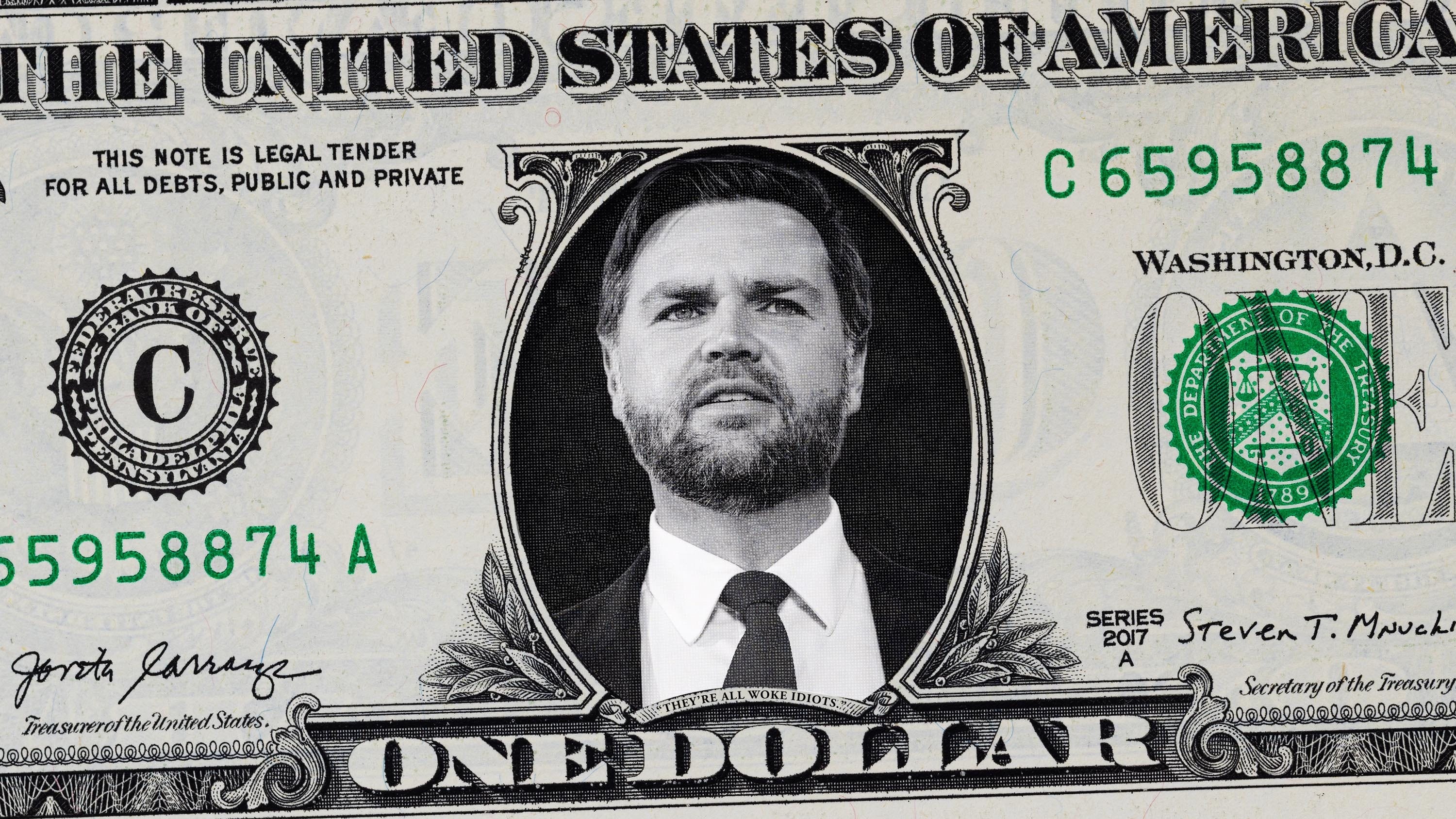
1. De-Dollarization
I hope you enjoyed the candy yesterday because I’m gonna force a pound of spinach down your gullet today.
Last week a friend sent me a link to a conversation JD Vance had three years ago with the MAGA think tank American Moment. This was before he was Trump’s vice. Before the Iran war. Before the Ozempic, even. It was the halcyon days of the Biden administration when the worst thing happening in America was the collapse of Silicon Valley Bank.
Maybe you remember Silicon Valley Bank? At the time, people like Vance warned that it was another of Sleepy Joe’s failures and would crater the economy. It wasn’t, and it didn’t. The Biden administration handled the situation responsibly. There was no contagion.
I want to draw your attention to two things from this talk. (The relevant sections are here.)
The first is Vance’s populist view of Silicon Valley Bank. At one point in the conversation he’s asked how regulators failed to anticipate the bank’s instability. Here’s his response:
“Because they’re all woke idiots.”
Really. That’s it. He blames a bank failure on “woke.”
After he does that, though, Vance talks about how ZIRP—the times when interest rates were set at zero—supercharged finance and tech and how bad this is:
In a super-low interest rate environment . . . capital flowed to, it flowed to two industries to an extraordinary degree: finance and tech. . . . QE [quantitative easing] was a massive, massive subsidy to finance and tech. . . .
[Y]ou can’t have a financial system that creates a massive asset inflation for the banks and for the tech companies and then when there’s a correction basically come in and say ‘Well, we’re going to protect you from the downside risk,’ right? That’s socialized risk. Socialized loss and privatized reward. That’s how you get the pitchforks.
I don’t necessarily disagree with this analysis. There’s just one problem: JD Vance is a cat’s paw for finance and tech.
Vance isn’t much more than a biological asset belonging to Peter Thiel. The world of finance was two fists in on the Trump 2024 campaign. Most of Silicon Valley—from Palantir, to OpenAI, to Meta, to SpaceX and the Elonverse—have chosen to collaborate with the Trump administration.
JD Vance has eagerly participated in socializing risk and privatizing reward at a scale never seen before.
The shamelessness of this guy is breathtaking.
Which brings us to the second thing that caught my eye: JD Vance says he thinks it’s bad that the dollar is the world’s reserve currency.
Here’s JD on the supremacy of the dollar:
I am not sure that I think the reserve currency is actually good for the United States of America. I think there is a good argument that reserve currency status is akin to coal in Appalachia. It’s a resource curse, right? It allows your consumers to consume very cheaply, right? That’s been the story of the American economy for the last fifteen or so years, even before that, is we can just borrow, basically in an unlimited way because we have the reserve currency. So that’s a massive subsidy to incurring debt. The debt is cheaper even in raised interest rate environments. That’s one of the crazy things about what’s going on right now is the market is in some ways pricing future interest rates lower than what the Fed is right now. That’s kind of weird. So we have this massive subsidy to cheap debt for the American consumer.
That is a . . . take.
You guys know how obsessed I am with the reserve status of the dollar. And there is an argument to be made that the true value of owning the world’s reserve currency is less than people like me believe. I’m open to that.
But the idea that holding the reserve currency is a curse? That Americans would be better off if China controlled the world’s reserve currency?
Wow.
At least on this one, JD’s actions are in line with his words. He’s helping prosecute the Iran war, which is helping to slowly de-dollarize the world.
JD Vance is a dumb person’s idea of what smart people sound like.
2. Limbic Capitalism
A couple weeks ago a friend introduced me to the idea of limbic capitalism, which he proposed as an explanation to a great deal of what we see in America today: From Donald Trump, to Fox News, to Kalshi and the ubiquity of sports betting.
Limbic capitalism is a concept popularized by historian David Courtwright in his 2019 book Age of Addiction. It’s an idea that sits at the intersection of brain chemistry and economics.
The limbic system is the network of structures in the brain that handle emotional processing and memories. It’s central to addiction. The limbic system is the part of your brain that (a) processes how good some thing (food, sex, heroin, winning a bet) makes you feel and then (b) links it to the memory of that thing.
Hey: I left today’s newsletter free for everyone because spinach is good for you and if I had to write about Natalie Harp every day I’d jump in front of a bus. If you like eating your vegetables, show me by joining Bulwark+.
C’mon, do it. Right now. I dare you. 😉
Addiction is an idiosyncratic state. Not everyone who tries an addictive thing becomes an addict. Not everyone who abuses a thing is an addict. Addicts can quit their addictive behaviors. Genetic predisposition plays a huge role in addiction. But so do environmental factors. For instance: If Sally is exposed to an addictive substance or behavior at the age of 13 she might become an addict; but if she isn’t exposed to that same substance or behavior until she’s 50, she might not.
With all of those caveats, there are some broad truths about addiction: We know that genetics do play a role. We know that some substances or behaviors are more addictive than others. We know that timing of first exposure does tilt the odds.
That’s the backdrop.
Courtwright takes this basic understanding of addiction and overlays it with market economics.
Some of this is well understood by everyone, the most obvious example being cigarettes. For generations the tobacco industry profited by selling highly addictive products. The industry specifically targeted young users to increase the chances of creating addiction.
But there’s a whole class of industries, colloquially thought of as “sin” categories, over which the government exercised special regulation. Sex, alcohol, drugs, tobacco, gambling. We didn’t have a scientific understanding of addiction, but we knew it when we saw it. Society intuited that something about, say, booze, created a category difference. Americans realized that we should regulate alcohol in ways we did not regulate ball bearings.
What Courtwright does is put all of the idiosyncrasies together and propose a systemic concept: limbic capitalism.
Limbic capitalism refers to a technologically advanced but socially regressive business system in which global industries, often with the help of complicit governments and criminal organizations, encourage excessive consumption and addiction. They do so by targeting the limbic system, the part of the brain responsible for feeling and for quick reaction, as distinct from dispassionate thinking. The limbic system’s pathways of networked neurons make possible pleasure, motivation, long-term memory, and other emotionally linked functions crucial for survival. Paradoxically, these same neural circuits make possible profits from activities that work against survival, businesses having turned evolution’s handiwork to their own ends.
Age of Addiction is a re-examination of history through this lens.
Because the book was published in 2019, it barely notices the Trump era in American politics. But I can’t help wondering if MAGA, too, is an example of limbic capitalism.1
Fox, Twitter/X, Facebook, Truth Social—the entire Trump ecosystem in which the president is not a distant, staid figure but a constant source of dopamine hits touching your pleasure centers—what if American politics is now operated in the mode of limbic capitalism?
Oh come on. Just sign up already. This is the good stuff.
Sit with that for a bit and then tell me your thoughts. Maybe it’s always been thus. After all, what is a demagogue if not a political figure who hacks the electorate’s limbic system?
But Courtwright argues, convincingly, that while addiction has always been with us, the infrastructure of limbic capitalism—the mass consumer culture, the emergence of digital communication—is relatively novel. (Meaning: New to the last couple hundred years or so.)
Is it possible that novel developments in American society are also creating a new kind of limbic politics, modeled on limbic capitalism?
I’m looking forward to your conversation on this.
3. Catch
This was not the best time for me to read this essay. But maybe it was the right time for me. And maybe the right time for you, too.
[B]aseball is something you inherit from someone, whether it’s your parent, grandparent, aunt or uncle, or even your persistent friend who begs you to come out to the ballyard some Sunday afternoon. . . . You don’t stumble into being a baseball fan; you’re led.
If you became a baseball fan when you were a child, it probably involved a game of catch. I think my uncle was the first one to really play catch with me, but I also played with my dad plenty. At some point, though, you have your last game of catch with your father. You typically don’t know it. It’s something the two of you have always done, but over time, you play less and less catch. Suddenly, you haven’t played in years. And you didn’t even know it. Maybe it’s when you left for college. Maybe it’s when you hung up your glove after two agonizing years of tee ball. Maybe your dad throws out his shoulder, as many middle-aged men do, and you never get back to it. Maybe Dad left too soon, earlier than either of you hoped or expected. . . .
I had the privilege of knowing I was playing catch for the last time with my father. When I was 24, and Dad was 58, he was diagnosed with early-onset Alzheimer’s. . . .
A few months after his diagnosis, I was visiting home. My younger brother was spending the summer in our hometown before leaving for graduate school, and we’d planned to play catch that afternoon. My brother called me a bit later, saying he’d gotten busy with some friends and not to wait up for him. So my dad, sensing the opportunity, asked if I’d like to play catch for a bit.
I have no idea when he’d last thrown a baseball, let alone when we’d last played catch together. His arm was shot from years of throwing us batting practice, and I’d hung up my cleats after my junior year to focus on other sports.
I clocked what was happening in the moment, and I think he did, too. He made it through about ten overhand throws, his shoulder stiff from years of disuse, before switching to underhand. We played for maybe ten minutes before putting our gloves away for good. But for those ten minutes, we were both 20 years younger.
It’s been seven summers since that game of catch. By his 59th birthday, he required a walker to get around, after a lower back injury that he never recovered from. These days, Dad doesn’t do much talking. Or moving. Or even looking around. Once in a while, on a good day, you’ll look him in the eyes, and you’ll know that he knows who you are.
We both knew we’d reach a day like today. So I like to think something divine kept my brother away from our backyard that day. We both needed that game of catch. To this day, I consider myself the luckiest man on the face of the earth to have had it—tied for first place with thousands of people I’ll never meet, and with Dad.
My story isn’t special. As I said, most people reading this of a certain age or experience have their own version of this story. There are an enormous number of people who would do anything to play catch with Dad one more time. I suspect many baseball fans think about exactly that every time the Field of Dreams game is played in Dyersville, Iowa. There’s the beauty of the players walking out of the corn, but there’s also the reminder of that final question. Hey, Dad. Wanna have a catch?
I’d planned on telling a version of this story about the man who coached me not only in baseball, but also in football, basketball, and track, at a later date. You know, that later date. But Thursday’s Twins-Phillies game hit home for me in a way that I wasn’t expecting. Every time MLB plays a game in that corn, I lower my head and shed a tear thinking about my own father.
But this time was different. Because when I lowered my head on Thursday to think about the big strong man that I used to play catch with, I saw my own newborn daughter, my firstborn, sleeping in my lap. She’d been born less than a week before; it was her first Twins game sitting in front of the TV with me.
Read the whole thing. I’m not crying, you’re crying.
If Rush Limbaugh’s career wasn’t an example of limbic capitalism, then I don’t know what is.
JD Vance is the king of knowing a little bit about a lot of things, and very little about important things.
I'm going to talk about JD Vance's stuff about the dollar as reserve currency being a curse. This is, patently insane.
It's also a form of insane that we can't explain to anyone else. The Sarah Longwell-types of the world will insist that we, as the educated, responsible people, have a responsibility to explain to the Cleti of the world how and why America's dollar being the reserve currency is good.
I cannot possibly understand how anyone could fail to understand 'selling someone ink and paper for $100 is a pretty good deal, that's why counterfeiters like to do it', but hey, apparently that happens.
How are we supposed to 'explain' it to them when educational polarization means they see our endorsement of something as a reason not to do it? If we tell someone not to whizz on an electric fence, and they say 'I'll show you, cuck' and electrocute themselves to death, is that somehow our fault for not being respectful enough of them?
Because that's where this argument is going.