The Empire Putin Tried to Rebuild Is Coming Apart
Russia’s “little brothers” are growing up.

MAY HAS BEEN A CRUEL MONTH for Vladimir Putin, between the embarrassment of a truncated Victory Day parade on Red Square, the reports of Russian troops stalled in Ukraine, and now Ukrainian drones sowing fear in Moscow and its environs. But there is other bad news for the Kremlin dictator as well: some stark reminders that he is losing his grip on former Soviet republics once content with dependency on the Russian “big brother.”
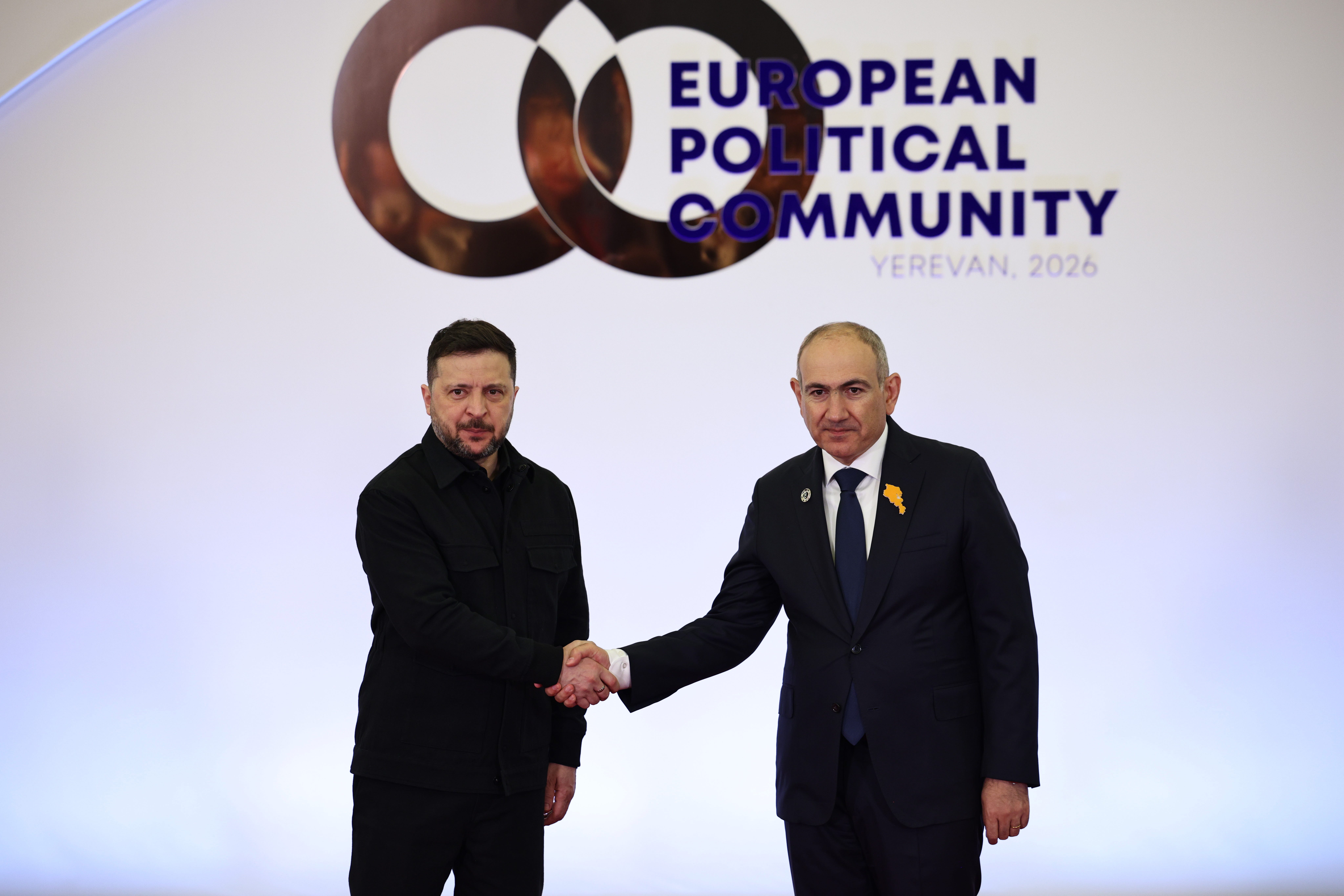
This shift is playing out most dramatically in Armenia, which is heading into June 7 parliamentary elections that pit the pro-Western party headed by Prime Minister Nikol Pashinyan against several Russia-friendly opposition parties. Pashinyan had long sought to maintain a delicate balance between Russia, with which Armenia has extensive economic ties, and Western powers. But the chill between him and Putin has been growing for a while. On May 9, Pashinyan was conspicuously absent from the dreary Victory Day celebrations in Moscow, citing campaign events. Just days earlier, he had presided over the first-ever European Political Community Summit in the capital of Armenia, Yerevan, where he mingled with EU leaders such as Emmanuel Macron and Volodymyr Zelensky—and stressed that Armenia was “not Russia’s ally on the question of Ukraine.” And, while Pashinyan had visited Moscow in April for an ostensibly amicable meeting with Putin, he had coolly rebuffed Putin’s complaints about the supposed persecution of pro-Russian politicians in Armenia with a thinly veiled dig at his host, noting that Armenia had not only free and competitive elections but “100 percent free” social media.
One might have thought that the unpleasant Armenian issue would be strenuously avoided in Moscow on May 9. Instead, it was highlighted: At Putin’s post-parade press conference, a reporter for the state television channel Rossiya asked Putin to comment on Pashinyan’s absence and his hosting of Zelensky in Yerevan. (There is approximately zero chance that this question was not coordinated in advance.) In response, Putin downplayed the non-attendance (It’s no big deal! We actually didn’t invite anyone because this wasn’t a special event like last year’s eightieth anniversary!) and asserted that Armenia’s path to the EU was “nothing extraordinary,” either: “I have told [Pashinyan] several times, and can publicly repeat, we will support anything that benefits the Armenian people,” including a polite divorce with Russia.
Then came the inevitable “but”: Given Armenia’s extensive trade with Russia, Putin went on, the issue of EU membership really ought to be put to a referendum. And anyway, he added, remember “everything that’s happening on the Ukrainian track”? Remember how it all started? That’s right, with “Ukraine joining, or trying to join, the EU.” And look what happened next! “A coup, the Crimea incident, the positioning of southeastern Ukraine, and the military action—that’s where it all led.” Of course Putin was blaming Western malfeasance, but the coded threat to Armenia was still transparent: Nice little country you got there. Shame if it got reduced to rubble.
Other high-level Russian officials, from Duma speaker Vyacheslav Volodin to foreign minister Sergei Lavrov to foreign ministry spokeswoman Maria Zakharova, have followed up with even more belligerent messages in recent days: charges that Armenia is being “subjugated” by the West and force-fed “liberal values,” warnings that the country is in danger of losing its sovereignty and its spiritual foundations, and personal attacks on Pashinyan himself. Meanwhile, Russian authorities have by total coincidence found dangerous pests or harmful chemicals in imported Armenian fruit, vegetables, dairy products, cognac, and flowers. And Kremlin bots in Armenian internet spaces have been busy spreading anti-Pashinyan fakes from their familiar dog-eared playbook: allegations of corruption, rumors about grave health problems, or dire warnings of warmongering plans for confrontation with Russia.
And yet all this bluster and intimidation may come from a place of weakness more than strength. “We can see that Russia is very nervous, it’s throwing fits, it’s freaking out,” Armenian political analyst and activist Ruben Mehrabyan told the RFE/RL-affiliated Russian-language webcast Current Time. “And it’s finding it harder and harder to hide those reactions.”
THE WARNING THAT ARMENIA may be heading in Ukraine’s direction are especially ironic given that the current chill between Moscow and Yerevan almost certainly has its roots in Russia’s war in Ukraine. Until a few years ago, Russia positioned itself as Armenia’s protector, particularly in its conflict with Azerbaijan over Nagorno-Karabakh, an Armenian-populated enclave that has been the subject of violent disputes since the late 1980s. In November 2020, Russia, Armenia and Azerbaijan had signed a three-way agreement under which the enclave’s security was to be guaranteed by Russian peacekeeping troops. In March 2022, shortly after the Russian invasion of Ukraine, minor skirmishes in the region resumed. In September 2023, Azerbaijani forces entered Nagorno-Karabakh and took complete control of the territory in a day, with no resistance from the small contingent of Russian peacekeepers and no additional peacekeeping troops dispatched to help. Nagorno-Karabakh was ethnically cleansed and incorporated into Azerbaijan in October; the Russian armed forces were busy elsewhere. Today, Pashinyan may still pay lip service to Putin’s diplomacy, but anger at Moscow’s perceived betrayal in Armenia is widespread. Ekaterina Kotrikadze, foreign policy analyst for the expatriate Russian channel TV-RAIN, reports that today, this lingering resentment is causing the Kremlin’s efforts at subversive propaganda to backfire.
The other irony is that, while Russia is losing Armenia (still formally a member of the Moscow-led Collective Security Treaty Organization), its relations with Azerbaijan have deteriorated even more—especially after the downing of an Azerbaijani airplane by Russian air defenses in December 2024 and Russia’s subsequent closure of the investigation into the crash. At an international forum in Baku in April 2025, Azerbaijani president and onetime Putin ally Ilham Aliyev voiced strong support Ukraine and its efforts to regain its occupied territories; a year later, Zelensky visited Azerbaijan to sign cooperation agreements with Aliyev.
It must be said that, however ridiculous Trump’s attempts to claim the glory of ending the war between Azerbaijan and Armenia—which had been over for nearly two years due to Armenia’s surrender of its disputed region—he does deserve some credit for brokering political and trade deals that have pulled both countries farther away from Russia and closer to the West. His motives may be opportunistic and egotistical: investment opportunities, that elusive Nobel Peace Prize, or simply a chance to slap his name on yet another location (for real: the Trump Route for International Peace and Prosperity, or TRIPP, connecting Central Asia to Turkey and Europe). But the outcomes so far are positive and, for once, genuinely damaging for Putin, both in terms of the weakening of his position in the post-Soviet space and in terms of loss of face.
One still-open question is whether Trump’s wooing of Belarusian dictator Alexander Lukashenko, however morally repugnant, may pay off in similar ways. Lukashenko has long perfected the fine art of balancing between the Kremlin and the West. At the moment, Putin is unsubtly pushing him, as Zelensky recently warned, to join the war on Russia’s side. But while Lukashenko may be willing to take symbolic steps such as Monday’s joint nuclear weapons drills with Russia, he is very unlikely to let himself get drawn into Russia’s Ukraine morass, especially at a moment when the fortunes of war seem to favor Ukraine.
Putin started the war in Ukraine in a deranged attempt to rebuild the Russian (or Soviet) empire; more recently, he has staked his hopes on a partnership with Trump that would hand him a victory and cement his control over his “sphere of influence.” It will be truly karmic if the results of this war, and of Trump’s ego-driven quest for foreign policy achievements, end up destroying the Russian vassalage in the post-Soviet “near abroad” that was the last vestige of this empire.
We didn’t “finish the job” of economically reforming the historically brutal and dishonest Soviet Union when we had the chance from November 1989 to sometime in 1991. We got distracted by whatever was shinier and more instantly gratifying. But now, these decades later, Russia destroys itself. Six of one, half a dozen of the other, I guess.
Love watching Putin’s world crumble.