
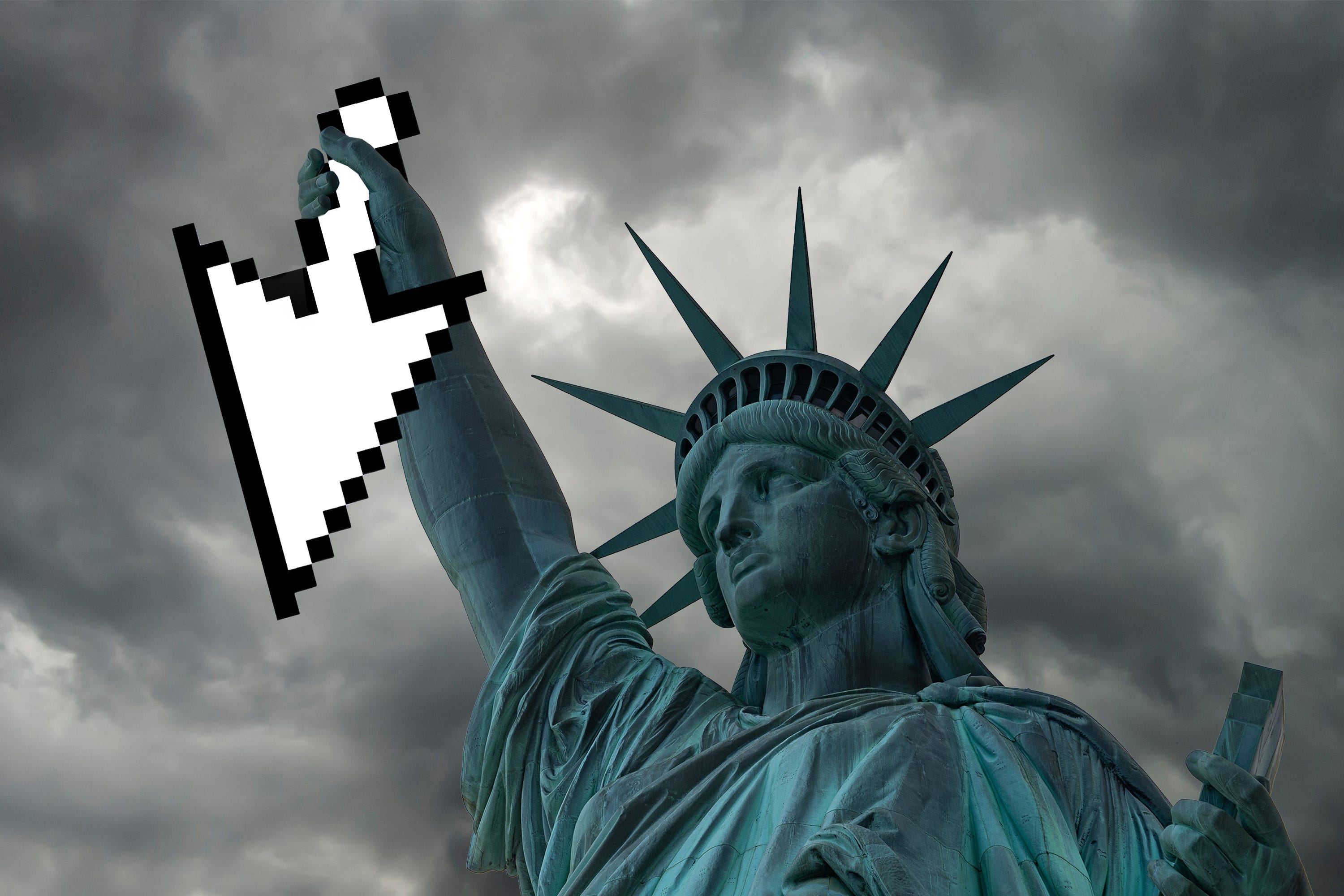
1. We’ve Got Spirit
Last week on Receipts Live with Catherine Rampell I said I was glad that Spirit Airlines was dead.
Let me clarify.
I don’t like it when people lose their jobs, so I’m sorry that the people employed by Spirit are out of work. But I’m happy that the corporate entity that was Spirit is gone.
Because Spirit sucked balls. And when a terrible company goes out of business, it’s a sign that the marketplace determined it wouldn’t tolerate their suckiness.
And I find that . . . hopeful? For America?
Today we’re going to have a high-concept conversation about business and airlines and tech companies and entropy and liberal democracy. It’s going to be a journey. I hope you’ll take the ride with me.
A few years back Cory Doctorow proposed the theory of “enshittification” to describe how Amazon had become significantly worse:
In Bezos's original plan, the company called “Amazon” was called “Relentless,” due to its ambition to be “Earth’s most customer-centric company.” Today, Amazon is an enshittified endless scroll of paid results, where winning depends on ad budgets, not quality. . . .
Search Amazon for “cat beds” and the entire first screen is ads. One of them is an ad for a dog carrier, which Amazon itself manufactures and sells, competing with the other sellers who bought that placement.
Scroll down one screen and you get some “organic” results – that is, results that represent Amazon’s best guess at the best products for your query. Scroll once more and yup, another entire screen of ads, these ones labeled “Highly rated.” One more scroll, and another screenful of ads, one for a dog product.
Keep scrolling, you’ll keep seeing ads, including ads you’ve already scrolled past. “On these first five screens, more than 50 percent of the space was dedicated to ads and Amazon touting its own products.”1 . . .
How did we get here?
The answer, Doctorow proposed, was that Amazon had built a $31 billion ad business inside its own retail platform. The incentives for Amazon went from “give customers the most helpful results so they’ll buy the most stuff” to “sell as many ads against products as customers will tolerate so that:
[ad sales profits] > [retail sales losses from abandoned searches]
Amazon got shitty because it got so big that it achieved both monopoly and monopsony powers: It had control over both buyers and sellers. Which allowed it to start extracting rents from each.
Which made Amazon worse, but also made it lots more money. When a platform is no longer beholden to either side of the transaction, the incentives change. Instead of aiming high to deliver better products, the platform aims low to find the worst pain threshold users will tolerate.
Doctorow expanded his thesis to describe how enshittification was eating the entire tech world and would go on to eat the rest of the world, too. Here he is in the Financial Times in 2024 inching toward a Grand Theory of Enshittification:
We’re all living through a great enshittening, in which the services that matter to us, that we rely on, are turning into giant piles of shit. It’s frustrating. It’s demoralising. It’s even terrifying. . . .
It’s a three-stage process: first, platforms are good to their users. Then they abuse their users to make things better for their business customers. Finally, they abuse those business customers to claw back all the value for themselves. Then, there is a fourth stage: they die.
Spirit Airlines was not a tech company and it did not have a monopoly. But it was a company driven by the ethos of enshittification. Spirit’s business model was:
How much crap can we force customers to put up with before they are so annoyed that they pay us more money?
I am a fan of no-frills, discount air carriers. Southwest has been, for decades, one of the best airlines in the business. But Southwest’s strategy has always been:
How do we deliver the best-possible service for the lowest-possible price?
Spirit went out of its way to make the customer experience worse, hoping to inconvenience customers so much that they could upsell remedies—hiding the true cost of a ticket. Spirit’s secret sauce was disguising rotten apples as oranges to confuse shoppers.
This was an attempt to enshittify air travel. So yeah, I’m glad Spirit is gone. Because it’s a signal to other companies that, at least in the air-travel market, consumers still have the power to reject—and defeat—enshittification.
2. The Cycle
I want to unpack that three-step enshittification process Doctorow talked about. In his FT piece, Doctorow uses Facebook as an example.
Step 1: Good for Users
As a startup, Facebook wasn’t first, so it competed on differentiation. As Doctorow explained:
When Facebook started off, it was only open to US college and high-school kids with .edu and K-12.us addresses. But in 2006, it opened up to the general public. It effectively told them: Yes, I know you’re all using MySpace. But MySpace is owned by a billionaire who spies on you with every hour that God sends. Sign up with Facebook and we will never spy on you. Come and tell us who matters to you in this world.
That was stage one. Facebook had a surplus — its investors’ cash — and it allocated that surplus to its end users. Those end users proceeded to lock themselves into Facebook.
Facebook achieved hockey-stick growth during this period.
Step 2: Good for Businesses
After a company establishes a dominant user base by leveraging investor cash to sustain unprofitability, it pivots to monetizing its audience. Which is what Facebook did.
To the advertisers, Facebook said: Remember when we told those rubes we wouldn’t spy on them? Well, we do. And we will sell you access to that data in the form of fine-grained ad-targeting. Your ads are dirt cheap to serve, and we’ll spare no expense to make sure that when you pay for an ad, a real human sees it.
Suddenly Facebook got bad for users, but at least it delivered value for its paying clients.
The problem is, once Facebook had its hooks into businesses, it pivoted again.
Step 3: Good for Facebook
Here’s Doctorow:
Users, advertisers, publishers — everyone was locked in. Which meant it was time for the third stage of enshittification: withdrawing surplus from everyone and handing it to Facebook’s shareholders.
For the users, that meant dialing down the share of content from accounts you followed to a homeopathic dose, and filling the resulting void with ads and pay-to-boost content from publishers. For advertisers, that meant jacking up prices and drawing down anti-fraud enforcement, so advertisers paid much more for ads that were far less likely to be seen. For publishers, this meant algorithmically suppressing the reach of their posts unless they included an ever-larger share of their articles in the excerpt. And then Facebook started to punish publishers for including a link back to their own sites, so they were corralled into posting full text feeds with no links, meaning they became commodity suppliers to Facebook, entirely dependent on the company both for reach and for monetisation.
Enshittification is not new. Once upon a time, everyone in America hated the phone company.2 In the 1970s, everyone hated General Motors.3 In the 1990s, everyone hated the cable company. We all recognize the pattern of legacy companies maturing to the point where they deliberately antagonize customers/users because there’s money to be made that way.
You might even say that this cycle is baked into capitalism. That it is part of why we get creative destruction and the progress that emanates from it. We take one step backward so that eventually we can take two steps forward.
And I’m open to that. Truly.
But I want to shift lenses here and ask a different question: Could the enshittification process apply to a democracy?
If you’re enjoying the ride so far, I hope you’ll consider joining Bulwark+ and supporting what we do here. Thanks.
3. The History of U.S.
Let me tell you a highly stylized version of the American story.
In the beginning, there was a startup called the United States, which we’ll refer to by its stock-ticker symbol, USA. It was young, scrappy, and hungry and needed to figure out how to deliver value to its citizens users.
So it did a bunch of things: It created a central bank. It expanded its territory. It established mass communications (the postal service) and roads and public education. Eventually, it took the painful step of expunging slavery.
This startup grew in size and productivity and market cap. Its user base became enormous. After about 160 years, USA became the biggest company on the planet, at which point it achieved a bunch of important network effects. Because USA benefited from free trade, it developed a military that could enforce a globalized system of free trade. Capital—both human and financial—flowed into USA. People—both users and clients4—loved USA. And for another 70 years it delivered good results for both. Its stock couldn’t have been higher.
But then USA went down the road toward enshittification.
No one is quite sure when it started, but at some point people realized that USA was no longer interested in making users’ lives better. Instead, it had decided to see just how much pain the user base would tolerate before it abandoned the platform. USA had become half Spirit Airlines, half Facebook, and half cable company.
And USA’s business clients—the other countries who had bent over backwards to get access to USA’s platform and user base—resented it and began looking for alternatives as they were also abused.
As a result, USA saw its position in the market decline.
Let’s not get too bogged down with this metaphor, though, because what I want to focus on are two questions about the United States as a platform.
4. Enshittified USA
Let’s stipulate that there was never a true golden age for our company, USA. Every era is filled with hardship, tragedy, and corruption. When you look at the long sweep of history, sure, the line has moved up and to the right. But when you zoom in to any one time period, it always looks like we’re just muddling through.
Even with that in mind, though, doesn’t it seem like our company, our platform, our country has been . . . getting worse, on balance, for coming on a quarter of a century?
It hasn’t been universally worse. We’ve shipped some new features that were nice. But net-net?
Does it seem to you like USA is trying to improve the user experience? Or has it become the cable company, or Facebook: You’ll put up with this shit because what are you going to do? Leave?
It’s at the systems level that things have gotten really enshittified. The federal government has been losing functionality for a long time. Why? Lots of reasons:
Increasing partisanship
Ideological sorting of the parties
The Supreme Court drastically expanding executive power while diminishing executive accountability
The legislature surrendering institutional prerogatives
Hyperscaled gerrymandering
Creation of an oligarch class
Breakdown of the rule of law and the hyperscaling of corruption
This is an partial list and yes, some of these shifts have been incremental. But others have been large-scale step changes. You can add your own favorite reason.
Here is a test for whether or not a system has been enshittified.
Identify a problem with a clear solution.5 For instance, you could craft an immigration-reform package that gets to sustained 60 percent public support pretty easily. Now ask yourself: Is it politically possible to enact that solution?
If not, the system is enshittified.6
Or take gerrymandering. Everyone knows that gerrymandering is a net negative. There are good (though not perfect) solutions to prevent it. But we’re actually moving backwards on gerrymandering because one party unilaterally disarmed, the Supreme Court has become a partisan entity, and the other party has become anti-democratic. So we know how to fix gerrymandering, most people want to fix gerrymandering, but not only can we not fix it, but it’s getting worse.
Or take the Supreme Court. There are a host of sensible reforms for the high court, such as term limits and set appointment schedules. But these are politically impossible to achieve. The only achievable reform is court expansion, which is a suboptimal solution that carries its own risks of even further enshittifying everything.
Even incremental reforms, like ranked-choice voting, are impossible to achieve at scale because of our system’s deep sclerosis.
I do not think it is possible to deny that America is a declining empire. But it is important to understand why. We are not losing control of our colonies, like England in the 1930s. We are not threatened by belligerent neighbors. There are no exogenous hardships. Everything we need to fix America is right here.
And yet we are incapable of doing so. Partly because of the will of the people—decline is a choice. But also because of structural barriers that have developed in the American system.
Isn’t that the definition of enshittification?
I do not know why Doctorow had that sentence in quotes. It was probably a typo, but I’m preserving his original formatting here.
Kids: Go ask your grandmother what the “phone company” was. I am not talking about a wireless carrier.
Among other complaints against GM, the company was a pioneer in “planned obsolescence,” a kind of enshittification that consumers became clued into starting in the 1960s through the writings of Vance Packard.
In this extremely tortured metaphor, other countries are the clients doing business with USA in order to get access to the platform’s user base.
This is harder than it sounds. Some problems don’t have clear solutions. Racism or poverty, for instance, are complicated, persistent, and hard to address in all times and places.
Spoiler: It’s not. We’ve been in the same place on immigration since—at least—2006.
Totally agree with the premise that the US is undergoing enshittification, and let me point out a rare exception to the general enshittification trend as represented by Spirit Airlines/US Govt.
That exception is Costco, and specifically, we can point to the $1.50 hot dog/soda combo as an example of how they have held the line against it.
Legend has it that some years after one of the founders of Costco stepped down, his successor CEO was floating the idea of raising the price of the $1.50 hot dog combo. And the founder sent his successor an email that said, "If you raise the price of the hot dog, I will f*cking kill you."
The price stayed the same, and is still the same. And that is just one example of how Costco has stayed true to the principles that made it a success in the first place.
It is one of the few places in America (along with public libraries, but I'm a public librarian, so I'm biased) that feels like it still works, that has remained GOOD, despite all the chaos, decay, and debasement happening around us.
One big enabler of enshittification is when users don't expect the service/product/government to make them happy/rich/free. This is what really pissed me off when Reagan claimed that government was not here to fix things. (Yes, I know there was context for his statement but he didn't really dispute the idea.) My impression is that people in other countries, the ones with high "happiness" scores, do expect and receive a lot more from government. We should do the same.