The Hard Right Hates Neil Gorsuch
How the freakout over Gorsuch’s comments reveals a deeper rift between constitutionalists and nativists.

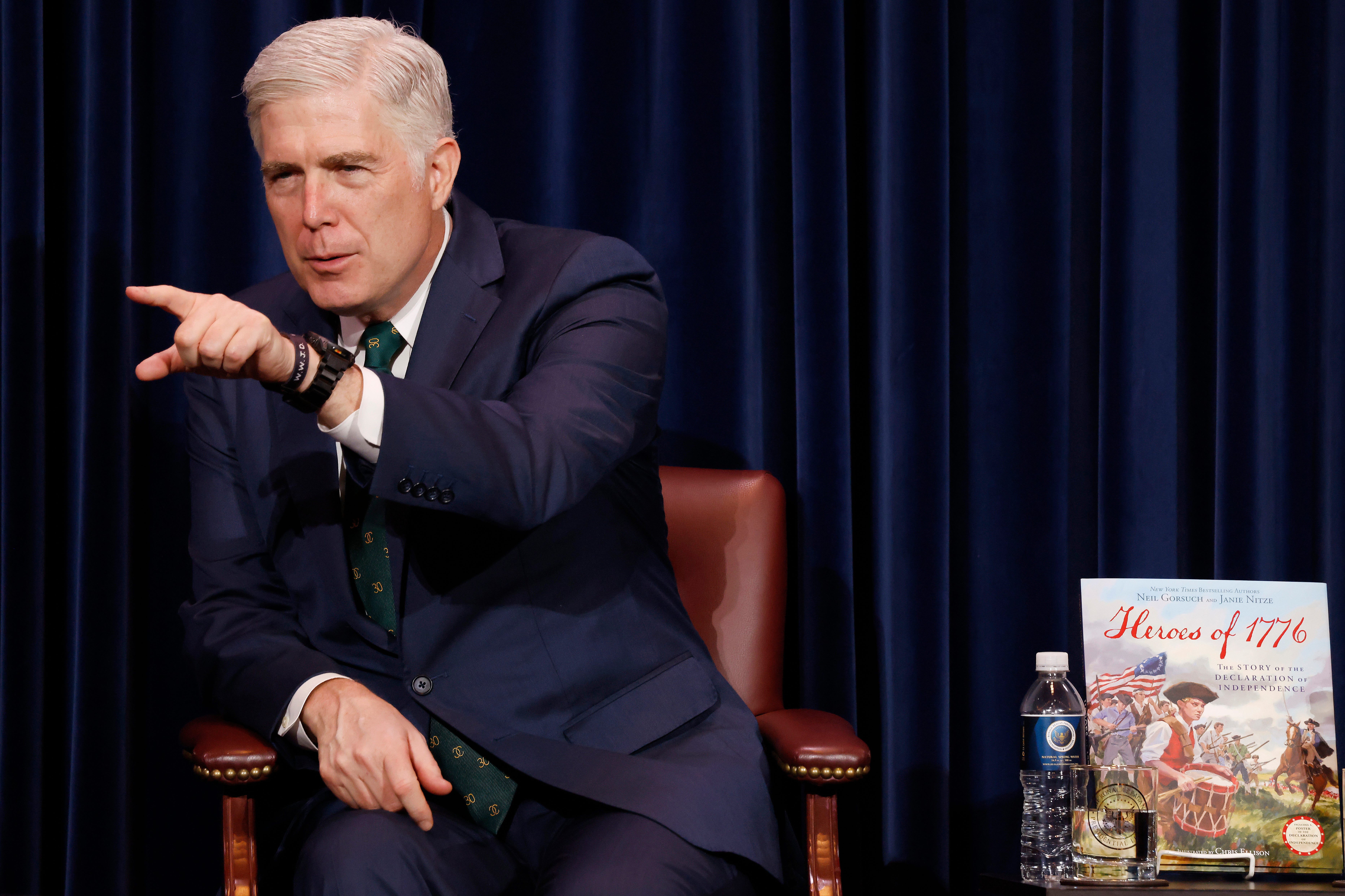
SUPREME COURT JUSTICE NEIL GORSUCH is in the crosshairs of the far right. During a media blitz this month to promote his new children’s book, Heroes of 1776: The Story of the Declaration of Independence, Gorsuch repeated the same message over and over: The United States is a “creedal” nation—that is, a nation unified by common belief in rights, liberties, and democratic institutions. Yes, he explained, we are a people with a singular “heritage,” but it’s one of ideals, not ethnicity. Being an American requires not lineage, but belief.
It was a gentle rebuke of nationalism—and it drove the hard right nuts.
Americans largely agree with Gorsuch that, when it comes to citizenship, belief in American ideas trumps genealogy. In an earlier dispensation, his comments would have been taken as an innocuous, even saccharine, idealism about the nation’s founding and self-rule—totally typical for a conservative jurist.
But we are not in that earlier dispensation. Gorsuch’s repeated references to “creed” exposed a stark divide between far-right ideologues (with their nativist America First agenda) and the conservative originalist old guard. For decades, the right has campaigned to fill courtrooms with self-professing originalists. Now, that old guard—personified by Gorsuch, Justice Amy Coney Barrett, and Chief Justice John Roberts—is something of a wild card on the Supreme Court. And it’s causing tension, especially as the court gets ready to rule on birthright citizenship.
I admit to experiencing a bit of schadenfreude watching nativists fume at Gorsuch. But the clash over an American “creed” portends something dark as well, to the degree it shows deep tensions between the extremist, illiberal right and its originalist predecessors. The hard right is ascendant and has courted key privileges in the Trump presidency. The originalist core of the conservative movement holds a critical institutional advantage on the bench of the Supreme Court and other courts that insulates originalists from insurgent populism. Who wins this battle will fundamentally redefine America.
The frenzied reaction to Gorsuch’s creedal comments shows just how much nativist existential panic has pervaded the hard right and turned its denizens against originalism. The Daily Signal’s Bradley Devlin called Gorsuch’s rejection of an essential “common culture” at the Founding “patently absurd.” Far cruder, the anti-democratic pseud Curtis Yarvin tarred Gorsuch with “cuck energy,” and feeling a certain “warmth as he gives away your country to South Sudanese bvll,” using a term drawn from cuckoldry porn. Devlin and Yarvin have staked out two poles of the nativist attack on Gorsuch. They did so while supplying little evidence for their historical and psychological claims.
But none is needed to get the point across. Their absurdities and exaggerations echo Vice President JD Vance’s admitted strategy of creating “stories so that the American media actually pays attention.” The message of the anti-creedal right is meant to summon an apocalyptic vision: Choose us or choose chaos.
Other critics rebuked Gorsuch by suggesting he had dismissed America’s more explicitly cultural heritage. Responding to an interview given by Gorsuch, the Federalist’s John Daniel Davidson cast the American Founding as the work of “men who shared a common culture” that was “derived from England and Christian Europe.” In Davidson’s terms, American identity is only for those who adopt this white, Protestant culture “as their own.” In a more cutting evaluation, Jeremy Carl, senior fellow at the Claremont Institute and failed Trump nominee for a senior role at the State Department, said Gorsuch’s rejection of nativism indicated the “broad intellectual failure of the conservative legal movement.”
It’s hard to make sense of this hard-right rage at Gorsuch and the conservative legal establishment. After all, hasn’t the Supreme Court largely enabled the Trump administration? Perhaps it’s psychological. The way Gorsuch downplays ethnic and cultural heritage contrasts starkly with the White House’s willingness to deliver on nativist rhetoric and policy priorities. The backlash to Gorsuch’s remarks reflects how much the hard right has come to expect the federal government to respond to and promote their interests.
But conservative jurists like Gorsuch seem to deny the hard right the recognition they’ve won from the Trump administration. Gorsuch’s mild, indirect rebuke to the nativist “heritage American” crowd suggests that liberals’ view of the Supreme Court’s right-wing majority—as beholden to hard right impulses or factions—is incorrect or at least incomplete: At least some members of the high court continue to owe allegiance to the Constitution.
THE ANTI-ORIGINALIST OUTBURSTS in response to Gorsuch mark a change on the right. Originalism has been the guiding light of the conservative movement’s legal ambitions for decades. There are several variations, but in essence, originalism pursues the “original understanding” of a law or constitutional provision. The legal doctrine broadly defers to the intention of the authors or arbitrators of our nation’s laws or statutes; or, depending on your flavor, the common usage and understanding of terms in the law at the time it was enacted. The purpose of originalism is to narrowly limit the application of an amendment, law, or statute.
Conservatives saw strict adherence to the explicit verbiage of the Constitution as the best corrective to the expansions to civil rights and state capacity associated with the Supreme Court under Chief Justice Earl Warren. For their part, liberal critics have often depicted originalism as a thinly veiled attempt to return to something resembling the social order of the founding, with the franchise largely restricted to white male landowners, and anachronistic political tools ill fitted for the conflicts and crises of the modern polity. After all, the Founders wrote the Constitution for a country that couldn’t imagine interstate highways, let alone the internet and air travel.
Originalism may have logical limits (wouldn’t true originalism require overturning Marbury v. Madison?), but the legal approach broadly reflects conservatives’ belief that history is theirs and that the Constitution can—indeed, must—be interpreted authoritatively on their terms. Even if they don’t know originalism by name, 88 percent of grassroots conservatives polled in 2014 at the tail end of the Tea Party movement said the Constitution should be interpreted as written. Only 14 percent of liberals said the same.
Within constitutional law, originalism has become so prominent that some liberals have proposed their own version of the theory. Originalism has even shaped the liberal bloc of the Supreme Court. While under questioning from conservative senators in her confirmation hearings in 2022, Ketanji Brown Jackson acknowledged that “the Supreme Court has made clear that when you’re interpreting the Constitution, you’re looking at the text at the time of the founding and what the meaning was then as a constraint” on the Court’s authority.
Yet, for all their preeminence within the conservative movement, the originalists are of limited use to conservatives. Originalism is a largely backward-looking measure intended to mitigate liberalism. As a legal strategy, conservatives developed originalism to respond to the institutional disadvantages they faced in the courts up through the 1980s and 1990s. During the 2000s and 2010s, conservative justices overturned many provisions dating back to the so-called “rights revolution” led by the Warren Court. Since then, the conservative majority on the Court has made good on many of the right’s longstanding aims, including overturning Roe v. Wade in 2022, striking down the Chevron doctrine deference to federal agencies’ interpretation of law in 2024, and, last month, gutting key provisions of the Voting Rights Act. There is little left for originalists to unmake, leaving right-wing activists with the tempting question: What could conservatives create if they left originalism behind?
Gorsuch’s comments have had the effect of taking this desire for creative constitutional innovation and tossing it into the Trump administration’s institutional subterfuge. Trump has shown, especially in his second term, that there are few constitutional norms he won’t challenge. His is, in many ways, an anti-originalism presidency.
WHILE THE MAGA HARD RIGHT may find the current Court, with Gorsuch on it, not entirely to its liking, they will find it hard to do much about it. There is little public appetite for removing judges and justices. Public opinion may not shift away from originalism so easily either. For conservative evangelicals especially, constitutional originalism seems natural and obvious, akin to reading an inerrant, literal Bible.
Some on the right will blast justices like Gorsuch as RINOs in attempts to sway their behavior, but charges of RINOism are only effective when there are sufficient carrots and sticks. A member of Congress tarred as a RINO is liable to be primaried. The same threat cannot be levied against a justice serving a life term. Only one Supreme Court Justice, Samuel Chase, has been impeached by Congress, and that was in 1804 (and he was acquitted anyway).
America’s constitutional design is intentionally conservative. The courts are minoritarian and unelected, which mitigates the impact of constantly fluctuating popular opinion. Some legal groups have formed around nativist and “America First” causes, but such groups must contend with benches already full of liberal justices and conservative appointees reared on originalism. For better or for worse, originalism’s slow seep into both conservative and mainstream constitutional law will not be easily undone.
Undoing originalism will take the sort of time that the hard right doesn’t think we have. As Kevin Roberts, president of the Heritage Foundation, put it, conservatives must fight “not for moderation, but for rupture.” Rupture “is what opens the door to renewal.” The deep sense of urgency in this dissent emboldens far-fetched rhetoric. As right-wing influencer Mike Cernovich wrote on X: “If Justice Gorsuch has his way . . . over one million anchor babies currently living in China” will flow into the United States to act as “spies with the same citizenship rights as you and me.”
Fearing their time is running out, the hard right may turn to an increasingly aggressive strategy: breaking things. Trump seems to be preparing to do so. On May 10, the president posted on Truth Social that Justices Gorsuch and Barrett, both of whom ruled with the majority against his unilateral use of tariffs, should be “loyal to the person that appointed them” and rule against birthright citizenship. (Such rhetoric about Supreme Court justices would be treated as a five-alarm fire from any other president; in the case of Trump, it’s entirely unsurprising.) Trump also floated the idea of packing the court, a strategy oft-entertained by presidents wanting to impose their will on the judicial branch. But the votes aren’t there in Congress. And even if they were, what mechanism would the president have to ensure the justices he packed the Court with were loyal to him—beyond the threat of more and more Court packing until he got his desired result?
The hard right’s best chances for rolling back (or overcoming) originalism may lie beyond the courts themselves. While SCOTUS seems hesitant to overturn birthright citizenship, its conservative bloc has empowered the president to carry out many of the hard right’s nativist ambitions, including deportations to third countries. Moreover, the Court has emboldened federal immigration officials, mainly ICE, to detain people over suspected immigration status, a practice derisively referred to by critics as “Kavanaugh stops.”1 So long as the Court permits the president to limit the due process and equal protection rights of American citizens and immigrants alike, nativists may be able to avoid a full-on confrontation with the courts and legal stricture.
But that’s an uncertain status quo. Fundamentally, originalists accept the democratic constraints of the Constitution and believe them to be a core component of America’s political tradition. Once an intellectual minority, conservative originalists have prevailed; their mode of constitutional interpretation has become the prevailing standard of legal thought. Postliberals and their nativist fellow travelers, on the other hand, have begun to reimagine the American state without any such constitutional guardrails. That such a conservative Supreme Court justice as Gorsuch—and a Trump nominee at that—can so enrage the far-right through the word “creed” tells us just how tenuous things have become and how dystopian the hard right’s worldview really is.
In a footnote to a relatively unrelated case before the Court, Justice Kavanaugh seemed to reverse his previous view on allowing perceived ethnicity to be a determining factor in immigration-related stops, most likely in an effort to distance himself from the term that in popular commentary bears his name.
 | A guest post by
|