The Kurds Won’t Solve the Iran Problem
They’re good fighters and good allies, but not a panacea.

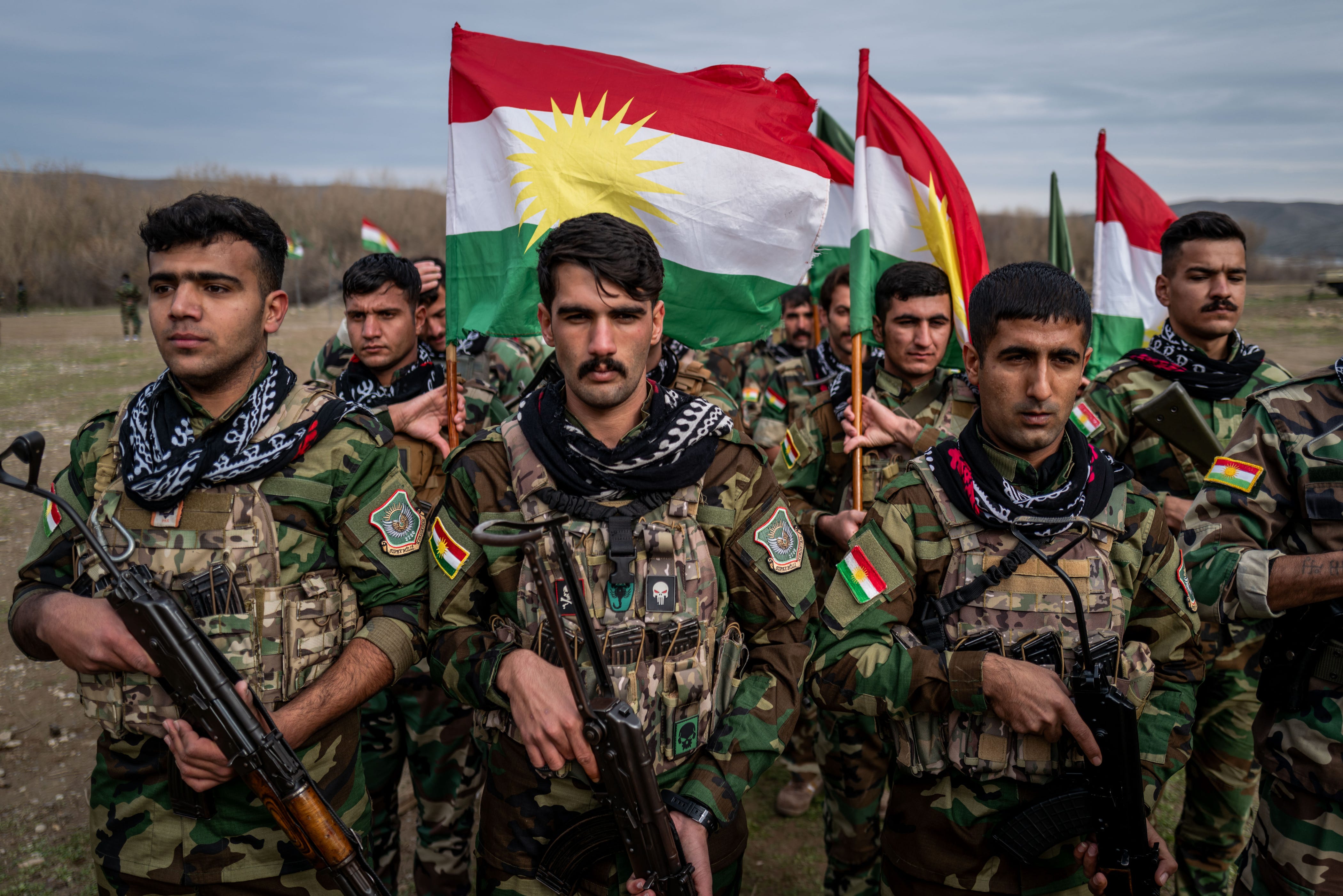
FOR MORE THAN FIFTY YEARS, when American presidents have wanted to put pressure on leader in Iraq or Iran, the same idea has consistently popped up: Use the Kurds. Now, as the Trump administration seeks “unconditional surrender” from the Iranian regime, the question of the Kurds has come up again. Last week, CNN reported that the CIA is arming Kurdish rebels “with the aim of fomenting a popular uprising in Iran.”
The logic behind the suggestion is easy to understand. The Kurds are fierce fighters. They are among the more pro-Western and pro-American groups in the region. They were partners and helped stabilize parts of Iraq during the U.S. invasion. They were decisive in helping defeat ISIS when the Iraqi state nearly collapsed in 2014 and in destroying ISIS in Syria. For many Americans, they represent the kind of ally we wish the Middle East had more of—courageous, disciplined, and willing to fight.
Having worked closely with Kurdish forces while commanding American troops in northern Iraq in 2007, I share the common admiration for the Kurds. The Kurdish leaders and fighters I worked alongside were some of the most capable partners U.S. forces had anywhere in the region, and it was widely accepted that of all the places in Iraq a soldier could be deployed to, the Kurdish city of Erbil was one of the most preferable.
But admiration should never substitute for understanding. Instigating or abetting a Kurdish insurrection against Tehran reflects a misunderstanding not only of the Kurdish people and Kurdish politics but also of the complex ethnic and political landscape of Iran and the broader Middle East.
THERE ARE TWO CONCEIVABLE reasons the administration might consider supporting a Kurdish uprising. One is using them as part of a broader destabilization strategy—multiplying the Iranian leaderships’ problems just as its leaders are being killed, its communications severed, and its military and political power eroded by American and Israeli air strikes. This purpose is straightforward, but would likely backfire.
Iran is far more ethnically complex than many Americans realize. While ethnic, national, and religious identities are intrinsically hard to identify, Persians are estimated to make up only about 61 percent the country’s population. The rest consists of numerous ethnic groups with their own histories and political concerns. Azeris represent the largest minority, comprising one sixth of the population and concentrated in the northwest, near Azerbaijan. Arabs, about 6 percent, live primarily in the oil-rich province of Khuzestan bordering Iraq, while Baluch communities, about 2 percent, inhabit the southeastern region bordering Pakistan and Afghanistan. The list goes on. Each of these communities has its own relationship with the central government in Tehran. Some even harbor deep grievances against the regime, but that’s not always the case. Iran’s current president, Masoud Pazeshkian, has a recognizably Azeri name and reportedly has mixed Azeri–Kurdish ancestry, though he considers himself Turkish. (Azeri is a Turkic language, while Kurdish is an Iranian language—again, these identity markers get murky fast.)
Kurds represent roughly eight to ten percent of the Iranian people, and they are concentrated primarily in the mountainous northwest along the Iraqi border. Several Kurdish opposition groups operate in or near Iran, including the Kurdistan Democratic Party of Iran and the Kurdistan Free Life Party. Both oppose the Iranian regime and have engaged in varying levels of insurgent activity over the years.


It would be a serious mistake to assume other ethnic minorities—to say nothing of Iran’s religious minorities like Bahá’i, Zoroastrians, Christians, Jews, Sunni Muslims, and others—would rally behind a Kurdish-led political transformation. In fact, most likely they would strongly resist it.
A Kurdish-led uprising in Tehran could easily be interpreted by most of these minorities—and by many Persians themselves—not as liberation, but as the first step toward fragmentation of the Iranian state. That perception would likely produce intense internal resistance and potentially trigger broader regional instability. One of the current regime’s weaknesses is its religious radicalism, which much of the country finds backward, stifling, oppressive, and hypocritical. At mass protests in recent years, the opposition has promoted signs of Iranian nationalism (not to be confused with Persian ethno-nationalism, though it’s not always easy to tell them apart) like the former national flag featuring the lion-and-sun emblem and chants of “Long live the shah!”
A Kurdish uprising would also raise alarms in neighboring Turkey, which hosts the world’s largest Kurdish population and has spent decades battling Kurdish separatist movements. Any development that appears to move the region closer to the creation of a broader Kurdish state is viewed in Ankara as anathema and a direct threat to Turkish territorial integrity.
THE SECOND POSSIBLE REASON the United States might be aiding the Kurds is a mistaken belief that they might form the nucleus of a successor government in the Islamic Republic. This would be a foolish assumption not only for the many reasons described above, but most importantly it is because it’s not what the Kurds want.
Before my time in Iraq, I knew the Kurds largely by reputation. Within military circles, they were widely respected as a tough and resilient fighting force that had resisted Saddam Hussein in their enclave beyond the Hamrin Mountains for decades. But reputation alone doesn’t reveal much about a people, their ambitions, or the strategic motivations that shape their decisions. It wasn’t until I began working closely with Kurdish leaders and their military forces, and meeting with the Kurdish population, that I started to understand them more clearly.
My understanding also deepened considerably after reading Quil Lawrence’s outstanding book, Invisible Nation, which traces the long history of the Kurdish struggle for identity and self-determination. Like many Americans who encounter the Kurds in a military context, I initially saw them through the lens of battlefield performance. Lawrence’s book helped place that performance within a much broader political and historical story.
The Kurdish forces—the Peshmerga—were disciplined, experienced, and operationally savvy. Their officers understood maneuver and terrain. Their soldiers possessed a fierce commitment to their nation, culture, and mission. At the time, they were noticeably more capable than many of the Iraqi units who were our partners (though the Iraqi security forces have improved significantly since those early years after Saddam’s fall).
But what drove the Peshmerga was not abstract ideology or loyalty to a distant government in Baghdad. They were motivated by something more personal and enduring: the defense of Kurdish land, Kurdish autonomy, and the long-held dream of a Kurdish statehood. That distinction matters, especially when Americans begin to speculate about Kurdish roles in broader regional political change.
When ISIS metastasized across Iraq in 2014, Kurdish forces became one of the most visible and effective ground partners the United States had available. Images of Kurdish fighters holding the line against the Islamic State captured the imagination of Western audiences, and they became the heroes of those campaigns. To many Americans, it appeared as though the Kurds were fighting not only for themselves but for the broader cause of regional stability and democratic values.
There was truth in that perception, as the brutality of ISIS offended Kurdish society just as it horrified the rest of the world. But the Kurdish response was primarily driven by strategic necessity. ISIS represented a direct and existential threat to Kurdish autonomy in northern Iraq. If the Islamic State had successfully consolidated control over Baghdad and the Iraqi state, the fragile self-governing Kurdish region would almost certainly have suffered. The Kurds fought ISIS fiercely because survival demanded it.
Understanding that motivation is essential to understanding Kurdish politics more broadly. Kurdish forces are deeply capable and often reliable partners, but their primary loyalty is not to Iraq, Iran, or the United States. It is to the Kurdish nation—an identity that transcends existing borders but has not yet been realized as an independent state.
That’s because the Kurds’ political aspirations are clear. Kurdish leaders and Kurdish societies are primarily focused on protecting and expanding Kurdish autonomy, and ultimately on achieving the long-sought dream of Kurdish self-determination and an independent Kurdish state. That aspiration does not naturally translate into governing complex multiethnic states like Iraq or Iran.
ANOTHER REASON THE KURDS are not the key to Iran’s “unconditional surrender” is that, taken as a whole, they are not one unified, organized, consolidated group or force. Americans often speak of “the Kurds” as though they represent a single cohesive political movement. In reality, Kurdish politics are highly decentralized, factionalized, and shaped by regional rivalries.
The Kurds have been described as the world’s largest stateless nation, numbering roughly thirty to thirty-five million people. But that population is spread across several countries. Significant Kurdish populations live in Turkey, Iran, Iraq, and Syria, each community shaped by different political systems and parties, unique personalities, security pressures, and historical experiences. These Kurdish populations share cultural ties and aspirations, but they are far from unified politically.
Even in Iraqi Kurdistan—the most stable and autonomous Kurdish region—political unity remains fragile. Two dominant political parties continue to shape the region’s political landscape: the Kurdistan Democratic Party, led by the Barzani family, and the Patriotic Union of Kurdistan, associated with the Talabani family. These organizations fought a Kurdish civil war in the 1990s and still maintain separate power bases and security structures in different parts of Iraqi Kurdistan. These kinds of connections sometimes produce cooperation, but often reflect competing agendas shaped by local realities. Kurdish politics, in other words, are not the unified national movement some Americans might imagine.
This reality becomes especially important when Americans begin discussing Kurdish roles in the future of Iran.
Working with the Kurds in northern Iraq remains one of the most rewarding experiences of my military career. Their soldiers were courageous, their officers thoughtful, and their leaders deeply committed to the welfare of their people. They were excellent partners, and they remain an important component of regional security. But the deeper lesson I learned—both in the field and through further study—is that the Kurds are best understood not as an instrument for other countries’ strategic ambitions, but as a nation pursuing its own.
While policymakers in Washington may occasionally imagine Kurdish fighters as the key to solving the Iranian problem, the truth is far more complicated. The Kurds are remarkable and useful allies, but they are not the solution the administration is looking for.