

The Last Thing Minneapolis Needs Is the Insurrection Act
Inserting military forces into the situation risks disaster.

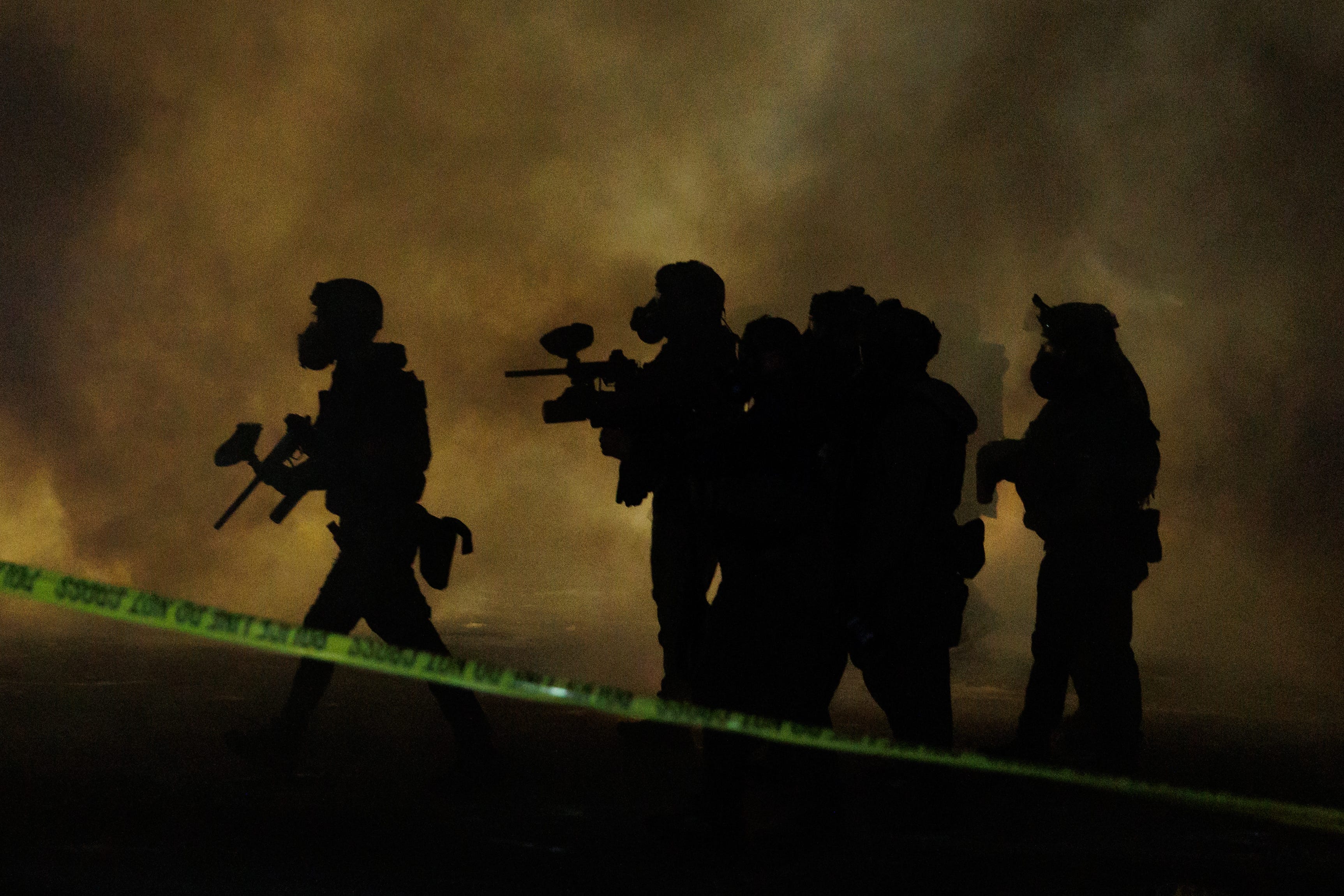
THE FOUNDERS EXPERIENCED INTIMIDATION and oppression by the British military, which is why, from the earliest days of our nation, they put restrictions on the ability of a president to use force against civilians. Fresh from a revolution, they designed a system that placed deliberation and civilian control between soldiers and citizens and gave Congress sole authority to declare war and appropriate money for the military. Later, when Congress passed the Insurrection Act in 1807, it did so not to create a convenient tool of governance, but to address rare breakdowns of order—moments when citizens’ safety and constitutional authority itself are under threat, and no other option remains.
That history explains why, for more than two centuries, presidents treated the Insurrection Act as a last resort. It is also why the military and scholars of civil-military relations were wary of the potential for any president to invoke it casually. But that reluctance has recently been eroded by rising executive impatience, the politicization and militarization of law enforcement, and an increasing tendency to view protest not as a constitutional right but as a provocation to be crushed.
Within living memory, when presidents invoked the Insurrection Act, they did so in circumstances that were extraordinary and in line with how the drastic act was intended to be used.
In 1957, President Dwight Eisenhower sent federal troops to Little Rock, Arkansas to enforce the law. State officials were actively defying a Supreme Court order to desegregate public schools, and the state’s governor had used the National Guard to block black students from entering Central High School. In response to a state openly violating the federal government, the law, and the Constitution—and threatening to use military force to defend its illegality—Eisenhower federalized the Guard and even deployed active forces from the 101st Airborne Division to Little Rock. The military’s mission was precisely defined: protect students, uphold federal law, then withdraw.
A decade later, President Lyndon Johnson invoked the Act during the Detroit riots, at that time the most violent episodes of civil unrest since the Civil War. Michigan’s governor had requested emergency federal assistance when his local and state forces were overwhelmed. Even then, the mission was not about punishing dissent; it was about stopping collapse.
The most recent invocation came in 1992, when President George H. W. Bush responded to the Los Angeles riots following the acquittal of LAPD officers who participated in the Rodney King beating. Again, California’s governor formally requested help when violence was widespread and deadly. Army and Marine units were deployed alongside federalized National Guard units to stabilize the city. They quickly withdrew once order returned.
These cases share three essential features: a genuine breakdown of civil authority, a narrowly defined mission, and a clear exit strategy. All forces had very distinct tasks and rules of engagement. No forces were used to intimidate political opposition or chill lawful protest.
Today’s talk of invoking the Insurrection Act implies a sharp departure from this approach. What was once a fire extinguisher behind glass—clearly labeled “break only in emergency” to quell violence—now looks like a bottle of lighter fluid.
From a military perspective, invoking the Insurrection Act places soldiers in an acutely uncomfortable position: facing fellow citizens who, in many cases, are exercising their constitutional rights to free speech and protest. American service members swear an oath to the Constitution. They are taught and trained to remain apolitical and to understand that peaceful dissent is not criminal. Ordering them into domestic confrontations risks not just escalation, but moral injury—forcing soldiers and leaders to navigate a collision between lawful orders and deeply ingrained professional ethics.
Senior military leaders understand this instinctively. For decades, they have reinforced the principle that the armed forces are not a domestic police force. The line between law enforcement and military power is not arbitrary bureaucracy—it is foundational to a democracy.
This is also why context matters. When federal enforcement agencies adopt tactics that appear designed to provoke rather than de-escalate—militarized posture, no identification, masks, aggressive tactics—they risk turning manageable unrest into combustible confrontation. In that sense, current ICE enforcement practices threaten to light the very fire the Insurrection Act was meant to extinguish.
If federal actions predictably generate public backlash, as has been occurring, and that backlash is cited as justification for deploying troops, the sequence becomes perverse. The Insurrection Act is no longer a stabilizing measure; it is part of an escalation loop. Protest leads to provocation. Provocation leads to unrest. Unrest becomes the rationale for extraordinary force.
The greatest danger is no longer the actions of federal officers on the ground; it is the overreach—an inversion of responsibility where executive decisions create more instability and the military is asked to absorb the consequences.
A democracy does not prove its strength by how quickly it deploys soldiers against its own citizens. It proves its strength by how carefully it preserves the boundaries between protest, policing, and military power. The Insurrection Act remains lawful, and it can be invoked by any president. But it was never meant to be used lightly.
Reaching for a fire extinguisher can help save a building. Lighting a match can end up burning it down. Leaders who confuse the two rarely escape the smoke.