The ‘Medicare for All’ Test for Michigan Democrats
Haley Stevens wants to move legislation. Abdul El-Sayed wants to move the debate. But first, one of them has to keep the seat blue.

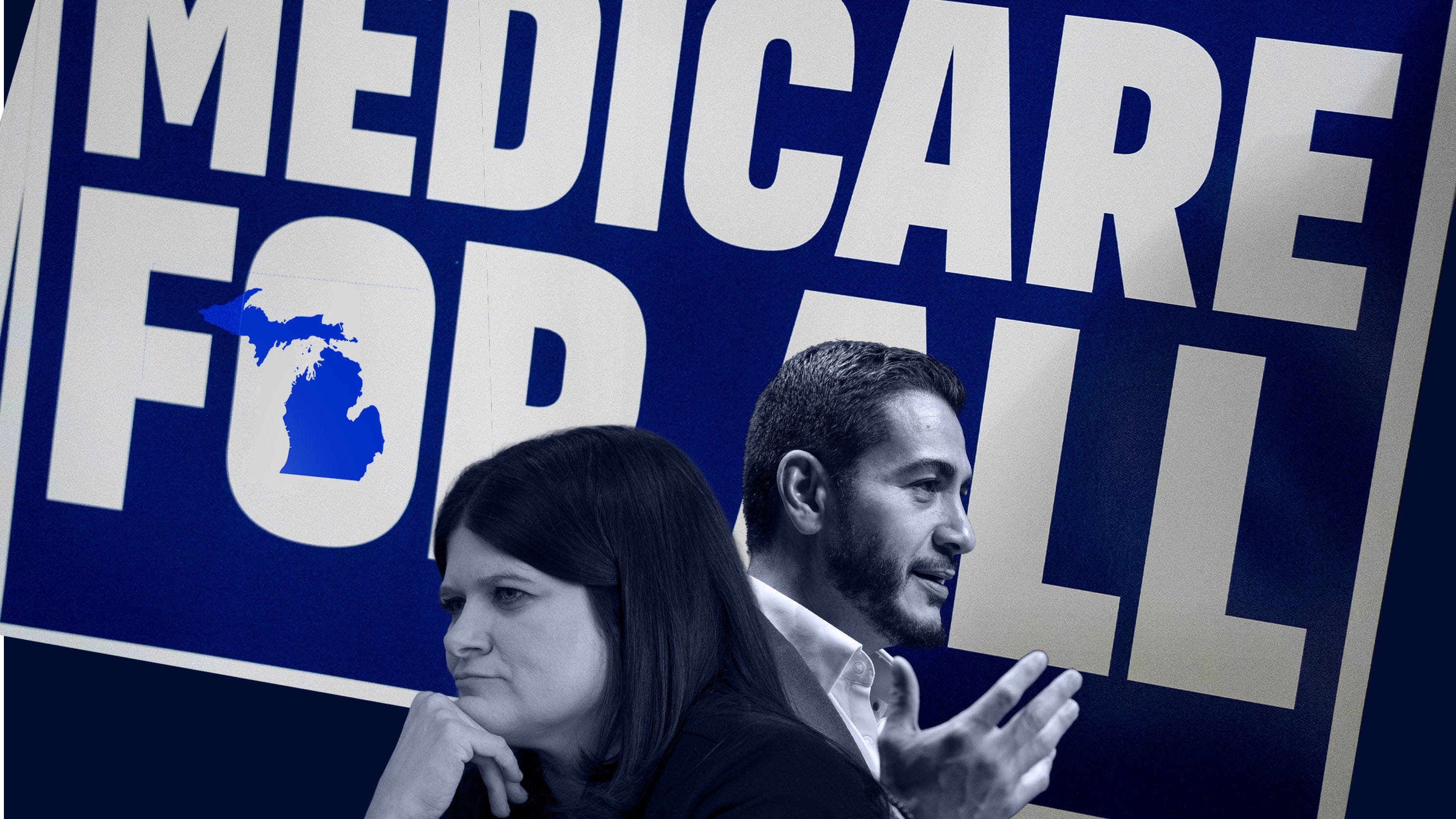
Detroit, Michigan
ABDUL EL-SAYED HAS BEEN RUNNING to become Michigan’s Democratic Senate nominee for more than fifteen months. And if there’s been one constant over that period it’s been his promotion of “Medicare for All” as a way to make sure all Michiganders—and all Americans—have access to affordable, quality health care.
It’s a big focus of his stump speech, something he usually raises right at the beginning. It’s all over his campaign signage. And it’s the only specific policy promise in his three-part campaign slogan, which he and supporters invoke constantly:
Money out of politics. Money in your pockets. Medicare for All.
Medicare for All—a proposed version of universal health care that would have the government cover everybody directly, mostly doing away with private health insurance—has been part of the policy conversation among Democrats since the 1940s, when Harry Truman proposed a national health plan that included a prototypical version of the idea.
In the last few decades, partly as a nod to real-world political constraints, Democrats have leaned more toward hybrid plans with both private and public insurance as the surest path to universal coverage. That approach gave us the Affordable Care Act in 2010, which alongside Medicare and Medicaid—and with some financial reinforcements put in place during the Biden administration—reduced the uninsured rate to a record low.1 It’s as close as America has ever come to a place where health care is a right, not a privilege.
But even then, millions of Americans didn’t have insurance or couldn’t cover their out-of-pocket costs. And that was before Donald Trump and the Republicans started hacking away at the existing programs, exposing even more people to crushing medical bills. Partly in reaction to those realities—and partly thanks to high-profile advocacy by the likes of Senator Bernie Sanders, the Vermont democratic socialist—over the last decade or so the idea of a full reset through Medicare for All has gotten increasing attention from the Democratic faithful.
On Tuesday, those sorts of voters in Michigan will get a chance to weigh in on this debate when they decide between El-Sayed, who is a former public health director in Detroit and Wayne County, and Haley Stevens, who is a four-term House Democrat. Stevens is from the wing of the party that prefers to work within and around existing arrangements, whether that means trying to repair the damage from Trump or creating a new, optional public insurance program for people who want an alternative to private coverage.
For voters here who care about health care, weighing the two candidates means considering the different policy paths they recommend, including the merits of Medicare for All itself. But it also means pondering something that hasn’t gotten as much attention: exactly what kind of senator El-Sayed and Stevens would each likely turn out to be, and what history teaches us about how their distinct styles would play out in the current political landscape.
Original reporting.
Sharp analysis.
Honest commentary.
Stick with us through the midterms and beyond—sign up for a Bulwark+ membership and get your first two weeks free.
IT WOULD BE DIFFICULT to overstate how central health care is to El-Sayed’s identity.
The political origin story he tells involves his journey through medical school when, while working in a New York City hospital, he saw the difference between the lavish attention to wealthy patients on the top floor and the shabby treatment that the destitute got down in the emergency room. One of his staple campaign lines is that the life expectancy in the country of his parents, Egypt, is roughly the same as it is in parts of Detroit.
He says it convinced him to focus on public health rather than the practice of medicine—which, in turn, drew him to Medicare for All. “In public health, we’re always in this position where we’re underfunded and underinvested-in,” El-Sayed told me during a phone interview Saturday, while driving between campaign stops. “That’s because our current health care system sucks so much money into the care part of things rather than the prevention part of things.”
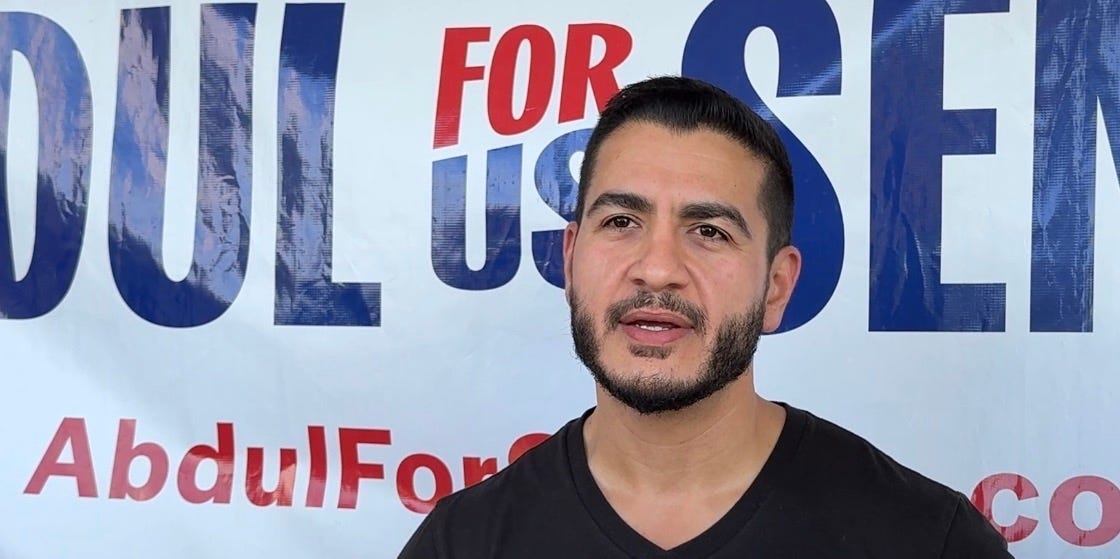
A few years ago, El-Sayed collaborated with a physician-researcher on Medicare for All: A Citizen’s Guide, a book that briefly explains how America’s health care system evolved, then sketches out the broad outlines of a Medicare for All system, including benefits and financing.2
The pitch El-Sayed makes in his speeches and appearances doesn’t get into the policy weeds; it is more like a general pitch for the idea of universal coverage, which is something that takes a variety of forms abroad. Many countries’ systems include significant roles for private insurance, and some have considerable out-of-pocket spending. At the same time, even the hybrid systems of countries like France or the Netherlands have more in common with the single-payer systems of Canada, Taiwan, and Sweden than they do with the American patchwork.
One way to think about Medicare for All—and to evaluate El-Sayed’s support for it—is to imagine, as a thought experiment, what it would be like to transplant one of those systems here. You’d have to account for all kinds of cultural differences, including among medical practitioners, that can have profound effects on the economics of health care. You’d also have to account for the transition, which may be the hardest part of the equation because health care represents one-sixth of the economy and even modest changes would entail massive disruption.
Spend any time with the numbers and you’ll discover Medicare for All, like all health care systems, including America’s status quo, would require making difficult tradeoffs. Throw in the political obstacles to any kind of substantial health care reform—a list that includes the power of monied interests, the skewed representation of the Senate, and the public’s fear of change3—and the chances of actually enacting Medicare for All anytime soon is slim at best, even if El-Sayed gets to the Senate.
Some people act like the only way to support universal coverage as a goal is to support Medicare for All, as if anyone who doesn’t back Medicare for All isn’t truly committed to universal coverage. That would surprise the likes of Ted Kennedy, the legendary Massachusetts Democratic senator who was the patron saint of universal coverage while he was alive, yet was a key orchestrator of multiple compromises including early work on the legislation that became the Affordable Care Act.4
El-Sayed hasn’t done anything to dispel this notion, and probably reinforced it by dismissing narrower proposals like one Democratic-aligned think tank’s call to make primary care free. But in our phone interview he said he understands the technical challenges and would, if elected, seek to help Democratic colleagues work through them.
He also said he understands the political challenge, which is why he routinely refers to Medicare for All as a “Mount Everest” to be scaled in stages. “I’ve been very clear that I want to get to Medicare for All, and I also believe that we’ve got to take a pathway there. To me, as long as it reduces the power of the health care corporations, expands health care, and does so publicly, I’m for it, and would be glad to work with likeminded partners on that path.”
FOR A MODEL OF WHAT this might look like in practice, you need look no further than Sanders, who is not just Medicare for All’s most visible champion but also El-Sayed’s, having endorsed both his 2018 gubernatorial bid and now his Senate run. The Vermont senator played a key role in shaping the prescription drug reforms that Democrats passed and Biden signed in 2022.
Sanders’s harping on persistently high health care costs during the 2016 presidential primaries frustrated Democrats who were preparing to defend the Affordable Care Act against possible repeal, and back in 2009 he held off supporting the law until the final stages of Senate debate. But he came around to yes, as the Obama White House and Senate leaders knew he would, with his one big ask being an $11 billion investment in community clinics entirely consistent with the law’s spirit. And in 2017, once the repeal effort got underway, Sanders proved an enthusiastic and effective defender of the law.
Another Sanders accomplishment was a landmark 2014 reform of veterans health services. That was a bipartisan effort, one that he negotiated with the late John McCain, and it’s an open question how much interest El-Sayed would show in such deal-making, or how much capacity he has for it. It requires EQ as much as IQ, and not disparaging adversaries in the way he has treated Stevens multiple times—most recently just this week, when he described the four-time election winner as the “least capable candidate in America.”
Stevens in many ways illustrates the opposite archetype. She has a proven record of bipartisanship. In fact, that’s been the main thrust of her campaign: that she’s a workhorse who gets stuff done, winning recognition as an effective legislator precisely because she makes deals on legislation targeting particular needs or groups of constituents.
Health care is not as central an issue for Stevens’s campaign or her public identity as it is for El-Sayed. (To be fair, you could say that of most politicians. In Stevens’s case, industrial policy is her thing, and she’ll hold forth on it for hours if you let her.) If Sanders is a prototype of who El-Sayed might be, a more likely role model for Stevens would be Debbie Stabenow, who represented Michigan in the Senate from 2001 to 2025.
Stabenow, who has endorsed Stevens, also focused on issues other than health care. But she did leave her mark in a few spots. One of those was the treatment of mental illness; over the course of years, she built a bipartisan coalition for legislation that now funds mental health clinics around the country, in a way that appears to be providing much-needed care while easing the burden on local law enforcement.
Other than that, Stabenow supported whatever health care measures Democratic leaders promoted. Most likely Stevens would too, because that’s how she’s conducted herself in the House whenever health votes came up. That includes the 2022 law giving the federal government power to negotiate some drug prices in Medicare. Stevens voted yes, notwithstanding some (relatively small) campaign donations from drug companies she has taken over the years.
Insofar as the Democrats stay on the path they’ve been on—using the policy architecture now in place to finally get to universal coverage—Stevens as senator figures to be another lawmaker helping that journey along. And she would come to office with legislative experience, something one of her key backers told me gave her an advantage over El-Sayed.
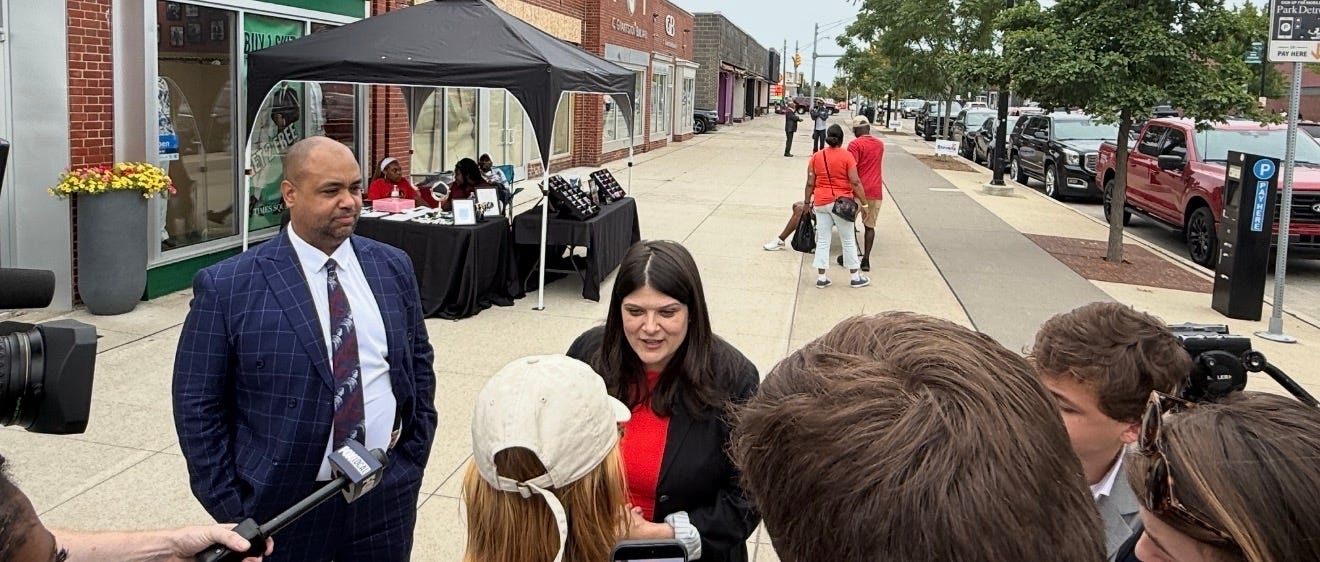
“She’s the only person that actually passed legislation,” Coleman Young II, president pro tem of the Detroit City Council, told me during a joint appearance with Stevens on Saturday. “If we were talking about who could be the best public health director, we’d be in trouble. We’re campaigning for who’s going to be the best United States senator. This is a legislative position, and Haley Stevens has the record.”
WHAT STEVENS WOULD CLEARLY not do as a senator is try to push the boundaries of debate over health care in the way that El-Sayed would. He has said repeatedly that if he is elected, he would try to use his platform to build support for his agenda—including Medicare for All—to national audiences, to the point of visiting other states where lawmakers might not be with his program.
Stevens has suggested that makes El-Sayed more interested in making headlines than making progress. And there was a time, certainly, when that kind of advocacy would look to fellow members of the Senate like grandstanding, making it difficult to accumulate power and negotiate—and, eventually, to pass laws that could benefit constituents.
But lawmaking in 2026 is different from, say, 2016 or 2006. More now than ever before, attention is political currency. In the hands of somebody committed to a cause like Medicare for All, it can change the agenda, sometimes substantially. The proof is Sanders, whose persistent advocacy for Medicare for All—even when he was the only nationally recognizable figure pushing for it—is a big reason it’s a central part of the conversation among Democrats.
In that sense, the main impact of electing El-Sayed would be adding to that chorus another, younger version of Sanders—somebody who would push the whole caucus in the direction of expanding health care access, and who could inherit the Medicare for All movement whenever Sanders, now 84, decides to hang up his democratic socialist spurs. And it is safe to assume that merely electing El-Sayed would have a galvanizing effect on the national debate, by challenging old conceptions of what’s politically possible in a swing state campaign.
But first El-Sayed would have to win the general election, while running in a state far less hospitable to his politics than Vermont has been for Sanders. And it doesn’t take a ton of imagination to see how difficult that could be.
Just for starters, El-Sayed would have to overcome an onslaught of negative advertising even more overwhelming than the one he’s facing now. And this time it would feature the sort of attacks fellow Democrats would never make but Republicans make all the time. Example: El-Sayed has said undocumented workers should get coverage if they pay taxes. The position is highly defensible as a substantive proposition but highly difficult to defend politically.
El-Sayed, never lacking in confidence, thinks he can win this fight. And he is well equipped to do that—especially in a campaign against presumptive GOP nominee Mike Rogers, a former GOP House member who took money from pharmaceutical companies and has a long record of supporting Republican bills to take health care away from people.
El-Sayed could leverage his background as a doctor and epidemiologist who has literally spent years helping people to get health care. And unlike Stevens, he could present himself as somebody who has never taken money from corporate PACs. Those are all powerful rhetorical tools, especially in the hands of a communicator as deft as El-Sayed.
ELECTABILITY IS A TOUGH THING TO PREDICT. Its consequences aren’t. Just look at the recent history of health policy debates.
One more Democratic senator in 2009 would have given the Affordable Care Act’s architects leverage to pass a more generous bill, one that got closer to delivering what Medicare for All would. And in 2021, one more Democratic senator would have allowed leaders to muscle through a program for home health care they had to drop, to expand the universe of drugs subject to government price negotiation, or to fund more years of the temporary Obamacare subsidies Republicans have since allowed to lapse.
By contrast, with one fewer Democratic senator in 2017, the Affordable Care Act probably wouldn’t have survived repeal. And with one fewer Democratic senator in 2009, it might not have become law at all.
There are countless more examples like that on other issues, all highlighting the same essential reality that is true on health care. The effect of nominating El-Sayed instead of Stevens as nominee would be substantial—for better or worse, depending on your perspective. But it would be small relative to the impact of putting up a losing candidate in the general election. For health care especially, the cost of turning Michigan’s Senate seat red could be catastrophic.
‘Bring better ideas.’
Excerpts from an interview with Abdul El-Sayed on August 1, 2026, lightly edited for clarity.
JONATHAN COHN: One of the things I want to do is predict for people—on health care—what you would be like in the Senate. And I was thinking back to when we had a video interview a few months ago, when I asked you whom you thought of as role models. You mentioned Bernie Sanders and Elizabeth Warren. Looking at them, are they a pretty good preview of how you would like to operate in the Senate?
ABDUL EL-SAYED: And I mentioned a third, Senator Chris Van Hollen. Yes. I think our work is about getting the nuts and bolts of the policy right, making the moral and political argument, and then working to line up the votes because you’ve moved the ground underneath the U.S. Senate and public policy. I want to be able to do my part on all three of them, working alongside colleagues who’ve been thinking about this and doing this work for a long time. I think about Senator Sanders, of course, and Congresswoman [Pramila] Jayapal and Senator Warren, and then many others. I hope that folks can rely on me to be a bona fide policy student, somebody who’s taking what I’ve learned as a researcher and an expert to build that into public policy. And then also an advocate on the ground, to use the broader public conversation around what all of us can believe in and should fight for when it comes to health care. And then working alongside somebody like a Senator Van Hollen to say, okay, how do we start to think about building the coalition for this in the Senate, to line up the votes that we need to get it done.
COHN: You look back at Bernie Sanders, he obviously is talking constantly about Medicare for All. But he also did a big bipartisan veterans bill with John McCain. And he worked on the prescription drug price negotiation. Do you imagine yourself being someone who would work on things like this that are not Medicare for All, and really put your muscle into them?
EL-SAYED: For sure. I’ve been very clear that I want to get to Medicare for All, and I also believe that we’ve got to take a pathway there. To me, as long as it reduces the power of the health care corporations, expands health care, and does so publicly, I’m for it, and would be glad to work with likeminded partners on that path. I think the mistake is sometimes to say, ‘Okay, we’ve made these changes and therefore we’re good to go. We’re not good to go until we have Medicare for All. But you know on the pathway—the steps along the way—I’ll be working hard with my colleagues to try to get those things done too. . . . When it comes to making the VA whole, when it comes to funding our investment in affordable prescription drugs, when it comes to our investment in medical science, you’re going to see me right at the forefront.
COHN: You’ve talked a lot about how you want to be going into other districts and states, making the case for Medicare for All, and other priorities too. Does that include fellow Democrats? Would you go to a Democratic district or state if you feel like a senator is pulling in a different direction?
EL-SAYED: I think we have a responsibility to fight for the things we need and deserve. In the end, politics is about a competition of ideas. I think you lose that competition if you’re not willing to take your ideas and present them to a broader public, and I think it’s important for voters to have an alternative to somebody who’s corporate bought. Now, that means beating Republicans big time. But it also means standing up within our own party, like I’m doing in this primary, when it is the power of corporations buying our own party against the will of the broader public. . . . I’m focused on the best interests of the people of Michigan. And to achieve the things I need for the people of Michigan, it’s going to be really important that we have the kind of movement inside the U.S. Senate to be able to pass the legislation that is in service of people here in my state. So the question is: Am I afraid of what colleagues might think of my advancing my ideas? I tell them: Bring better ideas.
COHN: I know some people are worried you’re more excited about attacking Democrats and fighting out a factional war in the party, rather than beating Republicans.
EL-SAYED: Give me thirteen weeks and ask them if they think that after I’ve dispatched Mike Rogers.
The low point was measured in 2023, when just 7.2 percent of the population had no insurance. That corresponded to 23.7 million people, a significant portion of them undocumented immigrants not eligible for public programs.
The book stresses that, in El-Sayed’s vision, the new program would fill in benefit gaps of the existing Medicare program (which doesn’t cover vision, hearing, or dental, for example, and has no out-of-pocket limit). It proposes financing from a combination of repurposed spending from existing programs, administrative savings, government regulation of payments to providers, and progressive taxes that in theory would not force lower- or middle-income people to pay more than they do now.
Very well analyzed. You did a great job! Michiganders have a difficult choice this year in their Democratic primary. I will be interested to see the outcome. Much as I want to see a younger advocate in the Senate for Medicare for All than Bernie Sanders, who is getting well up there in age, I think the most important, immediate concern is taking a majority in the Senate to put an end to the current abuses of the system. Sayad can run in two or four years for the next open Senate seat and then back/replace Sanders as the Medicare for All advocate. Waiting on that issue for me is the better choice when the most pressing issue right now is stopping the rape of America.
Nice summary of the two perspectives. I for one appreciate you attributing good faith to both.