The Mixed Messages of Sending USS Gerald Ford to the Caribbean
The move raises questions of power, prudence, and proportionality.

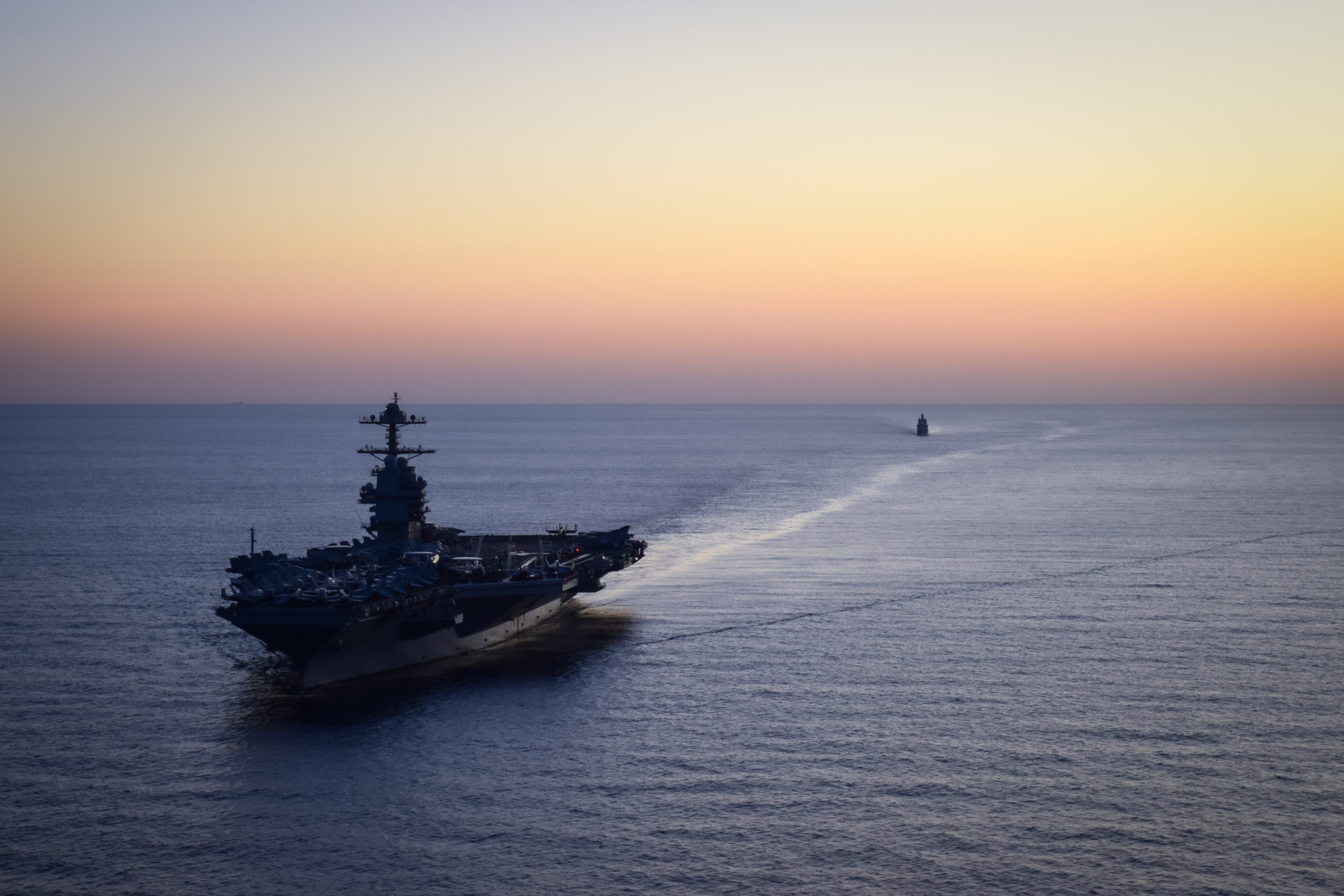
WHEN A CARRIER STRIKE GROUP changes oceans, it’s not just a move—it’s strategy. The Trump administration’s recent decision to redeploy USS Gerald R. Ford and its strike group from the Mediterranean to the waters off Latin America might sound like a shift from deterring adversaries near Europe and the Middle East to countering “illicit actors” in the Caribbean. But beneath the Pentagon phrasing lies a far more consequential question: Why are we moving one of America’s rarest and most capable instruments of military power from a theater of genuine danger to one of political ambiguity?
A century ago, this sort of thing went by the name gunboat diplomacy. It meant sending warships—and sometimes Marines—to make a point when words failed or patience wore thin. In 1903, American ships anchored off Panama (and landed Marines on the isthmus) to guarantee the birth of a canal-friendly republic. In 1914, the Navy bombarded Veracruz to punish Mexico’s president for an insult to the flag. Through the following decades, U.S. forces landed again and again in Haiti, Nicaragua, and the Dominican Republic to “stabilize” governments and protect corporate interests. Each action achieved its stated purpose, but at a lasting cost: Latin American nations learned to read American intervention with its multiple naval deployments as intimidation cloaked in rhetoric. That legacy of resentment still colors regional suspicion whenever a gray hull appears on the horizon. Even the 1962 Cuban Missile Crisis—perhaps the most perilous episode of the Cold War—fit the same pattern, with the U.S. Navy’s quarantine of Cuba serving as the ultimate act of gunboat diplomacy. In that case, the display of sea power was justified and carefully controlled, but it also walked a razor’s edge between deterrence and disaster.
As the twentieth century advanced, wooden decks gave way to flight decks, and the aircraft carrier replaced the gunboat as the visible emblem of American reach. Showing the flag evolved into projecting power. The presence of a U.S. aircraft carrier—5,000 sailors, 75 aircraft, and a floating city of steel—communicates capability and intent, especially when it is accompanied by a full component of cruisers, destroyers, frigates, submarines, and various logistics ships. In diplomatic crises, a carrier strike group is how Washington underlines a sentence with “America means business!” These modern fleets are meant to deter adversaries, reassure allies, and give presidents options short of invasion. But like all tools of military power, they are finite, and every movement carries costs.
The United States Navy currently has eleven aircraft carriers on paper, yet only about half are deployed at any given time (the rest are refitted, repaired, and crews rested). The ones deployed represent billions of dollars, thousands of lives, and a slice of deterrence carefully balanced across the globe. Diverting the Ford—our newest, most advanced, and most expensive carrier—from the Mediterranean to the Caribbean removes a key deterrent from waters bordering both Russia’s southern flank and an increasingly unstable Middle East.
To understand why that tradeoff matters, let’s start by looking at the Trump administration’s stated goal: “to detect, monitor, and disrupt illicit actors and activities that compromise the safety and prosperity of the United States.” The method they are using to meet those objectives is naval presence—a show of force to interdict drug traffickers and reassure partners. But the chosen means, a nuclear-powered carrier strike group designed for high-end war, raises the question of proportionality. When a platform built for global conflict is used for coastal policing, the signal to the world can sound less like resolve and more like confusion.
Naval presence is a zero-sum game. When a carrier steams west, deterrence to the east declines. In Europe, the Ford’s flight deck projected credibility to allies watching Russia’s war on Ukraine expand beyond its borders. In the Middle East, it reassured Israel and other Gulf partners and contained Iran’s adventurism. Now those theaters will rely on smaller formations—or nothing at all—while a supercarrier chases traffickers in a region already patrolled by Coast Guard cutters and capable partner navies. It is difficult to imagine that narco-subs and go-fast boats require a platform capable of launching eighty sorties a day. The optics are grand; the strategic return is questionable.
The parallels to history are hard to ignore. The United States once used “show-the-flag” missions to coerce compliance and protect economic interests. We now claim a motive of hemispheric security. Yet Latin American leaders remember those earlier visits. Even friendly governments may privately view this deployment as a reminder that Washington still reaches first for military muscle, an increasing flex over the last several decades.
Multiple reports describe lethal U.S. airstrikes on “suspected drug-smuggling vessels” in international waters. However justified those actions may be to some, for those pulling the triggers they raise serious questions of legality and legitimacy. Who authorizes the use of deadly force against non-state actors—suspected criminals—in peacetime? What standards of evidence apply? How do partner nations perceive a supercarrier conducting combat operations near their coasts? These are all questions that military commanders ask. When military power substitutes for diplomacy, both suffer. The satisfaction of doing something often erodes the trust that sustains long-term influence.
MILITARY LEADERS OWE THEIR FORCES clarity of purpose and proportionality of risk, because sailors and aviators understand the difference between strategic necessity and political gesture. This decision fails that balance test. The reward—marginal disruption of transnational criminal networks—is limited and fleeting. The risk—thinning deterrence in Europe and the Middle East, miscommunicating intent to allies and adversaries, and inflaming regional sensitivities—is substantial. Strategically, it dilutes focus. Morally, it confuses power with purpose.
I’m not a Navy guy, but a smart one once told me that the Ford Strike Group is built for air superiority, sea control, and high-end warfare. That guy didn’t mention counter-drug patrols. Deploying it to chase smugglers is akin to sending a brain surgeon with a scalpel to stitch a finger—technically possible, strategically absurd. Such choices often reveal political showmanship more than coherent strategy. The sailors will perform magnificently; they always do. But excellence of execution cannot compensate for errors of conception.
Deployments speak louder than communiqués. Allies, adversaries, and competitors all read movement as intent. Pulling the Ford from the Mediterranean tells Israel, Moscow, Tehran, and many others that U.S. attention is divided. Sending her to the Caribbean tells Latin America that Washington still defaults to coercive display over cooperative partnership and engagement with partners and allies. And it tells Beijing—now quietly expanding its economic and naval presence in South America—that the United States sees the region primarily through a military lens rather than a developmental one. Presence without purpose means turning deterrence into distraction.
Good strategy starts with clarity of ends. What outcomes do we seek in the Western Hemisphere—reduced drug flow, stronger governance, deeper partnerships? If those are our objectives, we ought to align means with those ends: intelligence sharing, law-enforcement capacity, Coast Guard expansion, regional maritime task forces, targeted economic aid, and sustained diplomacy. A carrier strike group should be the final instrument employed, not the opening act.
Theodore Roosevelt once justified his ‘big stick’ by claiming that civilized nations must exercise “an international police power.” In his era, that line built empires. In our era, it corrodes alliances. Today’s measure of leadership is legitimacy, not intimidation. Power divorced from prudence is not strategy; it’s noise.
In the calculus of limited carriers and unlimited headlines, prudence—not spectacle—remains the most powerful signal of all. Using a carrier named for President Ford—a man defined by steadiness and restraint—seems more than misguided. Americans should ask what message this voyage really sends. Is it deterrence, distraction, or déjà vu?
 | A guest post by
|