

‘The Odyssey’ Review
The concluding epic in Christopher Nolan’s Death Drive trilogy.

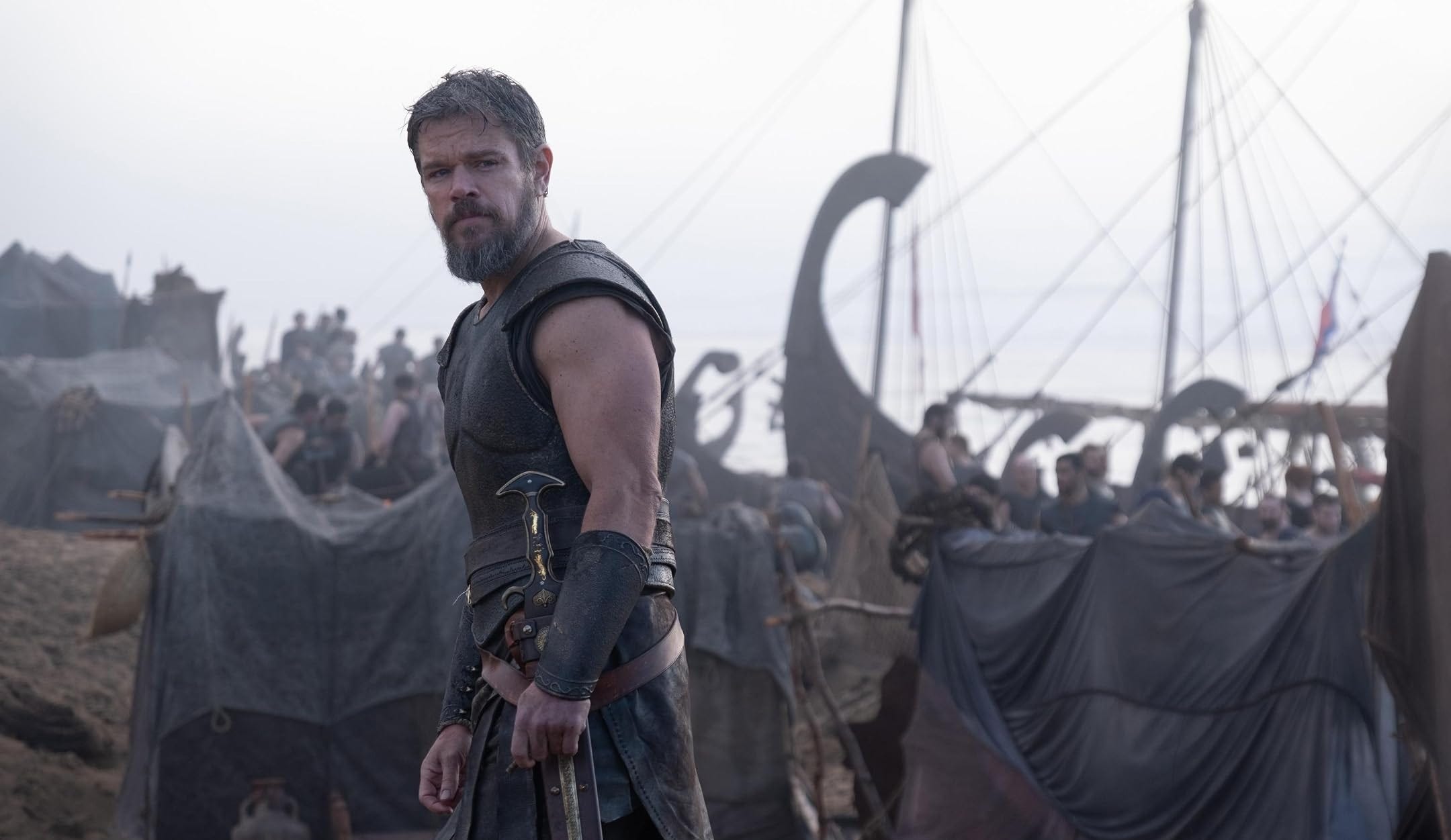
CHRISTOPHER NOLAN HAS ONLY ONE official trilogy under his belt. His Dark Knight Trilogy involves a masked man waging war on crime bosses, yes, but it doubles as a comment on the post-9/11 age and the collision of liberty and order that occurred as a result. The Dark Knight remains right at the top of any list of movies about the Global War on Terror despite never once mentioning al Qaeda.
Nestled in between his Batman films was a sort of shadow trilogy. And while The Prestige, Inception, and Interstellar couldn’t seem more different—a period magic drama; a near-future sci-fi action flick; and a Spielbergian space adventure—they are all connected by a thematic unity, the drive of parents to reunite with their children. Watch them all in order; it’s a series of films about semi-negligent fathers attempting to protect, and get home to, their kids. That’s what drives the action in each of them, and it’s the best rejoinder to any dolt out there who insists on calling Nolan a robotic fashioner of multiplex puzzle boxes.
His three most recent films—Tenet, Oppenheimer, and The Odyssey—are, on the surface, also radically different. A Bond-inflected sci-fi adventure film; a historical drama about the fashioning of the atomic bomb; and a recreation of one of the West’s foundational myths. But they too have an underlying thematic unity, albeit one that’s a bit darker than his other films. They are, all of them, fascinated by the human compulsion toward self-destruction. Toward annihilation.
The Odyssey, then, is the conclusion of Nolan’s Death Drive Trilogy.
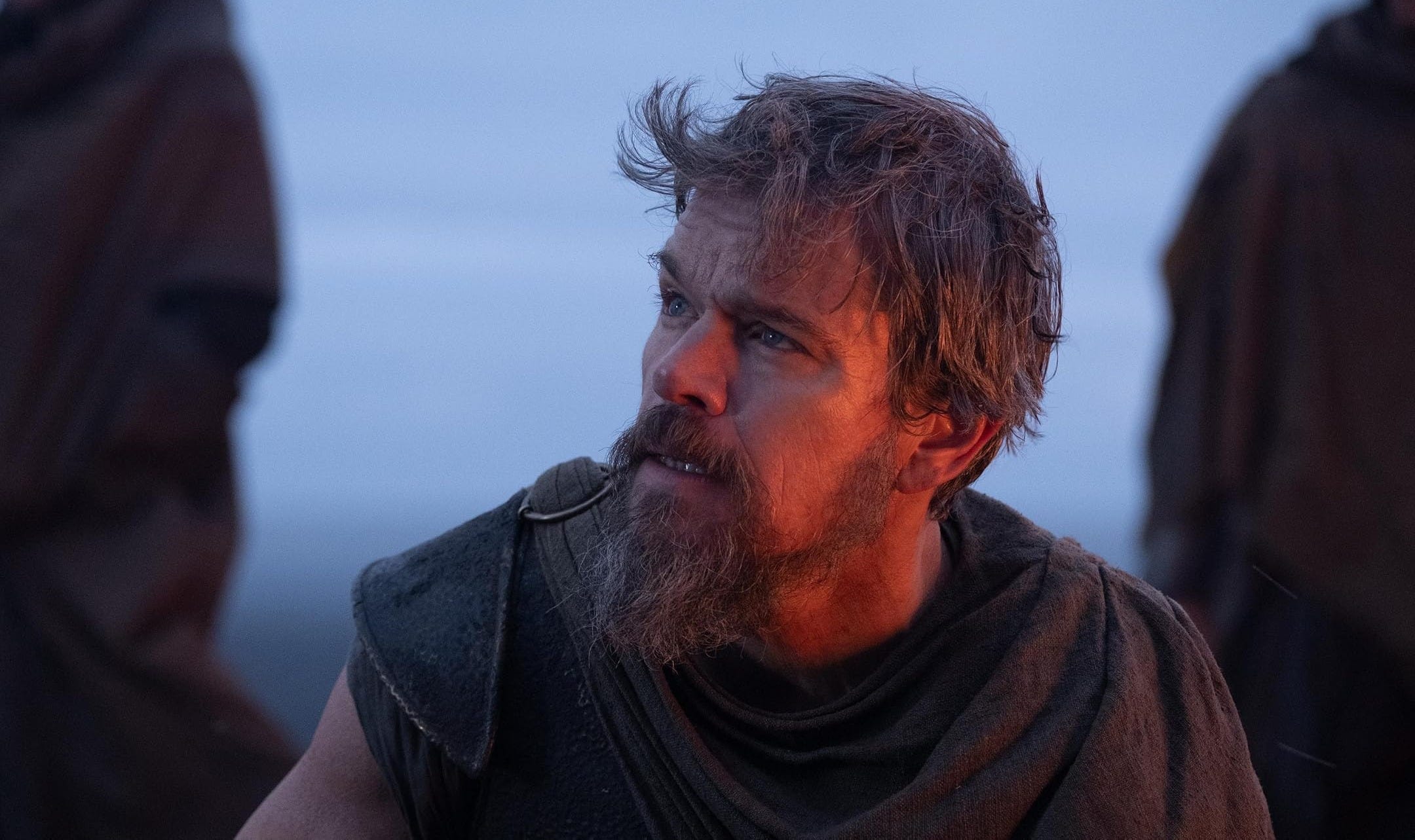
Odysseus (Matt Damon) speaks to the shade of the blind seer Tiresias (James Remar), whom Circe (Samantha Morton) has told the hero of the Trojan War to summon from Hades for guidance home. There are two ways forward, and a choice: risk Charybdis, a whirlpool that will kill every man on board, or sail past Scylla, a multiheaded serpent who will snatch precisely six men from the ship. Regardless of the path chosen, Tiresias foresees that all of Odysseus’s men will die. A sacred island beckons. Its livestock belong to Apollo. If they eat of these beasts, they will be punished by the gods. Why worry about the fate of the six when they’re all doomed anyway?
“I can still save them from the gods,” Odysseus replies. Not haughtily or with hubris. More in desperation. And Tiresias’s reply is, I think, key to the whole film.
“But not from themselves.”1
The Odyssey is driven by the belief that man is, inherently, self-destructive. That our inability to hew to the laws of the gods—the most important of which is repeatedly stated to be Zeus’s law, the command to host strangers as if they were gods in disguise in the understanding that you should be treated similarly in a stranger’s home; basically, to uphold the golden rule about doing unto others—will be our undoing. That violations of sacred norms have consequences which cannot be foreseen or defended against. And Odysseus, by flouting one such law, ushers in a dark age from which it will take centuries to recover.
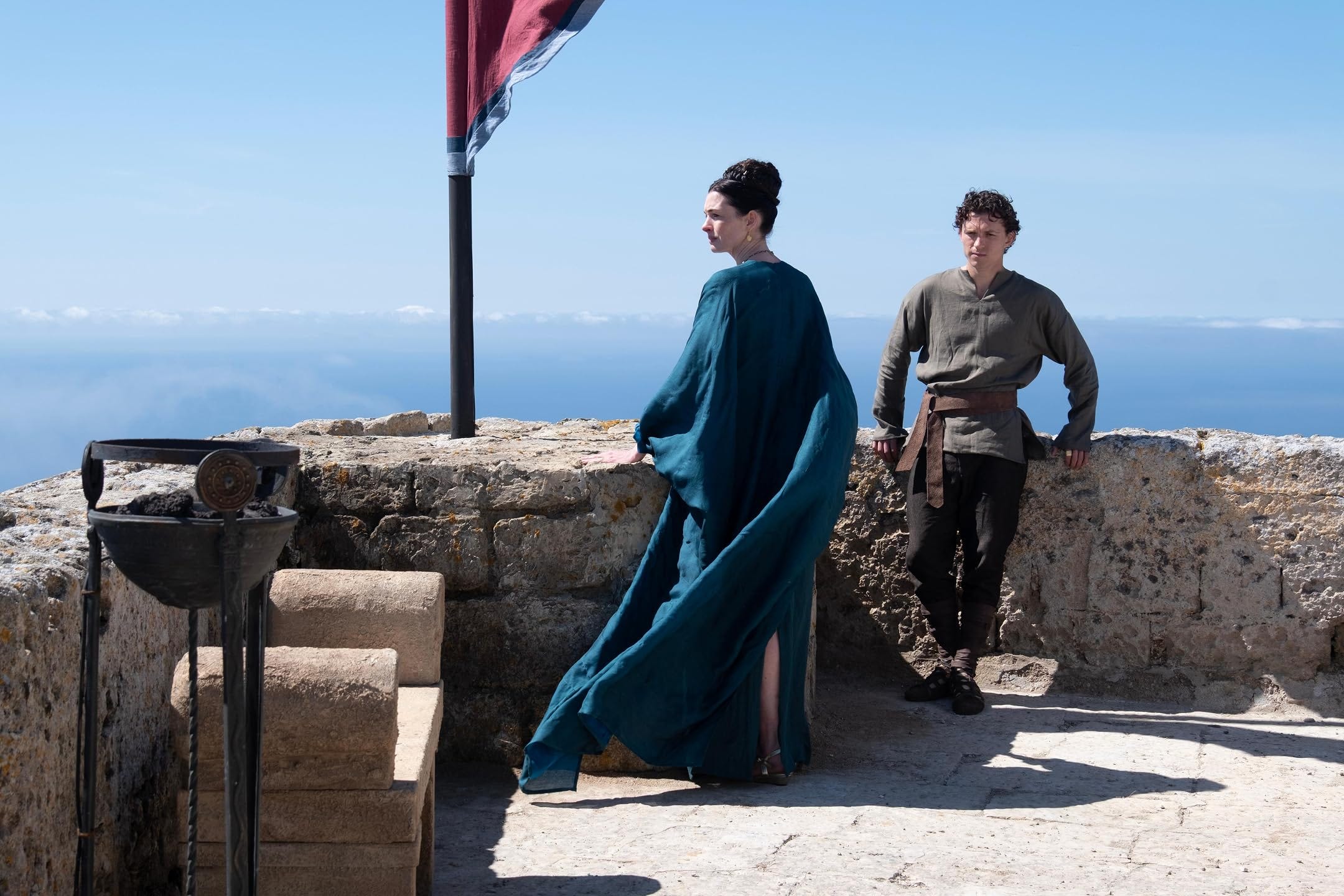
Odysseus’s wife, the queen Penelope (Anne Hathaway), and son, the young prince Telemachus (Tom Holland), labor under the pretense of Zeus’s law even as the suitors who vie for her hand in Odysseus’s halls scorn it. The suitors eat like locusts, they abuse the beggars who line the halls seeking succor, they plot to kill Telemachus. The most locust-like among them is Antinous (Robert Pattinson) who, as a young man, convinced a poor boy to take his place on Odysseus’s voyage to Troy.
Troy, of course, is where this story truly begins. Ten years on a beach stalemated by the world’s strongest walls, driven into war by a king hoping to destroy the last remnants of opposition, ended by a wily trickster’s violation of sacred norms.2 The reverberations of that violation—the question of whether man can save himself from his own self-destructiveness, whether he will learn any lessons from it—are the main concern of The Odyssey.
I’m hopping around, but that’s because the film itself hops around, and that’s because Homer’s epic poem hops around. If The Odyssey has a fatal flaw, it’s that it’s almost too faithful to the structure of the poem on which it is based, which takes six of its twenty-four books just to get to Odysseus, and then tells the story of his journey in a fractured flashback. The result is a herky-jerky, stop-start style of storytelling that feels less fluid than Nolan’s previous works. This is the secret mastery of Oppenheimer: It’s a historical biopic that’s edited like a high-caliber comic book movie, seamlessly flowing between timelines and characters, using the rhythm of the cuts to make a congressional hearing or a deposition feel like a fistfight.
The Odyssey is more fractious, more fissured. It is, first, two hours of abuse and defeats and arguments and disappointments and the occasional bit of grubby cleverness, followed by an hour of glorious vengeance. (So glorious, in fact, that people in my audience were clapping at the mere plucking of a bow and the beautiful twang of its reverberations.) Odysseus, like Oppenheimer, is a man who changed the world, albeit one who had some regrets after the fact: Change is momentous, change is dangerous. When you shatter norms and fail to respect what has come before, you risk calamitous darkness.
In a way, both films are about men who ended the world; as I wrote in my review of Oppenheimer, the father of the atomic bomb sees the world as both intact and consumed by nuclear fire simultaneously, existing in a sort of Schrödinger’s Annihilation. Humanity, in his view, is incapable of being trusted with the gift of nuclear fire. Odysseus, too, sees a civilization coming to ruin thanks to his works, sees chaos spreading to all corners of the known world as cherished norms are torn asunder. He sees the fall of one empire and the rise of another, knowing “our mistakes will once again be forgotten.” And Tenet is centered on the efforts of a dying Russian to reverse the flow of entropy at the behest of future dwellers convinced that the past’s destruction is the only way to ensure their own existence.
These films, like the bullets in Tenet, flow backward through time, from the near future to the recent past to ancient history. Yet we speed headlong toward our own destruction ever faster, the Freudian iteration of thanatos compelling us.
Support our coverage of movies, books, and ideas—join Bulwark+ today.
“THIS IS ALL VERY INTERESTING,” I can practically hear you muttering with frustration. “But will I enjoy it?”
That is a hard question to answer. As I said, there were literal cheers at my preview screening about two hours in. Matt Damon is rough-hewn and righteous but not charming. Pattinson is perfect as the sleazy schemer; it’s a mode he does as well as anyone. There are endless small roles that are played perfectly: Jon Bernthal as an aggressively nurturing Menelaus; Charlize Theron as the bewitching Calypso; Mia Goth as the treasonous handmaiden, Melantho; John Leguizamo as the blind swineherd, Eumaeus; and Zendaya as a sad, watchful Athena.
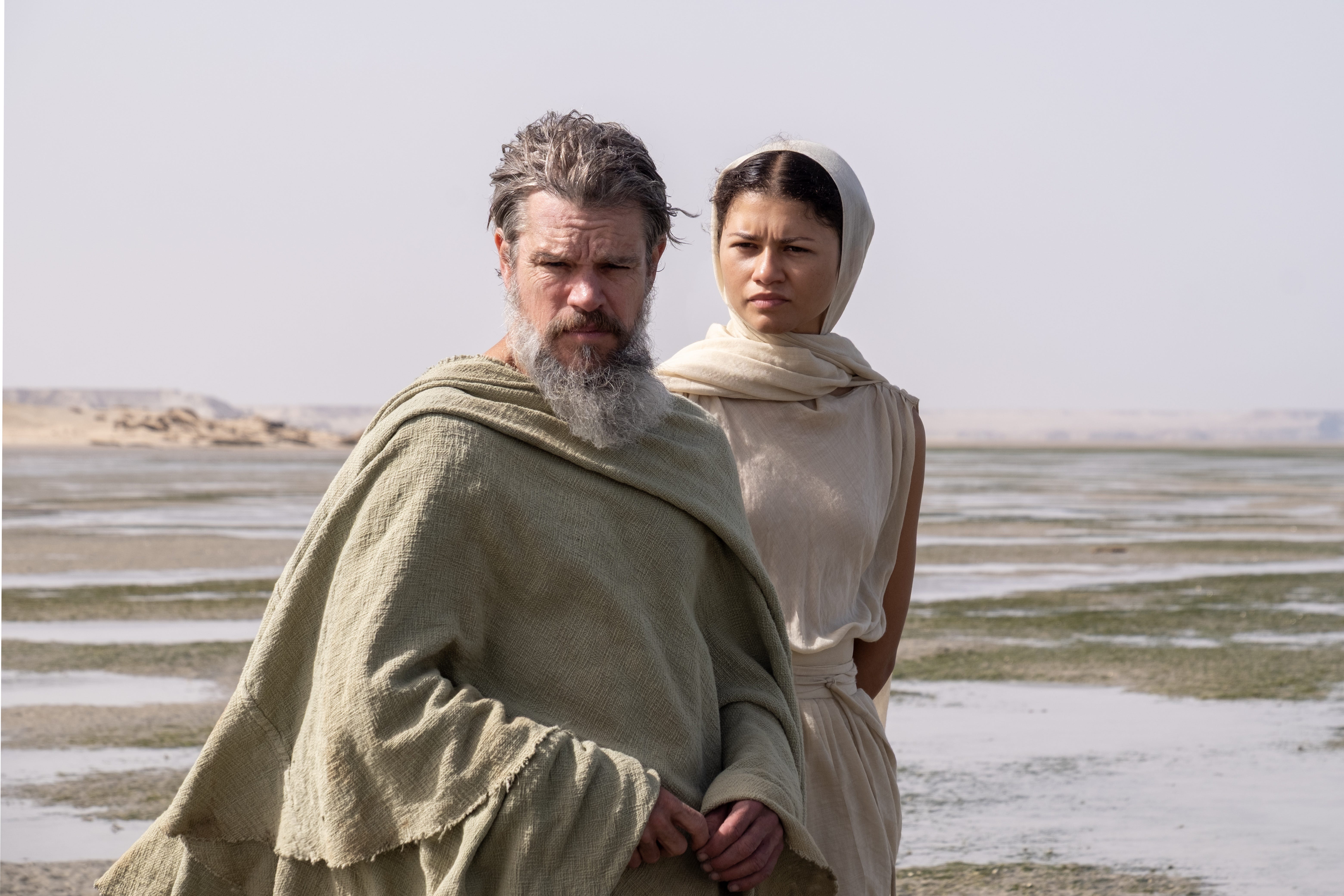
It is this role and this performance that may mark the greatest deviation from Homer’s poem. Despite monsters appearing as real and regular parts of Odysseus’s journey—Sirens and Scylla and Cyclops, oh my!—the gods are more opaque. She is constantly with him, in more ways than one, but also maybe not. She may be a memory. She may be a ghost. Haunting him for the sacrilege committed in Troy in her name.
Frankly, I don’t love the choice; if you’re going to have witches turning men into pigs and one-eyed giants dismembering guests, there’s no reason not to have the gods make a more explicit entrance. But Nolan seems to agree with Zeus, who proclaims, in the first book of the Odyssey, that people “themselves, with their own reckless ways, compound their pains beyond their proper share.”3
And you know what? Maybe we do. That death drive exists within each of us, eternal and inextinguishable.
Evergreen disclaimer that any dialogue here is potentially slightly inaccurate, as I do not yet have my copy of the shooting script.
This is neither here nor there, but Nolan’s Odyssey probes something that has haunted me about the story of the Trojan horse ever since I first heard it as a child. I do not worship the Greek gods, but if I did worship the Greek gods, it seems to me that using a false offering to bring about the destruction of an enemy goes beyond any notions of fair play and straight into blasphemy. The West’s earliest tale of heroic triumph is predicated on spitting in the face of the gods, yet in our day that layer of meaning is overlooked and we celebrate the story in the shallowest way possible, as the story of a clever trickster pulling one over on his enemies.
From Robert Fagles’s translation.
I have been waiting for exactly one review of The Odyssey and it was this one. In the words of another of another character, "and you didn't disappoint."
I can't wait to sit in the theater and watch this film.
Glad to see, Sonny, that you avoided a comment or two about Emily Wilson's translation versus all others since the beginning of civilization. Ha! Thanks for the review. Will see as soon as it opens this week. Nolan has a style!