The One Word Trump Won’t Say in Turkey
While Recep Erdoğan reaps the fruits of hosting a NATO summit, Turkish democracy pays the price.

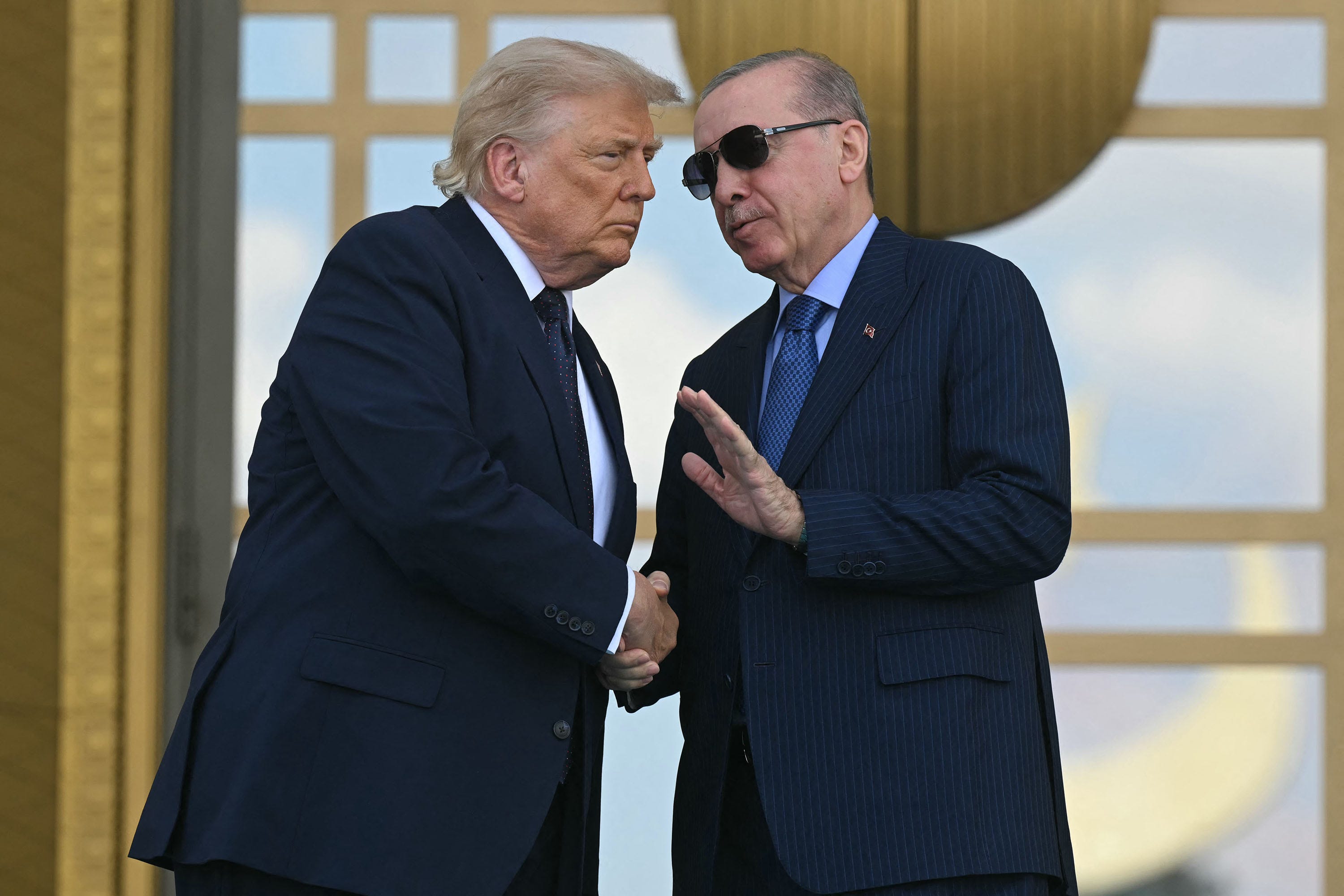
THE NATO SUMMIT JUST BEGUN in Ankara, Turkey is already freighted with drama. President Trump, in his first meeting in the summit, already brought up thorny issues like establishing some sort of American protectorate in Greenland and selling F-35 fighter jets to Turkey. NATO Secretary General Mark Rutte’s pre-emptive visit to Washington to butter Trump up in the hopes of avoiding a disastrous rupture does not appear to have totally soothed the president’s sense of grievance against NATO allies for not helping extricate him from the messy war with Iran that he launched, without alliance consultations, in February. U.S. Ambassador to NATO Matthew Whitaker and Secretary of Defense Pete Hegseth have declared that sales of U.S. defense articles will flow to those NATO members who have been the most cooperative and have increased defense spending by the largest amount. Europeans will be holding their breath in hopes that more such Trumpian headaches can be avoided, and discussion at the summit can focus on defense spending and investments as well as the ongoing war between Russia and Ukraine.
One subject that will be studiously avoided is the damage being done to the state of human rights and democracy in the host nation by Turkey’s President Recep Tayyip Erdoğan. His assault on the fundamentals of Turkish democracy has been ongoing for more than a decade, but it has reached a crescendo over the past year. His continuing mismanagement of the Turkish economy caused his Justice and Development Party (AKP) to suffer a devastating electoral rebuke in the municipal elections of 2024. But rather than developing a revised program to appeal to voters, Erdoğan has chosen to pursue a strategy of disqualifying his most popular opponents and creating a sham opposition of his own design.
For years, Erdoğan had used a stratagem of discrediting, detaining, and replacing elected mayors against the pro-Kurdish Peoples’ Democratic Party (HDP). Starting in March 2025, he began to apply the same technique to the leading opposition party, Atatürk’s People’s Republican Party (CHP). As a group of Turkish political scientists noted, “What was wielded earlier to target a stigmatized minority has now become a general tool of political control.” The initial target was the popular Istanbul mayor Ekrem İmamoğlu who was widely seen as the most likely challenger against Erdoğan should the latter bend the constitution in a way that would allow him to pursue another term in office (as he seems bent on doing).
İmamoglu has been charged with, among other things, treason and corruption, and has had his university degree retroactively invalidated (Turkish law requires presidential candidates to be university graduates). The Financial Times reported that in the days before the NATO summit, İmamoglu was shuttled across “three different court hearings, in front of three different judges, in a case decried by critics as a parody of justice.” The EU rapporteur for Turkey, Nacho Sanchez Amor, noted that “the court no longer appears to be preserving even the appearance of a fair trial” and added that this case, “which may shape Turkey’s democratic future, is being accelerated while international attention is being focused on [the] historic NATO summit.” But Erdoğan’s offensive against Turkish democracy is not limited to one potential opponent. Forty-five other CHP mayors have been detained, removed, or replaced since the 2024 elections.
Moreover, Erdoğan’s campaign against the main opposition party has not stopped there. Prosecutors have also launched an assault on the very structure of the opposition CHP. After Erdoğan was re-elected in 2023, in the face of a united opposition, the CHP had dumped its colorless leader, Kemal Kılıçdaroğlu, who had insisted that he should be the opposition candidate despite polling that consistently showed him as a weak opponent. A CHP Party congress replaced him with the more energetic Özgur Özel, who began working closely with İmamoglu to prepare for a presidential election showdown with Erdoğan’s AKP in 2028. Conveniently for the incumbent president, some former AKP figures who had defected to the CHP filed a lawsuit alleging irregularities in the congress that that overwhelmingly put Özel in charge of the opposition party. In April, an appeals court invalidated the congress and re-instated Kılıçdaroğlu. This action has divided the party and has all the earmarks of Erdoğan abusing the justice system to pick a weak opposition candidate against whom to run for another term.
This brazen assault on what’s left of Turkish democracy was met with public protests, and Erdoğan’s government has moved with alacrity to ensure that no public display of opposition can manifest itself while NATO are enjoying his hospitality. A massive crackdown has ensued, with security forces detaining and arresting more than 300 lawyers, academics, journalists, and political activists—including the popular comedian Deniz Göktaş, who had the temerity to refer to Erdoğan as a “dictator.” The arrests, according to Human Rights Watch, highlight “Türkiye’s ruthless intolerance of freedom of speech and assembly.” The abuse of the nation’s counter terrorism laws, HRW noted, “flies in the face of the founding values of the alliance,” which include individual liberty, democracy, human rights and the rule of law.
One might expect that democratic backsliding on this scale would draw some attention from the leaders of the transatlantic alliance attending the summit in Ankara, especially given the fraught relations between most of Europe and Turkey over the past fifteen years, including a major NATO summit crisis precipitated by Erdoğan in 2009 and his obstruction of Sweden and Finland’s accession to NATO in recent years. But the conjunction of the Trump restoration in the United States and the intensifying Russian threat to Europe have resulted in a conspiracy of willful blindness to domestic developments in Turkey. Trump, who benefits from a multimillion-dollar licensing agreement for the Trump Tower Istanbul along with other business interests, has long regarded Erdoğan as a “friend” and notes that transactionally, “everything I’ve ever asked him for, he’s done.” The U.S.–Turkish relationship in his first term was less a government-to-government relationship and more of a family-to-family connection mediated via sons-in-law Jared Kushner and Berat Albayrak, along with Turkish businessman Mehmet Ali Yalçındağ. That pattern has continued in the second term, with Trump family friend Tom Barrack handling relations as not only ambassador to Turkey but also as special envoy for Syria (where he has consistently echoed Turkish talking points) and Iraq. Barrack has consistently disparaged democracy as ineffective in the Middle East, so it’s not surprising that the trajectory of Turkish democracy is a matter of indifference to him.
For their part, the Europeans have had years of tempestuous relations with Erdoğan over EU membership, immigration, and other issues, but the course of Russia’s war in Ukraine, the collapse of the Assad regime in Syria, and now the war in Iran have all highlighted Turkey’s geopolitical importance and crucial role in providing support for Ukraine, negotiating a truce in the Black Sea that allowed crucial agricultural products and fertilizer to flow despite the naval war underway, and its potential as a broker of peace in multiple theaters. Turkey’s large military establishment and growing and diversifying defense industry are seen as crucial components for Europe’s deterrence of prospective Russian aggression and long-term effort at rearmament. With all these interests at play, it’s no wonder that despite a recent, harshly critical European Commission report on Turkey and a June 17 European Parliament resolution condemning Turkey’s democratic decline, it’s highly unlikely that negative comments on Turkey will feature at the summit. European leaders are hoping that Erdoğan’s friendship with Trump and desire for a successful summit will prevent the kind of Trumpian tantrums that have disrupted previous summits.
The Trump administration, for its part, is hoping to build on a successful summit in Ankara to normalize a relationship with Turkey that has been roiled for over a decade by Turkey’s purchase of a Russian S-400 air and missile defense system that resulted in the country’s expulsion as a partner in the F-35 aircraft program. Under the Biden administration, Turkey was able to purchase some new F-16s after a protracted period of discussions over Turkey’s recurrent threats against NATO ally Greece. The Trump administration has announced the sale of jet engines for Turkey’s indigenously produced KAAN jet fighter, and Vice President Vance suggested at the end of June that the administration was reviewing the possibility of bringing the Turks back into the F-35 program. Vance’s announcement prompted a bipartisan Congressional letter pushing back on the notion of Turkey being allowed back in the program, and a group of House Democrats, led by Rep. Dina Titus of Nevada, have introduced legislation to block re-entry into the program, which already would contravene a provision of the 2020 National Defense Authorization Act. Nonetheless, Trump indicated in Ankara that he might try to sell F-35s to Turkey anyway.
Normalization of relations with Turkey and turning a blind eye to domestic political repression in Turkey are being justified on grounds of realpolitik. Turkey is geopolitically important, and the foreign policy bureaucracy in the United States has usually seen the country as too big and important to fail. But the history of the last decade and half has shown that Turkey has become and remains an unpredictable ally subject to changing policies at the whim of its current president, who is erecting an authoritarian, personalistic system. In the long run, failure to call out the suppression of human rights and the consolidation of a system of electoral authoritarianism in a deeply divided society is a recipe for unrest and conflict, not a stable relationship. What might seem the acme of realistic statesmanship today is simply buying bigger problems for the future.
 | A guest post by
|