China’s Military: ‘We’re Coming for You’
The People’s Liberation Army has been planning for decades to challenge the U.S. military. They may be getting close.

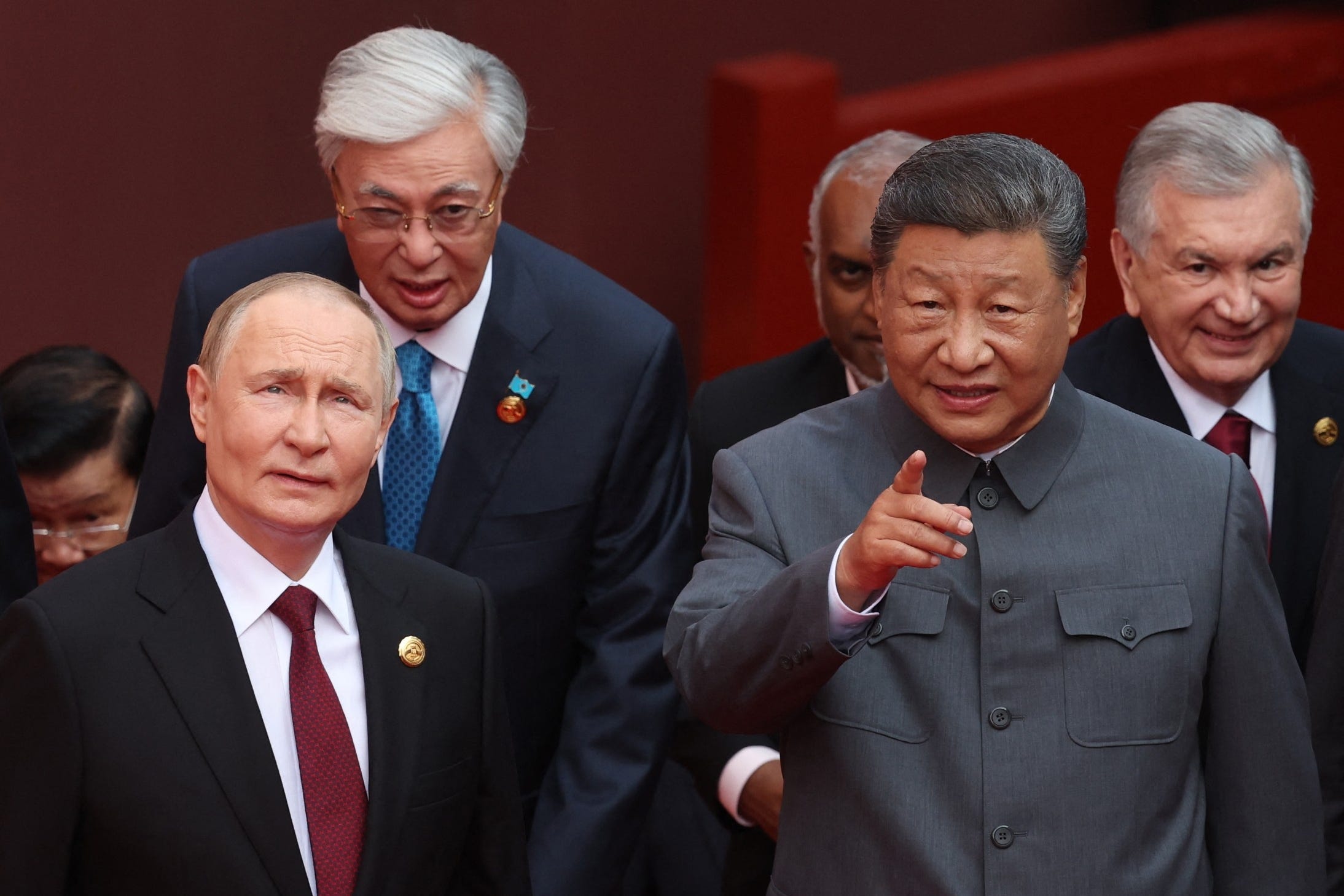
WHEN CHINA STAGED ITS MILITARY PARADE in Beijing last week, much of the commentary in the West focused on the political optics: Vladimir Putin was a prominent guest, joined by Kim Jong-un, Narendra Modi, and even representatives from NATO countries. While the list of attendees is important, as a former soldier, I was focused on something else. The message of this parade wasn’t just about political power, but about military power: the scale of the Chinese armed forces, the pace of their modernization, and the capabilities they now bring to bear.
My first encounter with the People’s Liberation Army was in 1998. I was a student at the National War College, which each year sent small teams of its students—officers and diplomats—to different parts of the world to assess regional power. I pleaded to go to China, largely because my earlier tours were exclusively in Europe and the Middle East. I got my wish, our group of one officer from each of the services, plus a diplomat, prepared intensively for months.
A retired Navy captain who was an expert on China was our instructor. He taught us everything he could about the PLA, as well as about the culture of the nation and how we might be treated during our many stops. On our tour, our most important visit was to Nanjing, home to China’s war college, where we received a briefing from their students and faculty on the PLA’s twenty-year modernization plan. That evening, over beers at our hotel bar, every one of us Americans had the same thought: Their goals were far too ambitious. They wouldn’t be able to pull it off, at least not so fast.
Then, for the next two decades and more, we watched. From 1998 to today, China has not only met its goals but usually exceeded them. In some ways, they are ahead of the schedules set out in subsequent modernization programs. They have overhauled their acquisition system, professionalized their officer corps, expanded training and exercises, and steadily modernized and up-gunned their massive force.
The PLA is now the world’s largest standing military, with roughly two million active-duty personnel. Its official defense budget is about $250 billion annually, though some analysts believe the real number, including spending on military forces outside the official defense budget and adjustments for labor costs and purchasing power, could be closer to $700 billion, on par with the U.S. defense budget. The force now encompasses the full range of modern military arms—land forces, a large and growing navy with multiple aircraft carriers (they had none back in 1998), an increasingly sophisticated air force, a missile force, and specialized units for space, cyber, and information warfare. Global indexes of military power consistently rank China behind only the United States.
China also now possesses a robust and growing nuclear arsenal, giving it a full set of strategic deterrent options. The parade in Beijing made this visible: nuclear-capable bombers and new, never-before-seen road-mobile intercontinental ballistic missiles. For obvious reasons, China’s nuclear missile submarines didn’t parade across Tiananmen Square, but they complete China’s nuclear triad. Only a handful of countries in history have ever had that capability. This was meant as much for Washington as it was for the Chinese domestic audiences and their VIP guests. The Department of Defense projects that China will have approximately 1,000 nuclear warheads by 2030. (Russia and the United States each have about 1,700.)
Most striking, though, is the speed at which China has modernized—shifting from outdated Soviet-like equipment focused on “mass” to advanced technologies that rival, and in some cases surpass, what the United States fields. The parade also displayed China’s growing fleet of hypersonic weapons, missiles that can maneuver at several times the speed of sound. Those systems are extremely difficult for existing U.S. or allied defenses to intercept, and their purpose is clear: Hold U.S. bases and aircraft carriers in the Pacific at risk, and complicate American military planning in the region.
Unmanned systems were another major display. China showed off long-range attack drones, stealth drones designed to be “wing-men” to piloted fighter aircraft, robotic ground vehicles, and even unmanned submarines. These systems are designed to be fielded in swarms of autonomous platforms that can overwhelm traditional defenses. The drones were complemented by directed-energy weapons, including a mobile laser system designed to shoot down drones and missiles. For years, lasers seemed like science fiction, but the United States, Israel, and other countries are deploying them in limited numbers, and China is clearly betting on them.
In the aircraft flyover, the Chinese military displayed new stealth fighters and modern bombers. It was obvious that China has benefited from industrial espionage and cyber-theft of American designs: Some of their planes, helicopters, tanks, and ships resemble U.S. systems so closely one needs to squint to see the differences. But while the equipment showed obvious knock-off design, what matters more than appearance is performance. Here China has moved from imitation to innovation, and in several cases, China is fielding capabilities faster than the United States.
A few caveats are warranted whenever watching military parades: These shows are designed to impress, but they can be superficial, and they don’t tell the whole story. We can’t see inside the vehicles to determine if they’re made of military-grade metal alloys or cardboard. We can’t see logistical organizations that would enable the Chinese to use these advanced weapons when and where they would need them. We can’t see maneuvers to determine how wisely and creatively these weapons would be used in an actual battle, especially in combined arms operations. What we can see of the upper levels of the Chinese political-military command suggests that, whatever tactical and operational strengths the PLA might have, its strategic leadership may be less than solid. Most importantly, we can’t see into the minds of Chinese soldiers to determine if they’d be as fierce on the battlefields of China’s first war in 50 years as they are on parade.
But even if we’re skeptical, it’s still worth taking these demonstrations seriously, because they do indicate the direction of the Chinese military and the kinds of force Xi Jinping may be willing to use to get his way. Some of the visual boasts in the parade might be exaggerated, but China’s continuing, decades-long modernization is real.
For the U.S. intelligence analysts that were likely watching the parade very closely, every piece of equipment on display carried a message. Hypersonic missiles are meant to push American carriers farther from Asia. Drones and unmanned submarines are designed to make U.S. operations in contested waters more dangerous. Lasers suggest a new defensive layer against U.S. aircraft and missiles and a way to defeat drone swarms. And a fully developed nuclear arsenal means China can deter Washington in ways that it could not just a generation ago. China has built a military designed not to look like ours, but to counter ours. That is what should worry American planners—and what should be communicated to the American public.
Against this backdrop, it’s absurd to hear domestic political chatter about attempting to renaming the Department of Defense the “Department of War,” in violation of the law, as President Trump has suggested. Changing a sign on a building or the words on a letterhead does nothing to change the realities of global military balance (except that it costs money that could otherwise be spent on real military capabilities). China’s modernization is accelerating. What matters is how we respond in three different ways—by investing in our own capabilities, by building and maintaining strong alliances, and seeking to better understand the competition we face.
I think back to that night at the bar in 1998, scoffing at the idea that Beijing could ever meet its ambitious military goals. The parade this year was not just a display of soldiers marching in perfect formation. It was a statement of intent and proof of progress. China is no longer a developing military. It dominates the other militaries in its region with capabilities that challenge ours across every domain—land, sea, air, space, and cyberspace. It has global ambitions to replace the United States as the world’s most powerful country. We can be skeptical of the parade as theater, but what it reveals should not be ignored.
 | A guest post by
|