The Self-Inflicted Decline of American Leadership
Team Trump is inadvertently convincing America’s allies that they need one another more than they need us.

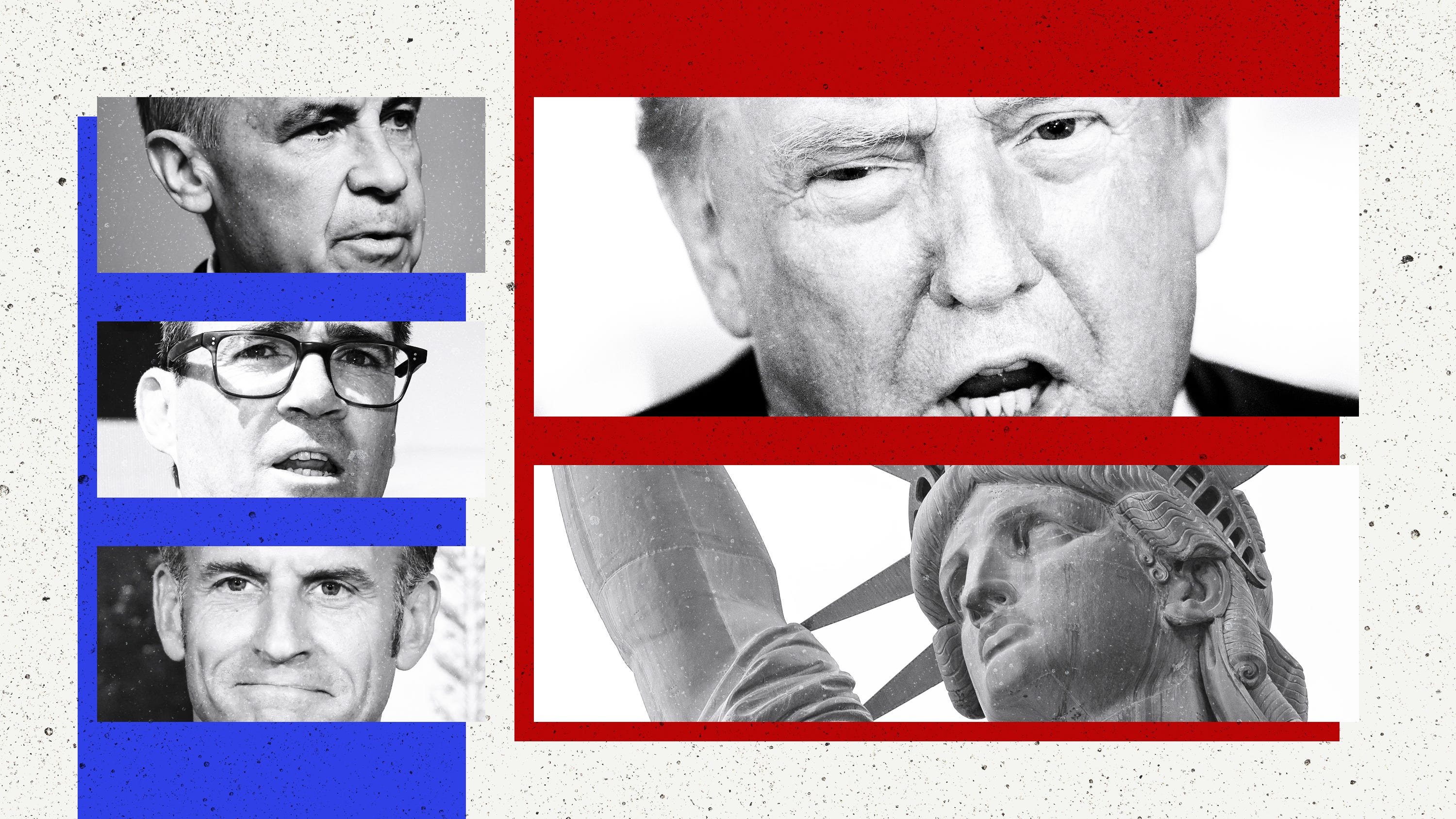
SENIOR OFFICIALS IN THE TRUMP ADMINISTRATION seem alarmed—maybe even insulted—that America’s traditional allies are seeking greater ties with one another, and are, in fact, planning for a possible future in which the United States is no longer at the center of their international relationships.
The administration’s apparently shocked reaction is both laughable and revealing. Trump’s bevy of foreign policy realists are strangely blind to how self-defeating their own actions have become. Their bullying and bluster is driving the formation of the very types of relationships they seem to find objectionable.
Take a look at the comments made by Elbridge Colby, the undersecretary of defense for policy, first in a series of tweets and then in an interview with Ross Douthat. “There is a great deal of hubbub about a collective ‘middle powers’ strategy these days,” Colby posted on X. “From our point of view, a collective middle powers strategy is based on a faulty understanding of international relations.” The whole middle power strategy is a regrettable waste of time, he contended. The comments are classic Colby, but also caught my ear as a belated response to the speech given by Canadian Prime Minister Mark Carney in Davos earlier this year. It’s a speech that’s clearly gotten under Trump’s (and his foreign policy enablers’) skin.
In the address, the Canadian PM declared:
Nostalgia is not a strategy, but we believe that from the fracture [of the former U.S.-led global order] we can build something bigger, better, stronger, more just. This is the task of the middle powers—the countries that have the most to lose from a world of fortresses and most to gain from genuine cooperation. The powerful have their power. But we have something too: the capacity to stop pretending, to name reality, to build our strength at home and to act together.
The speech hit home and Trump and co. have been having a totally normal one in response. I’ll say this for the administration: they’re not hard to read. Trump responded to Carney by name in his own Davos address, retorting that “Canada lives because of the United States.” (To be fair, most of Trump’s speech was given over to griping about NATO being ungrateful and Denmark’s refusal to hand over the “piece of ice” that we call Greenland.)
But Trump’s immediate reply to Carney clearly did not suffice to express the administration’s displeasure. Senior officials are still talking about it seven months later, even if they won’t acknowledge Carney or the speech by name.
At the NATO ministerial summit in June, for example, Secretary of Defense Pete Hegseth said, “Some of NATO’s largest economies, some of the richest countries—allies that are happiest to go on about the rules-based international order and middle powers banding together—still seem to think the era of free riding is here.” It’s pretty clear whom he means here, eh?
Even the more conciliatory members of the administration, such as Secretary of State Marco Rubio, have spoken down to European allies in a “not angry, just disappointed” register. “We want allies who are proud of their culture and of their heritage, who understand that we are heirs to the same great and noble civilization, and who, together with us, are willing and able to defend it,” Rubio told the Munich Security Conference in February. “And this is why we do not want allies to rationalize the broken status quo rather than reckon with what is necessary to fix it. For we in America have no interest in being polite and orderly caretakers of the West’s managed decline.”
Rubio may have been more polite, but the overall message was consistent with the Trump administration’s prolonged effort to lose friends and alienate allies. Trust Colby, though, to state it most baldly. Based on his warped worldview, he contended that nothing intrinsic binds America’s allies together. Instead of seeking to duplicate or replace American power, he argued, Western middle powers should draw closer to America.
Colby’s comments echo similar calls often made by the president, who routinely remarks that, while America doesn’t need anyone’s help (whether that’s anti-drone assistance from Ukraine or trade deals with Mexico and Canada), the rest of the world desperately needs America. The logical implication, in his domination-obsessed style, is that other countries should give America whatever it wants since America’s allies have no choice but to kiss the ring.
(If the president is aware of the incongruity of asserting that the United States needs nothing from anyone while also fuming about a lack of NATO support in the Persian Gulf, he’s yet to give any sign of it.)
THE NOTION THAT NOTHING binds America’s traditional allies together is a genuinely bizarre contention for Trumpian realists to take. Surely Colby and other senior officials are smart enough to have realized that, at the moment, they are the bond. The greatest thing bringing together Japan and South Korea and Canada and Europe and others is mutual alarm at the daily reality of dealing with an erratic United States subject to the whims of Trump and a Republican base content to crow about “America First.” For now, that’s plenty.
And it’s not just Trumpy rhetoric that’s discomfiting allies. Reciting the list of bizarre U.S. foreign policy moves seems rote by now, but some highlights:
Trump’s comments about invading Greenland got serious enough to trigger European military preparations.
He continues to joke (?) about his desire to annex Canada and make it a state.
He has publicly vacillated about whether or not the United States is prepared to defend Taiwan’s autonomy from China.
The United States has signaled that it will be withdrawing units assigned to defend Europe (and has incoherently canceled and uncanceled existing deployments).
And even Israel, a close American ally, has lately found itself marginalized as the Trump White House, in palpable desperation to get out of the war it started with Iran, has simply declared that Israel must cease fire on its northern border with Lebanon—apparently without consulting the Israelis.
Such belligerent inconsistency is underlined by the type of comments regularly made by administration officials like Stephen Miller, who noted in January that our world is one “that is governed by strength, that is governed by force, that is governed by power.” You may not like it, but “these are the iron laws of the world,” he gloated.
Short of actual kinetic attacks on an ally, it’s hard to imagine what more the United States could do to negatively unite the rest of the West. Every speech, tweet, and leaked Signal chat expressing contempt for U.S. allies confirms to other nations and their leaders that America no longer guarantees safety but may now be a threat as a predatory White House seeks to exploit them for trade or territorial concessions.
Trump’s foreign policy is ultimately self-defeating. Any previous administration would have been delighted to see Europe and Canada and others dramatically expanding their militaries and defense industries and speaking firmly about the threat posed by authoritarian states like Russia and China. Europe is rapidly rearming, and will be able to provide much more support for Ukraine. Canada is expanding its armed forces, and is moving ahead with major purchases of aircraft and submarines and is planning a new fleet of surface ships. This will make it a dramatically better partner in the defense of North America. Both Europe and Canada are also building out their defense industries, meaning more weapons and munitions can be produced, faster.
All of this could have enhanced American leadership and influence. Now, these developments, if realized, will instead reduce it.
The comments from Trump and Colby undermine any real confidence U.S. allies can have in America’s willingness to sacrifice for them—and, given public reports about the alarming state of America’s munitions stockpiles, the allies must be growing skeptical about America’s ability even to come to their aid. Once again, regardless of whatever Colby might think, this is all the more reason for the rest of the West to draw closer together.
AND NOW I HAVE TO TALK ABOUT the squishy elephant in the room. Something so notably absent from Colby and Hegseth’s remarks—and certainly from Trump’s—that the omission is glaring. When the Trumpians suggest that nothing binds the middle powers, they overlook the most fundamental commonality of all—basic liberal-democratic values. The kind of values that U.S. leadership once espoused and held up as an example to others.
This is a little hard for me to admit. I am a cynic who agrees with the likes of Colby and Miller on the fact that hard power still matters. Just look at the world around us. Countries do have real national interests, and they can, and indeed must, pursue them. It is true that many of America’s allies to some extent forgot that lesson at some point and coasted on American power—a decision that was both morally wrong and strategically foolish. Too often, the values Western countries touted were observed in the breach, or obligations we neglected. The fact that it took nihilistic opportunists in the White House to show us this is a lesson we shouldn’t forget quickly.
But abandoning our shared liberal democratic values altogether, as Trump seems to instinctually desire and as Colby and Vice President JD Vance demand, is the wrong response. Those values still matter. The middle powers may be imperfect, but they’re still at least gesturing at the same thing: free trade (at least among allies), international cooperation, collective defense against and containment of hostile nations, and—most importantly—coherent, predictable, and stable foreign policies that include abiding by their agreements. This is what mature countries do, especially with their friends.
If America won’t stand up for international norms the way it once did, others need to step up. Canada, France, the U.K., Germany, Australia, New Zealand—wherever—must take the mantle of liberal democracy and stand up to bullies. If America’s allies can’t count on U.S. support, they’ll seek it elsewhere. The best place to start is with like-minded countries facing the same predicament.
 | A guest post by
|