

The Silver Lining of Trump’s Reheated Election Denialism
Take Trump seriously. Take him literally. But also see his speech for what it is: He knows he’s losing.

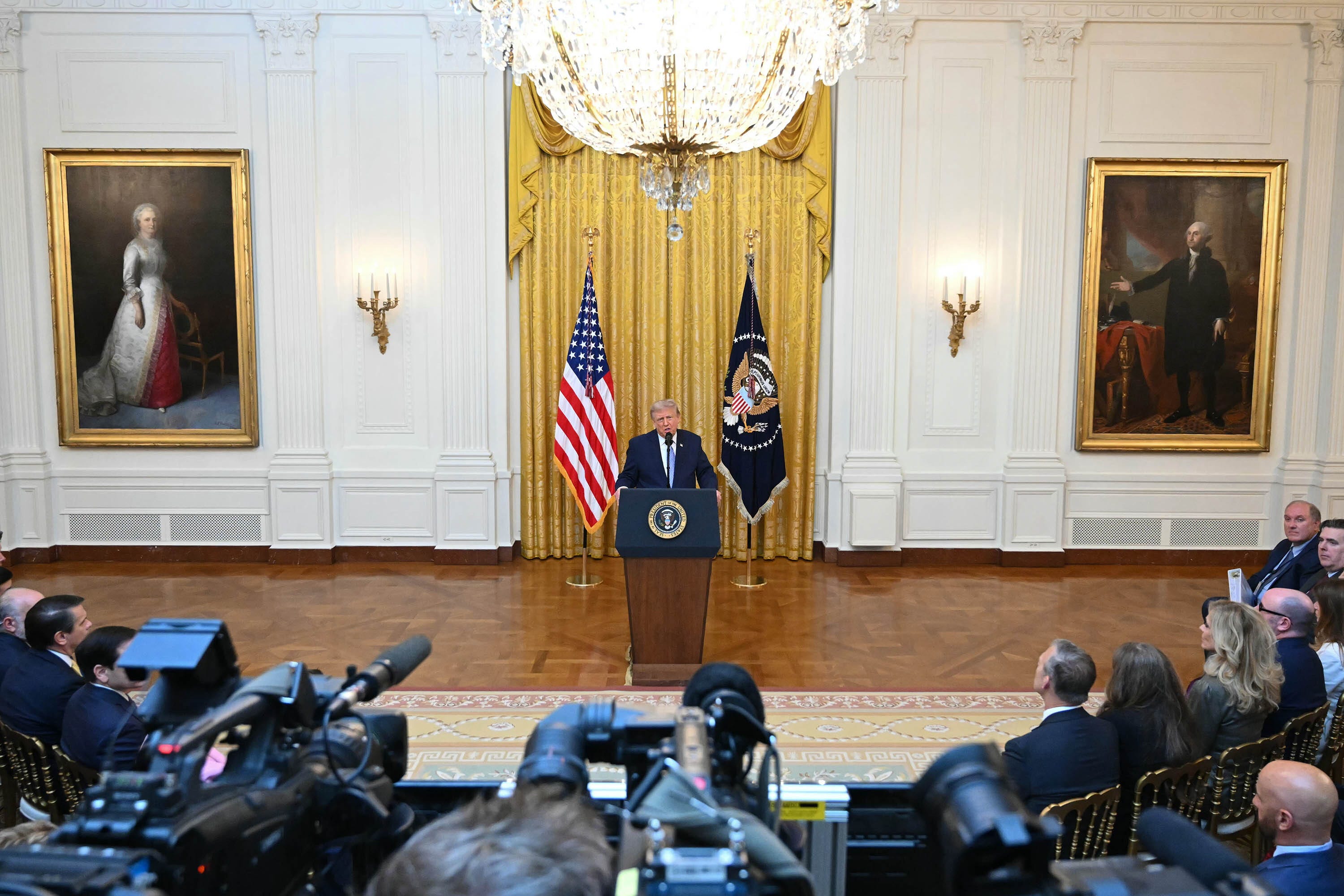
HOURS BEFORE DONALD TRUMP addressed the nation Thursday night, his press secretary Karoline Leavitt promised he would deliver shocking claims.
They did not materialize.
What we got instead was reheated election conspiracy theories in a winding, largely nonsensical speech that several media outlets saw little value in airing live.
In it, Trump claimed that China gained access to more than 200 million voter files (in most states, voter data can be freely downloaded online; in some states, it is available for purchase). He claimed that Venezuela plotted to manipulate its domestic voting technology (this scheme, according to the CIA, could not be replicated abroad). He claimed that more than a quarter of a million noncitizens are on the voter rolls (a number that seems to be exaggerated by about 99.96 percent—or 900 percent if you’re a fan of Trump math).
The speech was so flat that Fox & Friends failed to to mention it even once during their broadcast the next morning. Apparently, the network felt that the prospect of another $787 million lawsuit wasn’t worth re-engaging in tired 2020 election denialism.
And yet, the Trump speech was shocking in ways that Leavitt probably didn’t envision or intend.
The address made clear that the president is hellbent on attempting to seize control of how elections are run in this country. His Department of Justice is suing thirty states plus Washington, D.C. for their unredacted voter rolls, for which they are currently 0–16 in court. His Department of Homeland Security is demanding access to run those rolls through citizenship-verification systems that keep wrongly flagging eligible voters. White House officials refuse to rule out the possibility of sending ICE agents to the polls. And Trump wants the voter-suppressing SAVE America Act to pass so badly that he was willing to sacrifice his housing bill for it. Hell, he exploited the death of Lindsey Graham to push it—unless, of course, you believe that Graham’s dying words to Trump were indeed that he wants to see the SAVE America Act passed.
The good news, for now, is none of it is working. But that just means Trump is going to swing for the fences. The Washington Post reported back in February that Trump allies have drafted a seventeen-page executive order that would let him declare a national emergency over supposed foreign election interference. But even Trump understands that he needs a pretext, flimsy though it may be. Thursday’s speech is his effort to create exactly that. It was the foundation to try and claim fraud. It was him gearing up to declare that the system is broken and China or Venezuela or [insert foreign country here] will interfere in our elections and, as such, I have no choice but to take extraordinary action to prevent that from happening again! Is he being honest? Not at all. But Trump doesn’t need to be. He’s post-truth. He just needs people to believe the lie. After all, remember this statement from the aftermath of the 2020 election: “Just say the election was corrupt and leave the rest to me and the Republican congressmen.”1
Trump has one setting, and he’s showcasing it.
But there is a silver lining here. If Trump were operating from a position of strength, he wouldn’t have to do this. He wouldn’t have to serve up tired and convoluted conspiracy theories about a six-year-old election that don’t resonate beyond his diehard base. But he’s not operating from a place of strength. And Americans know it. He knows it.
The problem Republicans face in having full control of government is that there are no Democrats to point to and blame. No Democrats to blame for surging costs, high inflation, a new war in the Middle East, suppressed Epstein files, high gas prices, and a government focused more on vanity projects for Dear Leader than lower prices for their own constituents. Trump wouldn’t need to engage in election denialism if he were winning; he engages in it because he knows that he’s not.
NONE OF WHICH IS TO SAY that we shouldn’t be concerned, vigilant, or worried as we head toward the midterms. But insofar as political gravity still exists, it presents what may very well be an insurmountable hurdle for the Republican party in these midterms.
To that end, there is also a lesson for Democrats to take from Thursday night. Trump is putting on a clinic in wielding power. And while he does it for self-enrichment, the Democrats can—and, as I argue in my new book, The Day After: How to Wield Power in a Post-Trump World, must—wield power aggressively for virtuous reasons, should they win power back in the midterms. They must do it to deliver on health care, on voting rights, on climate, on a just economy, and so much more. They must remember that they are not in office to defend the institutions of government; they are there to deliver for the American people, including the defense of the sanctity of our elections.
Brian Tyler Cohen is the author of the new book The Day After: How to Wield Power in a Post-Trump World, now on sale. His first book, Shameless, was a #1 New York Times bestseller.
Richard Donoghue, Trump’s ex-acting deputy attorney general, testified to Congress that these were Trump’s exact words during a December 2020 phone call.
Yes! It’s wonderful to see a BTC article here on The Bulwark. I mentioned in a comment this morning that his video after the speech last night was excellent. Just as this article does, it sums up the idiocy, lies and hubris of this stunt without downplaying how dangerous it is, all the same. Thanks for your work, Brian!
Yes he knows he’s losing. He’s psychologically incapable of internalizing and moving past a loss. He will deny, lash out, attack, burn down the house. And apparently a whole political establishment, previously known as the Republican Party, who also knows he’s losing, will enable his pathology.