

The Slop Doctrine
Why the right has overwhelmingly embraced terrible AI-generated imagery.

THE HILLS STAR AND TMZ FIXTURE Spencer Pratt’s unsuccessful run for mayor of Los Angeles was notable for its heavy use of viral AI-generated videos. The most famous of these, something of a cross between Sofia Coppola’s Marie Antoinette and DC Comics, features a slimmed-down Pratt in superhero garb leading a group of angry Californians in throwing tomatoes at a posse of decadent DSA members, LA Mayor Karen Bass, California Gov. Gavin Newsom, and Kamala Harris. It got more than five million views on X.
While Pratt, the latest reality-TV figure to attempt a political career, may be particularly drawn to carefully engineered fakery, the use of AI has become a surprising marker of partisan identity.
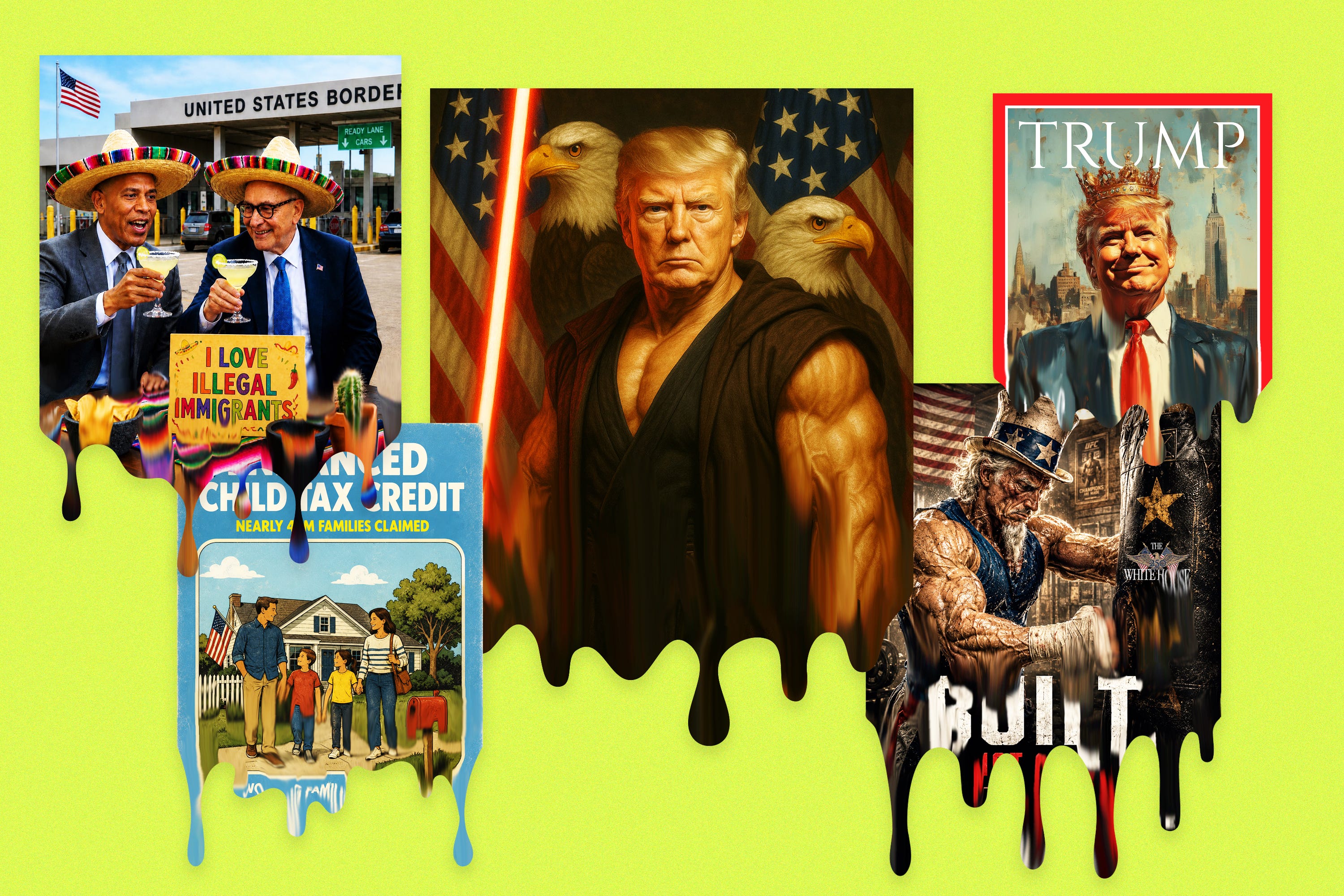
AI “slop” imagery—banal pictures or videos, generally characterized by a kind of airbrushed boring realism, a lifeless surrealism, or obvious errors, produced by image generators trained on stolen stock photos, illustrations, movies, photojournalism, and Instagram selfies—has been widely embraced by the American right. Researchers call its political deployment slopaganda. From Trump’s mocked-up Time cover that inspired the No Kings protests to videos of James Talarico supposedly singing pro-trans musical numbers to over-the-top attack ads, the right has swiftly taken to slapped-together AI deepfakes and other generated imagery to promote candidates, push narratives, and depict opponents in humiliating ways. While Republicans and Democrats are growing suspicious of AI at roughly the same pace, right-wing politicians and influencers have embraced AI slop in a way that the left has not. Why?

THE TRUMP ADMINISTRATION’S wholehearted support of Big Tech is part of this puzzle. As data center projects get struck down nationwide by grassroots organizing, leading Trump administration figures remain heavily invested in Big Tech wares, especially crypto and AI. It’s a fraught relationship at times, given AI companies and Big Tech’s capitulation to Trump’s demands, donations to his pet campaigns, and use of their technologies for immigration enforcement and domestic surveillance, but in exchange the executive branch has worked toward removing barriers to AI development. Policy preference seeps into political identity, and then becomes part of online performance.
But there’s something aesthetic at work as well. AI slop is filtered and sanitized. Another Pratt video features a group of uniformly thin and shiny women at a pilates class, expressing relief at finding out they’re all voting for the Republican-aligned candidate. They don’t look like real women, but rather signifiers of a “feminine ideal” that erases any look that falls outside conventional beauty standards. The effect becomes obvious when we contrast Pratt’s campaign ad with the viral videos of Zohran Mamdani’s mayoral campaign, which showed bodega workers, students, and city employees with gray hair, imperfect features, dark skin, hijabs, yarmulkes, and other features often erased by AI. AI-generated imagery is homogenizing by its very nature. As Roland Meyer, a scholar of AI and the far right, writes, “the generic images of AI image synthesis are not so much the product of artistic choices and conventions as the result of statistical calculations.” In AI-generated America, everyone is glossy, white-coded, good-looking, and generic, which mirrors the Republican party’s project to dismantle pluralistic democracy, erase difference, and embrace homogeneity.
But image and video generators didn’t invent schmaltzy right-wing visual propaganda; they only made it cheaper, easier, and faster. Before the AI boom, conservative visual artists such as painter Jon McNaughton became famous for mixing patriotic kitsch with religious iconography. His paintings present Trump as a hero (football player, boxer, warrior) fighting against a gallery of right-wing punching bags (Elizabeth Warren, AOC, Hillary Clinton, Barack Obama) who variously burn the Constitution, ignore the plight of the American people, and flood the Southern border with dangerous immigrants.
McNaughton isn’t concerned with contemporary art criticism; his unsophisticated style is part of the appeal. He and his fans imagine themselves as plain, sincere, ordinary people, stalwart in opposition to snobby art critics. Any mockery of his painting confirms a key conservative worldview: liberal elites despise and look down on regular folks. As he writes, “Brushstrokes have become my weapon of choice in the battle for our sacred FREEDOM OF SPEECH.”
McNaughton consistently portrays white Americans as victims of a minority threat, another hallmark of the right’s shared set of symbolic imagery that genAI now automates. The Trump administration has deployed it to the hilt, sharing idealistic illustrations of white families, retro renderings of white workers, butched-up historical icons, action movie versions of immigration enforcement, Democrats as dangerous losers, and of course Trump-as-hero (Superman, the Pope, a Jedi, Jesus), all produced by AI.
There is little subtext here; instead, as in Pratt’s videos, genAI is used to visualize a binary good-versus-evil battle in which talking points come to life.
AI solves a specific problem for propagandists: the most useful lies have no photographable evidence. No newspaper could publish a picture of Haitian immigrants eating pets, because it never happened. GenAI makes it possible to provide this “evidence” and make it as affecting as possible. Across Europe, far-right parties used image models to create swarms of migrants flooding French shores, Muslim Britons threatening children with knives, and German women warning of gang rape by immigrants. The German AfD party enthusiastically uses genAI to mock opponents and idealize German culture. In the leadup to local Indian elections, Hindu nationalists in Assam flooded social media with AI-generated images of Muslim men as dangerous, backward outsiders. As journalist Shahzeen Khan writes, “What if detailed visuals of your worst fears about ‘the other’ appeared on your feed daily? How should it shape your voting choices? Your sense of self? Your perception of those outside your community?”
Like it or not, people often put more stock in images, regardless of provenance, than eyewitness accounts or sober reporting. Right now we can still tell when images are AI-generated, but this will not last long. Visual models are rapidly improving, to the point where images generated even a year ago look hopelessly outdated. Once it becomes impossible to identify AI-created content, it’s likely that visual propaganda will often be accepted as fact.
AI slop lets the right simultaneously annoy anti-AI liberals, animate divisive stereotypes, and boost tech companies embracing anti-democratic principles, all while increasing social media engagement.
It’s unusually well suited to a form of politics grounded in mythic narratives, symbolic enemies, idealized identities, and fabricated evidence. And it evokes emotion, whether fear of difference or pride in a bygone America.
By visually conjuring political talking points in an instant, genAI enables the right to bring its inflammatory rhetoric to life. If you can prompt a right-wing fantasy, perhaps you can create it.
 | A guest post by
|
I love The Bulwark! I listen daily, if it weren’t for all of you I think I would have moved back to Canada. Thank you for everything you do . I applaud you all.
It blows my mind how stupid and gullible people are , the tech bros are having an easy time installing techno feudalism .