The Supreme Court Hacks Away at the Voting Rights Act Yet Again
Get ready for new fights over racist gerrymandering.

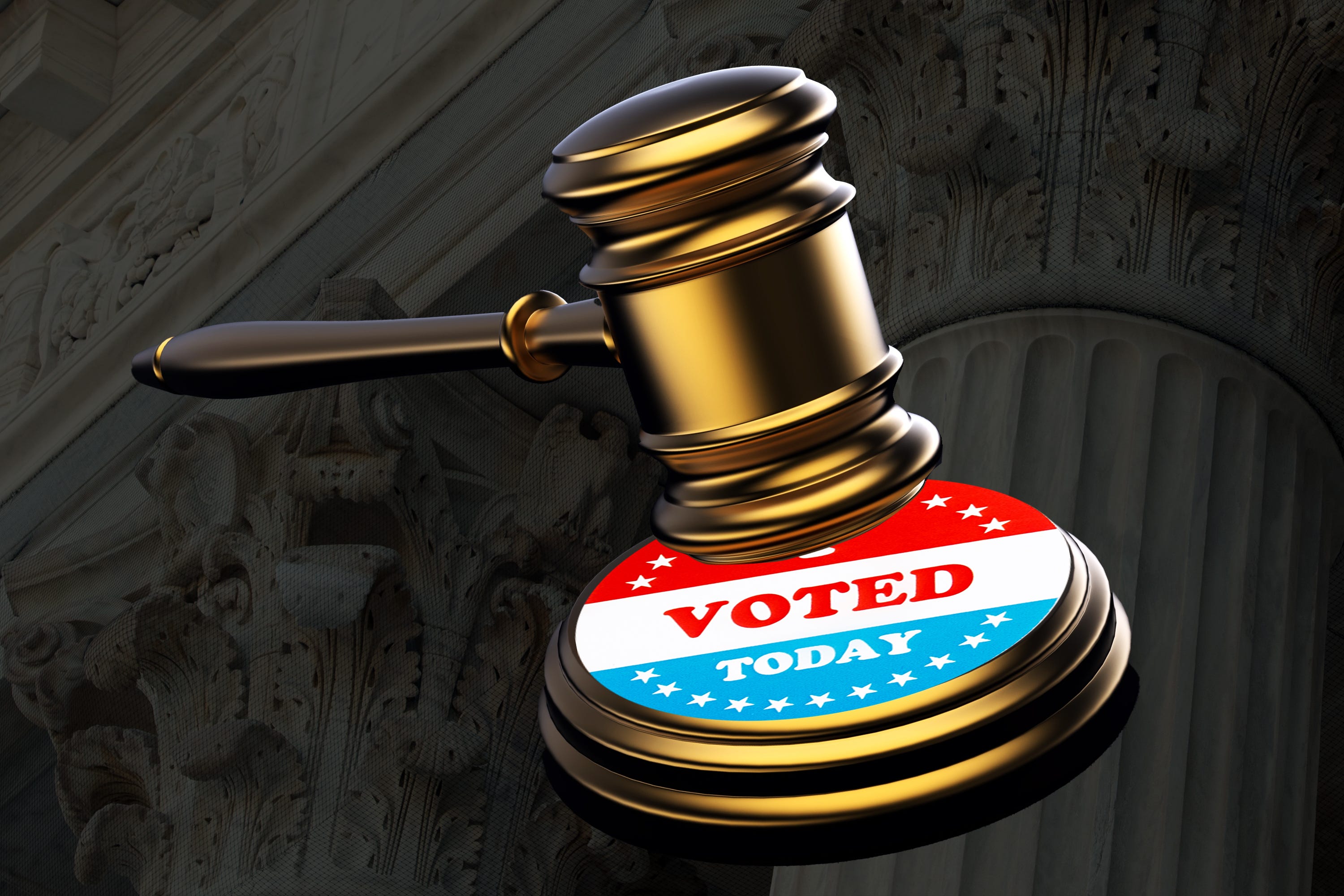
THE U.S. SUPREME COURT’S RIGHT-WING MAJORITY gutted what remained of the Voting Rights Act of 1965 on Wednesday. In a 6–3 ruling in Louisiana v. Callais, the Court picked a favored outcome then contorted (you might even say gerrymandered) the law to fit it, all while ignoring the history of the post-Civil War Amendments to the Constitution and Congress’s unequivocal and overwhelmingly bipartisan goals in passing the Voting Rights Act in the first place.
Worse still, the justices are probably not finished disemboweling the country’s decades-long legacy of remedying generations of racial injustice.
The case arose from the state legislature of Louisiana redrawing the map of congressional districts after the 2020 census to create only one majority-minority district out of the six districts apportioned—even though over 30 percent of the state’s population is black. (A majority-minority district is one in which racial or ethnic minorities make up more than half of the population, thereby affording a better chance to elect representatives reflecting their interests.) Black voters sued, urging the creation of an additional majority-minority district. In her dissenting opinion in Callais, Justice Elena Kagan explained problem the original plaintiffs were trying to fix:
A minority community that is cohesive in its geography and politics alike, and that faces continued adversity from racial division, is split—“cracked” is the usual term—so that it loses all its electoral influence. Members of the racial minority can still go to the polls and cast a ballot. But given the State’s racially polarized voting, they cannot hope—in the way the State’s White citizens can—to elect a person whom they think will well represent their interests. Their votes matter less than others’ do; they translate into less political voice.
They won their case in the lower court, and in response to that ruling, the Louisiana legislature in January 2024 redrew the congressional redistricting map in Louisiana’s Senate Bill 8, creating a second majority-minority district. Upset by that revision, a group of self-described “non-Black voter[s]” in Louisiana sued, arguing that the newly redrawn second district was an unconstitutional racial gerrymander because it illegally took race into consideration. The lower court disagreed, and the state appealed to the U.S. Supreme Court, which originally considered the case last year, but reconsidered it this term—narrowed in scope—before issuing its ruling on Wednesday.
TO REALLY UNDERSTAND what the majority did in Callais, it’s worth taking a trip back to 1896 when, in Plessy v. Ferguson, a different group of justices declared racial segregation in public facilities constitutional so long as the separate facilities were deemed “equal.” The lawsuit arose when a black man, Homer Plessy, was arrested for sitting in a whites-only train car in Louisiana, in violation of Louisiana law. He sued under the Equal Protection Clause of the Fourteenth Amendment, which at that point was only twenty-eight years old, one of the three post-Civil War Amendments designed to constitutionalize the humanity of a category of people who had been legally enslaved and degraded for hundreds of years in the United States simply by virtue of their skin color.
In a famous dissenting opinion, Justice John Marshall Harlan condemned the nation’s systematic degradation of individuals on the basis of race: “Our Constitution is color-blind, and neither knows nor tolerates classes among citizens. In respect of civil rights, all citizens are equal before the law.”
Fast-forward to 2023, when in Students for Fair Admissions (SFFA) v. Harvard, a 6–3 majority1 declared consideration of race in college applications unconstitutional. In his opinion, Chief Justice John Roberts underscored “Justice Harlan’s view in his lone dissent in Plessy” that “our Constitution is color-blind.”
Bear in mind that Harlan was dissenting from a grotesquely racist and shameful ruling, one ultimately rejected in the 1954 landmark case Brown v. Board of Education, in which a unanimous Court declared racial segregation in education unconstitutional. Chief Justice Earl Warren wrote for the Court that “to separate [black children] from others of similar age and qualifications solely because of their race generates a feeling of inferiority as to their status in the community that may affect their hearts and minds in a way unlikely ever to be undone,” depriving black children of equal protection of the laws guaranteed by the Fourteenth Amendment.
In her dissent to the SFFA affirmative action ruling, Justice Sonia Sotomayor correctly chided the majority for “distort[ing] the dissent in Plessy to advance a color-blindness theory.” The majority had also thumbed its nose at history and the inescapable reality of slavery, despite its alleged devotion to “originalism” and “history and tradition” as the touchstone of modern constitutional interpretation. From Plessy, she wrote, “emerged Jim Crow—a system that was, as much as anything else, a comprehensive scheme of economic exploitation to replace the Black Codes, which themselves had replaced slavery’s form of comprehensive economic exploitation.” (Black codes were post-Civil War laws enacted to restrict the rights of newly freed African Americans.)
Although the Fifteenth Amendment banned states from denying the right to vote based on race, Southern states ignored it. A decade after Brown, Congress and President Lyndon Johnson responded by enacting the Voting Rights Act of 1965 to lift the barriers of Jim Crow.
AND THE RIGHT-WING SUPREME COURT under Chief Justice John Roberts has over the last several years sequentially stripped that law of its protections.
Section 5 of the Voting Rights Act, for example, required states with histories of voting discrimination to get “preclearance” from the Justice Department or a federal court before imposing new, restrictive voting laws. This worked well, opening the ballot box to generations of racially disenfranchised voters. But in Shelby County v. Holder, the Court in 2013 effectively shut down the preclearance process, inviting pretextual maneuverings by anti-voting legislatures.
In 2019, in Rucho v. Common Cause, the Court categorically shut the door to any claims of gerrymandering on the basis of political party—even if there’s a valid argument that the gerrymandering is otherwise illegal.
Section 2 of the Voting Rights Act, which the Callais case addresses, prohibits voting policies and practices that deny or abridge the right to vote based on race or color. After Shelby County wiped out Section 5, Section 2 became the primary vehicle for challenging unfair voting laws. In 2021, the Court, in Justice Samuel Alito’s opinion in Brnovich v. Democratic National Committee, essentially added a multipart test to Section 2 voting-rights claims—a test that isn’t in the actual statute enacted by Congress—which made it harder to win cases challenging laws hindering ballot access under the illusory guise of “fraud.”
At least in theory, Section 2 was still available for challenging gerrymandered districts even after Brnovich. But in his new majority opinion in Callais on Wednesday, Alito effectively did away with that part of Section 2, too.
In 1980, in a case called Mobile v. Borden, the Supreme Court had already tried to water down Section 2 by imposing a “discriminatory intent” requirement to bring racial gerrymandering cases. Congress responded by amending the statute in 1982 to make clear that proof of discriminatory purpose by legislators (a virtually insurmountable hurdle) is not the standard—discriminatory results are enough.
The Court has since applied what’s known as the “strict scrutiny” standard to racial gerrymandering claims. Under for the Fourteenth Amendment, the test requires that the state give a “compelling state interest” for a redistricting scheme that has a discriminatory effect. Compliance with the Voting Rights Act—meaning ensuring that the interests of black and minority voters are not diluted by white-majority politicians, as the law provides—has traditionally been viewed by courts as sufficiently compelling to allow redistricting plans like Louisiana’s to stand.
In his majority opinion, Alito nods to the history of the Voting Rights Act and the Fourteenth and Fifteenth Amendments. He also acknowledges that strict scrutiny is the proper test for racial gerrymandering claims. But instead of reckoning with Congress’s intent under the Voting Rights Act and the history of discrimination in this country, he concludes that compliance with the Voting Rights Act isn’t a good enough reason to enact a redistricting plan that accounts for minority voters.
His conclusion? The Constitution requires “a strong inference that intentional discrimination occurred.” As an exasperated Justice Kagan responded in her fierce, eloquent 48-page dissent, that means “a plaintiff will have to show—contrary to Section 2’s clear text and design—that the legislators were “‘motivated by a discriminatory purpose.’ And that, as Section 2’s drafters knew, is well-nigh impossible.”
Too bad for the Congress that passed the Voting Rights Act in 1964. Too bad for the nation’s Civil Rights-era legacy that produced it. Too bad for the Congress that rejected a discriminatory intent requirement when it amended the Voting Rights Act in 1982. Too bad for the Louisiana legislature that redrew the map to comply with federal law. And too bad for black voters. From now on, if you want to show that a voting district is unconstitutionally discriminatory, you have to somehow give evidence that it was the intention of the mapmakers to discriminate.
Just as the 2023 ruling in SFFA set the stage for the Trump administration’s DEI purge, we’ll likely now see this week’s ruling in Callais give permission for the drawing of blatantly discriminatory districts in several states.
The Court thus unceremoniously ends an important part of the story of American justice, equality, and civil rights. Now that the right-wing majority has, in the words of Justice Kagan, finished “this latest chapter in the majority’s now-completed demolition of the Voting Rights Act,” far-right litigants will set their sights on the next frontier. What comes next could be even worse.
Technically a 6–2 majority, as the Court’s newest justice, Ketanji Brown Jackson, did not join in the SFFA decision—although she did sign on to the main dissent and authored a dissent of her own. Which is to say that the Court broke along the exact same ideological lines as in Wednesday’s Louisiana v. Callais ruling.
 | A guest post by
|