The ‘Transactional’ Trap
America’s partners shouldn’t think they can deal their way out of Trumpian chaos.

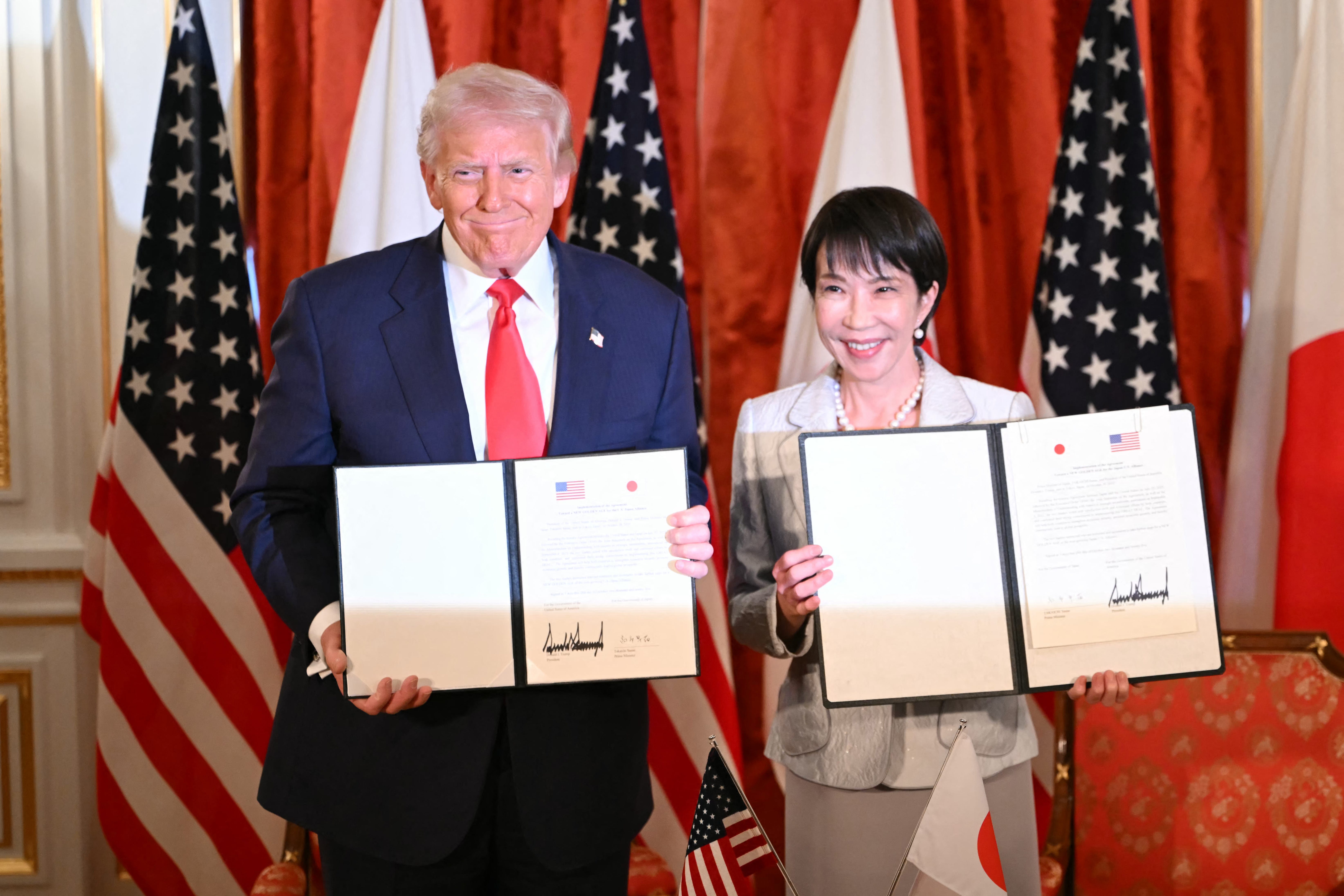
IN ITS DEALINGS WITH ALLIES, the Trump administration is often described as “transactional”—a term that means that any entreaties by America’s partners grounded on appeals to shared values are a waste of time. Instead, tangible, commercially minded proposals must be put on the table, with direct economic benefit to the United States—or, even better, to the president himself.
This advice, which has congealed into conventional wisdom in Washington and has been heard by just about every visiting delegation seeking to stay on America’s good side, is at best highly incomplete. At its worst, it produces the exact forms of interdependence that Western governments would recognize immediately, in other contexts, as a source of vulnerability.
Acquiescing to putative Trumpian transactionalism, furthermore, validates the worst instincts of the administration—and delays the course correction that is necessary if U.S.-led alliances are to survive. Instead of jumping into ill-thought-out “deals,” U.S. allies need a serious strategy of derisking their economic and other relations with the United States.
First of all, the evidence that humoring the current occupant of the White House turns him into a more reliable ally is scant. Since the disastrous Oval Office meeting at the end of February, Ukraine’s leaders have said yes to nearly every proposal put forward by the United States, including most prominently a deal on rare-earth minerals. Yet, during that period, the Trump administration has run hot and cold, sometimes signaling support, sometimes not, sometimes pausing military assistance, then resuming it. Nor has Washington put meaningful economic pressure on Russia, aside from the sanctions imposed recently on Lukoil and Rosneft—which will likely only prove effective if secondary measures are also taken against their customers.
Earlier this year, the European Union, the United Kingdom, and Japan accepted humiliating, one-sided trade deals, tearing up longstanding principles of international trade, on largely non-economic grounds. At a time when the European continent both showed serious economic vulnerabilities and continued to rely on U.S. security guarantees, a trade war with the United States might have been indeed ill-advised.
Yet, little suggests that the deals in question have translated into a more credible U.S. posture in Europe or in the Indo-Pacific. And, within weeks of the deal with the EU, Washington issued new threats of tariffs against the EU, in response to the bloc’s longstanding rules governing large technology companies.
Likewise, Canada, which has also sought to accommodate the United States, is now facing U.S. tariffs after the government of Ontario bought airtime for a trade-related television ad (featuring old footage of Ronald Reagan) that got under Trump’s skin.
And even Qatar’s blatant bribing of Trump—an airplane!—did not protect the emirate against strikes from a U.S. ally, Israel.
WHAT LIES AT THE HEART of the illusion of the “transactionalist” Trump is Norman Angell’s chestnut of liberal peace—the old idea that liberal countries that engage in commerce with one another are unlikely to engage in war with one another. In its new version, the notion is that economic interdependence will soften Trump’s politics by changing the incentives to which the U.S. president responds.
Now, one does not need to believe that Trump’s America is equivalent to Vladimir Putin’s Russia or Xi Jinping’s China to be skeptical that this approach will work. And it is incumbent on those advocating for transactionalism to explain why Trump’s success in forging one-sided, quasi-colonial deals with America’s clients will not encourage him to be more predatory. Otherwise, transactionalism becomes simply a self-serving slogan for those unwilling to confront the realities of America in 2025.
None of this is to say that allies should pick needless fights with the United States or be deliberately unconstructive in their dealings with the Trump administration. However, for their own sake, they must think of their countries’ relationships with the United States also in terms of “weaponized interdependence”—much like they do in the context of relations with other, not necessarily benevolent powers.
For example, for Romanians or Czechs to buy F-35s, to be delivered sometime in the 2030s and with massive price tags, is approximately as rational as Spain’s (now aborted) decision to invite Huawei to upgrade its government networks, or to use the company to store judicial wiretaps.
In the year that followed Russia’s full-scale invasion of Ukraine, the Draghi report notes, 63 percent of European defense purchases went to U.S. companies. That makes little sense and would be fundamentally unsustainable even under the most optimistic assumptions about the United States and the health of the transatlantic relationship.
While the United States still has a long way to go to resemble autocratic regimes such as China, it has rapidly been building a disturbing new nexus of executive power and big business. The list of donors to Trump’s ballroom project and the ongoing capitulation of big media companies to Trump’s blackmail indicate the ever-thinner line separating the U.S. government and the corporate sector.
Ultimately, Europeans can’t solve this problem. Neither can America’s Indo-Pacific allies. Only the U.S. voting public can. But they must entertain the possibility that in case of a major transatlantic dispute, for example, their F-35s might stop receiving critical software updates or spare parts.
They must understand they may not be able to rely on Starlink—just as Ukraine could not at a critical moment in the war.
They must grasp that U.S. supplies of liquid natural gas may start coming with strings attached.
They must also face the very real prospect of social media platforms, controlled by figures close to the Trump administration, pumping out content to sway European elections in ways that are congruent with Steve Bannon’s authoritarian project.
At the same time, the embrace of transactionalism by allies make the prospect for a change of course in the United States more distant—both by cushioning the direct impact of Trumpism and by helping to disarm political opposition at home. It is harder to mobilize domestic opposition against Trump if key allied leaders indulge his every whim and let themselves be humiliated at regular intervals.
There is a better way to engage with the United States in 2025 than to flatter Trump and look for compelling business deals. It starts by acknowledging that America’s democratic decline and its pugilistic turn on the global stage are real and potentially chronic conditions, and proceeds by managing the associated risks—not only by appeasing the current administration but also by using leverage to push back whenever appropriate and by reducing exposure to economic, technological, and other interdependencies with an increasingly unreliable America. To do so is not to accelerate the disintegration of the U.S.-led alliance. Rather, it is simply to deal with reality—and set conditions for a reconstruction of the relationship when political circumstances in the United States allow.
 | A guest post by
|