To Fight Fascism, Embrace Liberal Patriotism
On America’s 250th birthday, a case for celebrating our country’s values, heroes, and moments of historic moral triumph in pursuit of a more perfect union.

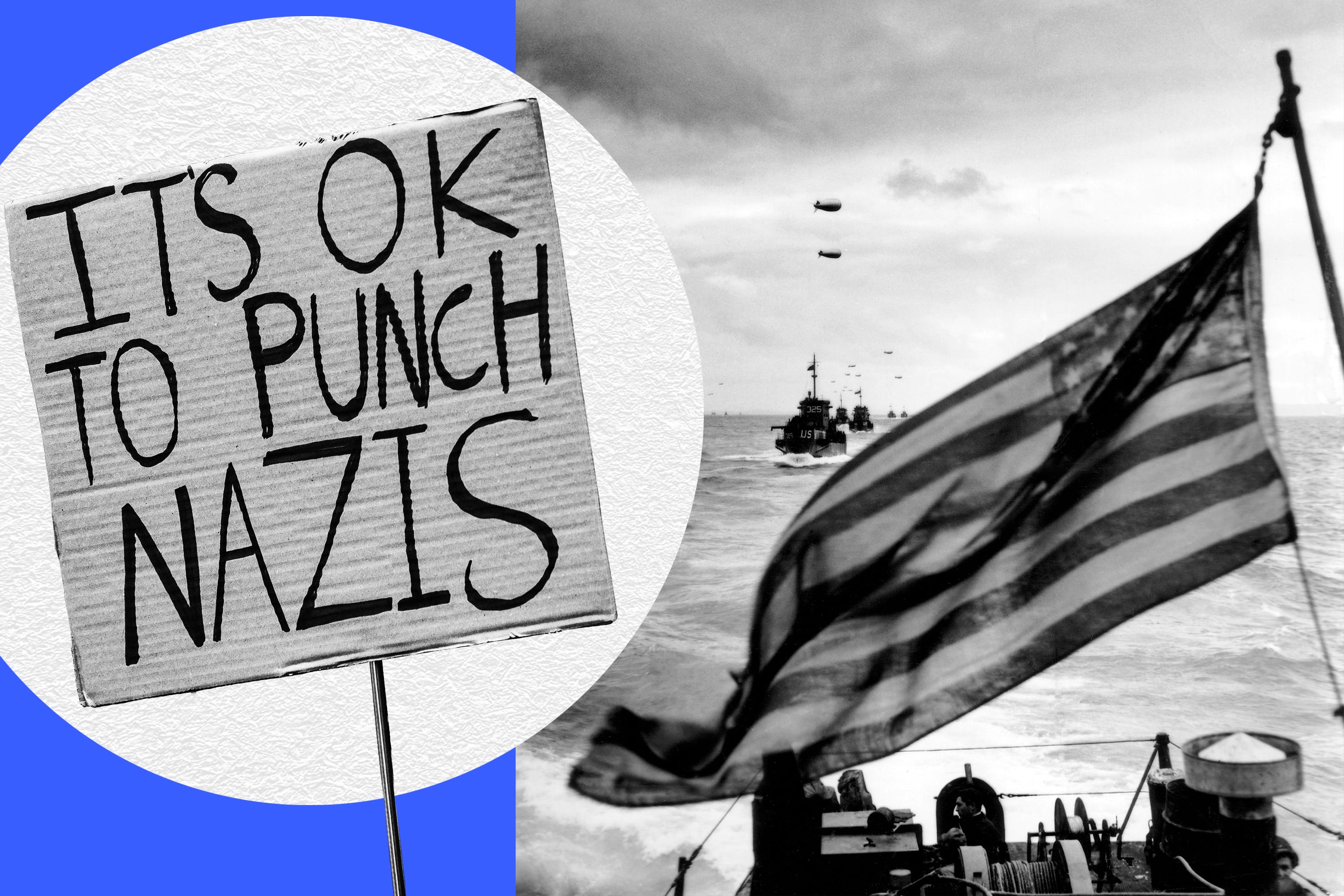
MY PATERNAL GRANDMOTHER, MAMY LILY, was a teenager during World War II. Her father was a commander in the French Navy, which meant when Toulon was occupied by the Vichy regime, two Nazi Waffen-SS officers were stationed in her home. She recalled the first—an older career-military officer of the Prussian school—as “quiet” and “gentlemanly.” But the second she called a brute and never said anything more. It took me far too long to realize the implications.
When the Allies launched Operation Torch, the invasion of French North Africa, my great-grandfather—Mamy Lily’s father—was there, deployed with the Vichy French navy. He sent word to his family that he was preparing to defect to Free French forces landing with the Allies: Be prepared to flee.
Even late in her life, my grandmother still remembered hearing the sound of the Vichy fleet being scuttled as her mother helped her and her younger brother pack their lives into bags as they faced imminent exile.
My paternal grandfather was slightly younger—a farm boy from Lorraine, the long-contested territory that borders Germany. At the start of the war, artillery shells arced over the valley where his family lived. Nazi officers accidentally killed his younger brother—he’d run into the road just as their Volkswagen careened around a corner. When Gen. George S. Patton’s U.S. Third Army marched toward Germany, my grandfather brought fresh vegetables to sell to the troops.
To their dying day, my grandparents spoke about Americans as saviors, regardless of whatever frustration they had with this or that presidential administration, this or that political decision. As my grandmother said: If it weren’t for the Americans, we’d be speaking Russian. (Even without D-Day, no one believed the Nazi regime could survive.) To her, the Americans saved France—they saved France as France. She talked about D-Day the way the French always, always do: as an act of heroism, of liberation, as a choice made by Americans to sacrifice themselves so that France could be free.1
If you visit Normandy American Cemetery in Colleville-sur-Mer, the feeling of reverence and honor is palpable. It is a holy site. The towns along the coast preserve the memory of the invasion with murals and enormous photographs of how the towns looked at the end of the campaign. Some 20,000 French civilians died in the invasion, killed amidst the shelling, bombing, and house-by-house fighting. Sometimes death is the price of liberty, and France honors those who pay it.
When I was growing up, America did, too. I remember D-Day celebrations where veterans of the campaign flew to France to be honored for their sacrifice. My father and I would watch The Longest Day or Patton every year in celebration and commemoration. When I was a boy, he took me to Normandy American Cemetery and up to the Ranger monument at Pointe du Hoc. I have repeated that pilgrimage with my own sons.
It is right for D-Day to be part of our national narrative. Our hearts should swell at the memory of American troops who stormed the beaches in the face of Nazi fire to liberate France, crush fascism, and restore democracy to Europe.
ALL OF WHICH IS WHAT MADE THIS widely quoted excerpt from Pete Hegseth’s remarks last month on the 82nd anniversary of D-Day in Europe, which he delivered at the cemetery at Colleville-sur-Mer, sickening:
Sadly, today, different European beaches are stormed by different, dangerous ideologies. Beaches in Spain, Italy, Greece and Bulgaria, boats and men arrive. . . . When will European capitals do something about that invasion, or is it too late? I pray not, and I believe not.
To score cheap political points, Hegseth perfectly inverted the meaning of what happened that day. We stormed the beaches, and it was not just right but morally urgent that we did so. The Nazis were the ones manning the machine gun posts. We came on boats, at great cost, at incredible risk, to liberate the continent from the fascist monsters and their network of massive camps purpose-built to force Jews, Catholics, Romani, those with disabilities and dissident political ideologies, into slave labor, and ultimately to put them to death.
Hegseth knows all of this quite well, of course, as the rest of his remarks make clear. This makes it even more upsetting and less comprehensible that he would choose to twist this part of our history into disfigurement.
Days before our secretary of defense made his remarks at Colleville-sur-Mer, the EU started moving ahead with an overhaul of its immigration policies along more restrictive and Trump-friendly lines; the coming changes include a commitment to building a network of detention centers abroad to better facilitate deportations. If Hegseth was aware of this policy shift, he didn’t give any sign of it when he got up to speak. Nor did he acknowledge it while castigating NATO during a meeting at the headquarters of the alliance later in June; he instead doubled down on his criticisms, promising a review of American military contributions to the continent’s defense as a result, in part, of Europe’s stance on border security not meeting his standard.
Assuming the secretary was properly briefed, it’s not unreasonable to conclude that Hegseth’s criticism is content-agnostic, which suggests in turn that its real function is not to advocate for specific policy changes at all, but to serve as a vehicle for a fascist narrative. Note that Greg Bovino, the former commander-at-large of the U.S. Border Patrol and a man who still flogs the cause of mass deportations, was coincidentally presenting in Portugal at a Nazi-adjacent conference on “remigration” the same week Hegseth repurposed the memory of Allied heroism on D-Day to slander migrants and refugees as invaders. Their advocacy is aligned with our country’s official national security strategy, adopted over the winter, which sets out, as a strategic objective, pushing Europe to move in far-right, illiberal directions, as it is already beginning to do.
This is a scandal and a betrayal of American values.
I AM FILLED WITH EQUAL PARTS SORROW AND FURY as I watch fascist rhetoric spread across Europe and North America, as I watch our government smuggle borderline white supremacist and neo-Nazi propaganda into their public communications channels, and as I listen to Trump administration officials parrot grotesque talking points that once would have been unthinkable as part of a program honoring the sacrifices of our veterans for the cause of freedom.
As a historian, I know the past is complicated and rarely simple. But on this matter, there is moral clarity: The Nazis were evil, and D-Day was one of the moments of genuine heroism in American history. We forget the truth of this at our peril; if we do forget it, we damage ourselves.
So as the United States celebrates its 250th birthday this year, we need to combat the perversities of the revisionist right with a revived liberal patriotism. Not a patriotism that obscures our mistakes and our crimes, nor one that pretends we are perfect—rather, a vision capable of recognizing two truths at once: the crimes were as real and lamentable as our nation’s founding values are real and worthy. Further, we need heroes to admire and moments of patriotic fervor to emulate. D-Day is one of them. We should be proud of our forebears for their heroism that day in Normandy in 1944.
The Trump administration has haphazardly attempted to launder its own narratives of American history. Hegseth, moonlighting as a political commissar, has also worked to flatten history along ideological lines, both before he was in office and now as the secretary of defense.
It’s a mangling approach, as could also be said of his “invasion” comments on D-Day. But we are not defenseless against these depredations. David Head’s argument in The Bulwark six years ago remains relevant and valuable: Liberal, patriotic, richly researched “dad history” is one way to effectively combat distortive right-wing revisionism and hagiography.
And there is much ammunition in the American historiographical armory to support the larger fusillade against fascist operatives in our culture. The far right’s narrative is, at heart, flimsy and sentimental. Just consider the relative merits of “Dixie,” a pastoral ditty Confederate soldiers repurposed as a marching song, alongside those of the Union’s proper war anthem, “The Battle Hymn of the Republic.” The examples of the strength of liberal patriotism multiply endlessly, cultural mementos of our nation’s honorable and decisive victories over the slave power, Nazism, and Soviet authoritarianism. Remember who you are, liberal!
This anniversary year we need that celebration more than ever. Let’s remember, among other heroes, the flesh-and-blood men who crossed the English Channel under the cover of night to wade into machine gun and mortar fire to break the Nazis’ back in Europe.
Those men did so to free people like my grandparents so they could grow up in a democratic society. They did it to give their children, including my father, a life in a free France. To give me, their grandchild, the hope that America might still remember it does not mewl before fascism—that it can choose better. To give my own children, French and American, a future where the legacy of America’s best moments can be equal to the horror of its worst. They did in the name of the great, universal principles written for all to see in the Declaration of Independence. This is the patriotism we need as we celebrate on America’s 250th birthday: a fighting, liberal patriotism that believes our best days are ahead of us, not in some mythic, fascist pretense of a past that never was.
This knowledge didn’t come down only from my French side: My maternal grandmother was part of the WASP training class 44-2. The Allied liberation of Europe culminating in V-E Day meant a great deal to all of us.
 | A guest post by
|
Thank you. The Nazis were, and still are evil.
Merci, Monsieur Lecaque, for those wise and soothing words. I also grew up in a household where my British father (who fought in WWII) and Belgian mother (who lived under German occupation) constantly reminded us that "were it not for the Americans, we would be living under the nazi boot". I have visited the American cemeteries in Normandy and the War Memorial in Bastogne which are tributes to the sacrifice of all those heroic American soldiers on D-Day and after, and a reminder of the horrors of that terrible WWII.
I am also beyond sad and angry to witness the revival of far-right fascist ideologies in Europe and, as unthinkable as it is, the United States. It seems WWII is now a vanished memory in the minds of many who support nationalism over patriotism, authoritarianism over freedom.
I sincerely hope this 250th anniversary of the Declaration of Independence reminds all Americans that "the rights to life, liberty, and the pursuit of happiness; the consent of the governed; and resistance to tyranny" were given to them to be cherished and protected.