The Tories’ Dangerous Drift
In the U.K., a shocking proposal from a Conservative MP elicited pushback from her party only belatedly. It signals darker things to come.

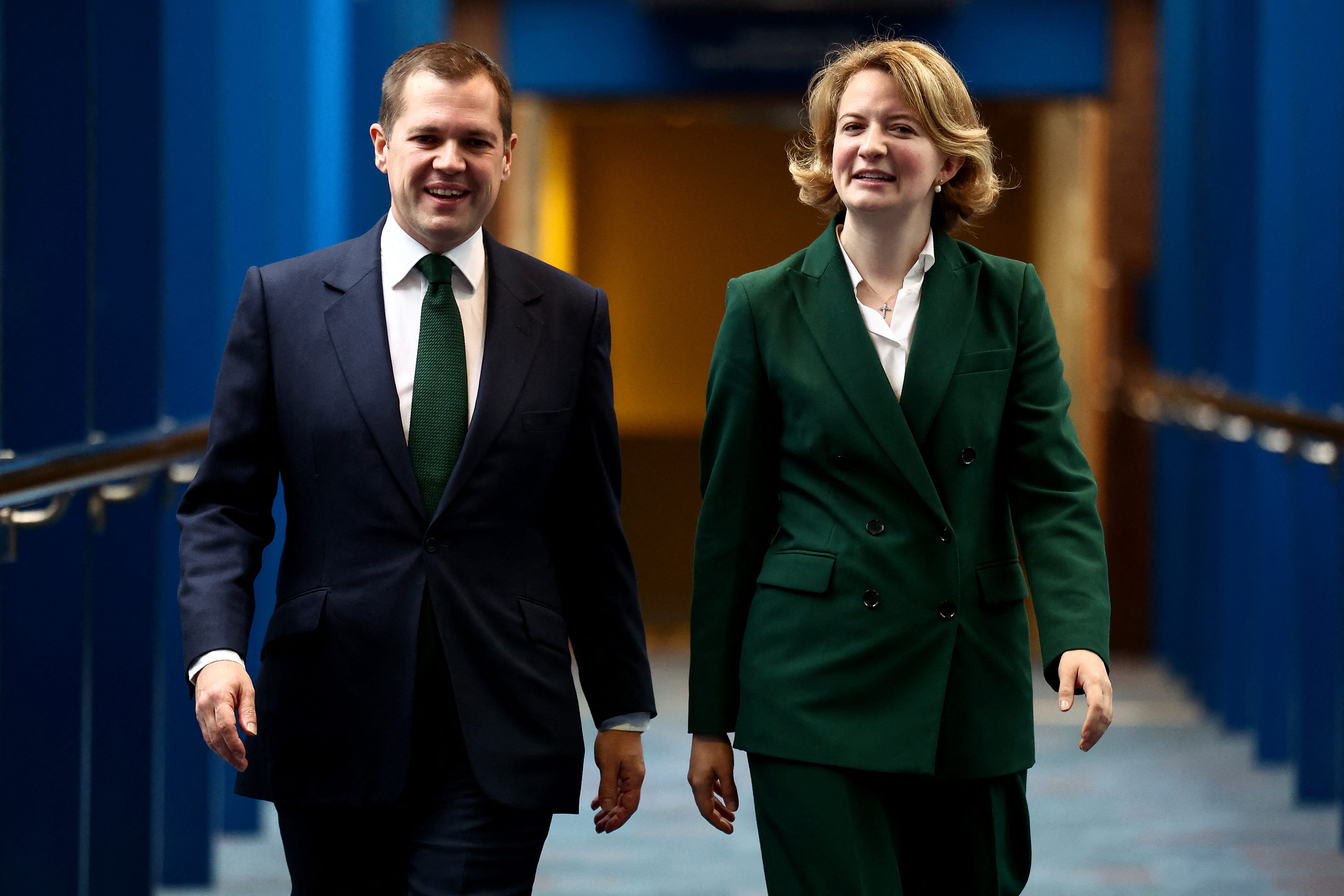
AN UP-AND-COMING MEMBER of Britain’s Conservative party is proposing to deport 4 to 7 percent of the legal population of the United Kingdom. That wasn’t a typo: Not 4 to 7 percent of the immigrant population, but of all of us.
Opposition MP Katie Lam created controversy last month by saying, in an interview with the Sunday Times, that there are a “large number of people in this country who came here legally, but in effect shouldn’t have been able to do so.” They “need to go home,” she said—which would leave behind “a mostly but not entirely culturally coherent group of people.”
Even by the standards of the modern far right this is extreme. Donald Trump won in 2016 and 2024 after running on a platform of deporting large numbers of those in the country without documentation, and other leaders have made similar pledges, but removing those with long-term legal status is different.
When challenged—did she really mean legal residents?—Lam doubled down. Yes, she wanted to retroactively end Indefinite Leave to Remain (ILR, the U.K.’s permanent settled resident status). She explains this with the dehumanizing visual metaphor (as in this video from July) of pouring beads representing migrants into overflowing glass containers.

Even more alarmingly, Lam could point to draft legislation published by Shadow Home Secretary Chris Philp back in May that would indeed revoke ILR for most who held it. (Both amusingly and worryingly, this went unnoticed at the time.) Despite some internal concern, Tory leader Kemi Badenoch confirmed through a spokesperson that all this was “broadly in line” with the party’s policy. She then backtracked, saying that while Conservatives want less immigration, they would not apply new rules retroactively. Lam had “just stated it imprecisely” according to Badenoch.
Whether or not we deport millions of legal residents is not a minor detail, as Badenoch’s ‘clarification’ implied. The party leader gives the terrible impression of not knowing what their own policy is. Lam was not caught in an offhand remark—she made several well-produced videos and followed them up with an interview in a major newspaper. Worse, the party’s draft legislation matches her rhetoric. If this isn’t their position, why did leadership allow it to be published? If Lam was out of line, why hasn’t her radical proposal been decisively rejected?
There are a few possibilities here. At best, Lam, Philp, and a handful of others went rogue, and party leaders, having noticed only belatedly, find it too embarrassing to shoot down their idea. Or the Tories were floating a radical new position and backed off a bit when there was an outcry. Or, at worst, this is still their position and they’re obfuscating. Realistically, I think they may not even know themselves. They’re internally divided with a leader too weak to adjudicate. Some want a ‘merely’ very draconian immigration policy and others, like Lam (who appear to be ascendant), want an overtly fascistic one.
I don’t use the term fascism lightly. The Lam/Philp plan, if enacted, would be a human rights violation of a scale without an obvious analogue in the modern era. The closest anyone can seem to find is Idi Amin’s expulsion of South Asians from Uganda in 1972. That notoriously sadistic and fanatical dictator forced out 80,000 people, or around 1 percent of his country’s population at the time. The Tories’ draft legislation would expel forty times as many.
To find something of this magnitude, you’d have to go back to the population transfers in the years just after the Second World War: of Arabs from Palestine during the creation of Israel, of Jews from majority-Muslim nations, of Muslims from India and Hindus and Sikhs from Pakistan during the partition.
People with ILR status—those whom the Philp removal proposal would target—have often lived large parts of their lives in the United Kingdom, and have received a promise from the government that they can stay. They have built lives and families around that promise. They are the parents and partners of British citizens. Imagine your wife having to leave to a country you cannot join her in. Imagine being separated from your children. Imagine not being able to be with a parent as they died, not being able to attend their funeral. Lam and her colleagues casually and condescendingly assert that we must do this to millions for ‘cultural cohesion’—the exact same justification Idi Amin used. If you do not feel a wave of nausea when contemplating this policy then you either haven’t understood it, or there is something profoundly wrong with you.
And, not that it would justify it, but this definitely wouldn’t create cultural cohesion. Donald Trump’s hard line on deportations quickly led to masked men grabbing people off the street. If such open authoritarianism were to happen in Britain (and it would; the Philp plan is more radical than Trump’s) the country would quickly become implacably internally divided over it. You cannot unify a country by tearing apart millions of the families within it. You cannot bring social peace with brutality and violence on a massive scale. The pain and anger from the partition of Palestine and India are still with us three generations later.
Not to mention it would be national suicide. We would never recover. This would make Brexit look like losing pocket change. Our care sector and National Health Service (NHS) are already stretched thin, with massive staffing shortages. Expelling huge numbers of people already working in these sectors would collapse them. One in five NHS staff, including 36 percent of doctors, are non-U.K.-nationals. Hospitals would close or stop functioning, the consequences would cascade into every other institution.
There is a reason why, outside of global total war or the creation of nations, only mad tyrants attempt such things. What makes this all the more striking is that it isn’t coming from Reform (the British far-right party, led by Nigel Farage) but from the Tories, a party that has often been held up as a bastion of serious, sensible center-right politicians. In the blink of an eye, that’s all gone. The party always had its share of bigots and idiots, but it also contained serious people with a sane approach to governance. Even in its worst post-Brexit manifestations, it wasn’t this. What on earth happened?
LET’S PUT THIS U.K. PROPOSAL IN CONTEXT: We are living through a global resurgence of fascism. This is the force that captured the Republican party in the United States, and its aspirations are global. Elon Musk is using his power and influence to promote far-right racists in the U.K. (as he also is in Germany). The Tories’ radical lurch shows just how successful Musk and his fellow travelers have been in this. It is not merely a matter of boosting far-right alternatives, but the capture of once mainline conservative parties. It’s not universal, but it’s increasingly true that those who work for the Tory party, or write for right-leaning outlets like the Telegraph or Daily Express, are increasingly rotting their brains in fascism-friendly echo chambers like X.
Christian Calgie, a senior political correspondent for the Daily Express, recently “joked” on X about deporting MP Zarah Sultana. Talk of deporting nonwhite progressive politicians is a staple of modern fascist politics; think of Trump’s calls to do this to Ilhan Omar. While Calgie apologized, the next person to say it probably won’t feel like they have to; the lines are being pushed further every day. Fascism is an opportunistic predator—it tests boundaries, backs off if there’s blowback, then tries again.
And these trends are felt across society. I regularly see anti-immigrant or anti-trans graffiti. Schools report a massive surge in racist bullying. Lawyers and judges working on immigration are facing violence and threats of murder and rape. Far-right groups are violently attacking events attended by trans people. Even those providing public services, like nurses, have experienced a sharp increase in racist abuse directed at them. The Philp draft legislation, and Lam’s rhetoric, should be understood in this context: They are picking a side.
The front lines are moving so fast, and institutions like the Tory party falling so quickly, in part because there is virtually no institutional opposition on the other side. Labour politicians are much less willing to name the threat directly than are Democrats in the United States. What Lam is proposing is ethnic cleansing, but you’d never know it. Labour put out a response disagreeing with the proposal (while stressing they believed the “right to stay here must not be automatic”), but stopped short of labeling the proposal racist, or fascist, or ethnic cleansing, or anything else that would draw a clear values contrast. “If a Labour government minister is now not willing to even put their name to denouncing out-and-out racism . . . then we are absolutely nowhere,” a senior Labour source (who themselves wouldn’t put their name to it), complained.
The mainline and liberal press in the U.K. are often not much better. There was some strong criticism of Lam, which I don’t want to downplay. But I don’t think it will be enough. For the most part, there has been a persistent tendency to massively understate the number of people who would be affected by her position. And the press have proven similarly reluctant to call things what they are. The vast majority, I think, have just not woken up to the ideological predator that is now inside the house. Despite the clear warning of the last decade of American politics, they have no idea, at all, how much danger we are in.
The U.K. is a small country. We have a small elite. My sense is that—even relative to their American or European counterparts—they’re unusually vulnerable to groupthink and even more uncomfortable attacking fellow elites in direct terms. Calling someone a fascist just isn’t the done thing. Especially if that person is well-spoken, went to the same university you did, and presents themselves as a mature, serious sort. They consider calling someone a racist or a fascist to be a statement about what they feel in their heart of hearts. Which makes such a claim epistemologically untenable—not to mention terribly rude.
These cultural blinders must be removed: In calling Katie Lam’s proposal fascist, I’m not claiming to know what’s inside her head, or throwing around a loaded term for effect. I’m making a claim about her politics—what policies she says she supports, the rhetoric with which she argues for them, and what they would do.
Our media and political elites, frankly, need to get over themselves. There is no intrinsic British sensibleness that will get us through this, that renders us invulnerable to what is destroying other free countries. The Tory party casually adopting a policy like this—or even just considering it in a confused and equivocal way—is a massive, glaring red light that our democracy is at serious risk. We have to talk about it in these terms if we are to save it.
The key question is not whether any individual Tory politician is personally a hateful bigot. My guess is some are and some aren’t. It’s whether the party is aligning itself with the global trend toward fascism. And increasingly, it is.
 | A guest post by
|