Trump Can’t Stop Backing Down
Where the bully encounters strength, he withdraws. Constantly.

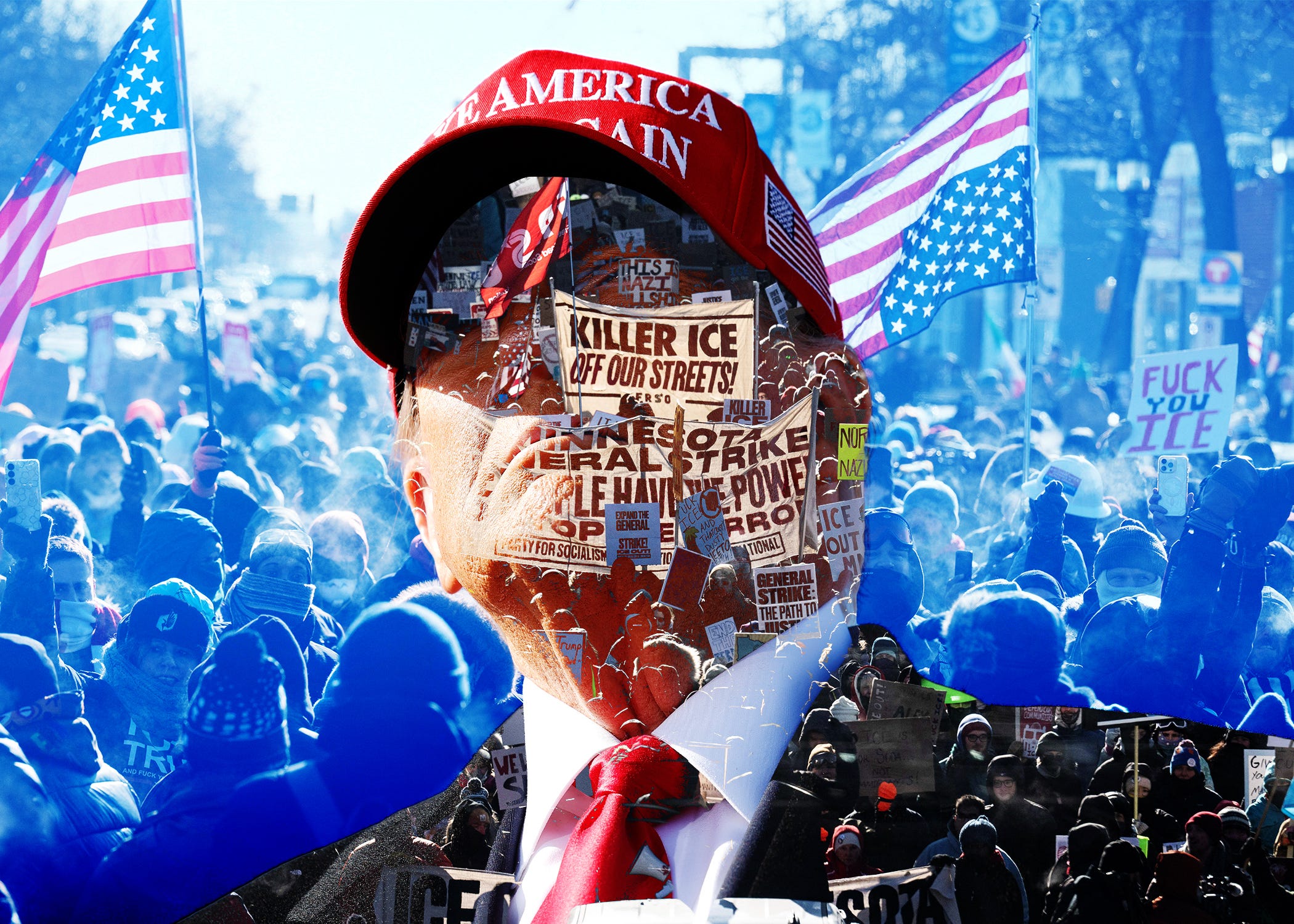
DOES IT SOMETIMES SEEM AS THOUGH too many people have never learned the lessons of the schoolyard? If you capitulate to a bully, you will be bullied forever. If you stand up to him, he will back down. What’s true on the playground is also true in the office, in politics, and in international relations.
Standing up to bullies is not free of risk. You might get bloodied in the process. But afterwards, the bully, having learned that there is a price, will hesitate to push you around, whereas if you fail to stand up to him, he will grow ever more menacing.
All of the bowing and scraping before the re-elected Donald Trump last year by corporate leaders, university presidents, major law firms, leading journalistic outlets, and European allies wasn’t just demoralizing—it was foolish. If he had met firm opposition in all directions, his power would have been diminished. Each pushback would have inspired others, creating a flood. Instead, we saw a cascade in the other direction—a cascade of capitulation.
Each surrender enhanced Trump’s power and inflated the menace we now face. They all had their rationalizations. The voters have spoken. If I raise my head over the parapet, it will just get shot off. Or, from the Europeans (before the Davos/Greenland moment), We must humor him. He’s mad for praise, so let’s lay it on thick and he’ll support Ukraine and NATO.
But the other path—etched in tragedy and martyrdom in Minneapolis—has shown repeated success. When you stand up to the bully, he backs down.
We don’t yet know from whence a national political leader will arise, but the people of Minneapolis have reminded us that this country is still planted thick with inspiring, selfless, heroic people who will put their very lives on the line rather than submit to MAGA’s naked barbarism. Renee Good, Alex Pretti, and so many others who have braved bitter cold, pepper spray and tear gas, and even being shot are the best of us. All honor to them.
That’s the spiritual message of Minneapolis. The political message is this: The bully backed down. In the face of opposition not just from his opponents but from some of his allies who found that their vocal chords were actually operative, Trump announced that the ogre Greg Bovino was being demoted and removed from Minneapolis in favor of the slightly less brutal Tom Homan. Republican Sens. John Curtis, Bill Cassidy, Susan Collins, Lisa Murkowski, Thom Tillis, Dave McCormick, and Jerry Moran called for investigations of Pretti’s murder. Sen. Rand Paul has asked the heads of ICE, CBP, and USCIS to testify on the Hill. Rep. Andrew Garbarino suddenly recollected that his branch has authority in our system. “I take my oversight duties for the department seriously, and Congress has an important responsibility to ensure the safety of law enforcement and the people they serve and protect.” Another crack in the cement.
They were joined by two GOP governors, a number of conservative commentators like Trey Gowdy and Erick Erickson, podcaster Joe Rogan, a couple of Fox News figures, the New York Post and Wall Street Journal editorial boards, and most dramatically, the Republican candidate for governor of Minnesota, Chris Madel, who announced that he was dropping his bid and his membership in the GOP. “I cannot support the national Republicans’ stated retribution on the citizens of our state. Nor can I count myself a member of a party that would do so.” The cracks accumulate.
Before there was Minneapolis, there was Chicago. Recall that in September, Trump posted that “I love the smell of deportations in the morning. . . . Chicago is about to find out why it’s called the Department of WAR.” A bit over the top for the commander in chief to threaten military invasion of a city in his own country, one might have thought. The governor of Illinois struck back, vowing that his state “won’t be intimidated by a would-be dictator.” Other Illinois elected officials joined in. Thousands thronged the streets in protest, and lawsuits were filed challenging the legality of Trump’s National Guard deployment. Eventually, the courts ruled against the administration, and Trump backed down. At the end of December, Trump announced that the National Guard would not be deployed to Chicago, and would be withdrawn from Los Angeles and Portland. He blustered—“We will come back, perhaps in a much different and stronger form, when crime begins to soar again - Only a question of time!”—but that was a rear-guard action as he was backing away.
Trump’s climbdown from the asinine “Liberation Day” tariffs was so swift that it inspired the acronym TACO, for Trump Always Chickens Out. The pushback in that case came from the markets, but the principle holds—when there’s resistance, Trump can be rocked back on his heels.
Admittedly, sometimes the victories are temporary, as Trump’s hamster wheel mind never settles for long. But consider his supposedly chief nemesis in trade matters, China. In an attempt to save face after backing off the most ludicrous “Liberation Day” tariffs, Trump announced that he was pausing the tariffs on, well, the world, for ninety days, but thundered anew that he would increase tariffs on China to 145 percent. But a month later, he reduced the level to 30 percent, and a few months after that he announced a trade “truce” with China for another ninety days. That was August. In September, he announced a slew of new tariffs on pharmaceuticals, semi-trucks, kitchen cabinets, and furniture.
Trump’s operating assumption on trade has always been that no one can counter U.S. market power and must tamely accept our terms—no matter how capricious or damaging—because they cannot do without our consumers. But in October, China reminded him that it isn’t 1970 anymore and they have cards to play as well. They announced new restrictions on the distribution of rare earths. This is a vulnerability for the United States, which acquires 70 percent of these minerals, which are key to defense and technology, from China. When the two sides met in South Korea in late October, the Trump administration backed off its threats and agreed to reduce its tariffs on China to levels comparable to other Asian nations. As one analyst put it, “Xi was ready for Trump in his second term and has a powerful weapon in rare earths. China is getting the better of the US in these recent truce negotiations.”
Some climbdowns are so rapid that they almost feel like internal MAGA housekeeping. Trump announced after the capture of Maduro that “we” would be running Venezuela. Within 36 hours, Marco Rubio and others were clarifying that actually, no we wouldn’t. Maduro clone Delcy Rodríguez would remain in charge.
Finally, the catastrophic Greenland threats, talking menacingly of getting the island “the easy way or the hard way,” demonstrated to the Europeans that appeasing this ravenous bundle of appetites was not a successful strategy. Europe got tough and Trump deflated—yet further proof that standing up to him works. Our (former?) allies let it be known that they were finished capitulating. Eight NATO nations deployed troops to Greenland to participate in military exercises. The Danish prime minister declared that “Europe will not be blackmailed,” and adding teeth to this position, a number of European diplomats spoke openly of deploying Europe’s “trade bazooka” that would limit intellectual property protections for American businesses and deprive U.S. companies of access to public procurement opportunities in Europe, among other things. Trump caved.
This is not to say that Trump is a paper tiger. He is erratic, frequently irrational, flagrantly immoral, and endlessly acquisitive. If he could confiscate all the wealth of the world, he would do so and still be unsatisfied. He’s dangerous—but the only counter is to resist with everything you’ve got. It’s the right thing to do, and it works.