Trump Is Considering More Iran Strikes. No One Knows Precisely Why.
As has become a pattern, the use of force isn’t part of a coherent plan.

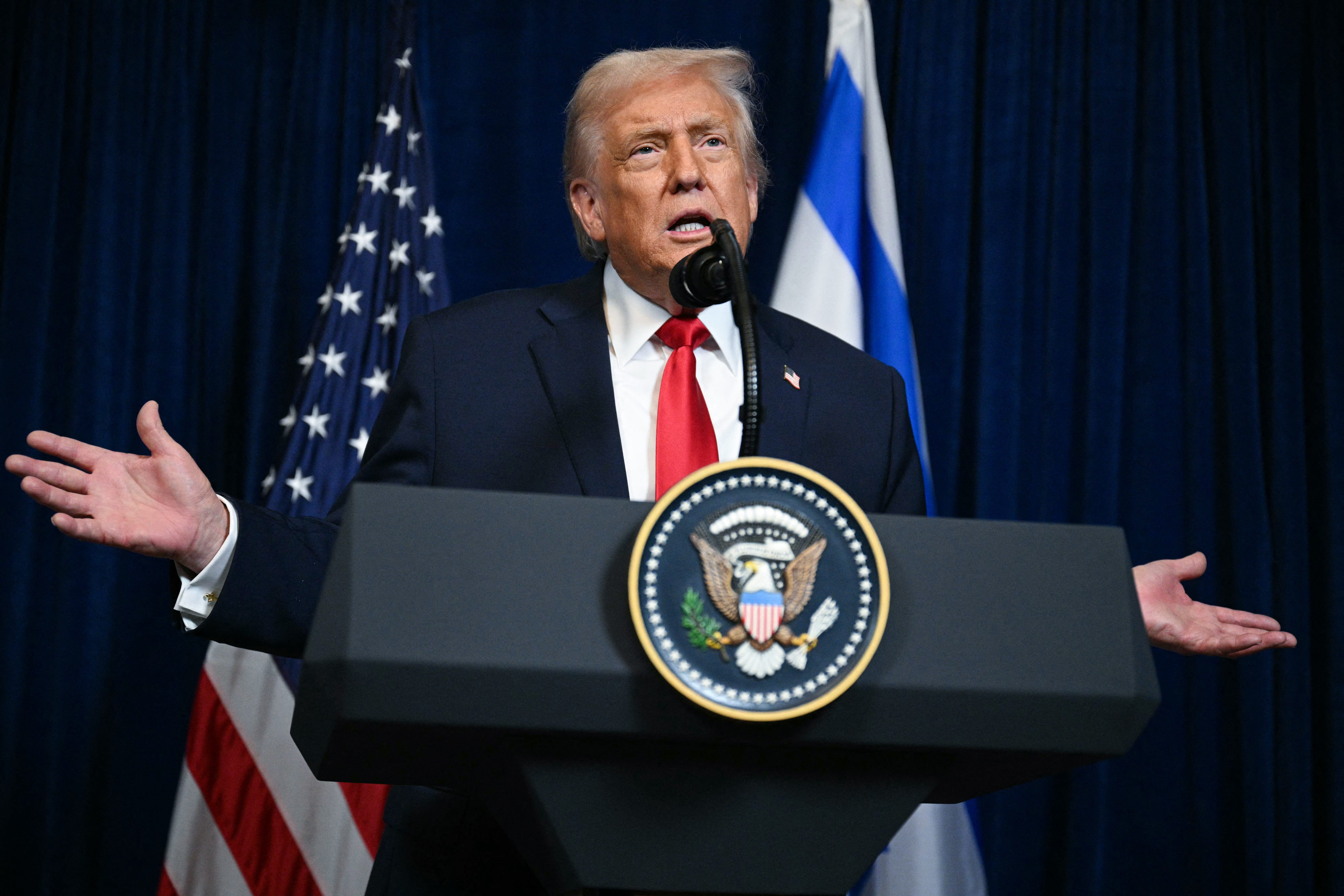
PRESIDENT TRUMP TOLD REPORTERS Friday morning that he was mulling limited military strikes on Iran, allegedly as a spur to the ongoing, so-far fruitless negotiations over the Islamic Republic’s nuclear program. “I guess I can say I am considering that,” he teased. The White House has been teasing an operation for weeks while U.S. Navy and Air Force have slowly been building a huge force package in the Middle East.
At this point, the shock would be if Trump doesn’t pull the trigger and pretty soon. He’s sent about half the currently available ships to the region—they can’t stay there forever—and a very large number of aircraft are on call. And the president and his team of “warriors” are overdue for a dopamine hit of “lethality,” and blowing up fishing boats in the Caribbean just doesn’t give the rush that it once did.
But strikes do not a strategy make. How strikes would help Trump accomplish his goal—or settle on one in the first place—isn’t entirely clear.
Indeed, “I guess you could say that” pretty much captures Trump’s offhand approach to the use of military force. For all the huffing and puffing of the past year—toward Iran, toward Venezuela, toward drug cartels—there is almost nothing lasting to show. The only mission that the administration has been truly committed to is the invasion of American cities, and even there Trump has hardly achieved a victory.
This is not to say that an Iran strike or strike campaign would be without strategic consequences—just that they would not be the consequences intended. A quick tour of the geopolitical horizons offers little encouragement.
Let’s start with the Iran problem per se, one that has bedeviled the United States since the overthrow of the shah in 1979. Negotiations with the ayatollahs have had almost no effect; the Obama administration’s 2015 Joint Comprehensive Plan of Action was about as good as it’s gotten. The day before his wink to reporters, Trump admitted, “It’s proven to be, over the years, not easy to make a meaningful deal with Iran.” And last June’s Operation Midnight Hammer—for which the Israelis paved the way—did not, despite Trump’s boast of having “obliterated” Iran’s nuclear program, produce a decisive result. There is no reason to think that it will be different this time around.
No strike campaign is likely to change the larger Middle Eastern balance of power, either. The Iranian regime has murderously suppressed the recent demonstrations across the country; “regime change,” however desirable, might have been possible a few weeks ago, but is no longer. Israeli Prime Minister Benjamin Netanyahu and his government will be happy, but Israelis will also fear Iranian retaliation. The Gulf Arab monarchies will do what they do best: look the other way.
Trump may yet again be able to destroy some hardware in Iran—perhaps important, expensive hardware. But to what end? Less than a year after “obliterating” Iran’s nuclear program, the administration is now warning that the theocracy is “probably a week away from having industrial-grade bomb-making material.” Most of the other setbacks to Iran’s regional aggression—the attacks on its missile program and its major proxies—are thanks primarily to Israel, not the United States. Whether Trump wants to usher the mullahs from power, limit their support for international terrorism, or end their nuclear program once and for all, it’s not clear how a campaign of air attacks will help.
MEANWHILE, THE REST OF THE WORLD will have its impression of a flailing superpower reinforced. The more that Trump exercises the extraordinary capabilities of the American military, the more others wonder, “What a waste!” Like a bar brawler, Trump doesn’t aim for the jugular but lunges at capillaries. The efforts in the Caribbean are especially misdirected, especially in comparison to the war in Ukraine and the need to bolster alliances and deterrence in the western Pacific. It’s good that the Europeans are planning to rearm, but it remains to be seen if they can make strategy collectively and effectively—and it’s not at all certain that it would be in American interests for them to do so. Even the British are unhappy with the idea of an Iran campaign, and are preventing the Air Force from using bases there. Vladimir Putin and Xi Jinping must be grinning like Cheshire cats.
The Trump national security leadership seems dangerously high on its own supply. Perhaps they mistake the astonishing tactical competence of the U.S. armed forces for strategic sagacity. Or their need for “content” is insatiable. In particular, they do not appreciate how lucky they have been in the strikes and raids conducted thus far. Operation Absolute Resolve, the January snatch of Venezuelan leader Nicolás Maduro, was, despite months of planning and rehearsals, a high-risk thing.
The cost of plain bad luck in an attack on Iran—especially one that involves many highly synchronized and exotic airplanes flying a long way far from home—could be high. Mid-air collisions have bedeviled American forces in Iran before. The fog of war is never entirely dispelled. American hostages in Iran can destroy a U.S. presidency. Pride goeth before a fall, and Donald Trump is nothing if not prideful.
Per the cliché, the enemy gets a vote. Just as we can get unlucky, they can get lucky. Israeli and U.S. intelligence have done an incredible job penetrating the Iranian security apparatus, but this achievement, like military tactical supremacy, should not be taken for granted. Past performance is no guarantee of future results. And Tehran has lots of opportunities for indirect retaliation, in Europe and Latin America, for example. Others might pay the price for our actions.
PERHAPS THE GREATEST COST of the administration’s cavalier approach to the use of armed force will be its effect on American politics. It’s not just splitting MAGA—as entertaining as that is. It’s also a challenge to the loyal opposition and the Democratic party. Since Vietnam, liberals have developed a paralyzing neuralgia over questions of military power, and for some, justified revulsion at Donald Trump is exacerbating the issue. The ranking members of the House Armed Services, Foreign Affairs, and Intelligence Committees quickly responded to Trump’s guess-you-could-say-that quip not by insisting that military action be tied reasonably and responsibly to a legitimate goal of American foreign policy, but by opposing any “preemptive U.S. military action against Iran” (if, after 47 years of mutual attacks and proxy wars, any attack could be truly “preemptive”) and urging “a broader diplomatic framework.” Senate Minority Leader Chuck Schumer took refuge in legal process and the need for congressional consultation, boldly declaring, “It has to be debated in Congress. . . . We’ve had no reach-out from the administration at this point.”
The Democrats’ positions are not wrong, necessarily. They just duck the important strategic questions. Trump is already brazenly and doggedly ignoring the questions of how he wants to pursue a foreign policy that is in America’s (as opposed to his own) best interests. It may be one of the few luxuries of the minority party to criticize the incumbents without presenting an alternative policy. But it would be a mark of true statesmanship if they had a little more to offer.
 | A guest post by
|