Don’t Expect Trump to Give Up on Deploying Troops Into American Cities
... despite the Supreme Court’s refusal to greenlight his use of the National Guard in Illinois.

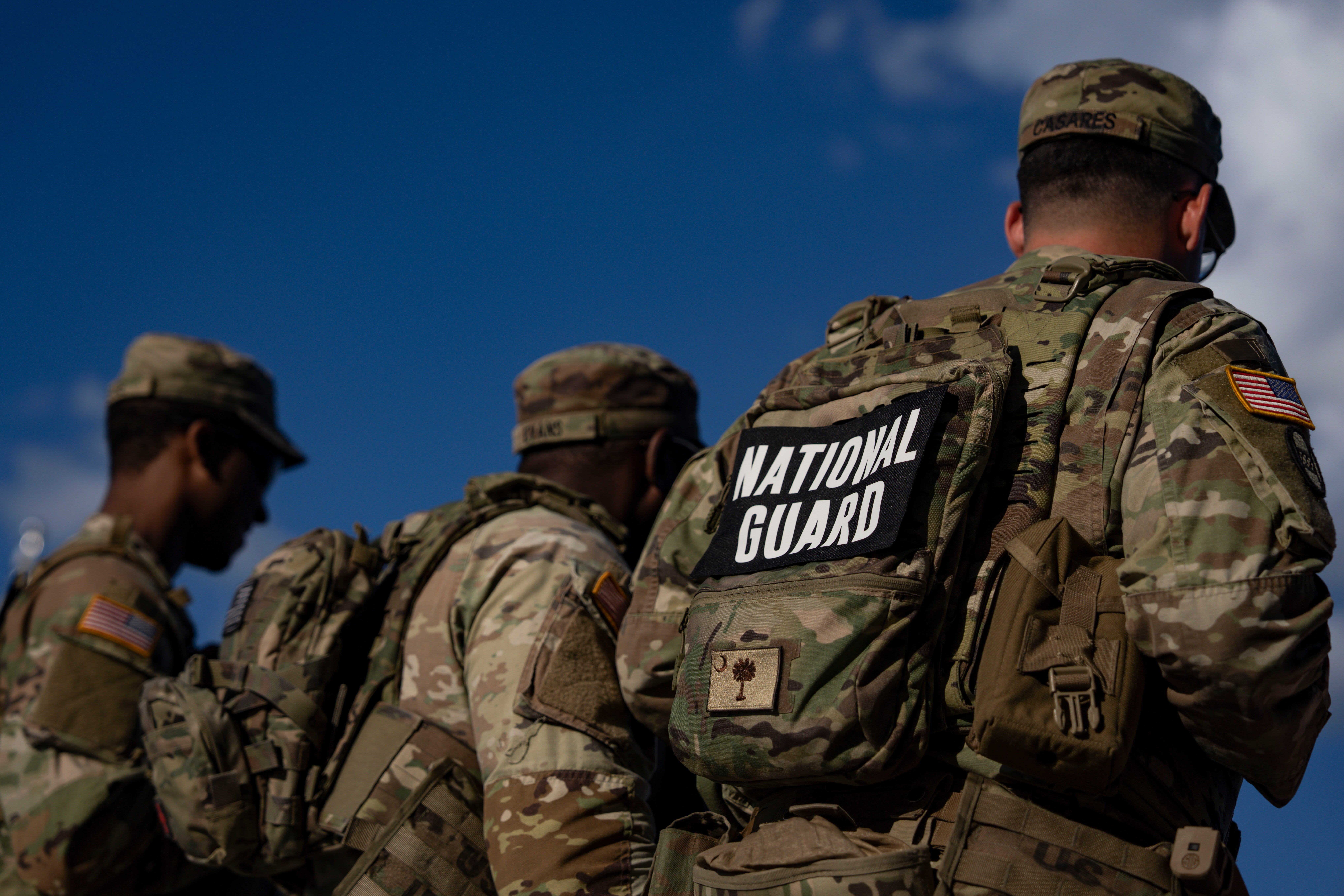
IN A RARE REBUKE OF PRESIDENT TRUMP, the Supreme Court last week refused to grant the administration’s “emergency” motion to stay a lower court injunction halting Trump’s use of Illinois National Guard troops to purportedly shield Immigration and Customs Enforcement (ICE) agents from violent protesters and to protect federal property in Chicago. Even more rare is the accompanying opinion, in which a 6–3 majority (with no one justice claiming authorship) explained why Trump lacks the legal authority to co-opt National Guard troops and thrust them in American cities basically just because he feels like it.
As welcome as this judgment is, no one should take it as reason to believe that a subset of the Court’s right-wing justices has had a change of heart about the mad king. And no one should think this spells the end of Trump putting troops in American cities at his command. Justices Samuel Alito, Clarence Thomas (joining Alito), and Neil Gorsuch all dissented, and Justice Kavanaugh wrote a concurring opinion signaling how Trump can legally regroup.
Bottom line? Instead of using National Guard troops, Trump could try and jump straight to the U.S. military. And it just might work.
Trump used a statute that allows the president to federalize the National Guard if he is “unable with the regular forces to execute the laws of the United States.” Trump’s lawyers took the position that “regular forces” means civilian law enforcement. Their claim is that ICE needs reinforcements in Illinois, so Trump can turn to the National Guard. The Court’s majority disagreed, concluding that “regular forces” means the U.S. military, not ICE. As a result, in order to invoke this particular law—codified at 10 U.S.C. § 12406(3)—Trump must first show that use of the military to “execute the laws of the United States” failed, and that the National Guard is needed as backup.
It’s not hard to see why, on the surface, this ruling is bad for Trump. The total number of Army National Guard troops across the United States is around 325,000, plus another 105,000 in the Air National Guard. But the number of service members on active duty in the Regular Army, the Navy, the Marine Corps, and the Air Force is much larger: about 450,000 soldiers, plus a combined 815,000 sailors, marines, and airmen. If Trump were to start with them, he wouldn’t need the National Guard. The ruling arguably renders § 12406(3) practically obsolete.
But as the Court majority went on to note, there’s another law—the Posse Comitatus Act—that generally forbids the use of the military for civilian law execution, unless a statutory exception applies. Because Trump hadn’t come up with any exception (yet), it concluded, the Posse Comitatus Act applies to bar him from using § 12406(3) to execute the laws if ICE did indeed need some help (which is factually dubious, as the lower courts found).
In a footnote, Kavanaugh gave Trump an out, observing that there’s yet a third relevant law floating out there, the Insurrection Act. That statute is an actual exception to the Posse Comitatus Act. It allows presidents to use federal troops on civilians in three circumstances: (1) a state legislature or governor asks the president for assistance with something; (2) the president identifies a need to enforce federal law because “unlawful obstructions, combinations, or assemblages, or rebellion” against the U.S. government make it necessary to “suppress . . . rebellion” or “impracticable to enforce” federal law “by the ordinary course of judicial proceedings”; or (3) the president identifies an “insurrection, domestic violence, unlawful combination, or conspiracy” that “so hinders the execution of the laws” in a way that deprives people of their constitutional rights.
If this all sounds unwieldy and overly broad, it’s because it is. Trump’s lawyers can easily concoct a bunch of theories for invoking the Insurrection Act, regardless of the facts on the ground. Kavanaugh thus rightly quipped: “One apparent ramification of the Court’s opinion is that it could cause the President to use the U.S. military more than the National Guard to protect federal personnel and property in the United States.”
But Kavanaugh didn’t stop there. He added that Trump could alternatively invoke “the President’s long-asserted Article II authority to use the U.S. military,” a notion feverishly embraced by the dissenting justices. What this means is that the president doesn’t even need Congress to create a statutory exception to anything, including the Posse Comitatus Act, because the president has inherent power to do what he pleases with the military because he is the commander-in-chief. This is an offshoot of the so-called “unitary executive theory,” which has been talked about lately in connection with Trump’s firing of a number of executive branch officials without cause despite Congress placing that statutory restraint on their firings. But the unitary executive theory is far more sweeping. If Justices Thomas, Alito, Gorsuch, and, so it seems, Kavanaugh had their way, Trump could bypass the statutory speedbumps altogether and invoke the illusory power of an American king.
As a result, if and when Trump takes up Kavanaugh’s invitation and sends the U.S. military directly into American streets, this entire mess will be back before the Supreme Court again. Presumably, the other two allegedly “conservative” justices on the Court—Chief Justice John Roberts and Justice Amy Coney Barrett—did not subscribe, at least for now, to the theory that presidents can constitutionally use the military on civilians regardless of what Congress says. (Whew.) But that doesn’t mean they won’t change their minds when this kind of case is brought before the Court on full briefing and oral argument (as opposed to on the emergency docket, as was the case here). Moreover, it’s entirely possible that a majority would read the broadly worded Insurrection Act as a gaping hole in the Posse Comitatus Act that allows Trump to call forth the military under the lofty words that the Insurrection Act uses to give him that power.
In a sane world, Congress would—right now—amend the law to shore up the Insurrection Act to make clear that it’s not an invitation for creating a militarized America to intimidate dissent and secure unyielding control in one party and one man. Of course, it won’t. And given the Supreme Court’s track record, it in all likelihood ultimately won’t do the right thing, either.
 | A guest post by
|