Trump’s Gift to the Money Launderers
Treasury isn’t merely shutting down an anti-corruption database. It’s deleting the data so future investigators can’t use it.

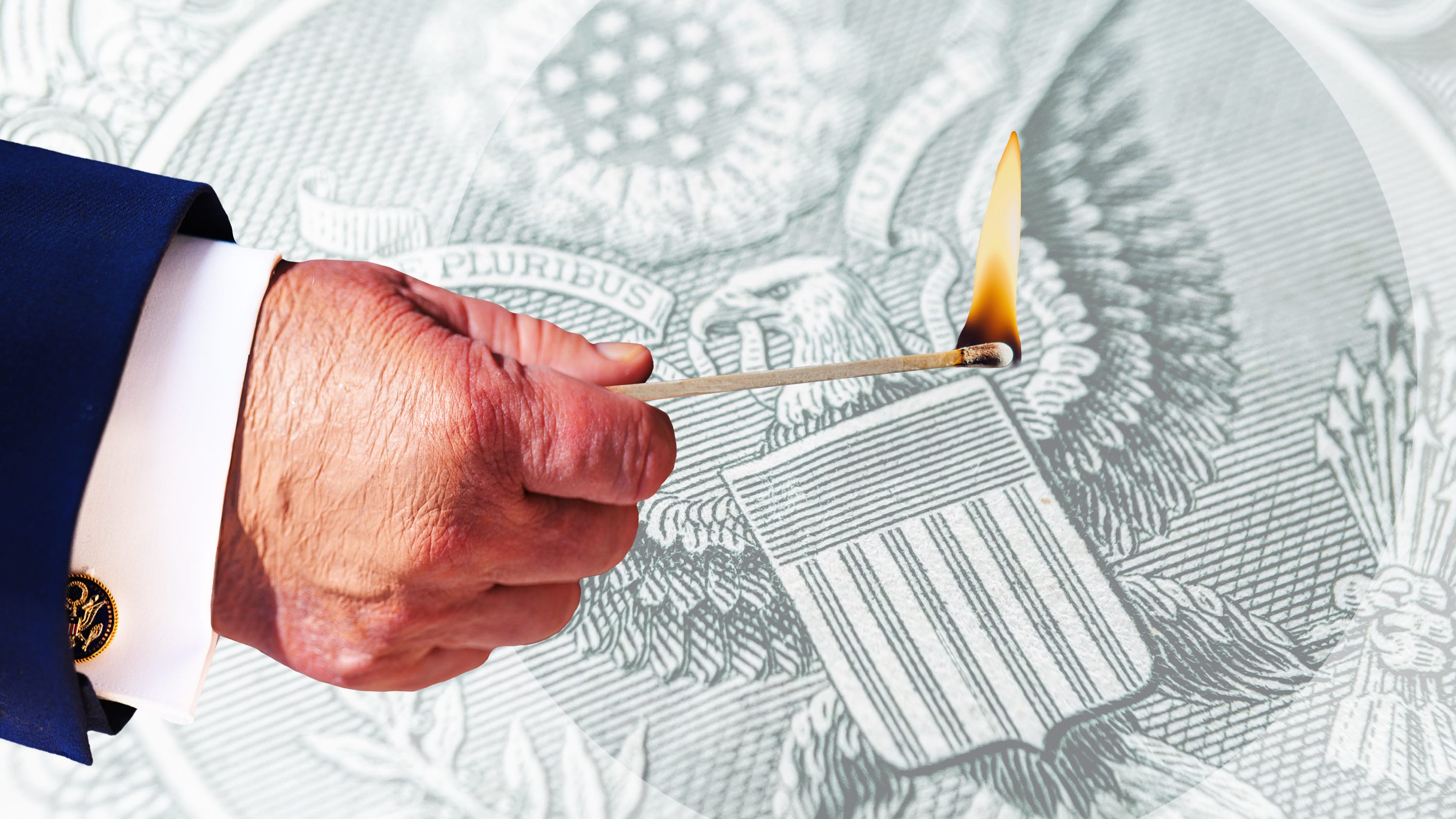
DONALD TRUMP PROMISED Americans a new golden age. Unfortunately, it turns out to be a golden age for diarrhea and white-collar crime.
Biological, social, and financial parasites are all flourishing, because the Trump administration has destroyed the institutional capacity necessary to detect and eradicate them.
In the latest (non-GI-related) development, the Department of the Treasury announced this week that it would destroy the government’s registry of shell-company ownership. This is an anti-corruption database that Treasury is by law required to maintain, so that law enforcement can more easily “follow the money” when investigating crimes.
Even worse, the Trump administration will also destroy all the data it has already collected, so that no future presidential administration or local police department can use it, either.
“It’s like Trump ordering the deletion of the FBI’s entire fingerprint database,” former congressman Tom Malinowski (D-N.J.), a champion of the 2021 law that created the corporate registry, told The Bulwark.
They’re effectively salting the earth, so that sex traffickers, scam artists, drug lords, money-launderers, and tax cheats can roam free not only through the end of Trump’s time in office but long after he’s out, too.
We are clearly in desperate need of more accountability. Luckily, that’s our mission. Become a Bulwark+ member.
Gimme shelter
“Shell companies” are companies that exist only on paper to hold other assets or businesses. Their existence is entirely legal and they are usually used for legitimate business activity. But ownership structures of these entities are often opaque, with shell companies buried within other shell companies within other shell companies, like a Russian nesting doll. The opportunities for complexity, subterfuge, and misdirection can make them useful in obscuring the identities of those engaging in illegal activity.
Massive data leaks such as the Panama Papers and the Paradise Papers have helped shed light on how some of these front companies work and what they were hiding—and the blind spots in U.S. law that allowed international criminal organizations to thrive.
“It became clear that the U.S. was actually a key node in the global money-laundering network,” Malinowski said. “We thought we were clean, that it was just Swiss banks and Virgin Islands and places like that. But actually the U.S. had some of the most lax laws in the world when it comes to registering companies.”
The result was that Russian oligarchs trying to hide their assets, or drug and human-trafficking cartels trying to shield their identities, or terrorists trying to funnel money to cells, could create an anonymous shell company in, say, Delaware. The Delaware company might in turn have twenty shell-company subsidiaries in tax havens around the world, making the funds flowing through them virtually untraceable—and thus harder for investigators to intercept.
So Malinowski and his colleagues introduced the Corporate Transparency Act, which mandated that shell companies report basic information about the names and contact info of their owners to a bureau within the Treasury Department.1 This information is kept confidential—it is not available to the public in any form—but could be used by law enforcement agencies around the country.
The bill became law in the very last days of Trump’s first term as part of a defense funding bill, which passed over Trump’s veto.2 It had broad bipartisan support. Besides Malinowski, one of the law’s cosponsors and greatest champions was Marco Rubio, then a Republican senator from Florida. Rubio, now Trump’s secretary of state, touted it at the time as “the most significant anti-corruption & money laundering law in decades.”
Don’t ask, don’t tell, don’t prosecute
Then Trump got re-elected. Suddenly cracking down on corruption and money-laundering was no longer so appealing to the federal government.
One of Trump’s earliest actions upon returning to office last year, for instance, was to pause enforcement of the Foreign Corrupt Practices Act. He claimed that punishing companies for bribing foreign officials put U.S. firms at a competitive disadvantage.
Which could well be true; if nothing else, this president probably has a decent understanding of how helpful palm-greasing might be for real-estate developers in, say, Azerbaijan.
He also understands how annoying it is to have a corporate account flagged for possible money laundering, given recent statements from Capital One about why it “de-banked” him.
And he has extensive experience dealing with shell companies, including for some less than savory purposes.
In addition to pausing the FCPA and pardoning lots of white-collar criminals, Trump also suspended most data collection required under that Corporate Transparency Act. He exempted roughly 99 percent of companies that had been required to disclose their ownership, according to a recent U.S. Government Accountability Office report. The new rule announced this week then made that suspension permanent, while also pledging to destroy any existing data.
Treasury says it still mandates disclosure of ownership of foreign shell companies. This may be technically true as a matter of following the letter of the law, but the administration crafted loopholes big enough to drive a cocaine-packed Mack truck through.
Or, perhaps, a cocaine-carrying private jet: A recent investigative series from the Amsterdam-based Organized Crime and Corruption Reporting Project found that international drug cartels have been buying aircraft by using shell companies that appear likely to avoid disclosure under Trump’s new rollback.
“One of the things we found in that corporate aircraft story is that cartels are using trusts and shell companies that made them look like U.S. citizens,” said OCCRP’s North America editor Kevin G. Hall. “We’re blowing boats up in the Caribbean Sea while letting cartels buy aircraft anytime they want.”
Ostensibly this is about reducing small businesses’ regulatory burden, according to Treasury Secretary Scott Bessent and GOP allies in the House. Malinowski acknowledged that the 2021 law probably dragged in some people or entities that Congress wasn’t interested in collecting information from—voluntary board members of condo associations and the like. But he said that could have easily been addressed with a technical fix.
Instead Trump has declared he will, for all intents and purposes, ignore the law and delete any data collected while the law was still being enforced under his predecessor.
The result, financial experts say, is that law enforcement officials will have fewer leads available when tracking down fraudsters and cartels.
“Before today, bad actors probably thought that there was still a chance of being caught by the reporting,” said Richard Berner, codirector of New York University’s Volatility and Risk Institute and former director of Treasury’s Office of Financial Research. “Now there’s zero chance.”
Dirty data, dirty money
These developments should be seen as part of the Trump administration’s broader effort to misuse or destroy government data.
In the grand scheme of Trump transgressions, this may sound like a nerdy, low-stakes thing to track,3 but it has enormous consequences. By hollowing out our statistical and scientific agencies, purging government records, and illegally seizing or sharing confidential records, the administration is making it harder for voters to objectively assess policy outcomes and hold elected officials to account.
The administration is also making it harder to enforce the laws that keep Americans safe, whether from pathogens or pump-and-dump scammers. The government needs rigorous, secure data collection to track supply chains for tainted lettuce, just as it needs rigorous, secure data collection to trace the spread of measles or the manipulation of markets or the nodes of a fentanyl-trafficking network. As the saying goes: You can’t manage what you don’t measure.
Of course that aphorism assumes that managing societal or biological ills is an actual objective of this administration. At best, Trump officials often seem indifferent to this aim; at worst, they are colluding in its subversion.
Ramparts
— On the bright side, hollowing out government capacity to track food pathogens could help Trump finally deliver on affordability. At least it’s helping reduce lettuce prices.

— Or maybe greed is just dead? Big Chicken is losing out, too.
— A new merger coming to Broadway: Hollywood mogul Ari Emanuel will acquire ATG Entertainment, a British company that operates seven theaters on Broadway and ten in the West End. Hey, maybe Broadway is worth investing in after all, despite Andrew Lloyd Webber’s warnings.
— “More than 10” companies have signed up to purchase early access to Trump’s posts on Truth Social, Trump Media says. On the one hand: “more than 10” doesn’t sound like a ton. On the other hand: 11 signups × ~$100k/month × 12 months/year = $13.2 million/year. That’s pretty good money. On the other, other hand: Trump Media on Monday reported $238 million in net losses in its second quarter (mostly due to bad bitcoin bets). So it’s still got a pretty big hole to dig itself out of.
— Meanwhile, a new lawsuit has been filed challenging this Truth Social scheme. Watch this space.
— Trump is paying yet another company to cancel its offshore wind projects. Including this latest deal, the government has so far spent roughly $3.9 billion to get companies to terminate twelve offshore wind leases. The irony here is that turbines are back-ordered, so this might never have gotten built anyway. But we’re spending billions of taxpayer dollars to make certain.
You can see the form that shell companies have had to fill out here, on Treasury’s Financial Crimes Enforcement Network (FinCEN) website.
At the time the White House said he vetoed this primarily for reasons unrelated to these shell-company provisions, including language renaming military installations honoring Confederate figures.
She says as she follows it obsessively. See long thread of data deletions/manipulations/abuses here.
Many thanks, Catherine, for your diligence in exposing even more of the anti-American, anti-democracy, anti-rule-of-law felony offenses of the nincompoop, treasonous, criminal in our White House! RESIST - DEFY - PERSIST
Some patriotic government employee needs to download the data before they can delete it.