Trump’s Latest Humbug on Russian Sanctions
European allies can’t take seriously demands by a deeply unserious U.S. administration.

IN YET ANOTHER CHANGE OF COURSE for U.S. policy on Ukraine, President Donald Trump this past weekend promised “major sanctions on Russia” if all NATO countries agree to stop buying Russian oil. Moreover, he called for 50 to 100 percent tariffs on Chinese exports to NATO countries as a way of stopping Russian aggression. If they do not agree, NATO allies “are just wasting [Trump’s] time, and the time, energy, and money of the United States.”
As is often the case, Trump’s post on Truth Social was a mixture of the superficially reasonable (it is less than ideal that several NATO members, including, prominently, Turkey and Hungary, continue to buy Russian oil), the preposterous (making Washington’s policy toward Russia conditional on Ankara’s and Budapest’s), and an absurd non sequitur (demanding that NATO act as a unified trade bloc vis-à-vis China). Its purpose, however, was not to move the needle on policy in any meaningful sense. Rather, it is to create an illusion of action, while buying more time for Trump to delay confronting Russia.
At the risk of stating the obvious, the last of Trump’s proposals is as impracticable as it is geopolitically unwise. Since NATO countries do not form a customs union (the EU does), a common tariff on China would require the EU as a whole to increase its own tariffs in concert with non-EU NATO members, such as Turkey (a country that imports more goods from China than from anyone else, although Russia is a close second).
Even if agreement to do so somehow emerged among NATO members, the move would require that EU countries that are not in NATO—namely, Austria, Cyprus, Ireland, and Malta—play ball. Outside the EU and NATO, yet inside the EU’s single market, Switzerland would be required to play along, too. Already faced with a 39 percent tariff on their exports to the United States, it is unlikely the Swiss would be thrilled by the prospect of being dragged into yet another trade war.
On the Sunday-morning news shows, Senator Lindsey Graham doubled down, suggesting that it was “now time for the Europeans to follow President Trump’s lead and to go after China and India.” Yet, how can any European policymaker take such proposals seriously if the same U.S. administration is toying with the idea of a “reverse Kissinger,” that is, a U.S.-Russian rapprochement aimed at weakening the ties between Beijing and Moscow? If anything, a coordinated policy of massive tariff hikes on both sides of the Atlantic against China (and India) can only drive Beijing, Moscow, and New Delhi more closely together, as illustrated by India’s own response to the U.S. tariffs.
Trump’s effort to guilt-trip the Europeans would be more compelling if the United States, and not Germany and other European nations, were still at the forefront of helping Ukraine. Defending Trump’s proposal, Secretary of State Marco Rubio said that its goal was to incentivize “our European partners . . . to impose the sanctions themselves that they’re asking us to impose. . . . We want to encourage them to actually do the things they’re asking us to do.”
That is, of course, disingenuous—and not just because it is the U.S. administration, not the Europeans, bringing tariffs on India and China into the equation. Since Trump’s inauguration, the EU has adopted three new packages of sanctions against Russia, while the U.S. Treasury Department has not updated its Russia-related sanctions lists once, opening ample opportunities for workarounds. The Justice Department also disbanded the Biden-era task force assembled to investigate and seize assets of Russian oligarchs in the United States.
The pressure on NATO, rather than a narrower coalition of countries, gives the game away: Trump has no intention of making his scheme work. Turkey, for one, is not going to go out of its way to decouple from China or Russia, and Ukraine’s backers in neither Europe nor the United States have the leverage to make Ankara sever such ties. Most importantly, it is hard to engage seriously with an impractical, highly complex, and risky scheme when the U.S. administration is doing its utmost to avoid putting any semblance of pressure on Russia.
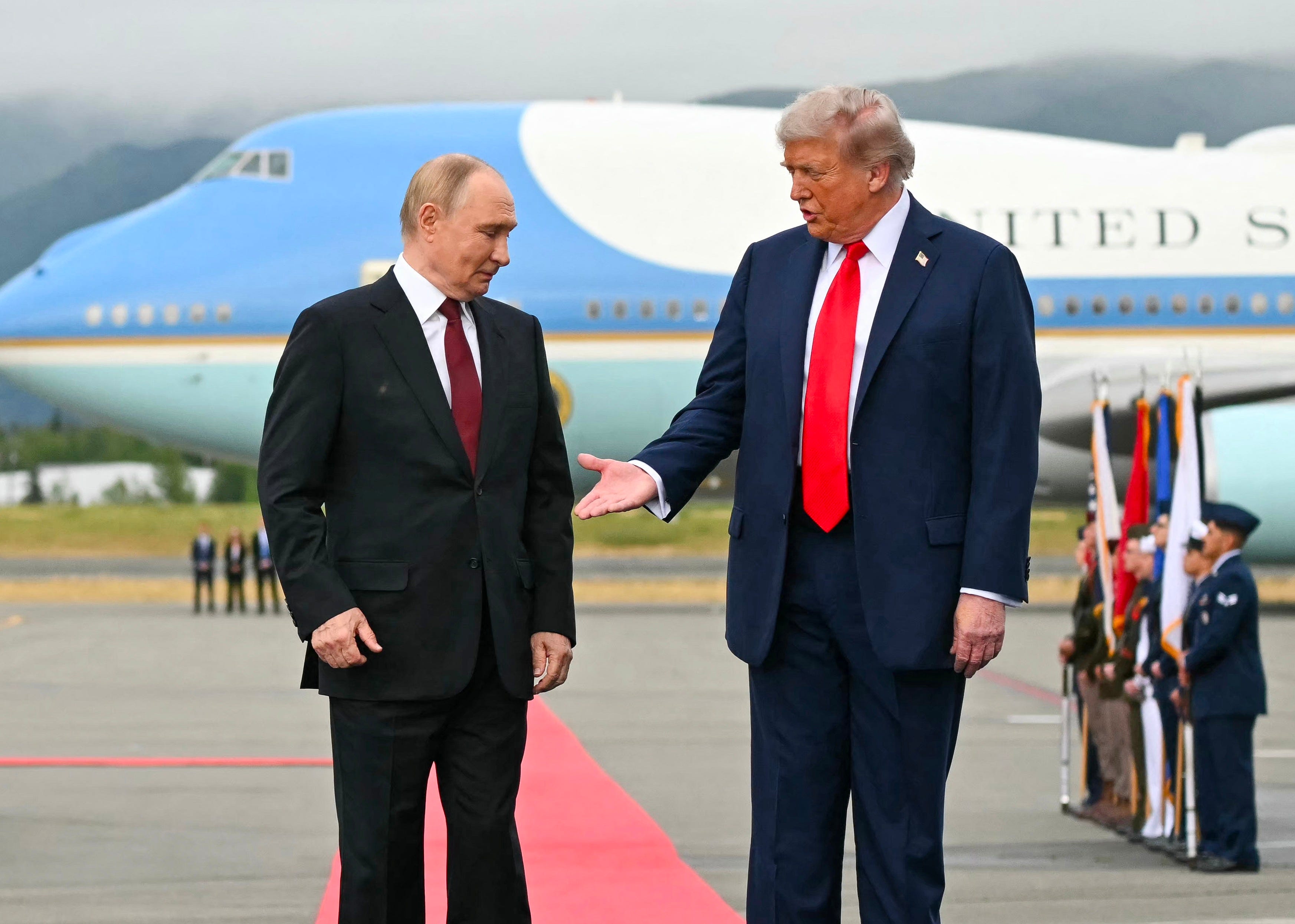
Since Trump took office, the United States has humiliated Ukraine’s President Volodymyr Zelensky in the Oval Office in February, effectively ended U.S. aid to Ukraine, rolled out the red carpet for Vladimir Putin, and mused about the return of U.S. energy companies to Russia. Furthermore, rewarding the Kremlin’s drone attack against Poland with the lifting of U.S. sanctions against Belarus, the closest of Russia’s allies—and even sending U.S. observers to Russian military maneuvers in Belarus—makes it clear that Trump is not ready to take the side of Ukraine and its European partners in his dealings with Putin.
To be sure, there is a debate to be had about Turkey, Hungary, and Slovakia’s dependence on Russian oil—and about Western European purchases of liquefied natural gas originating in Russia (not mentioned by Trump). Yet those are, at best, second-order issues in the context of what one might hope is an ongoing transatlantic effort to stop Russian aggression against Ukraine.
Likewise, in the abstract, it may be desirable for the Western alliance, however defined, to agree on a common trade policy toward China and use the combined economic weight of U.S. and European markets as leverage to stop Beijing’s predatory economic practices. But such a shared strategy cannot be arrived at by one-sided diktats from an administration that in the eyes of a growing number of Europeans is indifferent, if not hostile, to some of Europe’s most existential interests.
As a result, European leaders must shrug off Washington’s most recent effort to muddy the waters. Instead, they ought to remember what their own strategic goals are, both in Ukraine and in their relationships with Beijing and Delhi, while hoping that opportunities for a more constructive transatlantic dialogue will return when this iteration of U.S. policies fails, as it inevitably will.
Dalibor Rohac is a senior fellow at the American Enterprise Institute in Washington, D.C. Twitter: @DaliborRohac.
 | A guest post by
|