Twilight of the Democratic Influencer Candidates
Online celebs keep trying to turn big followings into viable congressional campaigns. Democrats should stay wary.

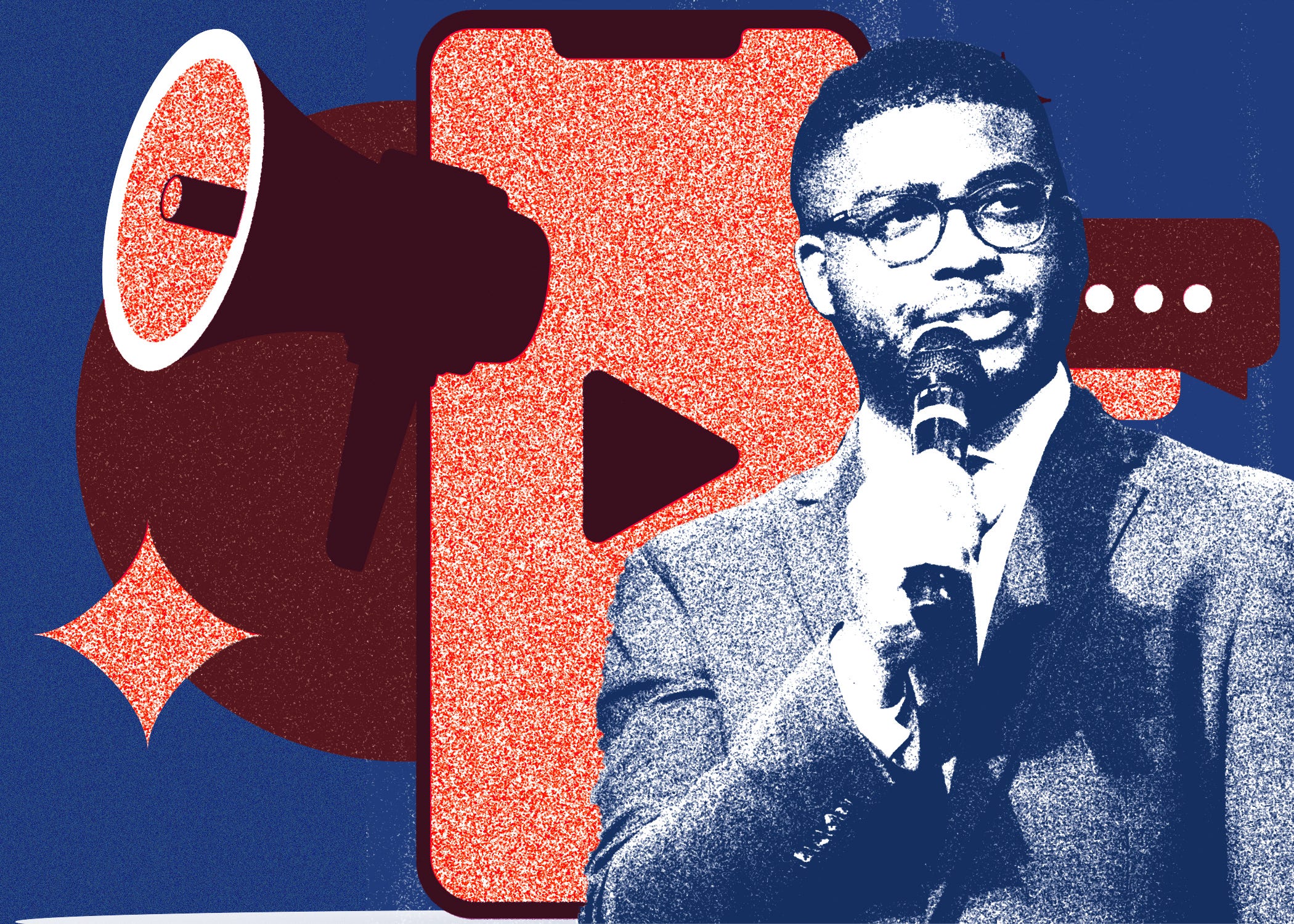
AS THE 2026 CAMPAIGN PRE-SEASON RAMPS UP, Democrats are working out their response to a novel challenge: To what degree should the party welcome social-media influencers becoming political candidates? Republican candidates without prior experience of public service, political or civic leadership, or other typical pathways into national politics have ridden the waves of national celebrity into elected office, former reality-TV host President Donald J. Trump foremost among them. If Democrats threw their support behind this new kind of political aspirant—influencers who hope to parlay their personal brands and audiences into successful congressional runs—could it help them achieve similar results?
Well, the party’s rank-and-file members have offered their own response to the influencer question. Recent primary- and special election–related polling and results suggest the Democratic base still values résumés, records, and deeply established community relationships over follower counts.
For a recent example of this dynamic, look at the case of Isaiah Martin, a 27-year-old influencer running in next week’s special election for Texas’s 18th Congressional District, which covers much of Houston. Despite achieving moments of viral fame—including after a recent arrest during an anti-gerrymandering protest at the Texas State Capitol—Martin has struggled to convert online attention into local support. He has also raised the hackles of some of the people whose support could help him succeed. An ad Martin posted to social media earlier this month presented him as a “senior adviser” to the late Rep. Sheila Jackson Lee, a characterization that has been challenged by pundits and at least one former Lee staffer (though one of Lee’s former chiefs of staff supports Martin’s claim). The latest polling puts him in the low single digits in a crowded Democratic primary; the most-favored candidates are more traditional Democratic politicians whose past work in public service appears to have given them credibility and visibility with the district’s voters—old-school engagement metrics, you might say.
Over the summer, Arizona’s special election primary for the 7th district told a similar story. Deja Foxx, a Gen-Z reproductive-rights activist with a formidable digital profile, lost decisively to Adelita Grijalva, whose longstanding ties to the local Tucson community and experience in local government gave voters something concrete on which to base their support. Foxx’s bid earned her national headlines, but in the end, she lost to Grijalva by nearly 40 points.
Content creator and former Media Matters researcher Kat Abughazaleh moved from Washington, D.C. to Illinois’s 9th district last year and is now running to represent her new neighborhood in Congress. Despite a spate of viral CNN appearances, Abughazaleh is still trailing her main opponent, Evanston Mayor and former state legislator Daniel Biss. He enjoys a far smaller online following than Abughazaleh does, but his endorsements page is full of city council members, local union chapters, and other community leaders. Meanwhile, although Abughazaleh’s campaign website has an “anti-endorsements” section that chronicles her beefs with right-wing heavies, it doesn’t appear to have a page listing of endorsements of the regular kind. We’ll see if this week’s news of her federal indictment on charges arising from a protest in which she slowed down an ICE vehicle for a few minutes—yes, really—has any effect on her standing.
In New York, news of Rep. Jerry Nadler’s retirement set the stage for a wide-open primary battle, which enticed 32-year-old liberal influencer Jack Schlossberg—grandson of President John F. Kennedy—into announcing an exploratory committee to help him decide whether to pursue Nadler’s seat. Asked about Schlossberg as a potential replacement on CNN, Nadler offered a response that helped to clarify what Democratic voters tend to look for in federal candidates: “There’s nothing particularly good or bad about a Kennedy holding my seat,” he said, but he continued: “The Kennedy should be somebody with a record of public service, a record of public accomplishment, and [Schlossberg] doesn’t have one. . . . He certainly is not going to be a major candidate.” So far, the Kennedy scion’s candidacy remains undeclared.
NADLER’S COMMENTS MAY SEEM HARSH, but it would be wrong to interpret them as an attack on influencers generally. Democratic-aligned creators have provided real value to the party as it continues working to recover its footing after losing the messaging battle and ceding ground with young voters to Trump in 2024. For years now, young communicators have translated abstract policy into plain English, pushed voter-registration drives, and helped the party navigate new media spaces where their most senior leaders have often come across as “cringe.”
Nadler’s point is instead about the importance of institutional literacy. To put it simply: A congressional district is not an audience, and a House seat is not a platform; the job of an elected official is about much more than messaging. Crafting legislation, building coalitions, and patiently working to earn trust from people and institutions that operate on extended timelines are all examples of the discipline and skills that real politics demands. Communication is an important leadership skill, to be sure, but it doesn’t cover the whole job.
What’s more, there are plenty of younger Democrats coming up through the ranks who have developed a sophisticated and appealing online presence without neglecting the governing fundamentals—a hybrid political approach that could represent a new way forward for the party. Rep. Jasmine Crockett pairs analytical skills she developed in the courtroom with a sharp, media-savvy digital presence; she is an effective advocate for liberal causes online, but she also knows how to work across the aisle IRL to deliver for her constituents. Republican Senator John Cornyn has said it’s a “no-brainer” to partner with Crockett when possible and described her as “very approachable.”
Texas State Rep. Jolanda Jones, one of Martin’s opponents in Houston, has an extensive CV featuring years of advocacy and leadership at different levels of government, but she is also a disciplined and charismatic figure on camera, whether in a news broadcast or a selfie video. Even unelected progressive leaders like Shannon Watts, founder of gun-violence prevention group Moms Demand Action, have used social media to build national movements and deliver real outcomes, including the 2022 passage of the Bipartisan Safer Communities Act and the Biden White House’s creation of an Office of Gun Violence Prevention.
Republicans, meanwhile, offer a cautionary tale of what happens when you elevate a candidate based on celebrity and audience alone. Donald Trump won in 2016 as an outsider celeb with zero experience in public service, and in both of his presidential terms he has governed the way you might expect based on that description: For him, policy is way downstream from posting, and chaos has flowed from both.
But for all that, Trump is a unique case, as is the race for the presidency. Republican-aligned influencers have not been particularly successful in political campaigns with more geographically limited constituencies than that of the president. For those who have attained to office, the most common outcome is legislative impotence. Anna Paulina Luna, a MAGA influencer–turned-congresswoman, won her seat in 2022 on the strength of social media, and while she has generated headlines and controversy aplenty, the only bill she has sponsored and seen enacted into law was one that renamed a post office. Other MAGA personalities have proven similarly incapable of meaningfully contributing to the legislative process.
THE PAST YEAR’S MINI-WAVE of Democratic influencer campaigns appears to be breaking over a boundary Democratic voters still appear to value. It is not that they are rejecting youth or energy, as should be clear from the rise of New York State Assembly member Zohran Mamdani, whose ability to couple social media savvy with vision, local elected experience, and a remarkable ground game has put him on the cusp of the New York City mayoralty. It is rather a rejection of the nihilistic idea that politics is content. MAGA candidates who value only culture war might believe that. But the idea is antithetical to that of public service and poisonous to aspiring Democratic politicians.
Democrats should obviously continue partnering with creators for turnout drives and rapid-response initiatives, and for help translating complex policy proposals into the clearest, punchiest language. But the party must never lose sight of the next step that must follow those things: converting attention and enthusiasm into real political progress and achievements. In politics as in so many other realms of life, an algorithm can take you only so far.
 | A guest post by
|