

Ukraine Mourns an Unlikely Champion
History won’t judge Lindsey Graham in just one language.

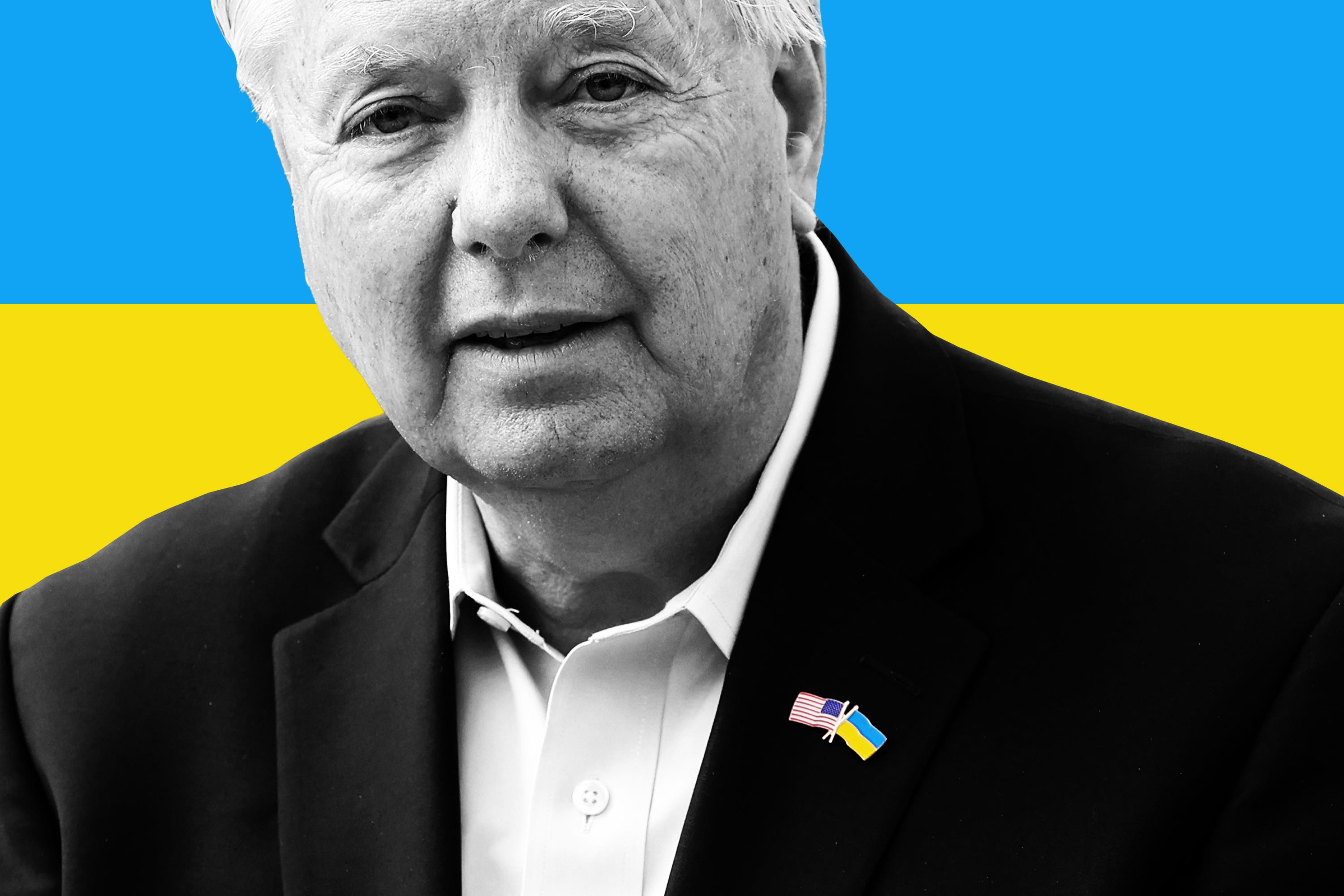
WHATEVER COMPLICATED FEELINGS Americans may have about Lindsey Graham, whose last ten years were marked by a morally compromised bargain with Donald Trump, there is no such ambivalence for Ukrainians or for pro-Ukraine Russian dissidents, who speak of the late South Carolina senator with unqualified admiration. “Lindsey Graham knew how to maneuver, but he also knew to take the right stand at the right time,” said Ukrainian TV journalist Olena Kurbanova on Monday. She spoke of her “personal sorrow” at Graham’s death, calling him “a close friend who championed our side” and noting that he had just made his latest visit to Kyiv—his tenth altogether.
Kurbanova’s guest, expatriate Russian human rights lawyer and political activist Mark Feygin, agreed, while noting Graham’s “opportunism” in rebranding from Trump critic to Trumpist: “The paradox is that he was different from most opportunists in that he gave up none of his ideas. He was consistent.”
Not on everything, of course: There was very little left in 2026 of the policymaker whose support for immigration reform led to his being derisively nicknamed “Lindsey Grahamnesty” by Rush Limbaugh. But it was certainly true with regard to being a foreign policy hawk—on Iran and Afghanistan, but notably, too, on Ukraine and Russia.
In August 2008, after Russia’s invasion of Georgia, Graham—fresh from a trip to Georgia, Ukraine, and Poland—coauthored a Wall Street Journal op-ed with Sen. Joe Lieberman (D-Connecticut) warning that “Russia’s aggression is not just a threat to a tiny democracy on the edge of Europe. It is a challenge to the political order and values at the heart of the continent.” He urged the United States to boycott the Sochi Olympics in 2013 and called for the suspension of Russia’s membership in the G8 and the G20 in 2014 after the annexation of Crimea. In the fall of 2014, after the signing of the Minsk Protocol declaring a ceasefire in the Donetsk and Luhansk regions where Ukrainian forces were battling Moscow-sponsored separatists and covertly present Russian troops, Graham was scathingly critical of the Obama administration for refusing to supply Ukraine with lethal weapons and allowing Ukrainian troops to be “overwhelmed.” Shortly before Trump’s first inauguration, in December 2016, he made a trip to Ukraine with two other senators—his close friend and fellow Republican John McCain and Democrat Amy Klobuchar—traveling not only to Kyiv but to the Donbas, where low-level military clashes never stopped, and assuring Ukrainian politicians and troops of continued American support.
Graham was also in the forefront of the pro-Ukrainian cause after the full-scale Russian invasion in February 2022; among other things, he sponsored a Senate resolution to designate Russia as a sponsor of international terrorism; the Biden administration demurred.
At times, Graham’s zeal arguably carried him too far; in a series of tweets in March 2022, he called for Vladimir Putin’s assassination, expressing a wish for a Russian Brutus or “a more successful Colonel Stauffenberg” and arguing that “the only way this ends is for somebody in Russia to take this guy out.” (It’s not that the sentiment is wrong, but it’s probably not a politic one for a U.S. senator to express.) Russia put Graham on a registry of “terrorists and extremists” and issued an arrest warrant for him in 2023, after a video released by Ukrainian president Volodymyr Zelensky’s office showed Graham expressing satisfaction over the fact that “Russians are dying” on the frontlines. Graham responded that the warrant was a “badge of honor.”
Graham’s devotion to Ukraine was sorely tested as Trump turned against it, succeeding in holding up $60 billion in desperately needed military assistance even before he was re-elected by pressuring Republicans in 2023 and 2024. After Trump’s return to office, Graham continued to “maneuver” and compromise: After the disgraceful spectacle of Trump and JD Vance berating Zelensky in the Oval Office in February 2025, Graham publicly took Trump’s side, urging Zelensky to “resign and send somebody over we can do business with or change.” But Graham apparently remained Ukraine’s “Trump whisperer” behind the scenes. In May 2025, he was back in Kyiv, having another friendly meeting with Zelensky, praising Ukraine for its positive engagement with Trump—and calling for sweeping new sanctions on Russia.
On what turned out to be his final visit to Kyiv last Friday, Graham told reporters he had finally managed to secure White House support for a sanctions bill that would severely penalize countries purchasing Russian oil. A White House official told CNN today that Trump would support the sanctions package.
AFTER THE NEWS OF GRAHAM’S DEATH, Russian propagandists reacted in their usual classy way, vying to outdo each other in derogatory slang words for dying. RT editor-in-chief Margarita Simonyan, who might have been expected to speak a little more respectfully on matters of mortality since she recently lost her husband and was herself diagnosed with breast cancer, announced Graham’s demise with a big grin, describing the senator as a “paid blabbermouth who defended, for money, the interests of companies that produce weapons and have an interest in the war.” “He called for terrible sanctions against us, then he flew back to America and croaked,” gloated chat host Vladimir Solovyov—speculating, for good measure, that Graham may have been murdered by the Ukrainians because he wanted bigger payoffs or because he “knew too much” about Ukrainian corruption. (On the other side, there was no shortage of anti-Putin Russian dissidents joining the speculation that Graham must have been the victim of a Kremlin hit—as indeed many MAGA Americans have been suggesting.)
Perhaps the most unusual tribute was delivered by Dmitry Bykov, the writer and poet now living in the United States, on a YouTube channel run by exiled Russian broadcast journalists: a bittersweet, half-ironic and half-serious verse eulogy for Graham as a proof that compromise is wiser than unbending idealism and people who work within the system are more useful than dissidents. Switching to prose, Bykov—no fan of Trump—asserted that “Lindsey Graham did much more good than numerous and militant anti-Trumpists; he was completely loyal outwardly, but on the inside, he did the right thing.” At least with regard to Russia and Ukraine, this may be true: While we don’t know what happened “on the inside,” it’s entirely possible that Graham was one of the reasons Trump didn’t completely throw Ukraine under the bus. Weapons shipments to Ukraine continued, even if they were paid for by European allies; intelligence sharing was not cut off; and Ukraine even received approval for long-range strikes inside Russia. Someday, we may learn how much of a role Graham played in these decisions.
Ukrainians fear what the loss of Graham’s support will mean for their cause—especially with another major pro-Ukrainian voice in the GOP, Sen. Mitch McConnell, hospitalized and on his way out of the Senate. One can debate the wisdom of compromise for a long time, and American history probably won’t remember Graham’s compromises very kindly. But his memory will certainly be honored in Ukraine—and someday, perhaps, in a free post-Putin Russia. History is complicated like that.
Good that he helped Ukraine. Terrible that he so catastrophically damaged America. The former doesn’t make up for the latter