Ukraine, Still Fighting for the Free World
In his fourth documentary, Bernard-Henri Lévy chronicles the everyday heroism of Ukrainians—and holds out hope even Americans will recognize it.

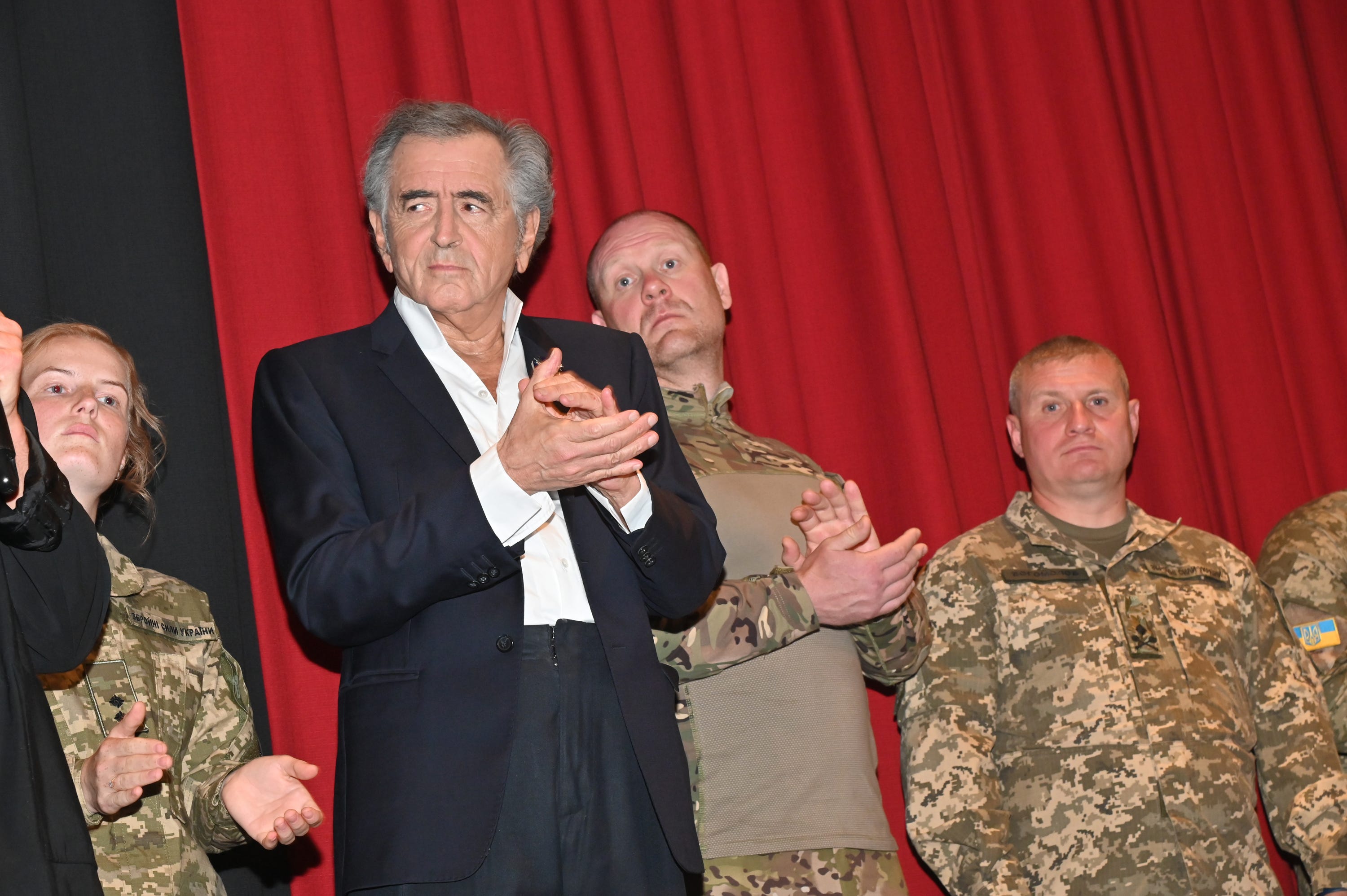
IT HAS BEEN NEARLY THREE YEARS since the documentary Why Ukraine? by French author and philosopher Bernard-Henri Lévy had its American premiere at the United Nations building in New York. At the time—a little over eight months after the Russian invasion of Ukraine—Lévy was working on a second film, Slava Ukraini (“Glory to Ukraine”); that was followed by Glory to the Heroes, released in January of last year. Lévy’s Ukraine trilogy is now a quartet: His latest, Our War, premiered on June 11 at the Quad Cinema in New York. It is the most powerful of the four films.
It is also perhaps the most disheartening of the four films, since the specter of the abandonment of the heroic nation fighting for its own freedom and survival hangs almost constantly over the narrative. Yet “disheartening” isn’t quite the right word, as the men and women (and even children) who are the true heroes of this narrative have so much heart that their spirit always shines through.
The film also has an antihero, as it were, in the 47th president of the United States. One of its more extraordinary scenes shows Lévy—and a group of Ukrainian soldiers—watching Volodymyr Zelensky’s infamous White House meeting with Donald Trump and Vice President JD Vance at a military-vehicle repair shop on the outskirts of the frontline city of Pokrovsk. (A “martyr city,” Lévy calls it later in the film.) As Lévy notes, these men still believe—“as they did three years ago, two years ago, a year ago”—that the Russian advance can be stopped if the West only sends enough of the right weapons. Then, we see Trump hectoring a rattled but dignified Zelensky about his supposed ingratitude for the supposed $350 billion received from Biden, our “stupid president.” As repulsive as this moment was to watch from the comfort of our American homes, watching it through the eyes of these weary men in the heart of the war takes the vileness to a truly unbearable level.
Later, there’s a glimpse of Ukrainian soldiers looking at a photo of the Trump/Zelensky Vatican huddle on a smartphone screen. But that, as we know, is meager consolation. The footage of Zelensky’s meeting with French President Emmanuel Macron, with whom he seems to share a real and heartwarming camaraderie, is a stark contrast to the ugliness of the scene with Trump; one needn’t be a Macron enthusiast to appreciate the difference. There is a palpable, though occasional, Francophile touch in this documentary: A chapter titled “France in Pokrovsk” takes us to a mechanized brigade equipped by France and to a Ukrainian Army battalion named for Charles de Gaulle, and we also see an elderly woman in newly liberated Kherson in 2022 shouting, “Bravo, France!” as she speaks of Ukrainians’ desire to be “a real European country” and “live like the French.” But Ukraine, of course, is always at the center. Describing, at the premiere, his experience during the months of filming, Lévy said, “My heart beat to the rhythm of Ukraine.” It shows.
AS IN THE OTHER FILMS, Lévy himself is a near-constant screen presence—but not an intrusive or egocentric one. For one thing, he is never showing off, even when we see him run and duck for cover under Russian shelling or drone attacks and when the footage goes haywire as the camera drops to the ground. For another, there is never any question that the real stars of Our War are the Ukrainians, famous and obscure.
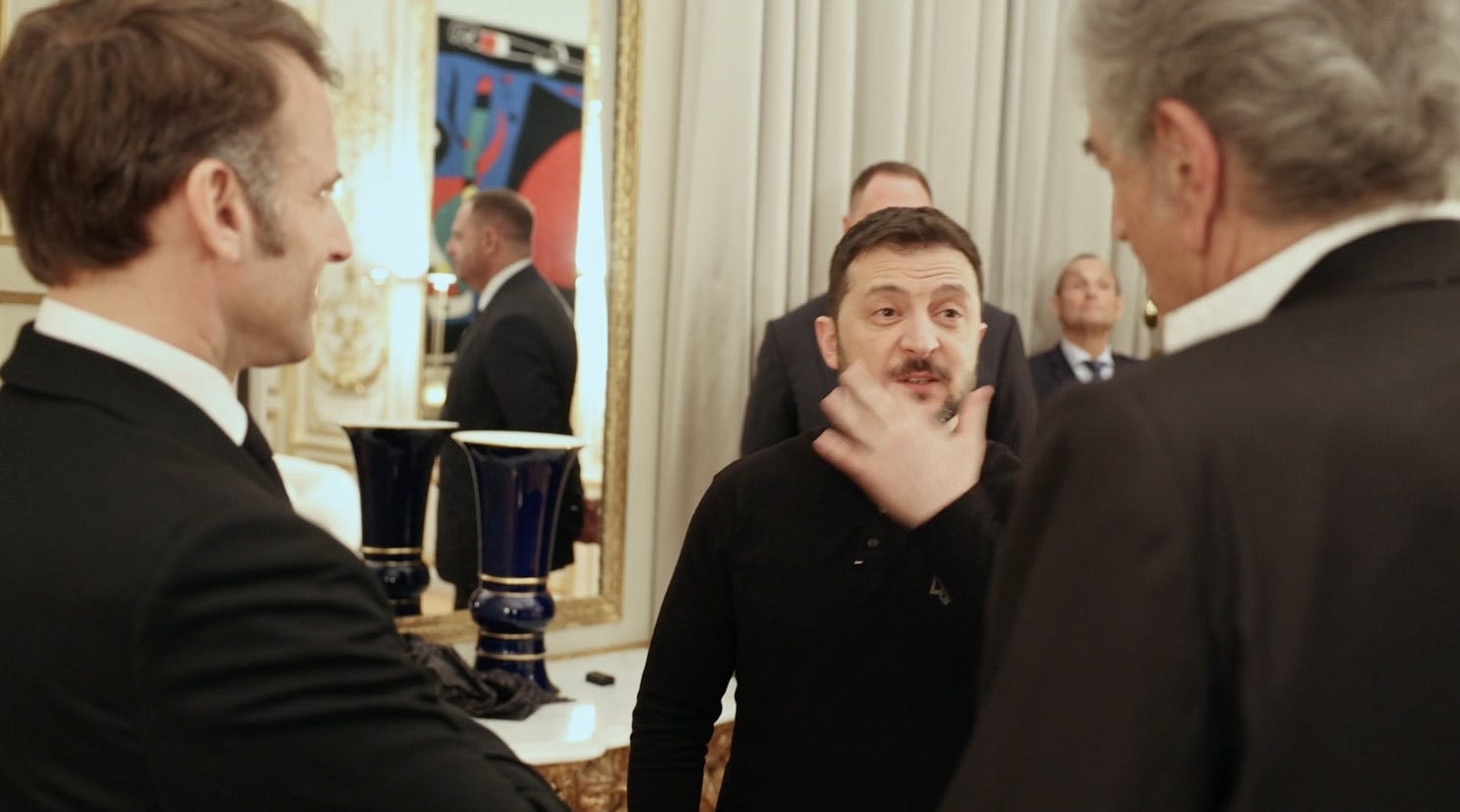
There are memorable scenes with Zelensky, whose charisma is well-captured here; his interaction with Lévy has a very authentic warmth, and the filmmaker remains unshaken in his view of the Ukrainian president as a modern-day embodiment of “l’esprit Churchillien.” There is the “enigmatic” Oleksandr Syrski, the commander-in-chief of the Ukrainian Armed Forces. There are men on the frontlines, constantly dodging drones and moving their machinery, often outmanned and outgunned. There is Oksana Rubaniak, a 22-year-old with an unassuming manner and a warm smile who is an army platoon commander—and the author of several books of poetry. When Lévy offers to have her work published in France, Rubaniak asks him to publish poems by her fiancé—who, she reveals with a heartbreaking matter-of-factness, was killed near Pokrovsk last February. (Lévy will be publishing both; he also notes that love for poetry is remarkably common in the Ukrainian army.) Not all heroes wear fatigues: We also admire the grit of elderly civilians who remain in half-destroyed cities in the war zones, ensuring that life goes on, and the resilience of children rescued from Russian captivity—a topic to which Lévy devotes a particularly poignant chapter.
In a discussion following the premiere, Lévy said that one of his goals in making Our War was to honor these heroic Ukrainians and make sure they did not “fight and die without leaving any trace.” The film concludes with such a tribute, in a stirring montage. “Should I doubt [victory],” Lévy says in a voiceover, “I’d think of these faces encountered over the years, whose nobility commands respect.” And they do: men and women, warriors and teenage girls; the rabbi, the army nurse, the elderly woman sitting in her ruined house with a look of quiet dignity; the soldier with prosthetic legs on an exercise bike who says, smiling cheerfully into the camera, “This is my country, this is my army—this is my heart, you understand.”
Our War is not a chronological narrative. Lévy’s 2025 journey to Ukraine is interspersed with flashbacks to his past trips and with other footage, revisiting both harrowing and inspiring moments: the grisly discovery of slaughtered civilians in Bucha and other Ukrainian towns; the joyous liberation of Kherson and Kupiansk; the haunting video of besieged Mariupol defenders in the catacombs of the Azovstal factory listening to a young female soldier sing a Ukrainian independence song; the equally haunting image of a bullet-riddled monument to the great nineteenth-century Ukrainian poet and freedom-seeker Taras Shevchenko, its wounds the marks of Russian occupation. Some of this footage has appeared in Lévy’s earlier Ukraine films—but, far from feeling recycled, it becomes part of a concise and powerful overview of this terrible war.
In a way, Our War is also an answer to the West’s Ukraine war fatigue. This fatigue is certainly keenly felt by Ukrainians themselves. The victories of the Ukrainian counteroffensive that sent Russians into in a demoralized and disorganized retreat in the fall of 2022 now seem woefully distant: “Did I dream it?” Lévy asks at one point. Yet, he insists, Ukrainians are not demoralized and still strongly believe they can win this war—with the right kind of support. That support, Lévy notes, is not simply altruistic. Revisiting Trump’s obscene complaint that Zelensky hasn’t lavished him with enough thank-yous for American military aid—and noting that, in fact, Ukrainians including Zelensky are immensely grateful for the assistance they have received—Lévy asks a key question: Who should be thanking whom? Ukraine, he argues, is Europe’s bulwark against an imperialistic Russia that would have likely swept over Georgia and Moldova, and would be threatening the Baltics and Eastern Europe, had it not been stopped by heroic Ukrainian resistance. It is, Lévy says, “a war Ukraine leads alone while it fights for all.” This is the meaning of the title, and the message explicitly stated at the end and addressed to “the world which calls itself free”: “This war is our war. We must help Ukraine to win.”
No work is flawless; one could argue that Lévy glosses too easily over the controversial history of the Azov regiment when interviewing Azov commander Denys Prokopenko—a survivor of the Azovstal siege and of Russian captivity—who has his own reported history of involvement with extremist groups. On the other hand, there’s only so much one can relitigate Azov’s complicated history at a time when the Kremlin regime and its propagandists traffic routinely in overtly fascistic, even Nazi-like exterminationist rhetoric. Whatever quibbles one may have, Our War is the masterpiece of Lévy’s Ukrainian cycle—and a film that should be seen as widely as possible. Negotiations about streaming the film on one or more online platforms, Lévy told me in an interview, are underway.
IN NEW YORK, THE SHOWING of Our War was followed by a standing ovation—for the film and for Lévy, on hand for a conversation with Melinda Haring of the Razom for Ukraine foundation. The next day, he was headed for a screening of the film in Washington, D.C. One inevitable question: What would he say to Trump if he saw him on his trip to Washington? Lévy replied that he would focus especially on stolen children who, if in their teens, are being trained to fight against their country—and drew a parallel to ISIS: “What we unanimously condemned when it was done in Mosul by Islamists is now being done in Ukraine by Vladimir Putin. . . . Radical Islamists and Putin are two sides of the same coin.”
Was he really holding out any hope that Trump would come around? After pondering the question a moment, Lévy replied, “I believe in the American people.” He mentioned public opinion, which remains supportive of Ukraine, as well as Republican members of Congress “in the Reagan tradition.” In a democracy, Lévy insisted, no leader can ignore public opinion. Unfortunately, that’s debatable, since Trump’s position on a wide range of issues seems to be influenced more by his hardcore base than by general opinion. But more pro-Ukraine pressure, especially within the GOP, could help.
Lévy also said that he hoped people who saw the film, and were still wavering about supporting Ukraine, would “understand a little more that this is their war”: for the men and women fighting it, “the creed they live by is the American creed, the European creed.” Here too, one could object that for a large portion of Trump’s base, at least, the “American creed” of classically liberal values is obsolete—especially if it is seen as something shared by European liberals like Macron. But the vision of freedom embraced by the Ukrainians Lévy is celebrating still resonates, even with many people in the Trump-era Republican Party.
(The morning after the D.C. screening, Lévy told me on the phone that it was attended by senators, representatives, and congressional staffers in a crowd that seemed to him evenly divided between Democrats and Republicans. “A lot of them told me after, ‘Thank you for giving flesh and life to what was only [facts and] figures,’” said Lévy. It’s his sense that there is a tangible shift back toward a more pro-Ukraine stance within the Republican establishment and that soon, many in the GOP will be “embarrassed” by incoherently pro-Russia noises coming from Trump.)
After the end of the discussion at the New York premiere, when Lévy mingled briefly with people in the audience, one of them told him, “I hoped this would be your victory film.” “Me too,” Lévy replied. There had already been such hopes for Slava Ukraini! in late 2022, when both Lévy himself and his fans were buoyed by the success of the Ukrainian counteroffensive. Our War is, at times, a grim reminder of how brutally that optimism was dashed. But it also shows enough of Ukraine’s heroic spirit to leave us with the thought that pessimism is not an option.