

Ukraine’s Second Miracle Year
The war isn’t won, but for the first time in years, outright victory seems possible.

THE END OF 2024 LOOKED GRIM FOR UKRAINE: President Trump was promising no further aid, and Hungary under Viktor Orbán was vowing to block any further European Union financial support. Seeing an opportunity, Russia poured all the manpower possible into collapsing Ukrainian front lines, hoping to convince Trump that Russia’s victory and Ukraine’s defeat were inevitable, so that he would pressure Ukraine into a peace treaty favorable to Putin.
Instead, Ukraine dug in. They continued to innovate, and gained superiority in drone warfare at the short, medium, and long ranges. As a result, the front lines have remained essentially stabile, while Russia is scraping the bottom of the barrel for manpower and losing more people than it is recruiting.
Extending out from the front lines in both directions runs a zone ten to twenty kilometers wide where drones from both sides constantly prowl for new victims. Ukraine has achieved slight advantage in this part of the war. The Institute for the Study of War (ISW) finds that Ukraine now has a distinct numerical and technological edge in drones on the battlefield.
Russia has opted for producing large quantities of a few types of drones rather than investing in technical innovation, but at least for now, Ukrainian production of small drones appears to exceed Russia’s, with at least 3–4 million units produced in 2025 and a goal of up to 7 million in 2026. This is within spitting distance of the 10 million per year that Ukraine estimates it will need to completely overwhelm Russia and achieve decisive victory. It’s also a tremendous advantage. Drones are the dominant force on the lines today, causing approximately 75–80 percent of all casualties. Ukraine now has 1.3 drones at the front line for every 1 Russian drone, and they are of better quality. Additionally, Ukraine has reportedly begun operating AI powered small drone “swarms” that are semi-autonomous and coordinate their attacks.
For most of the war, Russia has had the advantage over Ukraine in number and quality of medium-range First Person View (FPV) drones than Ukraine, like the Lancet, which can hit up to 70 kilometers behind enemy lines. This range is similar to the GMLRS rockets used on HIMARS launchers. The last time Ukraine had the advantage in medium-range attacks was after the introduction of HIMARS to the battlefield in 2022. Over time, HIMARS gradually lost effectiveness, due to Russian electronic countermeasures and a lack of resupply of ammunition from the United States. The result is that Ukraine, unlike Russia, had struggled to hit moving targets more than 20–30 kilometers behind the front lines.
This is changing rapidly. Ukraine’s home-grown drone systems like the FP-2, RAM-2X, and Hornet can now strike targets at medium ranges. They are small enough to operate with near impunity against air defenses, and they are also more technologically advanced than Russia’s Lancet.
The latest Ukrainian medium-range drones reportedly have the ability use AI for navigation. Terrain-matching guidance systems have been around for decades—American Tomahawk cruise missiles use terrain contour mapping and digital scene matching area correlator systems to plot their paths to their targets. They compare the terrain they see below it with what they expect to see—but the use of AI makes the Ukrainian systems even more advanced and flexible. This autonomous navigation capability prevents them from being jammed. They can also find and lock onto targets visually using AI, making them impossible to jam during the terminal phase of their attack. Amazingly, the TFL-1 autonomy module has a unit cost of only $70.
Ukraine’s Hornets reportedly can navigate autonomously, identify targets using AI, and conduct attacks autonomously far behind Russian lines. They also reportedly can autonomously find and attack targets as well using optical recognition AI. This is beginning to have a significant impact on Russian logistics, and the situation will only get worse as production ramps up.
The Ukrainian army has increasingly been using medium-range drones to destroy out the high-value anti-aircraft radars and launch vehicles that Russian forces placed well behind the front lines. Eliminating Russian air defenses not only makes it easier for Ukrainian fighter-bombers to operate closer to the front lines, but also opens corridors for longer-range Ukrainian strikes into Russian-controlled territory and even into Russia itself.
There are signs this is working. Ukrainian drones have been spotted operating with impunity over Donetsk. With Russian defenses degraded, as well as increased Ukrainian production and continuous technical advancement, more Ukrainian drones appear to be getting through to important targets far behind the lines.
WHICH BRINGS US TO THE LONG-RANGE SITUATION. Ukraine’s smaller size gives it an intrinsic geographic advantage in drone defense to begin with. In March 2026, for the first time, Ukraine launched more long-range munitions into Russia (7,300+) than Russia launched into Ukraine (6,400).
Ukrainian drones have been hitting deeper and deeper into Russian territory, all the way up to the Primorsk and Ust-Luga Baltic Sea terminals near St. Petersburg, about 600 miles (almost 1,000 kilometers) from Ukraine’s borders. Although these long-range drones have often targeted military systems and installations, their primary targets have been oil infrastructure and manufacturing capability related to the war. Russia’s export capacity is now down an estimated 40 percent.
At this point, most of Russia’s populated areas—mostly in the south and west of the Urals—are within Ukraine’s reach. This makes their primary production, logistics and military sites vulnerable. Ukraine’s deepest strike was against the Ukhta refinery in the Komi Republic, located 1,750 kilometers from the Ukrainian border. If current trends continue, even the Russian Northern Fleet at docked at Severomorsk will soon be vulnerable.
Ukraine’s long-range strike campaign into Russia, now years in development, has been criticized for diverting attention and resources away from more important theaters and domains of the war. But now the effects of the campaign are starting to show up elsewhere.
The most crucial is that Russia’s spring offensive seems to have stalled as soon as it began. Russian forces took only 23 square kilometers of territory in March. At that pace, Russia would finish conquering Ukraine in 1,775 years. They are at a standstill, and despite already having numerical superiority along the front lines, they have already begun to commit their strategic reserves for the spring–summer campaign.
Over the past few months, Russian casualties have been extraordinarily high. They averaged roughly 35,000 per month in 2025, and similar averages are continuing into 2026. Over the course of the war, Russia has suffered more than 1.3 million wounded and killed. President Zelensky has set a target of 50,0000 Russian casualties per month—a rate at which they expect that Russia will have so much trouble reconstituting its forces that it will lose the ability to continue to fight. The record number of Russian losses in March suggests that they are moving toward their goal.
There are indications that Russian recruiting cannot handle the losses incurred by their tactics. Russian forces now are mostly infantry and drone based, using squad-sized elements to probe and infiltrate the weaknesses in Ukraine’s thinly defended lines. In 2024 and 2025, this strategy usually resulted in lots of Russian casualties and occasional successful breakthroughs. But now, with drone swarms growing increasingly dense, omnipresent, and lethal, the result is almost always the annihilation of Russian troops before they ever contact Ukrainian lines.
The life of Russian soldiers is nasty, brutish, and short. Conditions in the trenches are abysmal, and corruption is rampant. Often recruits who were former prisoners extort money from the other soldiers and punish those who fail to comply by stripping them, tying them to a tree, and leaving them for Ukrainian drones to find. Soldiers who refuse to go to their deaths are executed. The contracts soldiers sign are indefinite: You’re in the Russian army until you die. One Russian deserter interviewed by the BBC revealed that of the 79 people he’s been mobilized with, he was the only one left alive.
Perhaps word of conditions on the front have gotten out, because Russian recruiting is lagging 20 percent behind where it was last year, even as signing and death bonuses climb ever higher. In some areas of Russia, signing bonuses approach five times the median annual income. This would be the equivalent of offering soldiers a $250,000 signing bonus in the United States.
Those who do accept are often completely unfit for service: alcoholics, drug addicts, amputees, felons, and people with severe health problems who literally have to be carried around by their comrades. One recent video shows three “new” recruits, ragged-looking older men in their fifties with a total of two fingers among the three of them. Amputees are being sent back to the front lines without prosthetics.
Desperation is growing. Russian attempts to pressure students have so far met with failure, despite setting a goal of recruiting 2 percent of current enrollees at colleges and universities. Some Russian governors are ordering companies to “volunteer” employees to be sent to the Army. It’s also being reported that Russian tank companies are being disbanded one platoon at a time, and the former tankers sent to the front to provide more bodies for the “Storm” infantry units. Drone operators and logistics specialists are suffering the same fate. Unsurprisingly, they don’t last long.
The recruiting shortfalls mean that Russia is slowly losing more soldiers than it’s gaining, and the quality of the new recruits is questionable at best. So great is the demand for soldiers on the front lines that a typical recruit’s total training amounts to just three weeks before they’re thrown into combat. On the other side of the ledger, Russia is facing its most severe labor shortage in decades, with a deficit of 2.4 to 3 million workers, potentially rising to 11 million by 2030. As the war drags on and the shortages get worse, its industrial and economic capacity will suffer. There is already competition between the military and the defense industrial base—which accounts for a huge proportion of Russian economic activity—for workers. As casualties mount, that competition will become even tougher, and whoever wins, the Russian war effort will suffer.
HOWEVER, THING’S AREN’T GREAT for Ukraine either. The country’s electrical system has been battered by Russia nearly to the point of collapse four winters in a row. They remain critically short of personnel, and their recruiting situation is dire (though less draconian than Russia’s). There are still issues with leadership at some levels.
Desertion is at crisis levels. The war has been a bloody slog for Ukrainian troops, with almost no end in sight. In some cases, poor leadership at the local level has compounded the problem by throwing men at what they consider to be suicide missions. Critical shortages of personnel mean that Ukraine cannot afford to take soldiers off the lines for rest and training for fear that the lines would collapse. As shortages make service more miserable for those who report for duty, that misery could create yet more manpower shortages in a vicious cycle. There may be as many as 150,000 men AWOL, and another 2 million who have fled to evade conscription.
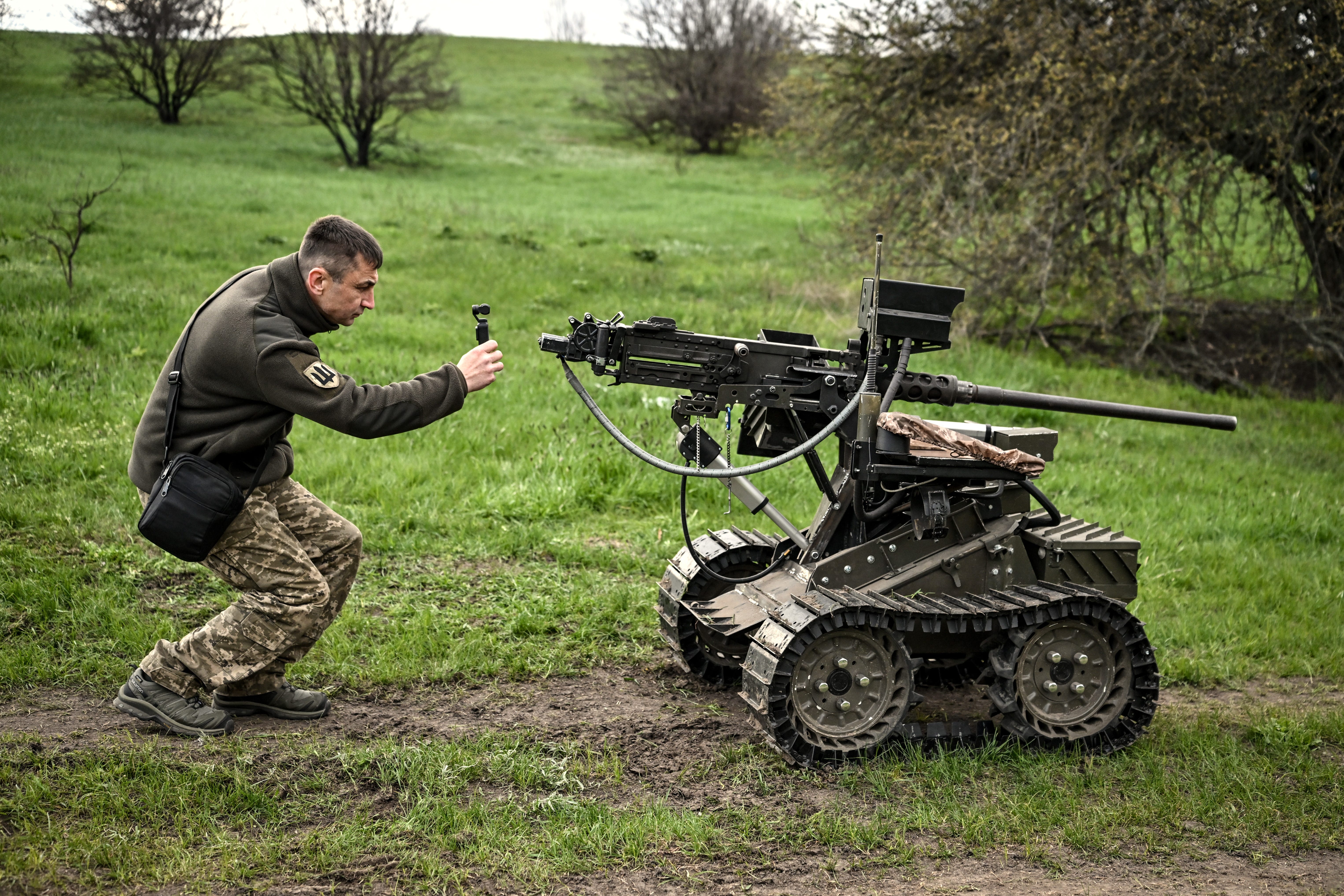
One part of Ukraine’s solution might be to adapt their successes with aerial drones to the ground. Ukraine has been leading the world—and leading Russia by a great degree—in the use of unmanned land vehicles for ground combat. In the last few weeks, remotely-operated ground combat vehicles forced the surrender of enemy soldiers and successfully captured an enemy position—both firsts in the history of the world.
Despite Ukraine’s dire conditions, there’s more hope now than a year ago. They have created novel, cost-effective interceptor systems to counter low-cost drones like the Shahed. This has led to Ukraine forging key partnerships with the Gulf States during the conflict with Iran. The fall of Viktor Orbán has opened the way for $90 billion euros in defense loans from the European Union to Ukraine. Russia is trending in the wrong direction, and Ukraine in the right one, just as these funds hit.
Strategically, Ukraine has a theory of victory that looks increasingly plausible, while Russia’s is crumbling. There is a path to Ukraine achieving overwhelming drone dominance at all levels and inflicting the casualties required to cause a Russian collapse. Russia bet the farm on the theory that meat waves would overwhelm Ukraine while the United States and Hungary blocked Western support, and failed.
Approximately 700,000 Russian soldiers are in Ukraine today. This is a massive force, and drawing them down will take time. But for once it looks like time may be on Ukraine’s side.
 | A guest post by
|