Vivek Ramaswamy Gets a Reality Check at the County Fair
He handled the hecklers. Explaining how he would pay for all his promises was harder.

Owensville, Ohio
FRESH OFF A HUMILIATION, last week saw Vivek Ramaswamy barnstorming Ohio’s county fairs.
On Wednesday, Ramaswamy attended an annual convention of Young Americans for Liberty, a libertarian group for college students, at Xavier University in Cincinnati. (Think of it as a Temu TPUSA.) It did not go well. He came across less like a traditional politician in campaign mode than a too-confident debater who assumes the way to win an audience is to out-argue it. He was booed. He was heckled.
I had seen Ramaswamy face an unfriendly audience at a Turning Point USA event back in April. At the time, it felt jarring to watch him struggle with a room that, at least ostensibly, should have been full of allies. YALCon was far worse.
Using a stump speech about “winners and whiners,” Ramaswamy exhorted the audience to choose winning over grievance. Alas, the audience, which did not see itself as a collection of whiners, whined.
In his 2022 book Nation of Victims, Ramaswamy invokes the “Nacirema” (“American” backwards), the fictional tribe from Horace Miner’s famous anthropology satire. “They died out eventually under the weight of their own insecurities,” Ramaswamy writes. “It’s hard to understand how the Nacirema managed to exist for as long as they did under the burdens they imposed on themselves.”
His point is that contemporary Americans have been consumed by insecurity and victimhood politics. The irony here is that, in our political life today, the people who are most driven by their insecurity and most outspoken about their victimhood are in today’s Republican party, which has moved beyond the original iterations of MAGA toward one grounded in the grievances of Donald Trump, whatever they happen to be that day.
So following his unpleasant experience at YALCon, I was curious to see how Ramaswamy would perform in a more neutral setting, like the Clermont County Fair. His campaign has largely avoided contentious public events, yet somehow keeps finding controversy in unexpected places. Would the gubernatorial candidate, born and raised in nearby Cincinnati, come across as normal and friendly, or off-putting and argumentative?
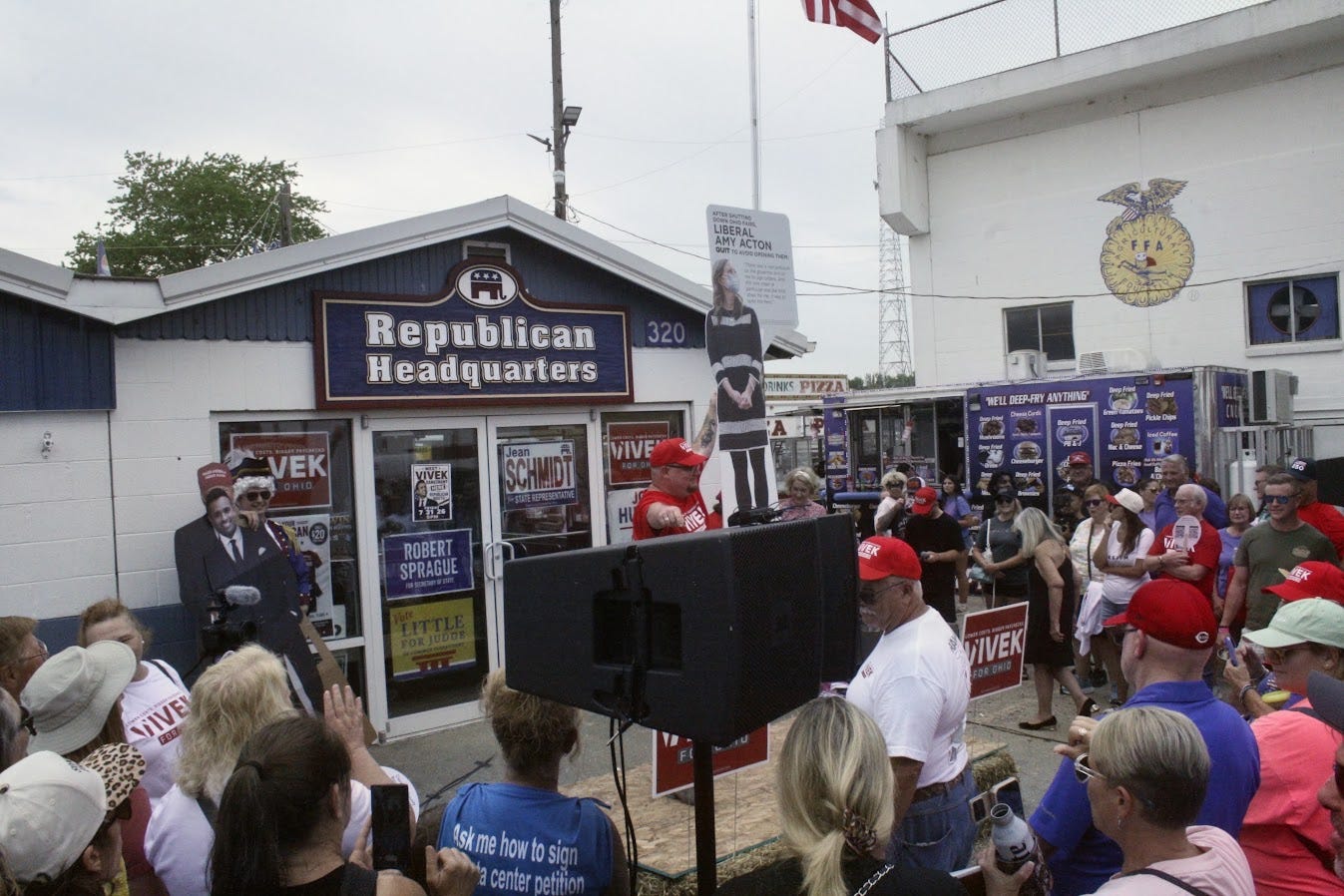
THE CLERMONT COUNTY REPUBLICAN PARTY headquarters is a permanent structure tucked behind the main grandstand, at the intersection of two of the fair’s busiest walkways. About two hundred people crowded around it on Friday afternoon to hear Ramaswamy speak.

A man in colonial garb and a tricorn hat stood guard at the door, carrying two copies of Ramaswamy’s book. Since fairgoers had to pay to get into the fair, this event was not quite as ‘open to the public’ as Ramaswamy’s TPUSA event was earlier this year. Still, the crowd offered a pretty good cross section of this mostly Appalachian county—although of course the crowd that gathered to hear him talk slanted Republican.
Clermont is a mix of old river towns and rural communities that has increasingly become an exurb of Cincinnati, complete with subdivisions, office parks, and even a few major companies. One of them is the trucking logistics firm TQL, whose name adorns the stadium where Cincinnati’s Major League Soccer team has played for the last five years.
Ramaswamy’s press secretary quickly marked me as a reporter. We had a polite chat, but when he told me there was unlikely to be a press scrum, I was disappointed: I had hoped to ask Ramaswamy whether he realized the Nacirema problem he identified had consumed his own party.
As the audience waited for the candidate’s arrival, I heard a man sitting near me—a guy double-fisting lemonades, including a half-gallon jug—tell his friend that he agrees with “95 percent-ish” of what Ramaswamy says. There are some doubters here, too, which makes sense: The booth for the Clermont County Democrats was just around the corner, near the fair entrance.
Lemonade is something of a cultural phenomenon at Ohio county fairs: People even bring back cups from previous years to get the refill price.1 While we were waiting, the man with the lemonades sitting near me was visited by his daughter and son, who came by to retrieve a refill cup and to get some money for food. The man forks over $20 apiece, along with some fatherly advice: “Ask how much it is before you hand over the money. And then do your change. If it’s not right, you say, ‘Hey, it doesn’t add up.’ Re-add it.”
He had no way of knowing it, but he had just offered the perfect advice for the audience about to listen to Ramaswamy speak.
Shortly before Ramaswamy arrived, a man associated with the local GOP brought up cutouts of Donald Trump and Vivek Ramaswamy, holding them up one by one to gauge the amount of cheers. It was also a useful way to identify troublemakers, as some people are booing. Ramaswamy’s cutout, predictably, didn’t get the same level of cheers as Trump’s did. (The cutouts might be to scale, as the one for Trump—who in real life is eight inches taller than Vivek—is noticeably taller.)
Then, the man puts up a cutout of Ramaswamy’s opponent, Amy Acton. The speech bubble on the sign says “AFTER SHUTTING DOWN OHIO FAIRS, LIBERAL AMY ACTON QUIT TO AVOID OPENING THEM.” It provides a quote from Acton about the pressure by the state legislature to change course during COVID. “There was a real pressure on the governor and on me to sign orders. And this one order in particular was the final straw for me. It was to open the fairs.”
The quote isn’t new—it comes from a 2025 interview she gave when she entered the race, and it’s about the events of 2020—but Republicans seem to hope that it may convince fairgoers, paying $15 a pop to get in, that Amy Acton just hates county fairs.
In fact, Acton wasn’t in favor of a complete closure of the fairs back in 2020, when she was the director of the state’s health department. She proposed county fairs be opened in a smaller capacity, along the lines of 4-H and Future Farmers of America–style activities. Not the crowded nightly smorgasbord from Charlotte’s Web.
Much of the crowd boos the Acton cutout, although some, presumably the Democrats, cheer. With the crowd semi-warmed up and potential agitators—like the woman wearing a t-shirt asking people to sign her data center petition in the front row—identified, we are ready to get started.
Ramaswamy arrived flanked by private security and Clermont County Sheriff’s deputies. Rep. Dave Taylor, the area’s congressman, kept his introduction short, billing Ramaswamy as “probably the brightest rising star in the Republican party” and a man who would unlock southern Ohio’s “unimaginably untapped” potential.
As Ramaswamy took the mic, he was immediately heckled by a woman in the front row. Here we go again, I thought.
But Ramaswamy, perhaps having learned from the YALCon failure, was able to right the ship a bit quicker. “We are Republicans. We’re respectful,” he said, promising to take questions and instructing the heckler to wait her turn.
What followed was a compact and polished stump speech built around the theme of restoration. Ramaswamy invoked Cincinnati’s machine tools, Dayton’s computing power, Toledo’s glass, Akron’s rubber and northeast Ohio’s steel. Ohio had once powered the country, he argued, and could do so again. Then came the promises: high-paying jobs, a zero-percent income tax (eventually), the largest property-tax cut in state history, cheaper electricity, and billions recovered from Medicaid fraud. He would make Ohio the state that Texas, Florida, and Tennessee looked up to rather than the other way around. I’d heard a version of this speech before in Columbus; it landed better here.
How he would pay for all this was left to the question-and-answer period. The fairgoers, to their credit, asked.
The state’s Republicans are dealing with a hard-to-control populist movement that wants to entirely eliminate property taxes in the state. This would be a first in the country: While a handful of states have no income taxes, and several states have very low property taxes, no state has zero property taxes. And while Ramaswamy does support moving toward zeroing out income taxes, he doesn’t support zeroing out property taxes.
Ramaswamy blamed inflation for soaring home values and promised to restore property-tax bills to their pre-pandemic level, then cap their growth. But Ohio’s property taxes don’t fund the state government; they fund local schools and local governments. One analysis of Ramaswamy’s plan to roll back property taxes to where they were at the start of the decade puts the immediate loss at roughly $4 billion a year. When you add on his longer-term promise to push toward entirely eliminating the state income tax—a tax that puts more than $10 billion into the state’s coffers annually—Ramaswamy’s plans are shaping up to be a fiscal disaster, leaving a combined state and local revenue hole of at least $14 billion a year, equivalent to nearly a third of Ohio’s general fund.
One fairgoer, Becky, wearing American flag aviators, said she supported Ramaswamy but was a little unclear about how his tax plans would work in practice:
I like what you say, and I like how you say it. I’m all for you, 100 percent. But I just would like to understand: When you talk about rolling back income tax to where it’s zero, and property tax is zero, how does that work? What’s the math there?
Ramaswamy corrected her, saying he was proposing a rollback in property taxes, not eliminating them. He said schools could absorb the lost revenue by cutting bureaucracy and directing more money toward classroom instruction. As for the income tax, he argued that previous cuts had generated more revenue than projected by keeping residents, spending, and investment in Ohio. He conceded that zero would not happen overnight, instead describing an eight-to-ten-year phaseout beginning with the elimination of the capital gains tax in 2027, too.
In other words, the tax cuts would largely pay for themselves. (Having been a Republican tax staffer in the late 2000s, I had heard this slogan a couple million times.)
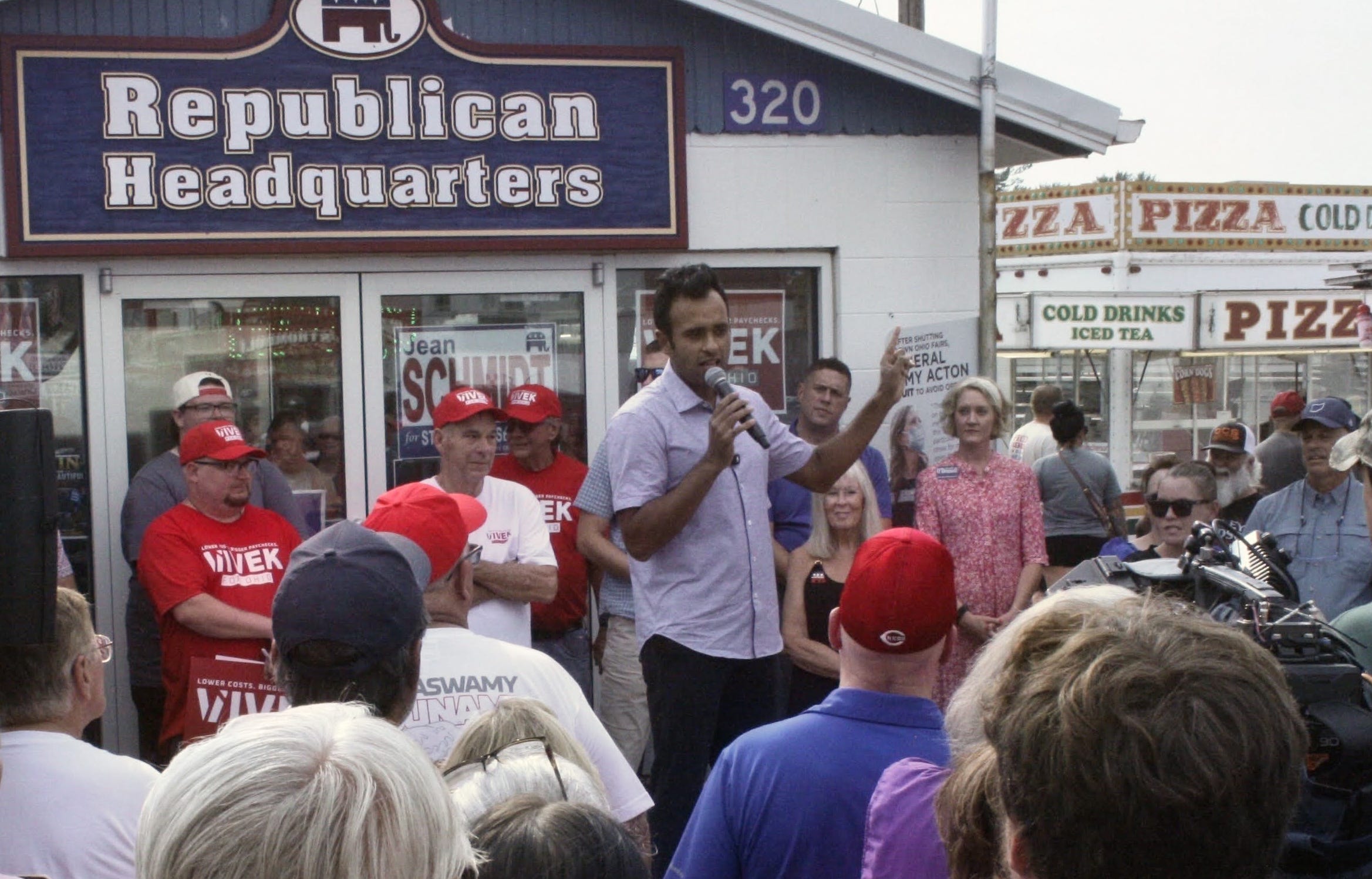
When another fairgoer, Vera, a caregiver for people with developmental disabilities, asked about higher Medicaid reimbursements for badly underpaid workers, Ramaswamy was very sympathetic to her, calling her a “hero” and saying he understood how bad things are in her field. (Ramaswamy’s wife is a doctor.)
But surprise: Ramaswamy has in mind another enormous pot of money that would pay for his proposed changes. He claimed Ohio sends at least $4.7 billion a year to hospice, nursing-home, and home-health providers that “don’t even exist.” He would prosecute the fraud, recover the money, and persuade Washington to let Ohio keep it.
Ramaswamy revealed he had hosted Dr. Mehmet Oz, the celeb doc who now heads the Centers for Medicare and Medicaid Services, in his backyard six weeks earlier to discuss “the deal we’re gonna do with the federal government.” He predicted the arrangement would return $3 billion to $4 billion a year to Ohio. Assuming his assessment of the scale of the fraud problem is remotely close to correct, and assuming a deal with the federal government can actually be struck, and assuming the deal withstands legal challenges, how long it would take to prosecute and recover those billions is anyone’s guess. In other words, a lot of “ifs.”
No credible campaign against “waste, fraud, and abuse” could make up the difference of what Ramaswamy is proposing. A spending gap of the sort his plans would create would almost certainly result in historic cuts to schools—think firings, school closures, delayed upgrades, leaky roofs, etc.—and Medicaid and local services.
Unless, that is, the money came from somewhere else—like, say, a dramatically higher and broader sales tax. Innovation Ohio, a progressive policy group, estimates that replacing the income tax alone would require a 65 percent increase in state sales tax collections. Separately, Jared Walczak, a senior fellow at the Tax Foundation, has estimated that replacing all of Ohio’s property taxes would require a 14.5 percent state sales tax rate, before local taxes. (Republicans have previously flirted with a sales-tax based economy, as I’ve written before. The idea is stupid, regressive, and unlikely to happen.)
The questions kept coming. Dave Loback of Anderson Township pointed out that much of his own property tax bill came from levies approved by local voters. Would Ramaswamy’s rollback eliminate those, too?
“The property tax question gets a little bit complicated,” Ramaswamy conceded. “I don’t even have a whiteboard here to lay it all out.”
So instead of getting into those details, he returned to his overarching promise: However the state accomplished it, each Ohioan’s total property tax bill would return to its pre-pandemic level, and for taxes outside the governor’s direct control there would be refunds. The details could wait. The money, somehow, would come back.
Ramaswamy’s answers were just like what the Lemonade Dad told his kids to watch out for: “If it’s not right, you say, ‘Hey, it doesn’t add up.’”
TAXES WEREN’T THE ONLY THING Ramaswamy was asked about. On data centers, Ramaswamy was more cautious. Jessica, the woman in the front row with the petition, asked him to sign it. He promised only to read it. Communities that wanted data centers should be allowed to have them, he said, while communities that did not should not have them forced upon them. He promised legislation on the matter within his first six months as governor, after he had met with people on both sides.
It was a more recognizably political answer—which is to say, it acknowledged complications rather than wishing them away. “This issue has changed so much in the last year and a half, like the facts every day, it’s a new one popping up, new facts,” Ramaswamy said.
Donald Trump almost entered the discussion. One member of the audience, a film student making a documentary, had been following Ramaswamy to recent public events. This was his first shot at a question. He began by praising Ramaswamy’s campaign against “fraud and waste and corruption,” then asked how he reconciled that message with reports that Trump had made $2 billion the previous year. Before he could finish, a woman in the crowd suffered a medical problem. Ramaswamy stopped to make sure she was okay. And when the questioning resumed, he moved on to someone else.
Trump, unlike property taxes, never came back up. In fact, Ramaswamy never mentioned Donald Trump once.
Ramaswamy did take some shots at Acton, calling her a “socialist” and challenging her to join him at Ohio’s county fairs, again trying to plant the idea that she is weirdly hostile to the fairs themselves because of the debate over pandemic-era restrictions. (In fact, Acton is slated to be at the Brown County Fair on August 9.)
Ramaswamy, after finishing with the audience, chatted with some 4-H members, and even paid a visit to the Democratic booth—resulting in an ‘I’m relatable, not hateable’ clip he could post to social media.
This was not YALCon. Ramaswamy controlled the interruptions, delivered a disciplined speech, and took unscripted questions from supporters and skeptics. He was markedly better with, well, grownups from a somewhat mixed public audience than he had been with the young, extreme activists who used to be his allies.
Yet the county fair crowd was, in a way, harder. This was not an audience asking about conspiracy theories, or making arguments about Jews, or wanting to debate whether they were winners or whiners. This was an audience that had their wallets on their minds. They wanted to know how the math worked.
And these are the kinds of Ohioans who vote.
I am one of those people.
Makes one wonder if the medical emergency was on cue...