Walking Away From Omelas
Christopher Slatsky follows Ursula K. Le Guin in asking difficult questions.


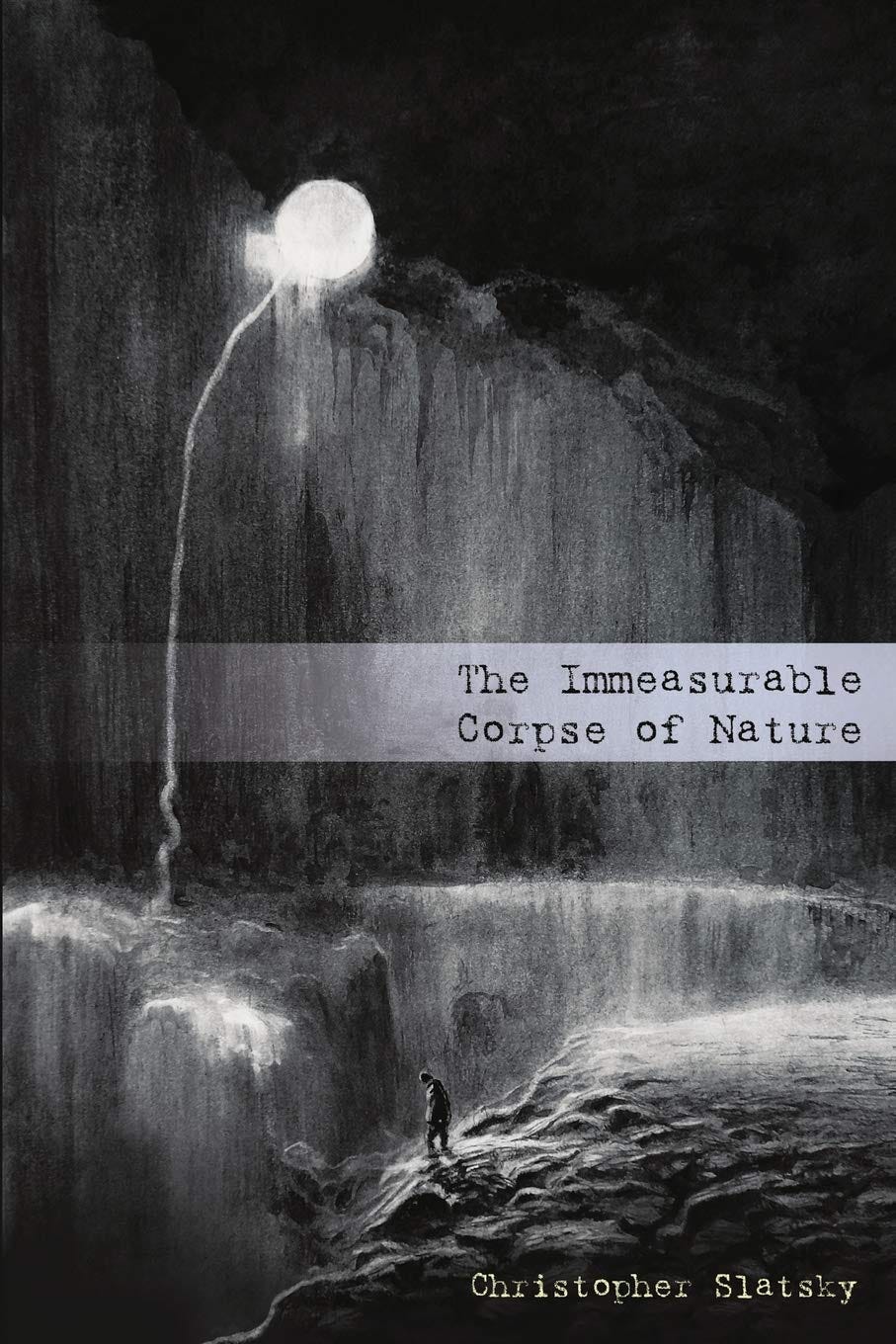
CHRISTOPHER SLATSKY IS THE AUTHOR of two collections of horror fiction. His second, The Immeasurable Corpse of Nature, from 2020, includes not just short fiction, but essays on horror, poetry, and even a play. Through no fault of his own, Slatsky operates on the fringes of horror, since this once-inclusive genre has fractured, roughly speaking, into two groups, which I might categorize as Serious Horror Fiction (Slatsky, Thomas Ligotti, Reggie Oliver, et al.) and Mainstream Slasher Movie Nostalgia Porn. His story “Phantom Airfields” builds a surreal nightmare around a well-known mysterious photographic image known as the “Solway Firth Spaceman” (it’s worth looking up). In “Professor Cognoscente’s Caliginous Charms Carnival,” what begins as a seemingly run-of-the-mill story about an evil carnival ringmaster transforms by the end into something far more horrible, something to do with failure, waste, disease, and disability, a tale that left me profoundly uncomfortable by the end.
The title novella of the aforementioned collection, “The Immeasurable Corpse of Nature,” strongly suggests that inducing discomfort in the reader—mental, emotional, and at times even edging toward the physical—is where Slatsky flourishes. The story is about a forensic pathologist named Mina Fawn. Her job has her traveling the world and cataloguing, investigating, and recording evidence of mass casualties in places like Rwanda, a career that she is only beginning to acknowledge has become hazardous for her:
She was embarking into what was sure to be a parade of repulsive and heartbreaking discoveries. . . . It was always a balancing act—Mina found the science and processes involved in studying human remains fascinating, exhilarating even, but exposure to tragedies and the depths of depravity humanity was capable of had grown harrowing over time. The faces of babies who’d been beaten so badly they’d lost an eye, or finding different levels of healing in a dead child’s rib fracture marking their history of abuse like tree rings never ceased to weigh on her.
At the scene of one particularly horrific murder—again, of children—Mina finds a baggie of heroin, which she snatches up before the investigators can see it. Though she deludes herself into believing she is not an addict, heroin has become her escape of choice.
Mina’s current assignment is to travel with an old colleague, Dr. Genet, to the Pacific Northwest, where there has been a mass cult suicide. The cult was started by a once-respected biologist and environmentalist named Dr. Karen Solberg. For years, the commune she created flourished, but along the way something poisoned the well. Solberg became a devotee of anti-natalism, a nihilistic philosophy that claims procreation is evil, the height of cruelty. It can be summed up by the first item in one of Solberg’s manifestos: “Let our species die out.” Solberg, we are told, named her collective “The Ones Who Walk Away after an Ursula K. Le Guin story she was reportedly obsessed with.”
Le Guin’s 1973 short story, “The Ones Who Walk Away from Omelas,” is one of the most famous and best-read short stories of all time; in its brief six or seven pages, Le Guin posits a society in which the people are exquisitely joyous, free of all care. It is a society not precisely like ours, but not pre-modern: “These were not simple folk. They were not less complex than us.” Their freedom and their joy come at a cost, however. Le Guin explains that their depthless happiness is only possible because in one of the big buildings in Omelas is a small basement, a single, tiny room, in which the young child who lives in it can do no more than sit or stand. The child, boy or girl (who knows?), is regularly beaten, fed just enough to keep him or her alive. The child is abused, treated cruelly, and has been for years. Worse, the child wasn’t born into this but can “remember sunlight and his mother’s voice.” The child begs to be released, promises to be good, and is ignored. No one is permitted to speak kindly to the child. And this abomination is why Omelas succeeds.
Worse, from a moral perspective, is that the people of Omelas know of this child and accept its suffering as the cost of doing business:
Some of them understand why, and some do not, but they all understand that their happiness, the beauty of their city, the tenderness of their friendships, the health of their children, the wisdom of their scholars, the skill of their makers, even the abundance of their harvest and the kindly weathers of their skies depend wholly on this child’s abominable misery.
ONCE YOU’VE READ BOTH STORIES, the connections beneath the surface become apparent. If Slatsky himself is an anti-natalist, he at least wrestles with it. The character Dr. Genet hates anti-natalism, dismissing it as high-toned whining and calling it (accurately, I’d say) “the philosophy of the privileged.” She adds, “How much inconvenience can I experience before I can justify condemning it as suffering?”
Mina pretends not to think about any of this, while sinking deeper into it, seeing things at the massacre site others don’t: bizarrely thin figures in the distance; scarecrows strewn about, from one of which Mina secretly pulls a human tooth. Not a tooth that had been placed there, but that had grown there. And as the horrors of the massacre—not a mass poisoning, but a mass shooting, a mass beating, a mass throat-slitting—increase in strangeness, the heroin takes hold, and she reflects on her place as a lonely Korean woman who believes herself ugly, who was adopted as a baby by a kind, American Christian couple, wondering if her birth parents, whom she’s never tried to find, ever think of her—“Or was she a memory lost to decay?”—reflecting that “Everything was transitional. The world was amorphous. Everyone changed depending on their own selfish desires.”
The most mysterious aspect of Mina’s work at the massacre site is the presence of a small hut, or shack. It’s flanked by heavily armed guards, for reasons nobody seems to know. Mina asks about it constantly but gets nowhere. When events begin to escalate in their inscrutability, Mina is informed that, as many bodies as there are to sort through, the one body they could have expected to find—or at least its decapitated head, one supposes—but haven’t, is that of Dr. Karen Solberg. Where in the world could she be? The presumption is they will eventually find her. But if you’ve read Le Guin’s story, the question becomes, What’s in that shack? Of course, without knowledge of “The Ones Who Walk Away from Omelas,” the idea that the missing Solberg might be in that shack could easily be arrived at, once you learn Solberg hasn’t been found. What you won’t have without Le Guin is a possible answer why. It’s rare to find, in one writer’s story, an explanation, or possible interpretation, in the story of a completely different writer’s quite different story.
IT’S NECESSARY TO SPOIL SOMETHING here, so this is how “The Ones Who Walk Away from Omelas” ends. We’re told that everyone in Omelas is told about the child in the shack, how it is to be treated, and why. Everyone is told this at adolescence, and they are even taken to the shack and shown the child. At first, every one of them is horrified and confused. The majority of them eventually accept it as just the way things are, and have to be, for the good of everyone else. Le Guin writes that the people of Omelas don’t even feel guilt.
But there’s something else. Some young people who see the child—and even some adults who’ve lived with the knowledge of Omelas their whole lives—do not return:
The place they go towards is a place even less imaginable to most of us than the city of happiness. I cannot describe it at all. It is possible that it does not exist. But they seem to know where they are going, the ones who walk away from Omelas.
There is so much to these two stories, individually and combined, that it’s not only difficult to know where to begin, it’s almost impossible to know when to stop. Slatsky’s story ends with a coda centered on Mina’s past, as a child given up for adoption, that, without negating what came before, seems to upend and transform it. The more overt horror elements in the novella might at first seem pat (scarecrows, really?), but in Slatsky’s hands they are restored to their primal nature; the decades of clichéd and thoughtless use having been stripped away. Slatsky writes about the physical site of the massacre as something almost alive, but disgusting, and dying: “The ground was soppy and tender as a blister.” The whole environment of “The Immeasurable Corpse of Nature,” both on and off the massacre site, feels like an open wound, or a contagious disease. One can’t help but want to walk away, but it will do no good. It will help nothing. All it would do is remove one from the pain and evil, which are dull and boring. Le Guin doesn’t really think they are, though. That’s the sort of excuse the people who stay in Omelas would come up with.
 | A guest post by
|