What It Felt Like to Face Combat in the Middle East
Everyone experiences fear differently. Here’s what it was like for me.

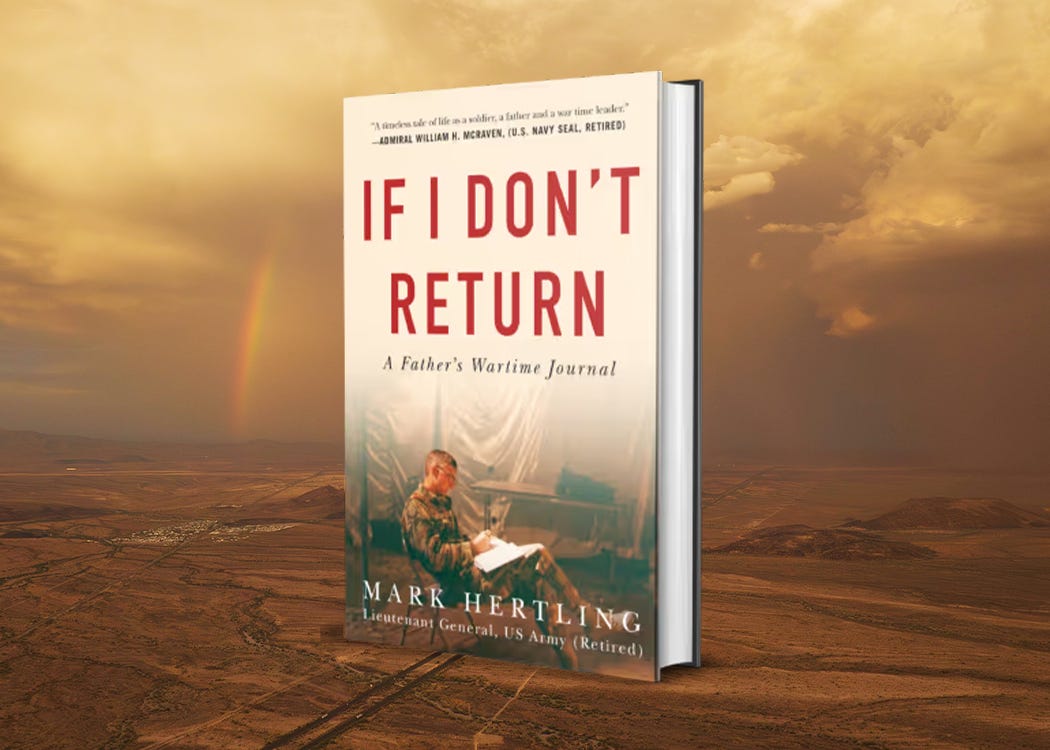
[The following article is adapted from Mark Hertling’s If I Don’t Return: A Father’s Wartime Journal, published today. The book, which he recently discussed on The Bulwark Podcast with Tim Miller, is drawn from journal entries Hertling wrote when deployed. You can order the book from Amazon or Barnes & Noble, or buy a copy signed by Hertling via the publisher.]
LATELY, AS I SEE THE NEWS OF AMERICANS once again being ordered into combat in the Middle East—and the threat of Americans losing their lives there—I’ve been thinking a lot about my deployments to that region. The first time I went there was in 1990–1991 for Operation Desert Shield, which later became Operation Desert Storm. After the 45-day air campaign, our unit crossed into Iraq and saw combat in the hundred-hour routing of the Iraqi Republican Guard. I thought I’d never see Iraq again. But I did return, first in 2003–2004 to help fight in a complex counter-insurgency in Baghdad, and then in 2007–2008 for a counter-terrorism fight during the Surge.
I’ve been thinking about the 253 young Americans we lost from our 1st Armored Division during those latter two deployments, mementos of whom I keep at my desk so I can look at a few of their faces every day.
Less than 1 percent of Americans serve in the armed forces. It can be hard to relate what combat is like to someone who hasn’t done it. That’s part of what I tried to do when, during Desert Shield/Desert Storm, I wrote a series of entries in a journal to our two sons, who were then very young. I recorded the thoughts of a soldier, hoping to explain to them what I was doing, thinking, and feeling.
But I also tried to tell them all the things I worried I wouldn’t be there to say if something happened to me. Thirty years later, at my sons’ urging, those letters became a book: If I Don’t Return: A Father’s Wartime Journal. Each chapter contains a letter I sent to my sons from Saudi Arabia, Kuwait, or Iraq, followed by a reflection of what I have experienced in the next 35 years. This excerpt, below, is adapted from a chapter about fear—about the fear soldiers feel before going into battle, about the fear their families feel whenever their loved ones are sent into harm’s way, and how the manner in which we respond to that fear can shape and reveal our true character.

SAUDI ARABIA, 1991—I KNOW YOU GUYS saw mom and I having some tough discussions before we shooed you out of the room back before I left. We were talking about “what happens if . . .” The “if” had to do with me possibly not coming home from the war or coming home injured. I know you won’t read this until you’re much older, and when you do you will understand the anxiety—rather, the fear—that we were both trying our best to overcome, so here’s what I’m thinking I want to pass to you on this late and cold night in the desert of Saudi Arabia.
Back before I left Germany, I’ll admit, I was scared. And fear is a most interesting emotion. As much as people tell you when fear plays on you to 1) overcome it, 2) don’t worry about it, or 3) block it out, all those things are hard to do.
You see, fear is a physiological reaction to what your mind is thinking about. When you’re worried about what may happen, or you perceive something bad or scary is going to happen to you, your body releases a certain amount of hormones to help get you ready for what you’re about to face, the so-called “fight or flight response,” developed by our ancestors when they were fighting saber-toothed tigers. If you have enough time to react to the influences of those hormones, and you have a solution, you’ll be in good shape.
If not, you might find yourself forcing yourself to do something you may not want to do. This can range from jumping off a high dive when you’re not quite ready, skiing for the first time, or giving a speech in front of your class. And those fears increase significantly when you’re asked to go to war, leave your loved ones, and perhaps even face death. That’s what mom and I were talking about when you caught us a couple of times in our small kitchen; we were having quiet discussions about what might happen to me, and how all of you would then live your life if I was gone. While I’d like to say that all my training and preparation helped me face going to war, I was very frightened at the prospect of leaving my family and possibly facing death.
You will never understand how I felt on the days leading up to my departure from Lehrberg. You probably couldn’t understand why I was repeatedly touching your hair, kissing and hugging you more than usual, and watching both of you do the everyday things that seem so normal. I also wanted to kiss and hug your mom at every opportunity because I didn’t know the next time I would be able to do that, if ever. The last night at the Gasthaus Kern, I was very quiet, letting you two boys joke and laugh and talk non-stop, because I just wanted to revel in your presence; I wanted to just sit there and listen and look at you as you did the type of things you normally do.
I knew I couldn’t face you the following morning as I left so early for the Katterbach airfield, so I told all of you to stay in bed, asleep! None of you listened to me. When I investigated your room, Todd was curled up pretending to be asleep, but he wasn’t. Scott was lying flat with just his and his stuffed Theo’s eyes uncovered staring at the door. Then, as I was leaving, I looked up at our bedroom window and saw Mom looking out as I was driving away. It was the saddest, and scariest moment of my life. I know now that when I return it will be the happiest, and we will never be apart again.
But know this: You will face fear that creeps up on you all during your life. For the things that make you tremble a bit, or the things that you think you can’t do so you need to bring about some additional courage, my advice is to push yourself. When you’re afraid of trying something new, or you’re afraid you might embarrass yourself, or you’re worried you might get hurt doing something, think mostly about the rewards that will come from doing it, then try it. Know that your fears will always creep up on you as you face something new or exciting, but there’s always a sense of accomplishment when you do it and achieve that feeling of pushing your limits. But also know that sometimes you just might be asked to do something that is very unpleasant, something that every part of your body and mind screams out that you just can’t do. But sometimes—if it’s important—you might just have to overcome your fears and do it anyway. That’s what I’m doing now, and mom helped me overcome those fears. Right now, I’m just focused on completing our mission and then returning to you, Mom, our dog Misty, and our cute little house in Lehrberg, Germany. I guess those thoughts have always been with soldiers who have gone off to war. I’ll just have to keep them at the forefront of my thinking, too.
Love ya,
Dad
ORLANDO, 2025—READING THIS JOURNAL ENTRY again, decades later, I remember exactly when I was writing it (it was after midnight), where I was writing it (it was in the squadron tactical operations center [TOC] , and how I was finding it extremely difficult to explain something that all people face at some point in their lives: fear and how we respond to it. Since writing those words, here’s what I’ve concluded four decades later: There is no courage without fear, and not all fear is bad. Some fear propels you forward. Some fear, if left unmanaged, can freeze you in place. I was trying to explain to our sons the difference between the two and how to react to each.
Fear, as I described it then, is physiological. I’d learned that a few years prior to teaching at West Point when I was getting my master’s in physiology from Indiana University. When your brain perceives a threat, your body dumps a lot of hormones, but it mostly releases\ adrenaline and cortisol. This is the same cocktail of hormones athletes release when they’re in a high-stakes athletic event—racing a mile, beating a personal weightlifting record, pushing past limits in training. The heart races, the muscles tighten, the gastrointestinal and cardiac systems become tense, and thoughts accelerate. In athletics, there’s controlled exertion, and after the event is over, there’s intense fatigue. But in fear—true fear—the body doesn’t know whether it’s supposed to fight, flee, or freeze. And in war, you often don’t get to choose.
The night before I wrote that journal entry, I had felt the rawest version of that fear. It wasn’t just about danger. It was about potential loss—of connection, of life, of unfulfilled hopes. I desperately wanted to live. I wanted to grow old with Sue, watch our boys grow into men, see their graduations, weddings, grandkids. While I believed in the mission we were sent to execute, a cause doesn’t make leaving your family easier.
Over time during that first deployment—and over several more combat deployments later—I learned how fear evolves. The fear of the unknown during my first combat deployment in 1991 gave way, years later, to the fear of not performing and not being able to control situations so I could protect others. As a commander in Iraq on my third deployment during the surge in 2007, I was no longer a young major responsible for a few hundred soldiers. I was a division commander responsible for tens of thousands of things. During Desert Storm, I was concerned about returning to my family. When I joined the 1st Armored Division in Baghdad as a newly promoted general, I felt a bit of imposter syndrome, wanting to do the best I could for my boss and friend, Gen. Marty Dempsey. During the surge, I was worried about failing our soldiers and not helping them return to their families.
As we were preparing to deploy in 2007, we accomplished all our tasks. But one afternoon, before the planes were staged to take our soldiers to Iraq, I wandered around some of our units and staff sections to get a gut check of morale. Entering our legal center, I found a room
full of lawyers and their paralegals talking about the deployment and what it might be like. A perfect setup for a division commander to walk into. After telling them our plans and explaining what it would be like for most of these soldiers who had never seen combat, I started to leave when a young soldier approached and asked me if she could speak to me privately. We walked into the hall, and when we were alone, she asked, with remarkable directness, “Sir, are you going to bring all of us back alive?”
Her question hit me like a punch to the gut. Not because it was inappropriate—it wasn’t—but because it was the first time anyone had the courage to ask me that, and it reflected her own deep fear. I saw in her eyes the same anxiety I had carried in 1991. And I also knew something she didn’t: I couldn’t say what she was hoping to hear. We were headed into a complex fight. There would be casualties. I didn’t know who, or when, or how many—but I knew it was unlikely we would all come home untouched.
So I gave her the most honest answer I could: “We have great leaders. We’ve trained hard. You’re part of a great team. And we will take care of each other. And I’ll do my very best to take care of you, personally. That’s all that I can promise.” It was true—but I also knew it wasn’t enough. She was asking for certainty. In war, there is no such thing. She smiled and thanked me, but I’m not sure I assuaged her fear.
That moment stayed with me through the entire deployment. We lost 153 soldiers on that tour, with many more injured. Each one of those losses still weighs on me. Each one reminds me that fear never disappears. It just transforms—into increasing personal courage, responsibility, vigilance, and remembrance.
But here’s the other side of fear: When you overcome it, when you face it and push through, you grow in ways you didn’t think possible. That’s true in combat, yes. But it’s just as true on a stage, in a classroom, at the head of a team, in a hospital room, or when facing a hard truth.
In our own lives, we all feel different kinds of fear. Fear of failing. Fear of disappointing someone. Fear of being seen but not being heard. All of that is natural. But we should also know that fear is often a signpost that we’re standing at the edge of something important. And on the other side of fear is often the next breakthrough—increased confidence, more courage, another life adventure accomplished.
When we say someone is “seasoned” or “battle-tested,” we usually mean they’ve faced fear—and they kept going. They didn’t allow fear to stop them. Instead, they learned from it; they found something stronger than fear that motivates and inspires them. That’s what experience does: It doesn’t erase fear; it teaches one how to manage it.
We don’t become brave by avoiding fear. We become brave by understanding it, walking with it, and learning to move forward anyway.
But here’s something just as important. If we find ourselves asking someone a hard question, like that young legal specialist asked me—know that the courage in asking may be the first step in addressing it, and it may prove more powerful than the answer received.
I did come home. So did that young specialist. I saw her at the welcome home ceremony with her family, where she came up to me again and thanked me for bringing her home. I told her then, in front of her husband and her small child, that her courage and dedication were what had brought her home. She had faced her fears, as had I.
And we’d both stared down those different kinds of fears with different types of courage.